





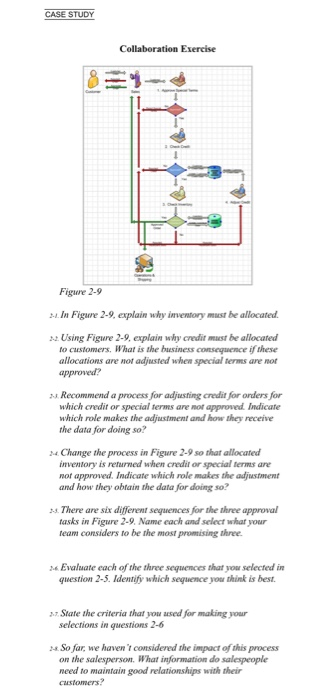
Question: CASE STUDY Collaboration Exercise Figure 2-9 2.1. In Figure 2-9, explain why inventory must be allocated. Using Figure 2-9, explain why credit must be allocated
CASE STUDY Collaboration Exercise Figure 2-9 2.1.
CASE STUDY Collaboration Exercise Figure 2-9 2.1. In Figure 2-9, explain why inventory must be allocated. Using Figure 2-9, explain why credit must be allocated to customers. What is the business consequence if these allocations are not adjusted when special terms are not approved? 33. Recommend a process for adjusting credit for orders for which credit or special terms are not approved. Indicate which role makes the adjustment and how they receive the data for doing so? Change the process in Figure 2-9 so that allocated inventory is returned when credit or special terms are nor approved. Indicate which role makes the adjustment and how they obtain the data for doing so? s. There are six different sequences for the three approval tasks in Figure 2-9. Name each and select what your team considers to be the most promising three. 2. Evaluate each of the three sequences that you selected in question 2-5. Identify which sequence you think is best. 2.7 State the criteria that you used for making your selections in questions 2-6 24. So far, we haven's considered the impact of this process on the salesperson. What information de salespeople need to maintain good relationships with their customers? CASE STUDY Collaboration Exercise Figure 2-9 2.1. In Figure 2-9, explain why inventory must be allocated. Using Figure 2-9, explain why credit must be allocated to customers. What is the business consequence if these allocations are not adjusted when special terms are not approved? 33. Recommend a process for adjusting credit for orders for which credit or special terms are not approved. Indicate which role makes the adjustment and how they receive the data for doing so? Change the process in Figure 2-9 so that allocated inventory is returned when credit or special terms are nor approved. Indicate which role makes the adjustment and how they obtain the data for doing so? s. There are six different sequences for the three approval tasks in Figure 2-9. Name each and select what your team considers to be the most promising three. 2. Evaluate each of the three sequences that you selected in question 2-5. Identify which sequence you think is best. 2.7 State the criteria that you used for making your selections in questions 2-6 24. So far, we haven's considered the impact of this process on the salesperson. What information de salespeople need to maintain good relationships with their customers

Step by Step Solution

There are 3 Steps involved in it

1 Expert Approved Answer
Step: 1 Unlock blur-text-image

Question Has Been Solved by an Expert!

Get step-by-step solutions from verified subject matter experts

Step: 2 Unlock
Step: 3 Unlock

Students Have Also Explored These Related General Management Questions!