







Question: Compare and contrast the exploratory, descriptive, and causal research designs Q2) Explain in detail the systematic random sampling. According to the following information, define
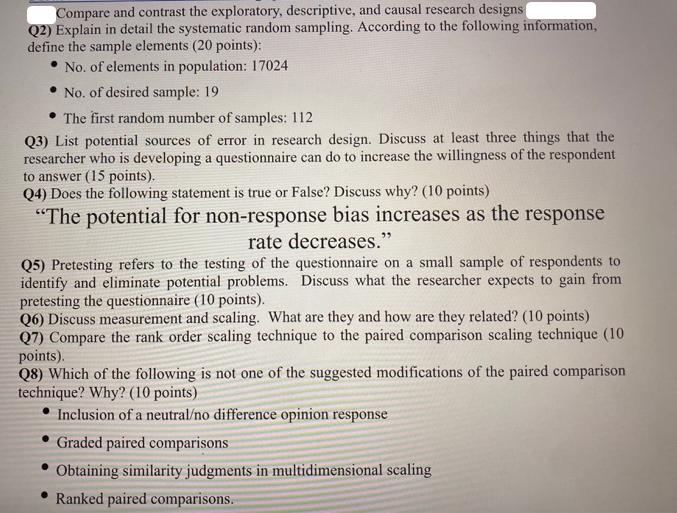
Compare and contrast the exploratory, descriptive, and causal research designs Q2) Explain in detail the systematic random sampling. According to the following information, define the sample elements (20 points): No. of elements in population: 17024 No. of desired sample: 19 The first random number of samples: 112 Q3) List potential sources of error in research design. Discuss at least three things that the researcher who is developing a questionnaire can do to increase the willingness of the respondent to answer (15 points). Q4) Does the following statement is true or False? Discuss why? (10 points) "The potential for non-response bias increases as the response rate decreases." Q5) Pretesting refers to the testing of the questionnaire on a small sample of respondents to identify and eliminate potential problems. Discuss what the researcher expects to gain from pretesting the questionnaire (10 points). Q6) Discuss measurement and scaling. What are they and how are they related? (10 points) Q7) Compare the rank order scaling technique to the paired comparison scaling technique (10 points). Q8) Which of the following is not one of the suggested modifications of the paired comparison technique? Why? (10 points) Inclusion of a neutral/no difference opinion response Graded paired comparisons Obtaining similarity judgments in multidimensional scaling Ranked paired comparisons.
Step by Step Solution
There are 3 Steps involved in it
Solution Q1 Compare and contrast the exploratory descriptive and causal research designs Exploratory Research Purpose To explore a new area generate ideas and gain a better understanding of a phenomen... View full answer

Get step-by-step solutions from verified subject matter experts
 Study Help