Question: Compare and contrast the issues discussed in Eceiza et al. (2020) with those presented in Greenbaum et al. (2019) Chapter 14. Mckinsey & Company Risk
Compare and contrast the issues discussed in Eceiza et al. (2020) with those presented in Greenbaum et al. (2019) Chapter 14.
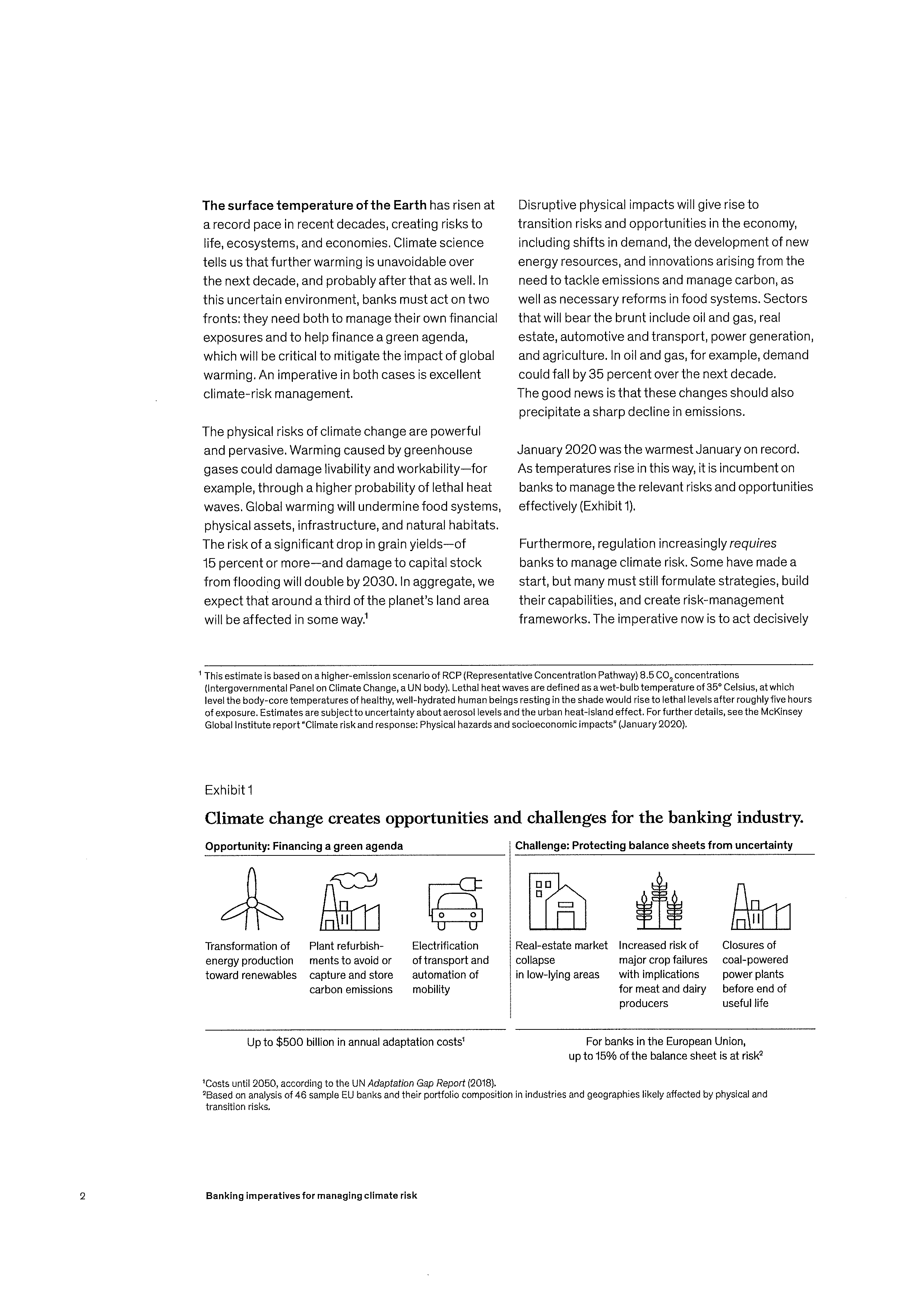
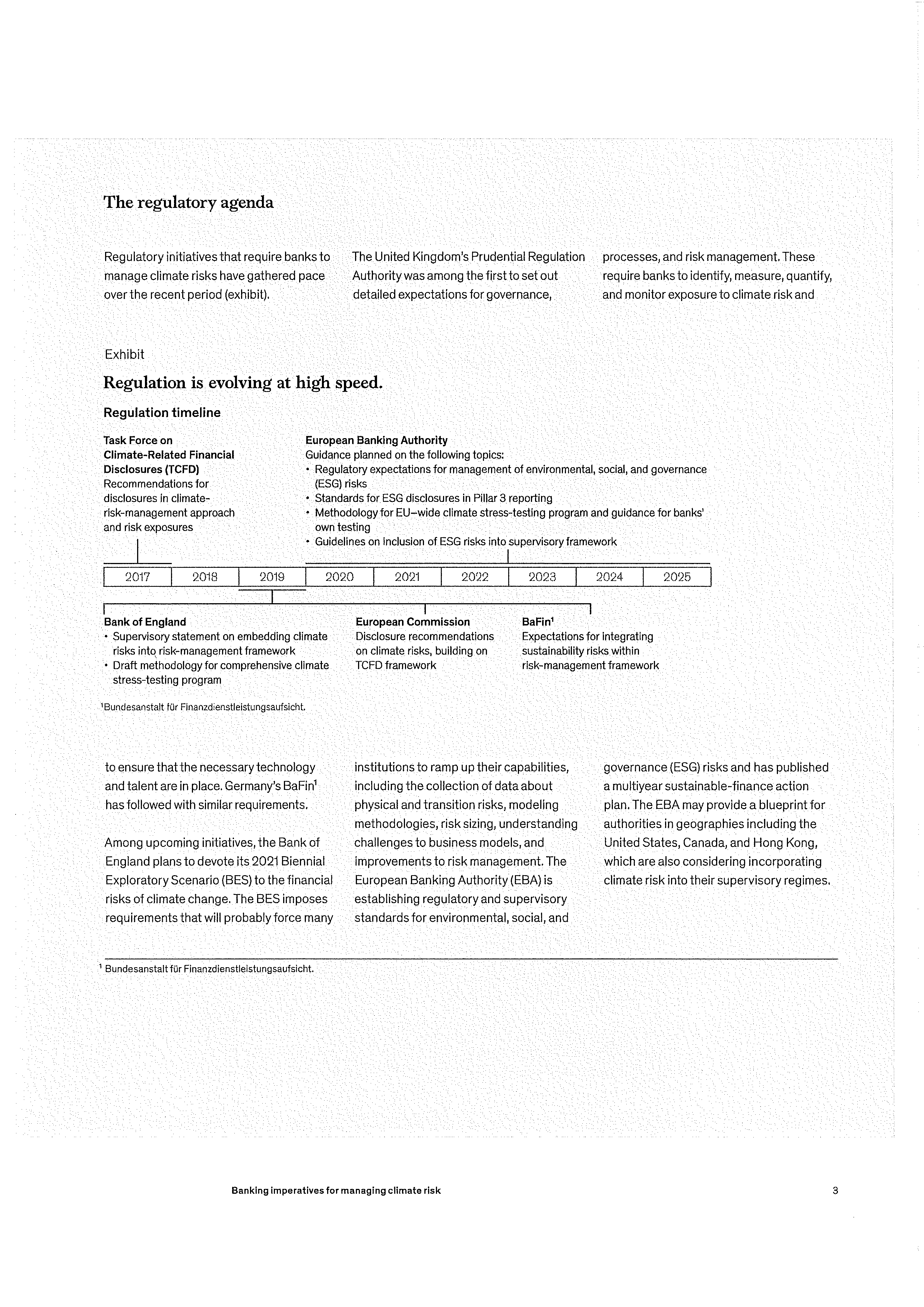
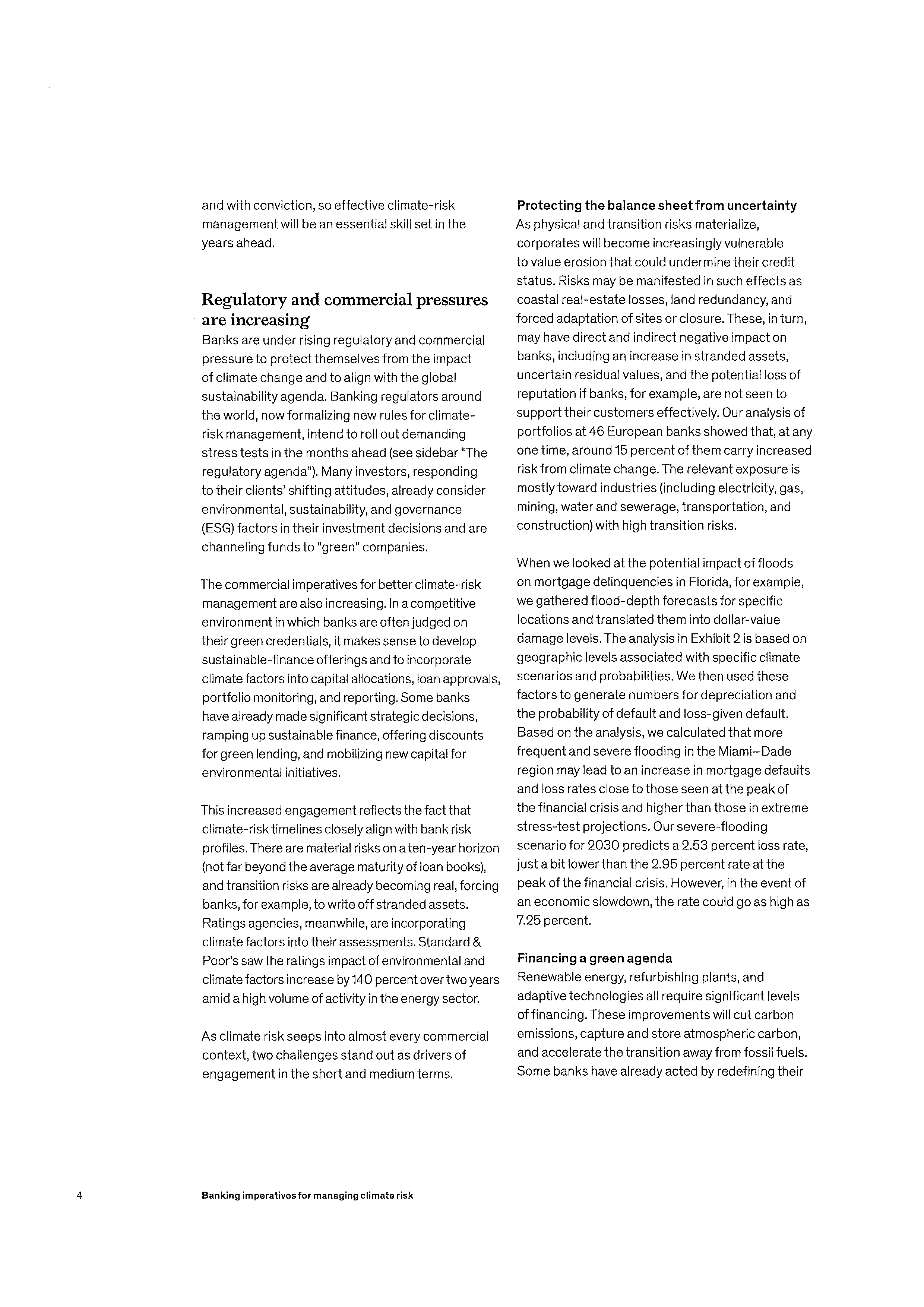
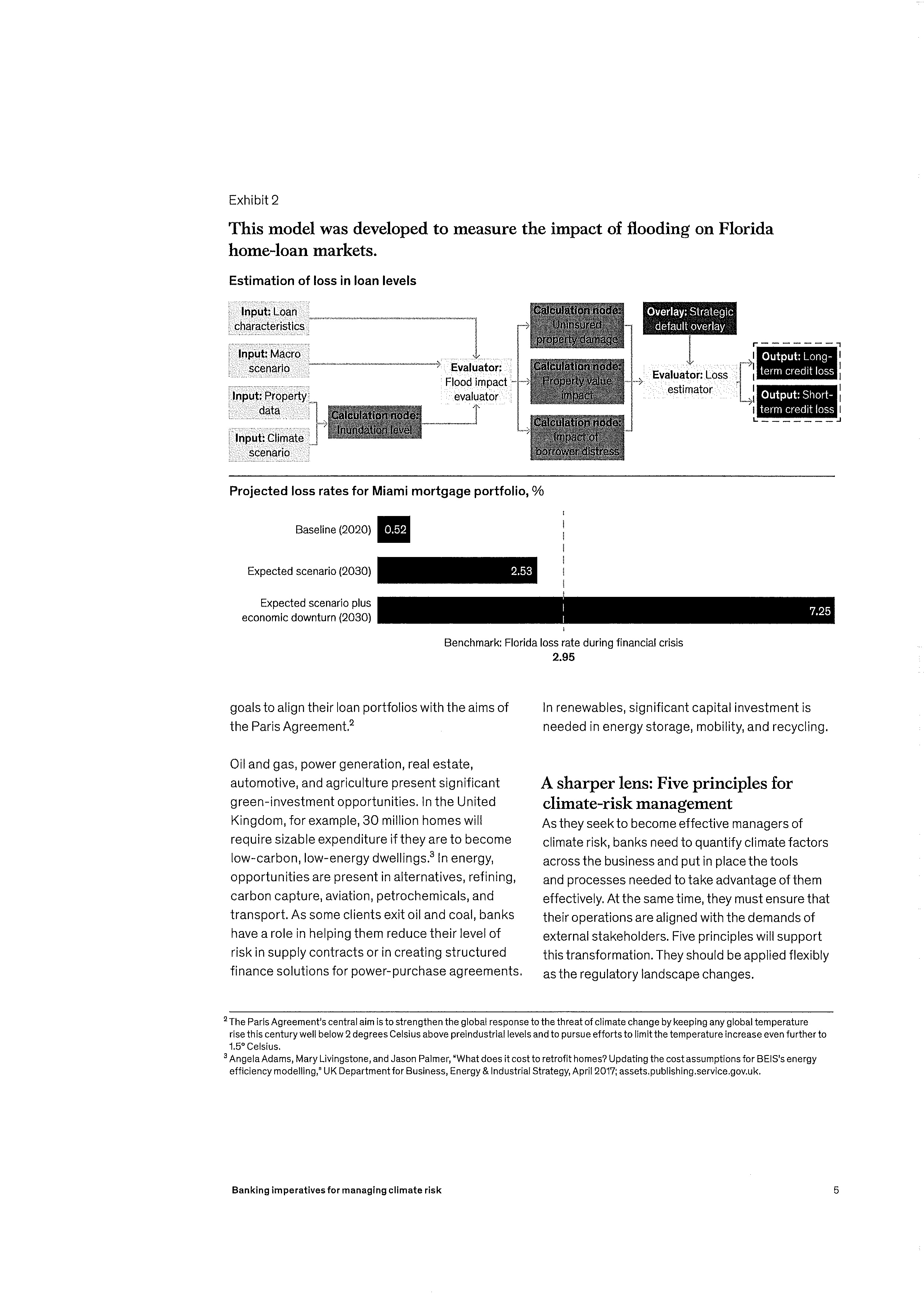
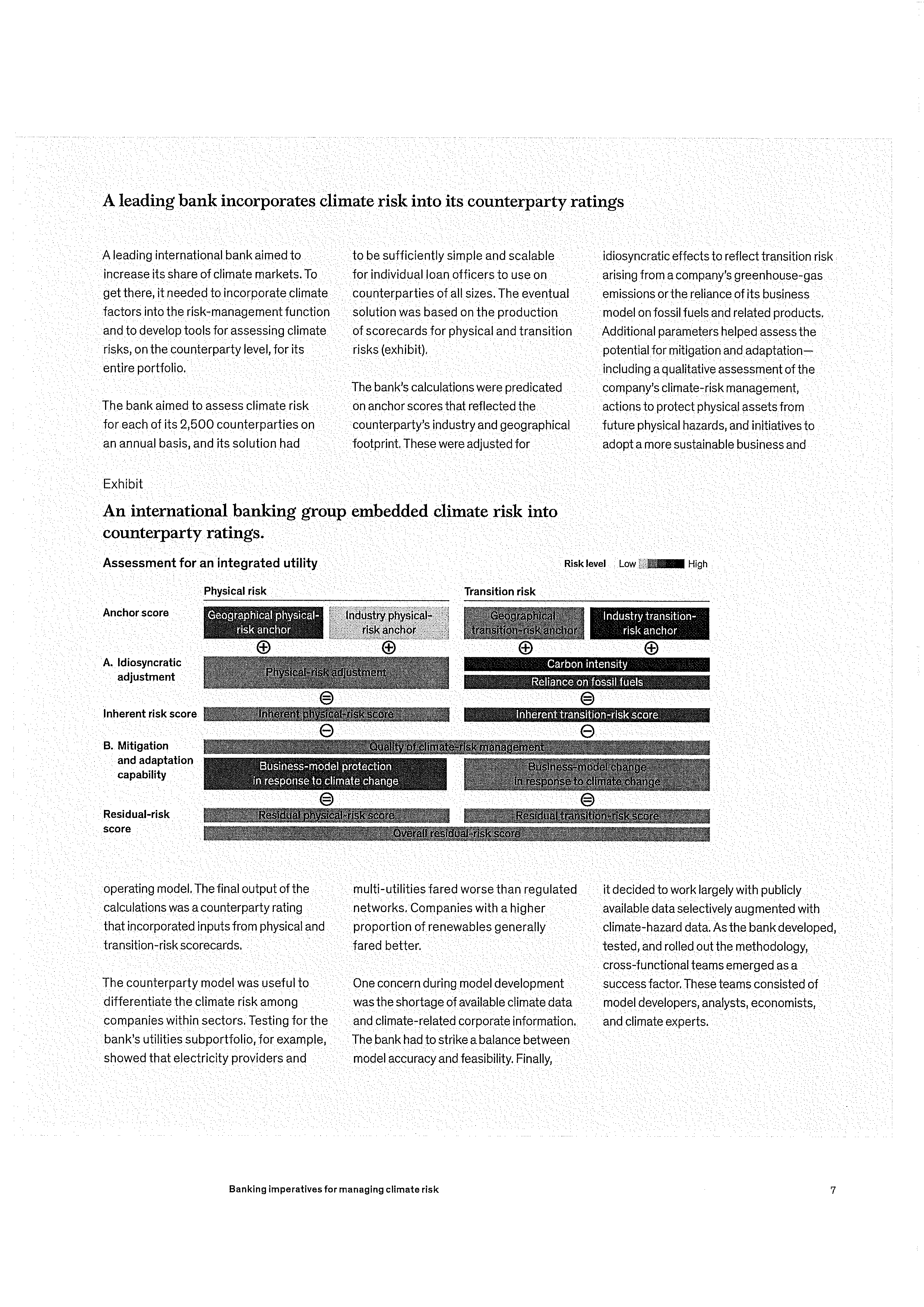
Mckinsey & Company Risk Practice Banking imperatives for managing climate risk More than regulatory pressure is driving banks to manage climate risk. Financing a green agenda is also a commercial imperative-but specialized skills are needed to protect balance sheets. by Joseba Eceiza, Holger Harreis, Daniel Hartl, and Simona Viscardi @MirageC/Getty Images May 2020The surface temperature ofthe Earth has risen at a record pace in recent decades, creating risks to life, ecosystems, and economies. Climate science tells us thatfurther warming is unavoidable over the next decade, and probably afterthat as well. in this uncertain environment, banks must act on two fronts: they need both to manage their own financial exposures and to help finance a green agenda, which will be critical to mitigate the impact of global warming. An imperative in both cases is excellent climate-risk management. The physical risks of climate change are powerful and pervasive. Warming caused by greenhouse gases could damage livability and workabilityfor example, through a higher probability of lethal heat waves. Global warming will undermine food systems, physical assets, infrastructure, and natural habitats. The risk of a signicant drop in grain yieldsof 15 percent or moreand damage to capital stock from flooding will double by 2030. in aggregate, we expect that around athird of the planet's land area will be affected in some way.1 Disruptive physical impacts will give rise to transition risks and opportunities in the economy, including shifts in demand, the development of new energy resources, and innovations arising from the need to tackle emissions and manage carbon, as well as necessary reforms in food systems. Sectors that will bearthe brunt include oil and gas, real estate, automotive and transport, power generation, and agriculture. in oil and gas, for example, demand could fall by 35 percent over the next decade, The good news is thatthese changes should also precipitate a sharp decline in emissions. January 2020 was the warmest January on record. As temperatures rise in this way, it is incumbent on banks to manage the relevant risks and opportunities effectively (Exhibit 1). Furthermore, regulation increasingly requires banks to manage climate risk. Some have made a start, but many must still formulate strategies, build their capabilities, and create riskmanagement frameworks. The imperative now is to act decisively 1 This estimate is based on a higher-emission scenario of RCP (Representative Concentration Pathway) 8.5 COa concentrations (intergovernmental Panel on Climate Change, a UN body). Lethal heat waves are defined as a wet-bulb temperature of 35 Celsius, atwhich level the body-core temperatures of healthy, well-hydrated human belngs resting in the shade would rise to lethal levelsafter roughly ve hours of exposure. Estimates are subjectto uncertainty about aerosol levels and the urban heat-island effect. For further details. see the McKlnsey Global institute report 'Climate risk and response: Physical hazardsand socioeconomic impacts\" (January 2020). Exhibitl Climate change creates opportunities and challenges for the banking industry. Opportunity: Financing a green agenda Challenge: Protecting balance sheets from uncertainty Transformation of Plant refurbish Electrification energy production ments to avoid or of transport and toward renewables capture and store automation of carbon emissions mobility Up to $500 billion in annual adaptation costs1 'Costs until 2050, according to the UN Adaptation Gap Report (9018). Realestate market Increased risk of Closures of collapse major crop failures coal-powered in lowlying areas with implications power plants for meat and dairy before end of producers useful life For banks in the European Union, up to 15% of the balance sheet is at risk? \"Based on analysis of 46 sample EU banks and their portfolio composition in industries and geographies likely affected by physical and transition risks. Banking Imperatives for managing climate risk The regulatory agenda Regulatory initiatives that require banks to The United Kingdom's Prudential Regulation processes, and risk management, These manage climate risks have gathered pace `Authority was among the first to set out require banks to identify, measure, quantify, over the recent period (exhibit). detailed expectations for governance, and monitor exposure to climate risk and Exhibit Regulation is evolving at high speed. Regulation timeline Task Force on European Banking Authority Climate-Related Financial Guidance planned on the following topics: Disclosures (TCFD) . Regulatory expectations for management of environmental, social, and governance Recommendations for (ESG) risks disclosures in climate- Standards for ESG disclosures in Pillar 3 reporting risk-management approach . Methodology for EU-wide climate stress-testing program and guidance for banks' and risk exposures own testing Guidelines on inclusion of ESG risks into supervisory framework 2017 2018 2019 2020 2021 2022 2023 2024 2025 Bank of England European Commission BaFin' Supervisory statement on embedding climate Disclosure recommendations Expectations for integrating `risks into risk-management framework on climate risks, building on sustainability risks within Draft methodology for comprehensive climate TCFD framework risk-management framework stress-testing program Bundesanstalt fur Finanzdienstleistungsaufsicht. to ensure that the necessary technology institutions to ramp up their capabilities, governance (ESG) risks and has published and talent are in place. Germany's BaFin' including the collection of data about a multiyear sustainable-finance action has followed with similar requirements. physical and transition risks, modeling plan. The EBA may provide a blueprint for methodologies, risk sizing, understanding authorities in geographies including the Among upcoming initiatives, the Bank of challenges to business models, and United States, Canada, and Hong Kong, England plans to devote its 2021 Biennial improvements to risk management. The which are also considering incorporating Exploratory Scenario (BES) to the financial European Banking Authority (EBA) is climate risk into their supervisory regimes. risks of climate change. The BES imposes establishing regulatory and supervisory requirements that will probably force many standards for environmental, social, and Bundesanstalt fur Finanzdienstleistungsaufsicht. Banking imperatives for managing climate risk wand with conviction, so effective climaterisk management will be an essential skill set in the years ahead. Regulatory and commercial pressures are increasing Banks are under rising regulatory and commercial pressure to protect themselves from the impact of climate change and to align with the global sustainability agenda. Banking regulators around the world, now formalizing new rules for climate- risk management, intend to roll out demanding stress tests in the months ahead (see sidebar \"The regulatory agenda"). Many investors, responding to their clients' shifting attitudes, already consider environmental, sustainability, and governance (ESG) factors in their investment decisions and are channeling funds to \"green" companies. The commercial imperatives for better climaterisk management are also increasing. In a competitive environment in which banks are often judged on their green credentials, it makes sense to develop sustainablefinance offerings and to incorporate climate factors into capital allocations, loan approvals, portfolio monitoring, and reporting. Some banks have already made significant strategic decisions, ramping up sustainable finance, offering discounts for green lending, and mobilizing new capital for environmental initiatives. This increased engagement reflects the fact that climaterisk timelines closely align with bank risk profiles. There are material risks on a ten -year horizon (not far beyond the average maturity of loan books), and transition risks are already becoming real, forcing banks, for example. to write off stranded assets. Ratings agencies, meanwhile, are incorporating climate factors into their assessments. Standard & Poor's sawthe ratings impact ofenvironmental and climatetactors increase by 140 percent over two years amid a high volume of activity in the energy sector. As climate risk seeps into almost every commercial context, two challenges stand out as drivers of engagement in the short and medium terms. Banking lm paratlves for managing climate risk Protecting the balance sheet from uncertainty As physical and transition risks materialize, corporates will become increasingly vulnerable to value erosion that could undermine their credit status. Risks may be manifested in such effects as coastal realestate losses, land redundancy, and forced adaptation of sites or closure. These, in turn, may have direct and indirect negative impact on banks, including an increase in stranded assets, uncertain residual values, and the potential loss of reputation if banks, for example, are not seen to support their customers effectively. Our analysis of portfolios at 46 European banks showed that, at any one time, around 15 percent of them carry increased risk from climate change. The relevant exposure is mostly toward industries (including electricity, gas, mining, water and sewerage, transportation, and construction) with high transition risks. When we looked at the potential impact of floods on mortgage delinquencies in Florida, for example, we gathered flooddepth forecasts for specific locations and translated them into dollar-value damage levels. The analysis in Exhibit 2 is based on geographic levels associated with specific climate scenarios and probabilities. We then used these factors to generate numbers for depreciation and the probability of default and lossgiven default. Based on the analysis, we calculated that more frequent and severe flooding in the MiamiDada region may lead to an increase in mortgage defaults and loss rates close to those seen at the peak of the financial crisis and higher than those in extreme stress-test projections. Our severe-flooding scenario for 2030 predicts a 2.53 percent loss rate, just a bit lower than the 2.95 percent rate at the peak of the financial crisis. However, in the event of an economic slowdown, the rate could go as high as 7.25 percent. Financing a green agenda Renewable energy, refurbishing plants, and adaptive technologies all require significant levels of financing. These improvements will cut carbon emissions, capture and store atmospheric carbon, and accelerate the transition away from fossil fuels. Some banks have already acted by redefining their Exhibit 2 This model was developed to measure the impact of flooding on Florida home-loan markets. Estimation of loss in loan levels Input: Loan Calculation nade Overlay: Strategic characteristics Uninsurede default overlay property damage Input: Macro Output: Long- scenario Evaluator: Calculation nodes Flood impact Evaluator: Loss term credit loss Input: Property evaluator estimator Output: Short- data Calculation nodes term credit loss Calculation nodes Input: Climate Inundation level impact of scenario borrower distress Projected loss rates for Miami mortgage portfolio, % Baseline (2020) 0.52 Expected scenario (2030) 2.53 ario plus 7.25 economic downturn (2030) Benchmark: Florida loss rate during financial crisis 2.95 goals to align their loan portfolios with the aims of In renewables, significant capital investment is the Paris Agreement.2 needed in energy storage, mobility, and recycling. Oil and gas, power generation, real estate, automotive, and agriculture present significant A sharper lens: Five principles for green-investment opportunities. In the United climate-risk management Kingdom, for example, 30 million homes will As they seek to become effective managers of require sizable expenditure if they are to become climate risk, banks need to quantify climate factors ow-carbon, low-energy dwellings." In energy, across the business and put in place the tools opportunities are present in alternatives, refining, and processes needed to take advantage of them carbon capture, aviation, petrochemicals, and effectively. At the same time, they must ensure that transport. As some clients exit oil and coal, banks their operations are aligned with the demands of have a role in helping them reduce their level of xternal stakeholders. Five principles will support risk in supply contracts or in creating structured this transformation. They should be applied flexibly finance solutions for power-purchase agreements. as the regulatory landscape changes. 2 The Paris Agreement's central aim is to strengthen the global response to the threat of climate change by keeping any global temperature rise this century well below 2 degrees Celsius above preindustrial levels and to pursue efforts to limit the temperature increase even further to 1.5 Celsius. Angela Adams, Mary Livingstone, and Jason Palmer, "What does it cost to retrofit homes? Updating the cost assumptions for BEIS's energy efficiency modelling," UK Department for Business, Energy & Industrial Strategy, April 2017; assets.publishing.service.gov.uk. Banking imperatives for managing climate riskFormulate climate-risk governance. It will be of crucial importance for top management to set the tone on climate-risk governance. Banks should nominate a leader responsible for climate risk; chief risk officers (CROs) are often preferred candidates. To ensure that the board can keep an eye on exposures and respond swiftly, banks should institute comprehensive internalreporting workflows. There is also a cultural imperative: responsibility for climaterisk management must be cascaded throughout the organization Tailor business and credit strategy. Climate considerations should be deeply embedded in risk frameworks and capitalallocation processes. Many institutions have decided not to serve certain companies or sectors or have imposed emissions thresholds for financing in some sectors. Boards should regularly identify potential threats to strategic plans and business models. Align risk processes. To align climate-risk exposure with risk appetite and the business and credit strategy, risk managers should inject climate risk considerations into all risk-management processes, including capital allocations, loan approvals, portfolio monitoring, and reporting. Some institutions have started to develop methodologies for assessing climate risk at the level of individual counterparties (see sidebar "A leading bank incorporates climate risk into its counterparty ratings\"). Counterparty credit scoring requires detailed sectoral and geographic metrics to interpret physical and transition risks as a view of financial vulnerability, taking into account mitigation measures. The resulting risk score can be used to inform credit decisions and to create a portfolio overview. The score can also be embedded in internal and external climaterisk reporting, such as responses to the disclosure recommendations of the Financial Stability Board (Task Force on ClimateRelated Financial Disclosures) or the European Banking Authority (NonFinancial Risk Disclosure Framework). Banking imperatives for managing climate risk Get up to speed on stress testing. Scenario analyses and stress tests, which are high on business and regulatory agendas, will be critical levers in helping banks assess their resilience. In preparing for tests, they should first identify important climate hazards and primary risk drivers by industry, an analysis they can use to generate physical and transitionrisk scenarios. These in turn can help banks estimate the extent of the damage caused by events such as droughts and heat waves. Finally, banks have to quantify the impact by counterparty and in aggregate on a portfolio basis. Riskmanagement teams should also prepare a range of potential mitigants and put in place systems to translate test results into an overview of the bank's position. Since regulators are prioritizing stress testing for the coming period, acquiring the necessary climatemodeling expertise and climate~ hazard and assetlevel data is an urgent task. Focus on enablers. Banks often lack the technical skills required to manage climate risk.They will need to focus on acquiring them and on developing astrategic understanding of how physical and transition risks may affect their activities in certain locations or industry sectors. Banks usually need quants," for examplethe experts required to build climate-focused counterparty or portfoliolevel models. They should therefore budget for increased investment in technology, data, and talent. in Reaching for risk maturity: Three steps As banks ponder how to incorporate climate- change considerations into their riskmanagement activities, they will find that it is important to remain pragmatic. The climate issue is emotive. Stakeholders want robust action, and banks feel pressure to respond. Those that make haste, however, increase the risk of missteps. The best strategy is adequate, comprehensive preparation: a bank can create a value-focused road map setting out an agenda fitted to its circumstances and taking into account both the physical and regulatory status quo. Once the road map is in place, banks should adopt a A leading bank incorporates climate risk into its counterparty ratings A leading international bank aimed to to be sufficiently simple and scalable idiosyncratic effects to reflect transition risk increase its share of climate markets. To for individual loan officers to use on arising from a company's greenhouse-gas get there, it needed to incorporate climate counterparties of all sizes. The eventual emissions or the reliance of its business factors into the risk-management function solution was based on the production model on fossil fuels and related products. and to develop tools for assessing climate of scorecards for physical and transition Additional parameters helped assess the risks, on the counterparty level, for its risks (exhibit). potential for mitigation and adaptation- entire portfolio. including a qualitative assessment of the The bank's calculations were predicated company's climate-risk management, The bank aimed to assess climate risk on anchor scores that reflected the actions to protect physical assets from for each of its 2,500 counterparties on counterparty's industry and geographical future physical hazards, and initiatives to an annual basis, and its solution had footprint. These were adjusted for adopt a more sustainable business and Exhibit An international banking group embedded climate risk into counterparty ratings. Assessment for an integrated utility Risk level Low Physical risk Transition risk Anchor score Geographical physical- Industry physical- Geographical Industry transition- risk anchor risk anchor transition risk anchor risk anchor + + + A. Idiosyncratic Carbon intensity adjustment Reliance on fossil fuels Inherent risk score Inherent physical risk score inherent transition-risk score O B. Mitigation Quality of climate risk management and adaptation Business- I protection iness-model change capability in response to climate change inse to climate change e Residual-risk Residual physical risk score Residual transition-risk scare score andautonomousOverall residual-risk score operating model. The final output of the multi-utilities fared worse than regulated it decided to work largely with publicly calculations was a counterparty rating networks. Companies with a higher available data selectively augmented with that incorporated inputs from physical and proportion of renewables generally climate-hazard data. As the bank developed, transition-risk scorecards. fared better. tested, and rolled out the methodology, cross-functional teams emerged as a The counterparty model was useful to One concern during model development success factor. These teams consisted of differentiate the climate risk among was the shortage of available climate data "model developers, analysts, economists, companies within sectors. Testing for the and climate-related corporate information. and climate experts. bank's utilities subportfolio, for example, The bank had to strike a balance between showed that electricity providers and "model accuracy and feasibility. Finally, Banking imperatives for managing climate riskmodular approach to implementation, ensuring that investments are tied to areas of business value by facilitating finance, offering downside protection, and meeting external expectations. Fordeveloping acomprehensive approach to risk management, we see three key steps, which should be attainable in fourto six months. 1. Define and articulate your strategic ambition Effective climaterisk management should be based on a dedicated strategy. individual banks must be sure aboutthe role they want to play and identify the client segments and industry sectors where they can add the most value. They should also establish and implement governance frameworks for climate riskframeworks that include the use of specialized senior personnel, as well as a minimum standard for reporting up and down the business. Some are already taking action. One financial institution made its CRO the executive accountable for climate change and head of the climatechange working group. Another institution divided these responsibilities among the board of directors, executive management, business areas, group functions, and the sustainablefinance unit. Banks should also factor in adjacencies because lending to some clients in riskier geographies and industrieseven to finance climaterelated initiativesis still riskier. This will ensure that banks formulate a structured approach to these dilemmas. 2. Build the foundations Banks should urgently identify the processes, methodologies, and tools they will need to manage climate risk effectively. This entails embedding climate factors into risk and credit frameworksfor example, through the counterparty-scoring method described above. Scenario analyses and stress tests will be pillars of supervisoryframeworks and should be considered essential capabilities. Outcomes should be hardwired into reporting and disclosure frameworks. Finally, banking. like most sectors, does not yet have the climaterisk resources it needs. The industry must therefore accumulate skills and build or buy relevant lT, data, and analytics. 3. Construct a ciimate-risk-management framework Banks must aim to embed climate-risk factors into decision making across theirfront and backoffice activities and for both financial and nonfinancial risks (including operational, legal, compliance, and reputationai risks). Data will be asigniticant hurdle. Data are needed to understand the fundamentals of climate change as well as the impact it will have on activities such as pricing, credit risk, and client- relationship management. However, a paucity of data should not become an impediment to action. As far as possible, banks should measure climate exposures at a number of levels, including by portfolio, subportfoiio. and even transaction. This will enable the creation of heat maps and detailed reports of specific situations where necessary. in corporate banking, this kind of measurement and reporting might support a climateadjusted credit scorecard (covering cash flows, capital, liquidity diversification, and management experience) for individual companies. Banks may then choose to assign specific risk limits. indeed, some banks have already moved to integrate these types of approaches into their loan books. As intermediaries and providers of capital, banks play a crucial role in economic development that now includes managing the physical and transition risks of climate change. Thetask is complex, and the models and assumptions needed to align the business with climate priorities will inevitably be revised and refined over time. However, as temperatures rise, speed is of the essence in managing the transition to a more sustainable global economy. Joseba Eceiza is a partner in McKinsey's Madrid office, Holger Harreis is a senior partner in the Dijsseldorf office, Daniel Hart! is an associate partner in the Munich office, and Simone Viscardi is a partner in the Milan office. The authors wish to thank Mark Azoulay, Hauke Engel, Hans Helbekkmo, Jan F. Kleine, Olivier Maillet, Daniel Mikkelsen, Arthur Piret, Thomas Poppensieker, and Hamid Samandari for their contributions to this article. Copyright 2020 McKinsey 8\\ Company. All rights reserved. Banking imperatives for managing climate risk
Step by Step Solution
There are 3 Steps involved in it
1 Expert Approved Answer
Step: 1 Unlock
Question Has Been Solved by an Expert!
Get step-by-step solutions from verified subject matter experts
Step: 2 Unlock
Step: 3 Unlock
Students Have Also Explored These Related Finance Questions!









 Study Help