







Question: Consider a simple world with only three countries. Country I and Country 2 are developed countries, and Country 3 is a developing country. Country's 1
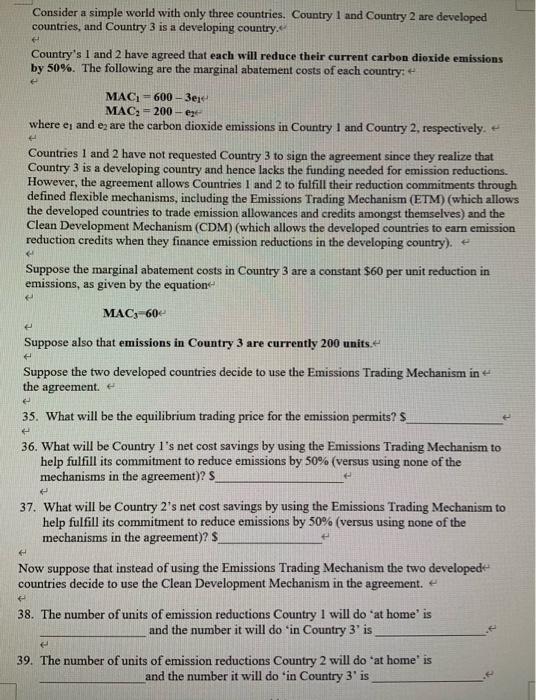
Consider a simple world with only three countries. Country I and Country 2 are developed countries, and Country 3 is a developing country. Country's 1 and 2 have agreed that each will reduce their current carbon dioxide emissions by 50%. The following are the marginal abatement costs of each country: MAC, 600 - 3e MAC, = 200 - ezt where e, and e, are the carbon dioxide emissions in Country I and Country 2, respectively. Countries 1 and 2 have not requested Country 3 to sign the agreement since they realize that Country 3 is a developing country and hence lacks the funding needed for emission reductions However, the agreement allows Countries 1 and 2 to fulfill their reduction commitments through defined flexible mechanisms, including the Emissions Trading Mechanism (ETM) (which allows the developed countries to trade emission allowances and credits amongst themselves) and the Clean Development Mechanism (CDM) (which allows the developed countries to earn emission reduction credits when they finance emission reductions in the developing country). Suppose the marginal abatement costs in Country 3 are a constant $60 per unit reduction in emissions, as given by the equation MAC3-60 Suppose also that emissions in Country 3 are currently 200 units. Suppose the two developed countries decide to use the Emissions Trading Mechanism in the agreement 35. What will be the equilibrium trading price for the emission permits? $ 36. What will be Country 1's net cost savings by using the Emissions Trading Mechanism to help fulfill its commitment to reduce emissions by 50% (versus using none of the mechanisms in the agreement)? S 37. What will be Country 2's net cost savings by using the Emissions Trading Mechanism to help fulfill its commitment to reduce emissions by 50% (versus using none of the mechanisms in the agreement)? $ Now suppose that instead of using the Emissions Trading Mechanism the two developed countries decide to use the Clean Development Mechanism in the agreement. 38. The number of units of emission reductions Country I will do at home' is and the number it will do 'in Country 3' is 39. The number of units of emission reductions Country 2 will do at home is and the number it will do 'in Country 3' is Consider a simple world with only three countries. Country I and Country 2 are developed countries, and Country 3 is a developing country. Country's 1 and 2 have agreed that each will reduce their current carbon dioxide emissions by 50%. The following are the marginal abatement costs of each country: MAC, 600 - 3e MAC, = 200 - ezt where e, and e, are the carbon dioxide emissions in Country I and Country 2, respectively. Countries 1 and 2 have not requested Country 3 to sign the agreement since they realize that Country 3 is a developing country and hence lacks the funding needed for emission reductions However, the agreement allows Countries 1 and 2 to fulfill their reduction commitments through defined flexible mechanisms, including the Emissions Trading Mechanism (ETM) (which allows the developed countries to trade emission allowances and credits amongst themselves) and the Clean Development Mechanism (CDM) (which allows the developed countries to earn emission reduction credits when they finance emission reductions in the developing country). Suppose the marginal abatement costs in Country 3 are a constant $60 per unit reduction in emissions, as given by the equation MAC3-60 Suppose also that emissions in Country 3 are currently 200 units. Suppose the two developed countries decide to use the Emissions Trading Mechanism in the agreement 35. What will be the equilibrium trading price for the emission permits? $ 36. What will be Country 1's net cost savings by using the Emissions Trading Mechanism to help fulfill its commitment to reduce emissions by 50% (versus using none of the mechanisms in the agreement)? S 37. What will be Country 2's net cost savings by using the Emissions Trading Mechanism to help fulfill its commitment to reduce emissions by 50% (versus using none of the mechanisms in the agreement)? $ Now suppose that instead of using the Emissions Trading Mechanism the two developed countries decide to use the Clean Development Mechanism in the agreement. 38. The number of units of emission reductions Country I will do at home' is and the number it will do 'in Country 3' is 39. The number of units of emission reductions Country 2 will do at home is and the number it will do 'in Country 3' is
Step by Step Solution
There are 3 Steps involved in it

Get step-by-step solutions from verified subject matter experts
 Study Help