







Question: Consider the rotational system shown below. A rotation speed is imparted to the input side of a rotational fluid coupling with damping coefficient B1,
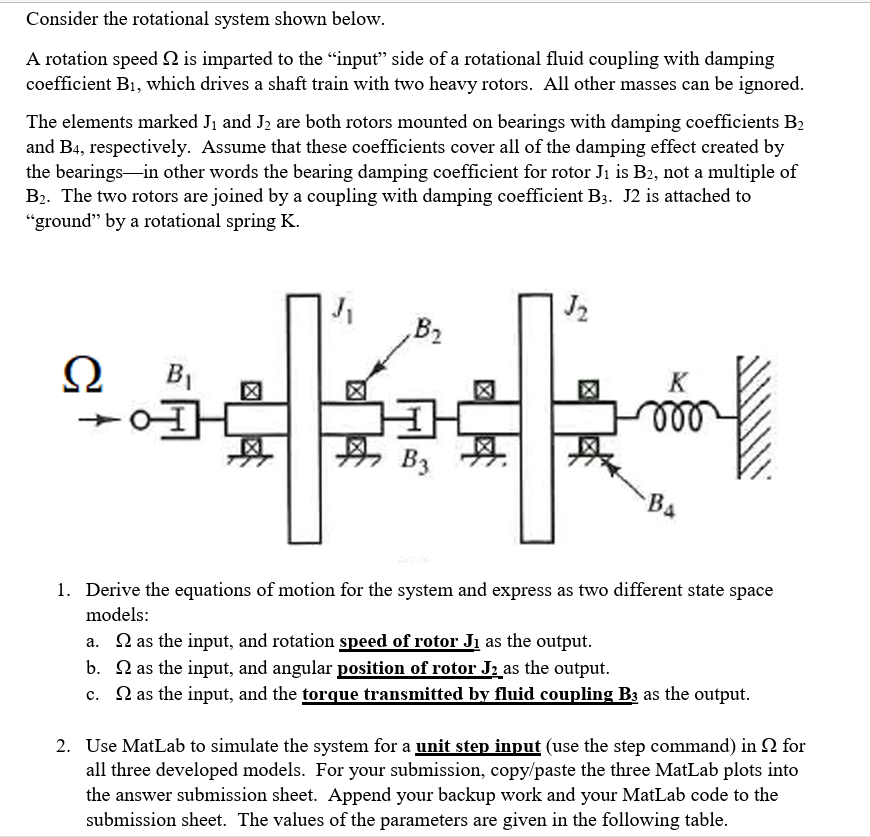
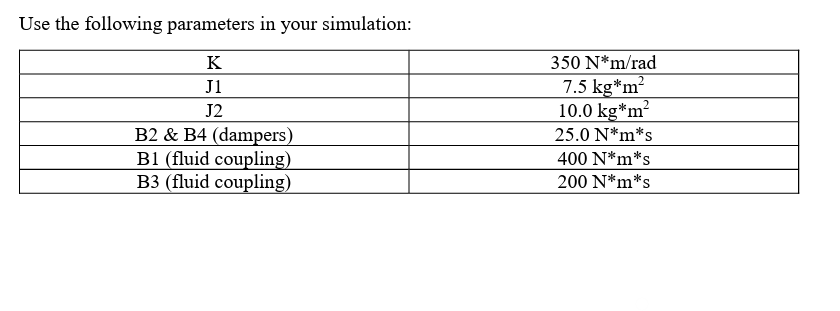
Consider the rotational system shown below. A rotation speed is imparted to the "input" side of a rotational fluid coupling with damping coefficient B1, which drives a shaft train with two heavy rotors. All other masses can be ignored. The elements marked J and J2 are both rotors mounted on bearings with damping coefficients B2 and B4, respectively. Assume that these coefficients cover all of the damping effect created by the bearings in other words the bearing damping coefficient for rotor J is B2, not a multiple of B2. The two rotors are joined by a coupling with damping coefficient B3. J2 is attached to "ground" by a rotational spring K. B B A B3 J2 K 000 BA 1. Derive the equations of motion for the system and express as two different state space models: a. as the input, and rotation speed of rotor Ji as the output. b. as the input, and angular position of rotor J2 as the output. c. as the input, and the torque transmitted by fluid coupling B3 as the output. 2. Use MatLab to simulate the system for a unit step input (use the step command) in Q for all three developed models. For your submission, copy/paste the three MatLab plots into the answer submission sheet. Append your backup work and your MatLab code to the submission sheet. The values of the parameters are given in the following table. 3. Briefly describe the qualitative behavior of the rotors as they start from rest in the presence of a step change in Q2. In other words, nothing is moving and then suddenly the input is changed to a new steady value. Note that this should not change for the three different models you've derived! 1 Use the following parameters in your simulation: K J1 J2 B2 & B4 (dampers) 350 N*m/rad 7.5 kg*m 10.0 kg*m 25.0 N*m*s 400 N*m*s B1 (fluid coupling) B3 (fluid coupling) 200 N*m*s
Step by Step Solution
There are 3 Steps involved in it

Get step-by-step solutions from verified subject matter experts
 Study Help