







Question: Consider the Un-normalized Entities Student and Lecturer. For each case study starts with the unnormalised entity given and the business rules given, normalize the entity
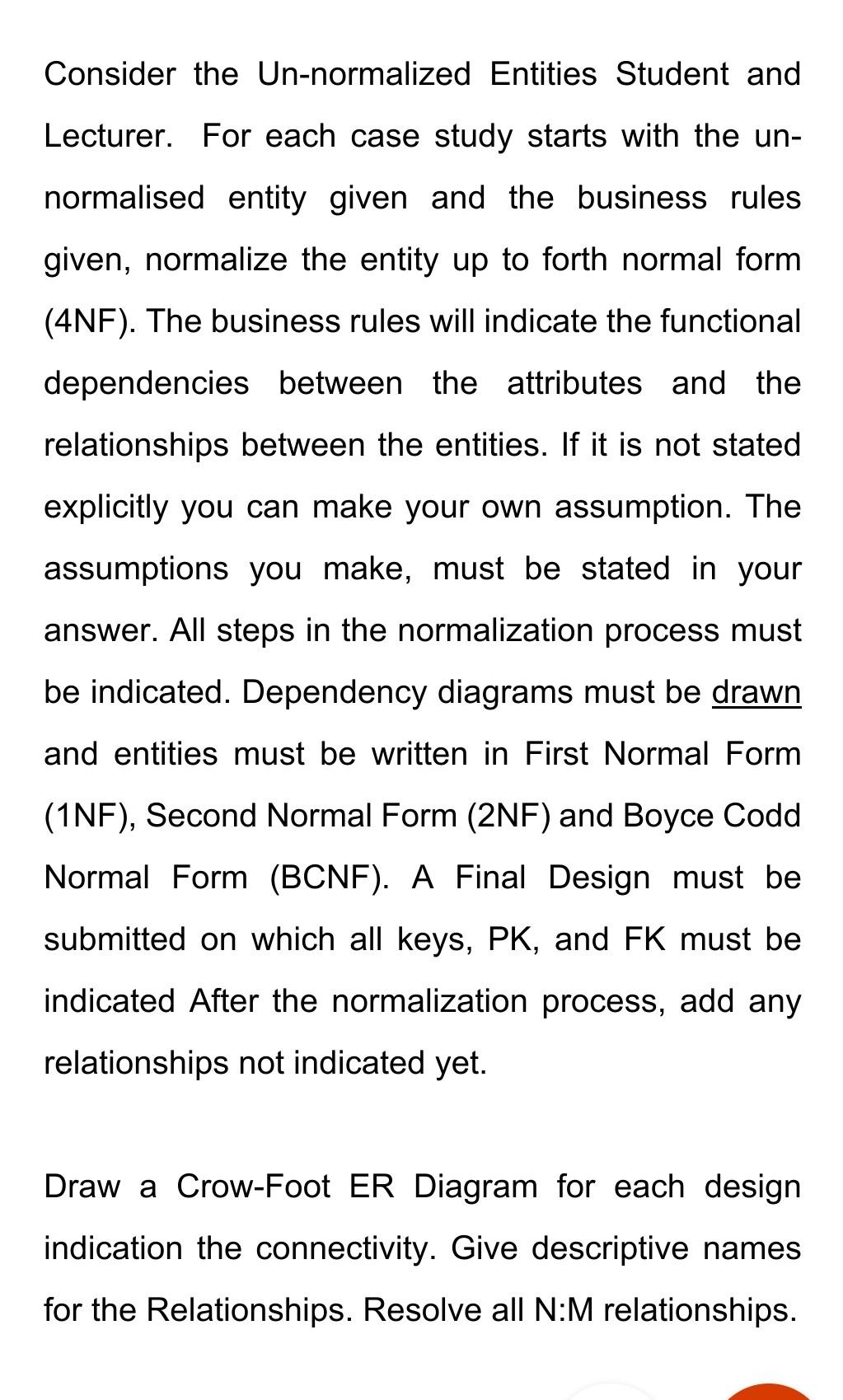
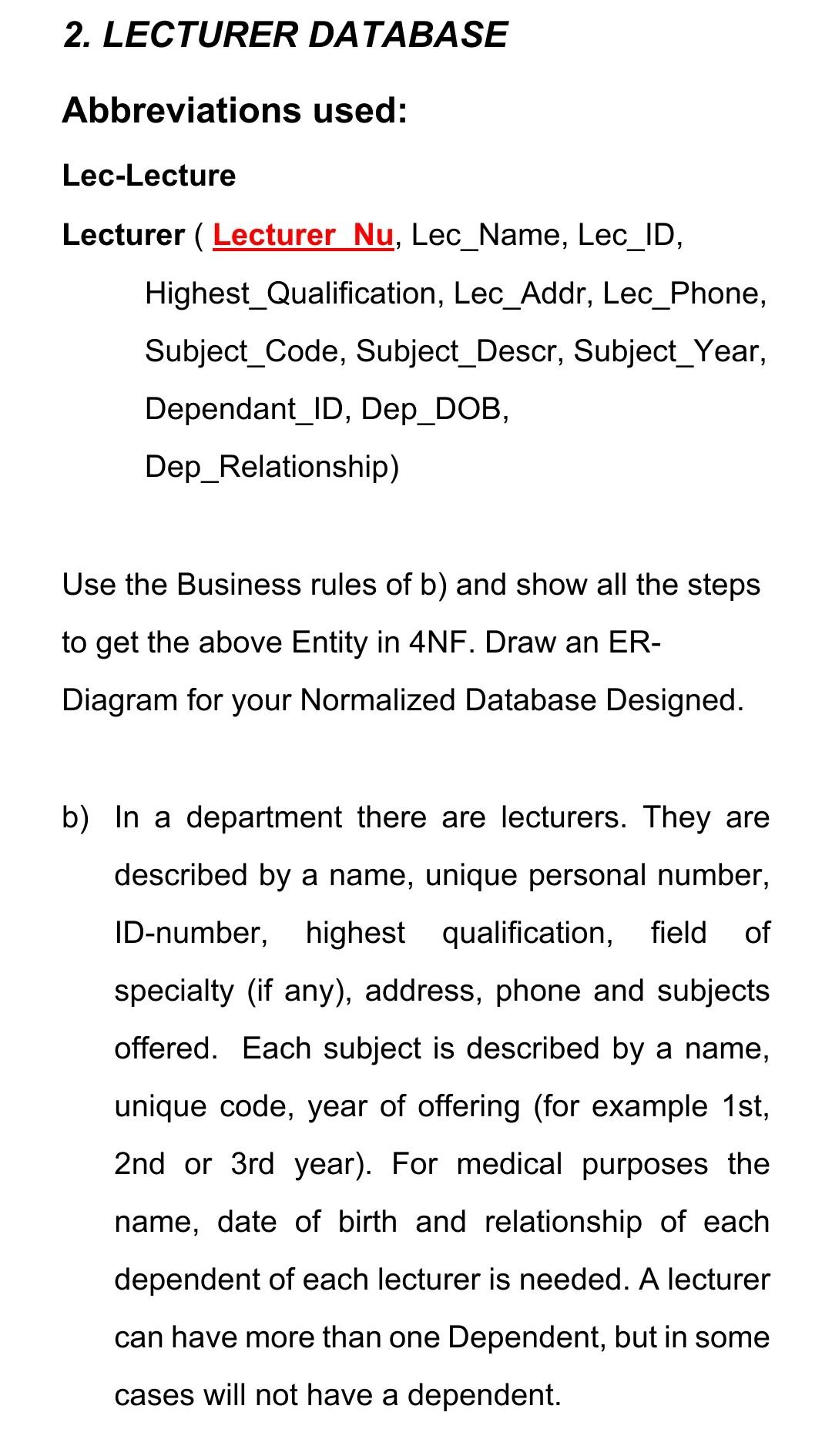
Consider the Un-normalized Entities Student and Lecturer. For each case study starts with the unnormalised entity given and the business rules given, normalize the entity up to forth normal form (4NF). The business rules will indicate the functional dependencies between the attributes and the relationships between the entities. If it is not stated explicitly you can make your own assumption. The assumptions you make, must be stated in your answer. All steps in the normalization process must be indicated. Dependency diagrams must be drawn and entities must be written in First Normal Form (1NF), Second Normal Form (2NF) and Boyce Codd Normal Form (BCNF). A Final Design must be submitted on which all keys, PK, and FK must be indicated After the normalization process, add any relationships not indicated yet. Draw a Crow-Foot ER Diagram for each design indication the connectivity. Give descriptive names for the Relationships. Resolve all N:M relationships. 2. LECTURER DATABASE Abbreviations used: Lec-Lecture Lecturer ( Lecturer Nu, Lec_Name, Lec_ID, Highest_Qualification,_Lec_Addr, Lec_Phone, Subject_Code, Subject_Descr, Subject_Year, Dependant_ID, Dep_DOB, Dep_Relationship) Use the Business rules of b ) and show all the steps to get the above Entity in 4NF. Draw an ER- Diagram for your Normalized Database Designed. b) In a department there are lecturers. They are described by a name, unique personal number, ID-number, highest qualification, field of specialty (if any), address, phone and subjects offered. Each subject is described by a name, unique code, year of offering (for example 1st, 2nd or 3rd year). For medical purposes the name, date of birth and relationship of each dependent of each lecturer is needed. A lecturer can have more than one Dependent, but in some cases will not have a dependent
Step by Step Solution
There are 3 Steps involved in it

Get step-by-step solutions from verified subject matter experts
 Study Help