







Question: design compufix cultural web and its main elements. base your answer on the description offered in the case study at about the time when the
design compufix cultural web and its main elements. base your answer on the description offered in the case study at about the time when the workshops begun (1992)
Case study: Compufix Inc, by Charles W. L. Hill and Maureen Kibelsted
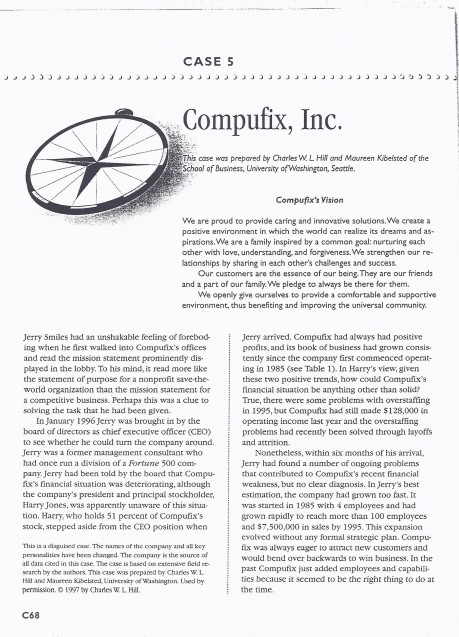
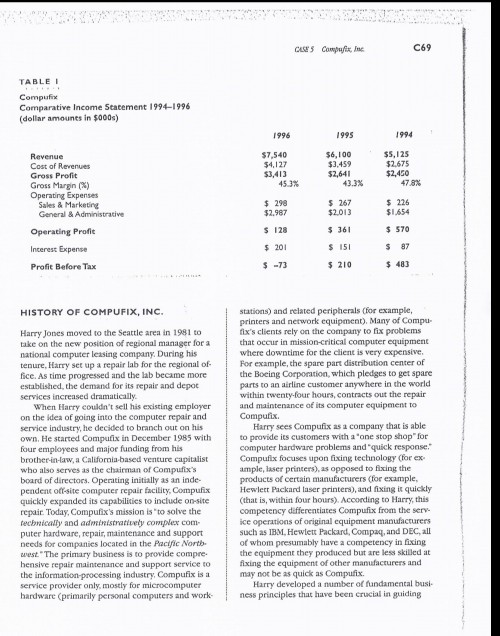
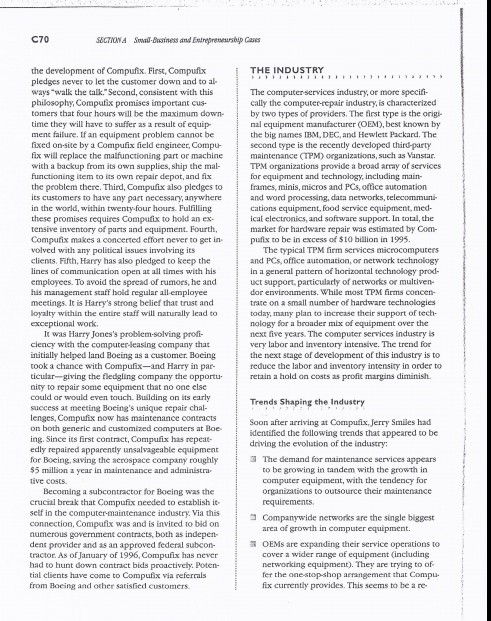
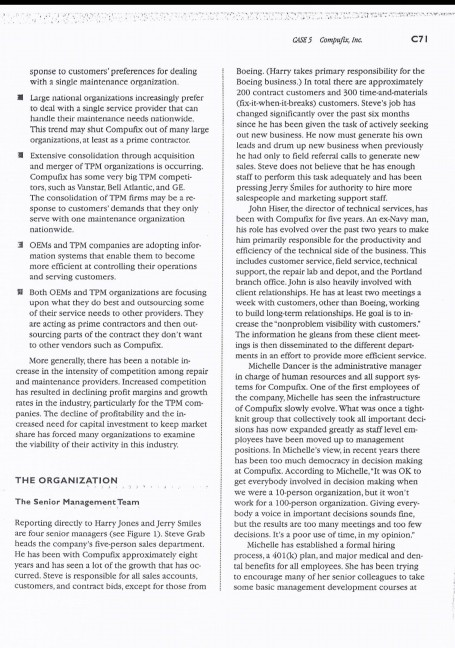
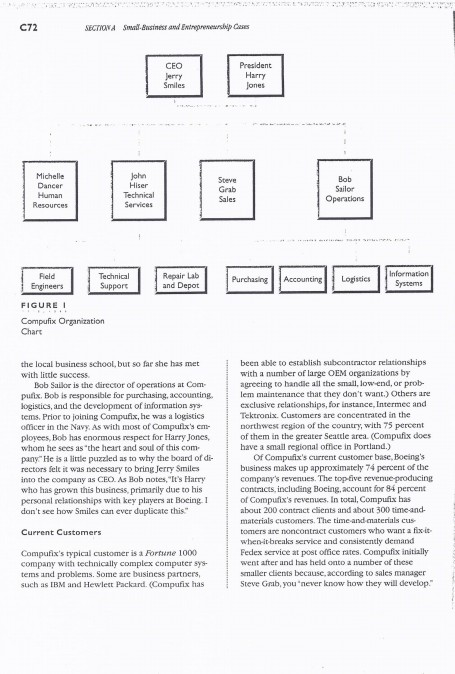
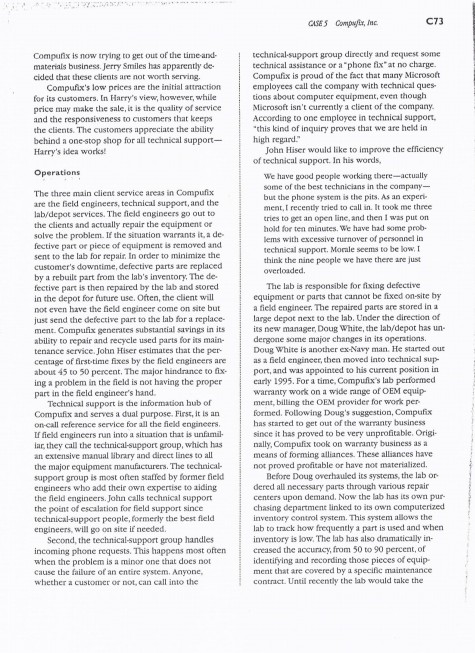
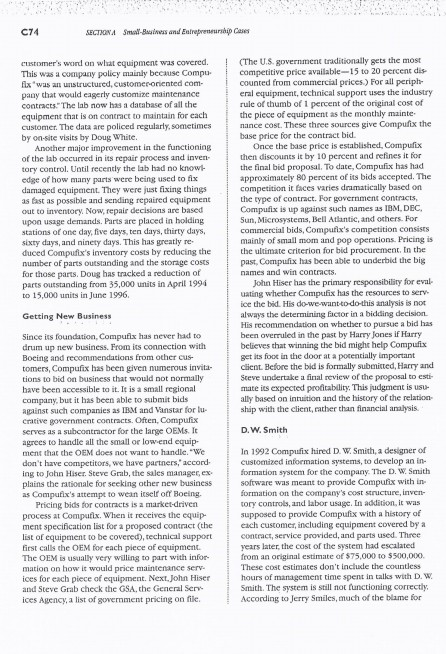
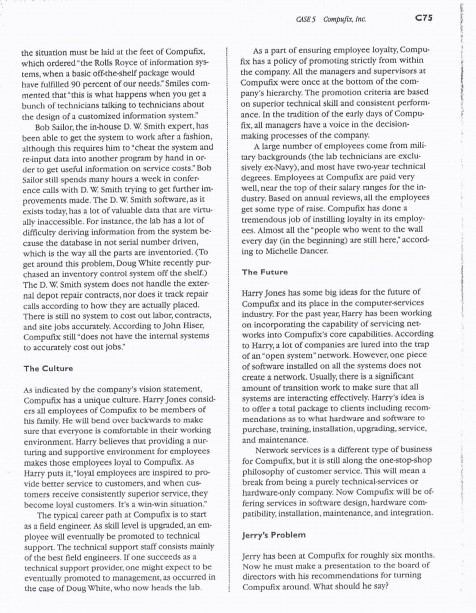
CASE 5 Compufix, Inc. This case was prepared by Charles W. L Hill and Maureen Kibelsted of the School of Business, University of Washington, Seattle, Compufix's Vision We are proud to provide caring and innovative solutions. We create a positive environment in which the world can realize its dreams and as- pirations. We are a family inspired by a common goal: nurturing each other with love, understanding, and forgiveness. We strengthen our re- lationships by sharing in each other's challenges and success. Our customers are the essence of our being. They are our friends and a part of our family. We pledge to always be there for them. We openly give ourselves to provide a comfortable and supportive environment, thus benefiting and improving the universal community Jerry Smiles had an unshakable feeling of forebod- ing when he first walked into Computix's offices and read the mission statement prominently dis- played in the lobby, To his mind, it read more like the statement of purpose for a nonprofit save the world organization than the mission statement for a competitive business. Perhaps this was a clue to solving the task that he had been given In January 1996 Jerry was brought in by the board of directors as chief executive officer (CEO) to see whether he could turn the company around Jerry was a former management consultant who had once run a division of a Fortune 500 com pany. Jerry had been told by the board that Compu- fix's financial situation was deteriorating, although the company's president and principal stockholder, Harry Jones, was apparently unaware of this situa tion. Harry, who holds 51 percent of Computix's stock, stepped aside from the CEO position when Jerry arrived. Computix had always had positive profits, and its book of business had grown consis tently since the company first commenced operat- ing in 1985 (see Table 1). In Harry's view, given these two positive trends, how could Compufix's financial situation be anything other than solid? True, there were some problems with overstaffing in 1995, but computix had still made $128,000 in operating income last year and the overstaffing problems had recently been solved through layoffs and attrition Nonetheless, within six months of his arrival Jerry had found a number of ongoing problems that contributed to Compufix's recent financial weakness, but no clear diagnosis. In Jerry's best estimation, the company had grown too fast. It was started in 1985 with employees and had grown rapidly to reach more than 100 employees and $7,500,000 in sales by 1995. This expansion evolved without any formal strategic plan. Compu fix was always eager to attract new customers and would bend over backwards to win business. In the past Compufix just added employees and capabili ties because it seemed to be the right thing to do at the time This is a disgused. The rames of the company and all key personalities been changed. The company is the source of all date cited in this case. The case is based on extensive field Search by the authors. This case was prepared by Charles WL Hiland Maureen Kitled Univery of Washington Used by permission 1997 by Charles WL Hil. C68 CASES Compaix, loc C69 TABLE Compufix Comparative Income Statement 1994-1996 (dollar amounts in $000s) 1996 1995 1994 $7.540 $4,127 $3,413 45.3% $6,100 $3.459 $2,641 43.3% $5,125 $2.675 $2,450 Revenue Cost of Revenues Gross Profit Gross Margin(%) Operating Expenses Sales & Marketing General & Administrative Operating Profit Interest Expense Profit Before Tax $ 298 $2.987 $ 267 $2.013 $ 226 $1654 S 128 $361 $ 570 $ 201 $ 151 $ 87 $ -73 $ 210 $ 483 HISTORY OF COMPUFIX, INC. Harry Jones moved to the Seattle area in 1981 to take on the new position of regional manager for a national computer leasing company. During his tenure, Harry set up a repair lab for the regional of fice. As time progressed and the lab became more established the demand for its repair and depot services increased dramatically When Harry couldn't sell his existing employer on the idea of going into the computer repair and service industry, he decided to branch out on his own. He started Computix in December 1985 with four employees and major funding from his brother-in-law, a California-based venture capitalist who also serves as the chairman of Compufix's board of directors. Operating initially as an inde- pendent off-site computer repair facility, Compufix quickly expanded its capabilities to include on-site repair Today, Computix's mission is to solve the technically and administratively complex com puter hardware, repair, maintenance and support needs for companies located in the Pacific North west. The primary business is to provide compre. hensive repair maintenance and support service to the information processing industry, Compufix is a service provider only, mostly for microcomputer hardware (primarily personal computers and work stations and related peripherals (for example, printers and network equipment). Many of Compu- fix's clients rely on the company to fix problems that occur in mission-critical computer equipment where downtime for the client is very expensive. For example, the spare part distribution center of the Boeing Corporation, which pledges to get spare parts to an airline customer anywhere in the world within twenty-four hours, contracts out the repair and maintenance of its computer equipment to Computix. Harry sees Compufix as a company that is able to provide mers with a one stop shop" for computer hardware problems and quick response." Compufix focuses upon fixing technology (for ex ample, laser printers), as opposed to fixing the products of certain manufacturers (for example, Hewlett Packard laser printers), and fixing it quickly (that is, within four hours). According to Harry, this competency differentiates Compufix from the sery ice operations of original equipment manufacturers such as IBM. Hewlett Packard, Compaq, and DEC, all of whom presumably have a competency in fixing the equipment they produced but are less skilled at fixing the equipment of other manufacturers and may not be as quick as Compufix. Harry developed a number of fundamental busi- ness principles that have been crucial in guiding C70 SECTION S-Business and Entrepreneursby Ganes THE INDUSTRY the development of Compufix. First, Compufix pledges never to let the customer down and to al ways walk the talk." Second, consistent with this philosophy, Compufix promises important cus- tomers that four hours will be the maximum down time they will have to suffer as a result of equip ment failure. If an equipment problem cannot be fixed on-site by a Compufix field engineer, Compu- fix will replace the malfunctioning part of machine with a backup from its own supplies, ship the mal- functioning item to its own repair depot, and fix the problem there. Third, Compufix also pledges to its customers to have any part necessary, anywhere in the world, within twenty-four hours. Fulfilling these promises requires Computix to hold an ex- tensive inventory of parts and equipment. Fourth, Computix makes a concerted effort never to get in volved with any political issues involving its clients. Fifth, Harry has also pledged to keep the lines of communication open at all times with his employees. To avoid the spread of rumors, he and his management staff hold regular all employee meetings. It is Harry's strong belief that trust and loyalty within the entire staff will naturally lead to exceptional work It was Harry Jones's problem-solving profi- clency with the computer leasing company that initially helped land Boeing as a customer. Boeing took a chance with Compufix-and Harry in par- ticular-giving the fledgling company the opportu nity to repair some equipment that no one else could or would even touch. Building on its early success at meeting Boeing's unique repair chal- lenges, Computix now has maintenance contracts on both generic and customized computers at Boe ing. Since its first contract, Compufix has repeat edly repaired apparently unsalvageable equipment for Boeing, saving the aerospace company roughly $5 million a year in maintenance and administra tive costs. Becoming a subcontractor for Boeing was the crucial break that Compufix needed to establish it self in the computer-maintenance industry. Via this connection, Compufix was and is invited to bid on numerous government contracts, both as indepen dent provider and as an approved federal subcon- tractor. As of January of 1996, Compufix has never had to hunt down contract bids proactively. Poten tial clients have come to Compufix via referrals from Boeing and other satisfied customers The computer services industry, or more specifi- cally the computer repair industry, is characterized by two types of providers. The first type is the origi- mal equipment manufacturer (OEM), best known by the big names IBM, DUC, and Hewlett Packard. The second type is the recently developed third-party maintenance (TPM) organizations, such as Vanstar. TPM organizations provide a broad array of services for equipment and technology, including main frames, minis, micros and PCs, office automation and word processing, data networks, telecommuni cations equipment, food service equipment, med- ical electronics, and software support. In total, the market for hardware repair was estimated by com- pufix to be in excess of $10 billion in 1995. The typical TPM firm services microcomputers and PCs, office automation, or network technology in a general pattern of horizontal technology prod- uct support, particularly of networks or multiven- dor environments. While most TPM firms concen trate on a small number of hardware technologies today, many plan to increase their support of tech- nology for a broader mix of equipment over the next five years. The computer services industry is very labor and inventory Intensive. The trend for the next stage of development of this industry is to reduce the labor and inventory intensity in order to retain a hold on costs as profit margins diminish. Trends Shaping the Industry Soon after arriving at Compufix, Jerry Smiles had identified the following trends that appeared to be driving the evolution of the industry: The demand for maintenance services appears to be growing in tandem with the growth in computer equipment, with the tendency for organizations to outsource their maintenance requirements Companywide networks are the single biggest area of growth in computer equipment. OEMs are expanding their service operations to cover a wider range of equipment (including networking equipment). They are trying to of fer the one stop shop arrangement that Compu- fix currently provides. This seems to be a re GUES Consulx, Inc. C71 sponse to customers' preferences for dealing with a single maintenance organization Large national organizations increasingly prefer to deal with a single service provider that can handle their maintenance needs nationwide, This trend may shut Compufix out of many large organizations, at least as a prime contractor Extensive consolidation through acquisition and merger of TPM organizations is occurring, Compufix has some very big TPM competi- tors, such as Vanstar, Bell Atlantic, and GE. The consolidation of TPM firms may be a re sponse to customers' demands that they only serve with one maintenance organization nationwide 1 OEMs and TPM companies are adopting infor mation systems that enable them to become more efficient at controlling their operations and serving customers # Both OEMs and TPM organizations are focusing upon what they do best and outsourcing some of their service needs to other providers. They are acting as prime contractors and then out- sourcing parts of the contract they don't want to other vendors such as Computix. More generally, there has been a notable in crease in the intensity of competition among repair and maintenance providers. Increased competition has resulted in declining profit margins and growth mtes in the industry, particularly for the TPM com panies. The decline of profitability and the in creased need for capital investment to keep market share has forced many organizations to examine the viability of their activity in this industry Boeing. (Harry takes primary responsibility for the Boeing business.) In total there are approximately 200 contract customers and 300 time and materials (fix-it-when-it-breaks) customers. Steve's job has changed significantly over the past six months since he has been given the task of actively seeking out new business. He now must generate his own leads and drum up new business when previously he had only to field referral calls to generate new sales. Steve does not believe that he has enough staff to perform this task adequately and has been pressing Jerry Smiles for authority to hire more salespeople and marketing support staff John Hiser, the director of technical services, has been with Computix for five years. An ex-Navy man, his role has evolved over the past two years to make him primarily responsible for the productivity and efficiency of the technical side of the business. This includes customer service, field service, technical support the repair lab and depot, and the Portland banch office. John is also heavily involved with client relationships. He has at least two meetings a week with customers, other than Boeing, working to build long term relationships. He goal is to in crease the nonproblem visibility with customers." The information he gleans from these client meet- ings is then disseminated to the different depart ments in an effort to provide more efficient service. Michelle Dancer is the administrative manager in charge of human resources and all support sys tems for Compufix. One of the first employees of the company, Michelle has seen the infrastructure of Compufix slowly evolve. What was once a tight- knit group that collectively took all important deci- sions has now expanded greatly as staff level em ployees have been moved up to management positions. In Michelle's view, in recent years there has been too much democracy in decision making at Compufix. According to Michelle, "It was OK to get everybody involved in decision making when we were a 10 person organization, but it won't work for a 100 person organization. Giving every body a voice in important decisions sounds fine, but the results are too many meetings and too few decisions. It's a poor use of time, in my opinion." Michelle has established a formal hiring process, a 101(k) plan, and major medical and den tal benefits for all employees. She has been trying to encourage many of her senior colleagues to take some basic management development courses at THE ORGANIZATION The Senior Management Team Reporting directly to Harry Jones and Jerry Smiles are four senior managers (see Figure 1). Steve Grab heads the company's five-person sales department. He has been with Compufix approximately eight years and has seen a lot of the growth that has oc curred. Steve is responsible for all sales accounts, customers and contract bids, except for those from C72 SECTION Sevil.siness and Entry Cases CEO Jerry Smiles President Harry Jones Michelle Dancer Human Resources John Hiser Technical Services Steve Grab Sales Bob Sailor Operations Repair Lab and Depot Purchasing Accounting Logistics Information Systems Field Technical Engineers Support FIGURE! Compufix Organization Chart the local business school, but so far she has met with little success Bob Sailor is the director of operations at Com putix. Bob is responsible for purchasing, accounting logistics, and the development of information sy tems. Prior to joining Computix, he was a logistics officer in the Navy. As with most of Computix's cm ployees, Bob has enormous respect for Harry Jones, whom he sees as the heart and soul of this com pany" He is a little puzzled as to why the board of di- rectors felt it was necessary to bring Jerry Smiles into the company as CEO. As Bob notes, "It's Harry who has grown this business, primarily due to his personal relationships with key players at Boeing. I don't see how Smiles can ever duplicate this." been able to establish subcontractor relationships with a number of large OEM organizations by agreeing to handle all the small, low-end, or prob lem maintenance that they don't want.) Others are exclusive relationships, for instance, Intermee and Tektronix. Customers are concentrated in the northwest region of the country, with 75 percent of them in the greater Seattle area (Compufix does have a small regional office in Portland.) Of Compufix's current customer base, Boeing's business makes up approximately 74 percent of the company's revenues. The top-Eive revenue producing contracts, including Boeing, account for 84 percent of Compufix's revenues. In total, Compufix has about 200 contract clients and about 300 time and materials customers. The time and materials cus tomers are noncontact customers who want a fix it when it breaks service and consistently demand Fedex service at post office rates. Compufix initially went after and has held onto a number of these smaller clients because, according to sales manager Steve Gmb,you never know how they will develop Current Customers Computix's typical customer is a Fortune 1000 company with technically complex computer sys- tems and problems. Some are business partners, such as IBM and Hewlett Packard. (Compufix has GASES Comply, Mc C73 Computix is now trying to get out of the time and materials business. Jerry Smiles has apparently de cided that these clients are not worth serving. Compufix's low prices are the initial attraction for its customers. In Harry's view, however, while price may make the sale, it is the quality of service and the responsiveness to customers that keeps the clients. The customers appreciate the ability behind a one-stop shop for all technical support- Harry's idea works! Operations The three main client service areas in Compufix are the field engineers, technical support, and the lab/depot services. The field engineers go out to the clients and actually repair the equipment or solve the problem. If the situation warrants ita de fective part or piece of equipment is removed and sent to the lab for repair in order to minimize the customer's downtime, defective parts are replaced by a rebuilt part from the lab's inventory. The de fective part is then repaired by the lab and stored in the depot for future use. Often, the client will not even have the field engineer come on site but just send the defective part to the lab for a replace ment. Compufix generites substantial savings in its ability to repair and recycle used parts for its main- tenance service John Hiser estimates that the per centage of first time fixes by the field engineers are about 45 to 50 percent. The major hindrance to fix ing a problem in the field is not having the proper part in the field engineer's hand Technical support is the information hub of Compufix and serves a dual purpose. First, it is an on-call reference service for all the field engineers If field engineers run into a situation that is unfamil, lar, they call the technical support group, which has an extensive manual library and direct lines to all the major equipment manufacturers. The technical- support group is most often staffed by former Dield engineers who add their own expertise to aiding the field engineers. John calls technical support the point of escalation for field support since technical support people, formerly the best field engineers, will go on site if needed Second, the technical support group handles incoming phone requests. This happens most often when the problem is a minor one that does not cause the failure of an entire system. Anyone, whether a customer or not, can call into the technical support group directly and request some technical assistance or a phone fixat no charge. Computix is proud of the fact that many Microsoft employees call the company with technical ques tions about computer equipment, even though Microsoft isn't currently a client of the company According to one employee in technical support, "this kind of inquiry proves that we are held in high regard." John Hiser would like to improve the efficiency of technical support. In his words, We have good people working there-actually some of the best technicians in the company- but the phone system is the pits. As an expert ment, I recently tried to call in. It took me three tries to get an open line, and then I was put on hold for ten minutes. We have had some prob- lems with excessive turnover of personnel in technical support. Monle seems to be low. I think the nine people we have there are just overloaded The lab is responsible for fixing defective equipment or parts that cannot be fixed on-site by a field engineer. The repaired parts are stored in a Targe depot next to the lab. Under the direction of its new manager, Doug White, the lab/depot has un dergone some major changes in its operations. Doug White is another ex-Navy man. He started out as a field engineer, then moved into technical sup port, and was appointed to his current position in early 1995. For a time, Compufix's lab performed Warranty work on a wide range of OEM equip ment, billing the OEM provider for work per formed. Following Doug's suggestion, Compufix has started to get out of the warranty business since it has proved to be very unprofitable. Origi- nally, Compufix took on warranty business as a means of forming alliances. These alliances have not proved profitable or have not materialized Before Doug overhauled its systems the labor dered all necessary parts through various repair centers upon demand. Now the lab has its own pur chasing department linked to its own computerized inventory control system. This system allows the lab to track how frequently a part is used and when inventory is low. The lab has also dramatically in creased the accuracy, from 50 to 90 percent of identifying and recording those pieces of equip ment that are covered by a specific maintenance contract. Until recently the lab would take the C74 SECTION A Small Business and Entrepreneurship Cares elastomer's word on what equipment was covered. This was a company policy mainly because Compu flxwas an unstructured, customceoriented com- pany that would eagerly customize maintenance contracts." The lab now has a database of all the equipment that is on contract to maintain for each customer. The data are policed regularly, sometimes by on-site visits by Doug White Another major improvement in the functioning of the lab occurred in its repair process and inven tory control. Until recently the lab had no knowl edge of how many parts were being used to fix damaged equipment. They were just fixing things as fast as possible and sending repaired equipment out to inventory. Now,repair decisions are based upon usage demands. Parts are placed in holding stations of one day, five days, ten days, thirty days, sixty days, and ninety days. This has greatly re- duced Computix's Inventory costs by reducing the number of parts outstanding and the storage costs for those parts, Doug has tracked a reduction of parts outstanding from 35,000 units in April 1994 to 15,000 units in June 1996. (The U.S. government traditionally gets the most competitive price available-15 to 20 percent dis- counted from commercial prices. For all periph eral equipment, technical support uses the industry rule of thumb of 1 percent of the original cost of the picce of equipment as the monthly mainte nance cost. These three sources give Compufix the base price for the contract bid. Once the base price is established, Compufix then discounts it by 10 percent and refines it for the final bid proposal. To date, Compufix has had approximately 80 percent of its bids accepted. The competition it faces varies dramatically based on the type of contract. For government contracts Computix is up against such names as IBM, DEC, Sun, Microsystems, Bell Atlantic, and others. For commercial bids, Compufix's competition consists mainly of small mom and pop operations. Pricing is the ultimate criterion for bid procurement. In the past, Compufix has been able to underbid the big names and win contracts John Hiser has the primary responsibility for eval uating whether Compufix has the resources to serv ice the bid. His do-we-want to do this analysis is not always the determining actor in a bidding decision His recommendation on whether to pursue a bid has been overruled in the past by Harry Jones if Harry believes that winning the bid might help Compufix get its foot in the door at a potentially important client. Before the bid is formally submitted, Harry and Steve undertake a final review of the proposal to esti- mate its expected profitability. This judgment is usu- ally based on intuition and the history of the relation ship with the client, rather than financial analysis Getting New Business D.W. Smith Since its foundation, Compufix has never had to drum up new business. From its connection with Boeing and recommendations from other cus tomers, Compufix has been given numerous inviti tions to bid on business that would not normally have been accessible to it. It is a small regional company, but it has been able to submit bids against such companies as IBM and instar forlu crative government contracts. Often, Compufix serves as a subcontractor for the large OEMs. It agrees to handle all the small or low-end equip ment that the OEM does not want to handle. We don't have competitors, we have partners,' accord ing to John Hiser. Steve Grab, the sales manager, ex plains the nationale for seeking other new business as Computix's attempt to wean itself off Boeing Pricing bids for contracts is a market-driven process at Computix. When it receives the equip ment specification list for a proposed contract (the list of equipment to be covered), technical support first calls the OEM for each piece of equipment The OEM is usually very willing to part with infor mation on how it would price maintenance serv- ices for each piece of equipment. Next.John Hiser and Steve Grab check the GSA, the General Sery ices Agency, a list of government pricing on file In 1992 Compufix hired D. W. Smith, a designer of customized information systems, to develop an in- formation system for the company. The D. W. Smith software was meant to provide Computix with in formation on the company's cost structure, inven tory controls, and labor usage. In addition, it was supposed to provide Compufix with a history of each customer, including equipment covered by a contract, service provided, and parts used. Three years later, the cost of the system had escalated from an original estimate of $75,000 to $500,000 These cost estimates don't include the countless hours of management time spent in talks with D. W Smith. The system is still not functioning correctly According to Jerry Smiles, much of the blame for GASES Combit, Inc C75 the situation must be laid at the feet of Compufix, which ordered the Rolls Royce of information sys- tems, when a basic off the shelf package would have fulfilled 90 percent of our needs. Smiles com- mented that this is what happens when you get a bunch of technicians talking to technicians about the design of a customized information system." Bob Sailor, the in-house D. W. Smith expert, has been able to get the system to work after a fashion, although this requires him to 'cheat the system and re input data into another program by hand in or der to get useful information on service costs." Bob Sailor still spends many hours a week in confer ence calls with DW Smith trying to get further im provements made. The D. W. Smith software, as it exists today, has a lot of valuable data that are virtu- ally inaccessible. For instance, the lab has a lot of difficulty deriving information from the system be cause the database in not serial number driven, which is the way all the parts are inventoried. (To get around this problem, Doug White recently pur chased an inventory control system off the shell) The D. W. Smith system does not handle the exter nal depot repair contracts, nor does it track repair calls according to how they are actually placed There is still no system to cost out labor, contracts, and site jobs accurately. According to John Hisee, Compufix still does not have the internal systems to accurately cost out jobs. As a part of ensuring employee loyalty, Compu. fix has a policy of promoting strictly from within the company. All the managers and supervisors ar Compufix were once at the bottom of the com pany's hierarchy. The promotion criteria are based on superior technical skill and consistent perform ance. In the tradition of the early days of Compu: fix, all managers have a voice in the decision- making processes of the company. A large number of employees come from mili tary backgrounds (the lab technicians are exclu sively ex-Navy), and most have two-year technical degrees. Employees at Computix are paid very well, near the top of their salary nanges for the in dustry. Based on annual reviews, all the employees get some type of raise. Compufix has done a tremendous job of instilling loyalty in its employ ees. Almost all the people who went to the wall every day in the beginning) are still here,'accord ing to Michelle Dancer The Future The Culture As indicated by the company's vision statement, Compufix has a unique culture. Harry Jones consid- ers all employees of Compufix to be members of his family. He will bend over backwards to make sure that everyone is comfortable in their working environment. Harry believes that providing a nur turing and supportive environment for employees makes those employees loyal to Compufix. As Harry puts it,"loyal employees are inspired to pro vide better service to customers, and when cus- tomers receive consistently superior service, they become loyal customers. It's a win-win situation." The typical career path at Computix is to start as a field engineer. As skill level is upgraded, an em- ployee will eventually be promoted to technical support. The technical support staff consists mainly of the best field engineers. If one succeeds as a technical support provider, one might expect to be eventually promoted to management, as occurred in the case of Doug White, who now heads the lab Harry Jones has some big ideas for the future of Computix and its place in the computer services industry. For the past year, Harry has been working on incorporating the capability of servicing net works into Compufix's core capabilities. According to Harry, a lot of companies are lured into the trap of an open system.network. However, one piece of software installed on all the systems does not create a network. Usually, there is a significant amount of transition work to make sure that all systems are interacting effectively. Harry's idea is to offer a total package to clients including recom. mendations as to what hardware and software to purchase, training installation, upgrading service, and maintenance Network services is a different type of business for Compufix, but it is still along the one-stop-shop philosophy of customer service. This will mean a break from being a purely technical services or hardware only company. Now Compufix will be of fering services in software design, hardware com patibility, installation, maintenance, and integration Jerry's Problem Jerry has been at Compufix for roughly six months. Now he must make a presentation to the board of directors with his recommendations for turning Compulix around. What should he say? CASE 5 Compufix, Inc. This case was prepared by Charles W. L Hill and Maureen Kibelsted of the School of Business, University of Washington, Seattle, Compufix's Vision We are proud to provide caring and innovative solutions. We create a positive environment in which the world can realize its dreams and as- pirations. We are a family inspired by a common goal: nurturing each other with love, understanding, and forgiveness. We strengthen our re- lationships by sharing in each other's challenges and success. Our customers are the essence of our being. They are our friends and a part of our family. We pledge to always be there for them. We openly give ourselves to provide a comfortable and supportive environment, thus benefiting and improving the universal community Jerry Smiles had an unshakable feeling of forebod- ing when he first walked into Computix's offices and read the mission statement prominently dis- played in the lobby, To his mind, it read more like the statement of purpose for a nonprofit save the world organization than the mission statement for a competitive business. Perhaps this was a clue to solving the task that he had been given In January 1996 Jerry was brought in by the board of directors as chief executive officer (CEO) to see whether he could turn the company around Jerry was a former management consultant who had once run a division of a Fortune 500 com pany. Jerry had been told by the board that Compu- fix's financial situation was deteriorating, although the company's president and principal stockholder, Harry Jones, was apparently unaware of this situa tion. Harry, who holds 51 percent of Computix's stock, stepped aside from the CEO position when Jerry arrived. Computix had always had positive profits, and its book of business had grown consis tently since the company first commenced operat- ing in 1985 (see Table 1). In Harry's view, given these two positive trends, how could Compufix's financial situation be anything other than solid? True, there were some problems with overstaffing in 1995, but computix had still made $128,000 in operating income last year and the overstaffing problems had recently been solved through layoffs and attrition Nonetheless, within six months of his arrival Jerry had found a number of ongoing problems that contributed to Compufix's recent financial weakness, but no clear diagnosis. In Jerry's best estimation, the company had grown too fast. It was started in 1985 with employees and had grown rapidly to reach more than 100 employees and $7,500,000 in sales by 1995. This expansion evolved without any formal strategic plan. Compu fix was always eager to attract new customers and would bend over backwards to win business. In the past Compufix just added employees and capabili ties because it seemed to be the right thing to do at the time This is a disgused. The rames of the company and all key personalities been changed. The company is the source of all date cited in this case. The case is based on extensive field Search by the authors. This case was prepared by Charles WL Hiland Maureen Kitled Univery of Washington Used by permission 1997 by Charles WL Hil. C68 CASES Compaix, loc C69 TABLE Compufix Comparative Income Statement 1994-1996 (dollar amounts in $000s) 1996 1995 1994 $7.540 $4,127 $3,413 45.3% $6,100 $3.459 $2,641 43.3% $5,125 $2.675 $2,450 Revenue Cost of Revenues Gross Profit Gross Margin(%) Operating Expenses Sales & Marketing General & Administrative Operating Profit Interest Expense Profit Before Tax $ 298 $2.987 $ 267 $2.013 $ 226 $1654 S 128 $361 $ 570 $ 201 $ 151 $ 87 $ -73 $ 210 $ 483 HISTORY OF COMPUFIX, INC. Harry Jones moved to the Seattle area in 1981 to take on the new position of regional manager for a national computer leasing company. During his tenure, Harry set up a repair lab for the regional of fice. As time progressed and the lab became more established the demand for its repair and depot services increased dramatically When Harry couldn't sell his existing employer on the idea of going into the computer repair and service industry, he decided to branch out on his own. He started Computix in December 1985 with four employees and major funding from his brother-in-law, a California-based venture capitalist who also serves as the chairman of Compufix's board of directors. Operating initially as an inde- pendent off-site computer repair facility, Compufix quickly expanded its capabilities to include on-site repair Today, Computix's mission is to solve the technically and administratively complex com puter hardware, repair, maintenance and support needs for companies located in the Pacific North west. The primary business is to provide compre. hensive repair maintenance and support service to the information processing industry, Compufix is a service provider only, mostly for microcomputer hardware (primarily personal computers and work stations and related peripherals (for example, printers and network equipment). Many of Compu- fix's clients rely on the company to fix problems that occur in mission-critical computer equipment where downtime for the client is very expensive. For example, the spare part distribution center of the Boeing Corporation, which pledges to get spare parts to an airline customer anywhere in the world within twenty-four hours, contracts out the repair and maintenance of its computer equipment to Computix. Harry sees Compufix as a company that is able to provide mers with a one stop shop" for computer hardware problems and quick response." Compufix focuses upon fixing technology (for ex ample, laser printers), as opposed to fixing the products of certain manufacturers (for example, Hewlett Packard laser printers), and fixing it quickly (that is, within four hours). According to Harry, this competency differentiates Compufix from the sery ice operations of original equipment manufacturers such as IBM. Hewlett Packard, Compaq, and DEC, all of whom presumably have a competency in fixing the equipment they produced but are less skilled at fixing the equipment of other manufacturers and may not be as quick as Compufix. Harry developed a number of fundamental busi- ness principles that have been crucial in guiding C70 SECTION S-Business and Entrepreneursby Ganes THE INDUSTRY the development of Compufix. First, Compufix pledges never to let the customer down and to al ways walk the talk." Second, consistent with this philosophy, Compufix promises important cus- tomers that four hours will be the maximum down time they will have to suffer as a result of equip ment failure. If an equipment problem cannot be fixed on-site by a Compufix field engineer, Compu- fix will replace the malfunctioning part of machine with a backup from its own supplies, ship the mal- functioning item to its own repair depot, and fix the problem there. Third, Compufix also pledges to its customers to have any part necessary, anywhere in the world, within twenty-four hours. Fulfilling these promises requires Computix to hold an ex- tensive inventory of parts and equipment. Fourth, Computix makes a concerted effort never to get in volved with any political issues involving its clients. Fifth, Harry has also pledged to keep the lines of communication open at all times with his employees. To avoid the spread of rumors, he and his management staff hold regular all employee meetings. It is Harry's strong belief that trust and loyalty within the entire staff will naturally lead to exceptional work It was Harry Jones's problem-solving profi- clency with the computer leasing company that initially helped land Boeing as a customer. Boeing took a chance with Compufix-and Harry in par- ticular-giving the fledgling company the opportu nity to repair some equipment that no one else could or would even touch. Building on its early success at meeting Boeing's unique repair chal- lenges, Computix now has maintenance contracts on both generic and customized computers at Boe ing. Since its first contract, Compufix has repeat edly repaired apparently unsalvageable equipment for Boeing, saving the aerospace company roughly $5 million a year in maintenance and administra tive costs. Becoming a subcontractor for Boeing was the crucial break that Compufix needed to establish it self in the computer-maintenance industry. Via this connection, Compufix was and is invited to bid on numerous government contracts, both as indepen dent provider and as an approved federal subcon- tractor. As of January of 1996, Compufix has never had to hunt down contract bids proactively. Poten tial clients have come to Compufix via referrals from Boeing and other satisfied customers The computer services industry, or more specifi- cally the computer repair industry, is characterized by two types of providers. The first type is the origi- mal equipment manufacturer (OEM), best known by the big names IBM, DUC, and Hewlett Packard. The second type is the recently developed third-party maintenance (TPM) organizations, such as Vanstar. TPM organizations provide a broad array of services for equipment and technology, including main frames, minis, micros and PCs, office automation and word processing, data networks, telecommuni cations equipment, food service equipment, med- ical electronics, and software support. In total, the market for hardware repair was estimated by com- pufix to be in excess of $10 billion in 1995. The typical TPM firm services microcomputers and PCs, office automation, or network technology in a general pattern of horizontal technology prod- uct support, particularly of networks or multiven- dor environments. While most TPM firms concen trate on a small number of hardware technologies today, many plan to increase their support of tech- nology for a broader mix of equipment over the next five years. The computer services industry is very labor and inventory Intensive. The trend for the next stage of development of this industry is to reduce the labor and inventory intensity in order to retain a hold on costs as profit margins diminish. Trends Shaping the Industry Soon after arriving at Compufix, Jerry Smiles had identified the following trends that appeared to be driving the evolution of the industry: The demand for maintenance services appears to be growing in tandem with the growth in computer equipment, with the tendency for organizations to outsource their maintenance requirements Companywide networks are the single biggest area of growth in computer equipment. OEMs are expanding their service operations to cover a wider range of equipment (including networking equipment). They are trying to of fer the one stop shop arrangement that Compu- fix currently provides. This seems to be a re GUES Consulx, Inc. C71 sponse to customers' preferences for dealing with a single maintenance organization Large national organizations increasingly prefer to deal with a single service provider that can handle their maintenance needs nationwide, This trend may shut Compufix out of many large organizations, at least as a prime contractor Extensive consolidation through acquisition and merger of TPM organizations is occurring, Compufix has some very big TPM competi- tors, such as Vanstar, Bell Atlantic, and GE. The consolidation of TPM firms may be a re sponse to customers' demands that they only serve with one maintenance organization nationwide 1 OEMs and TPM companies are adopting infor mation systems that enable them to become more efficient at controlling their operations and serving customers # Both OEMs and TPM organizations are focusing upon what they do best and outsourcing some of their service needs to other providers. They are acting as prime contractors and then out- sourcing parts of the contract they don't want to other vendors such as Computix. More generally, there has been a notable in crease in the intensity of competition among repair and maintenance providers. Increased competition has resulted in declining profit margins and growth mtes in the industry, particularly for the TPM com panies. The decline of profitability and the in creased need for capital investment to keep market share has forced many organizations to examine the viability of their activity in this industry Boeing. (Harry takes primary responsibility for the Boeing business.) In total there are approximately 200 contract customers and 300 time and materials (fix-it-when-it-breaks) customers. Steve's job has changed significantly over the past six months since he has been given the task of actively seeking out new business. He now must generate his own leads and drum up new business when previously he had only to field referral calls to generate new sales. Steve does not believe that he has enough staff to perform this task adequately and has been pressing Jerry Smiles for authority to hire more salespeople and marketing support staff John Hiser, the director of technical services, has been with Computix for five years. An ex-Navy man, his role has evolved over the past two years to make him primarily responsible for the productivity and efficiency of the technical side of the business. This includes customer service, field service, technical support the repair lab and depot, and the Portland banch office. John is also heavily involved with client relationships. He has at least two meetings a week with customers, other than Boeing, working to build long term relationships. He goal is to in crease the nonproblem visibility with customers." The information he gleans from these client meet- ings is then disseminated to the different depart ments in an effort to provide more efficient service. Michelle Dancer is the administrative manager in charge of human resources and all support sys tems for Compufix. One of the first employees of the company, Michelle has seen the infrastructure of Compufix slowly evolve. What was once a tight- knit group that collectively took all important deci- sions has now expanded greatly as staff level em ployees have been moved up to management positions. In Michelle's view, in recent years there has been too much democracy in decision making at Compufix. According to Michelle, "It was OK to get everybody involved in decision making when we were a 10 person organization, but it won't work for a 100 person organization. Giving every body a voice in important decisions sounds fine, but the results are too many meetings and too few decisions. It's a poor use of time, in my opinion." Michelle has established a formal hiring process, a 101(k) plan, and major medical and den tal benefits for all employees. She has been trying to encourage many of her senior colleagues to take some basic management development courses at THE ORGANIZATION The Senior Management Team Reporting directly to Harry Jones and Jerry Smiles are four senior managers (see Figure 1). Steve Grab heads the company's five-person sales department. He has been with Compufix approximately eight years and has seen a lot of the growth that has oc curred. Steve is responsible for all sales accounts, customers and contract bids, except for those from C72 SECTION Sevil.siness and Entry Cases CEO Jerry Smiles President Harry Jones Michelle Dancer Human Resources John Hiser Technical Services Steve Grab Sales Bob Sailor Operations Repair Lab and Depot Purchasing Accounting Logistics Information Systems Field Technical Engineers Support FIGURE! Compufix Organization Chart the local business school, but so far she has met with little success Bob Sailor is the director of operations at Com putix. Bob is responsible for purchasing, accounting logistics, and the development of information sy tems. Prior to joining Computix, he was a logistics officer in the Navy. As with most of Computix's cm ployees, Bob has enormous respect for Harry Jones, whom he sees as the heart and soul of this com pany" He is a little puzzled as to why the board of di- rectors felt it was necessary to bring Jerry Smiles into the company as CEO. As Bob notes, "It's Harry who has grown this business, primarily due to his personal relationships with key players at Boeing. I don't see how Smiles can ever duplicate this." been able to establish subcontractor relationships with a number of large OEM organizations by agreeing to handle all the small, low-end, or prob lem maintenance that they don't want.) Others are exclusive relationships, for instance, Intermee and Tektronix. Customers are concentrated in the northwest region of the country, with 75 percent of them in the greater Seattle area (Compufix does have a small regional office in Portland.) Of Compufix's current customer base, Boeing's business makes up approximately 74 percent of the company's revenues. The top-Eive revenue producing contracts, including Boeing, account for 84 percent of Compufix's revenues. In total, Compufix has about 200 contract clients and about 300 time and materials customers. The time and materials cus tomers are noncontact customers who want a fix it when it breaks service and consistently demand Fedex service at post office rates. Compufix initially went after and has held onto a number of these smaller clients because, according to sales manager Steve Gmb,you never know how they will develop Current Customers Computix's typical customer is a Fortune 1000 company with technically complex computer sys- tems and problems. Some are business partners, such as IBM and Hewlett Packard. (Compufix has GASES Comply, Mc C73 Computix is now trying to get out of the time and materials business. Jerry Smiles has apparently de cided that these clients are not worth serving. Compufix's low prices are the initial attraction for its customers. In Harry's view, however, while price may make the sale, it is the quality of service and the responsiveness to customers that keeps the clients. The customers appreciate the ability behind a one-stop shop for all technical support- Harry's idea works! Operations The three main client service areas in Compufix are the field engineers, technical support, and the lab/depot services. The field engineers go out to the clients and actually repair the equipment or solve the problem. If the situation warrants ita de fective part or piece of equipment is removed and sent to the lab for repair in order to minimize the customer's downtime, defective parts are replaced by a rebuilt part from the lab's inventory. The de fective part is then repaired by the lab and stored in the depot for future use. Often, the client will not even have the field engineer come on site but just send the defective part to the lab for a replace ment. Compufix generites substantial savings in its ability to repair and recycle used parts for its main- tenance service John Hiser estimates that the per centage of first time fixes by the field engineers are about 45 to 50 percent. The major hindrance to fix ing a problem in the field is not having the proper part in the field engineer's hand Technical support is the information hub of Compufix and serves a dual purpose. First, it is an on-call reference service for all the field engineers If field engineers run into a situation that is unfamil, lar, they call the technical support group, which has an extensive manual library and direct lines to all the major equipment manufacturers. The technical- support group is most often staffed by former Dield engineers who add their own expertise to aiding the field engineers. John calls technical support the point of escalation for field support since technical support people, formerly the best field engineers, will go on site if needed Second, the technical support group handles incoming phone requests. This happens most often when the problem is a minor one that does not cause the failure of an entire system. Anyone, whether a customer or not, can call into the technical support group directly and request some technical assistance or a phone fixat no charge. Computix is proud of the fact that many Microsoft employees call the company with technical ques tions about computer equipment, even though Microsoft isn't currently a client of the company According to one employee in technical support, "this kind of inquiry proves that we are held in high regard." John Hiser would like to improve the efficiency of technical support. In his words, We have good people working there-actually some of the best technicians in the company- but the phone system is the pits. As an expert ment, I recently tried to call in. It took me three tries to get an open line, and then I was put on hold for ten minutes. We have had some prob- lems with excessive turnover of personnel in technical support. Monle seems to be low. I think the nine people we have there are just overloaded The lab is responsible for fixing defective equipment or parts that cannot be fixed on-site by a field engineer. The repaired parts are stored in a Targe depot next to the lab. Under the direction of its new manager, Doug White, the lab/depot has un dergone some major changes in its operations. Doug White is another ex-Navy man. He started out as a field engineer, then moved into technical sup port, and was appointed to his current position in early 1995. For a time, Compufix's lab performed Warranty work on a wide range of OEM equip ment, billing the OEM provider for work per formed. Following Doug's suggestion, Compufix has started to get out of the warranty business since it has proved to be very unprofitable. Origi- nally, Compufix took on warranty business as a means of forming alliances. These alliances have not proved profitable or have not materialized Before Doug overhauled its systems the labor dered all necessary parts through various repair centers upon demand. Now the lab has its own pur chasing department linked to its own computerized inventory control system. This system allows the lab to track how frequently a part is used and when inventory is low. The lab has also dramatically in creased the accuracy, from 50 to 90 percent of identifying and recording those pieces of equip ment that are covered by a specific maintenance contract. Until recently the lab would take the C74 SECTION A Small Business and Entrepreneurship Cares elastomer's word on what equipment was covered. This was a company policy mainly because Compu flxwas an unstructured, customceoriented com- pany that would eagerly customize maintenance contracts." The lab now has a database of all the equipment that is on contract to maintain for each customer. The data are policed regularly, sometimes by on-site visits by Doug White Another major improvement in the functioning of the lab occurred in its repair process and inven tory control. Until recently the lab had no knowl edge of how many parts were being used to fix damaged equipment. They were just fixing things as fast as possible and sending repaired equipment out to inventory. Now,repair decisions are based upon usage demands. Parts are placed in holding stations of one day, five days, ten days, thirty days, sixty days, and ninety days. This has greatly re- duced Computix's Inventory costs by reducing the number of parts outstanding and the storage costs for those parts, Doug has tracked a reduction of parts outstanding from 35,000 units in April 1994 to 15,000 units in June 1996. (The U.S. government traditionally gets the most competitive price available-15 to 20 percent dis- counted from commercial prices. For all periph eral equipment, technical support uses the industry rule of thumb of 1 percent of the original cost of the picce of equipment as the monthly mainte nance cost. These three sources give Compufix the base price for the contract bid. Once the base price is established, Compufix then discounts it by 10 percent and refines it for the final bid proposal. To date, Compufix has had approximately 80 percent of its bids accepted. The competition it faces varies dramatically based on the type of contract. For government contracts Computix is up against such names as IBM, DEC, Sun, Microsystems, Bell Atlantic, and others. For commercial bids, Compufix's competition consists mainly of small mom and pop operations. Pricing is the ultimate criterion for bid procurement. In the past, Compufix has been able to underbid the big names and win contracts John Hiser has the primary responsibility for eval uating whether Compufix has the resources to serv ice the bid. His do-we-want to do this analysis is not always the determining actor in a bidding decision His recommendation on whether to pursue a bid has been overruled in the past by Harry Jones if Harry believes that winning the bid might help Compufix get its foot in the door at a potentially important client. Before the bid is formally submitted, Harry and Steve undertake a final review of the proposal to esti- mate its expected profitability. This judgment is usu- ally based on intuition and the history of the relation ship with the client, rather than financial analysis Getting New Business D.W. Smith Since its foundation, Compufix has never had to drum up new business. From its connection with Boeing and recommendations from other cus tomers, Compufix has been given numerous inviti tions to bid on business that would not normally have been accessible to it. It is a small regional company, but it has been able to submit bids against such companies as IBM and instar forlu crative government contracts. Often, Compufix serves as a subcontractor for the large OEMs. It agrees to handle all the small or low-end equip ment that the OEM does not want to handle. We don't have competitors, we have partners,' accord ing to John Hiser. Steve Grab, the sales manager, ex plains the nationale for seeking other new business as Computix's attempt to wean itself off Boeing Pricing bids for contracts is a market-driven process at Computix. When it receives the equip ment specification list for a proposed contract (the list of equipment to be covered), technical support first calls the OEM for each piece of equipment The OEM is usually very willing to part with infor mation on how it would price maintenance serv- ices for each piece of equipment. Next.John Hiser and Steve Grab check the GSA, the General Sery ices Agency, a list of government pricing on file In 1992 Compufix hired D. W. Smith, a designer of customized information systems, to develop an in- formation system for the company. The D. W. Smith software was meant to provide Computix with in formation on the company's cost structure, inven tory controls, and labor usage. In addition, it was supposed to provide Compufix with a history of each customer, including equipment covered by a contract, service provided, and parts used. Three years later, the cost of the system had escalated from an original estimate of $75,000 to $500,000 These cost estimates don't include the countless hours of management time spent in talks with D. W Smith. The system is still not functioning correctly According to Jerry Smiles, much of the blame for GASES Combit, Inc C75 the situation must be laid at the feet of Compufix, which ordered the Rolls Royce of information sys- tems, when a basic off the shelf package would have fulfilled 90 percent of our needs. Smiles com- mented that this is what happens when you get a bunch of technicians talking to technicians about the design of a customized information system." Bob Sailor, the in-house D. W. Smith expert, has been able to get the system to work after a fashion, although this requires him to 'cheat the system and re input data into another program by hand in or der to get useful information on service costs." Bob Sailor still spends many hours a week in confer ence calls with DW Smith trying to get further im provements made. The D. W. Smith software, as it exists today, has a lot of valuable data that are virtu- ally inaccessible. For instance, the lab has a lot of difficulty deriving information from the system be cause the database in not serial number driven, which is the way all the parts are inventoried. (To get around this problem, Doug White recently pur chased an inventory control system off the shell) The D. W. Smith system does not handle the exter nal depot repair contracts, nor does it track repair calls according to how they are actually placed There is still no system to cost out labor, contracts, and site jobs accurately. According to John Hisee, Compufix still does not have the internal systems to accurately cost out jobs. As a part of ensuring employee loyalty, Compu. fix has a policy of promoting strictly from within the company. All the managers and supervisors ar Compufix were once at the bottom of the com pany's hierarchy. The promotion criteria are based on superior technical skill and consistent perform ance. In the tradition of the early days of Compu: fix, all managers have a voice in the decision- making processes of the company. A large number of employees come from mili tary backgrounds (the lab technicians are exclu sively ex-Navy), and most have two-year technical degrees. Employees at Computix are paid very well, near the top of their salary nanges for the in dustry. Based on annual reviews, all the employees get some type of raise. Compufix has done a tremendous job of instilling loyalty in its employ ees. Almost all the people who went to the wall every day in the beginning) are still here,'accord ing to Michelle Dancer The Future The Culture As indicated by the company's vision statement, Compufix has a unique culture. Harry Jones consid- ers all employees of Compufix to be members of his family. He will bend over backwards to make sure that everyone is comfortable in their working environment. Harry believes that providing a nur turing and supportive environment for employees makes those employees loyal to Compufix. As Harry puts it,"loyal employees are inspired to pro vide better service to customers, and when cus- tomers receive consistently superior service, they become loyal customers. It's a win-win situation." The typical career path at Computix is to start as a field engineer. As skill level is upgraded, an em- ployee will eventually be promoted to technical support. The technical support staff consists mainly of the best field engineers. If one succeeds as a technical support provider, one might expect to be eventually promoted to management, as occurred in the case of Doug White, who now heads the lab Harry Jones has some big ideas for the future of Computix and its place in the computer services industry. For the past year, Harry has been working on incorporating the capability of servicing net works into Compufix's core capabilities. According to Harry, a lot of companies are lured into the trap of an open system.network. However, one piece of software installed on all the systems does not create a network. Usually, there is a significant amount of transition work to make sure that all systems are interacting effectively. Harry's idea is to offer a total package to clients including recom. mendations as to what hardware and software to purchase, training installation, upgrading service, and maintenance Network services is a different type of business for Compufix, but it is still along the one-stop-shop philosophy
Step by Step Solution
There are 3 Steps involved in it
1 Expert Approved Answer
Step: 1 Unlock

Question Has Been Solved by an Expert!
Get step-by-step solutions from verified subject matter experts
Step: 2 Unlock
Step: 3 Unlock
 Study Help