Question: Discuss fully the future trends that will affect training. choose four only. Part 4 Social Responsability and the Future Training for Sustainability Sustainability refers to
Discuss fully the future trends that will affect training. choose four only.

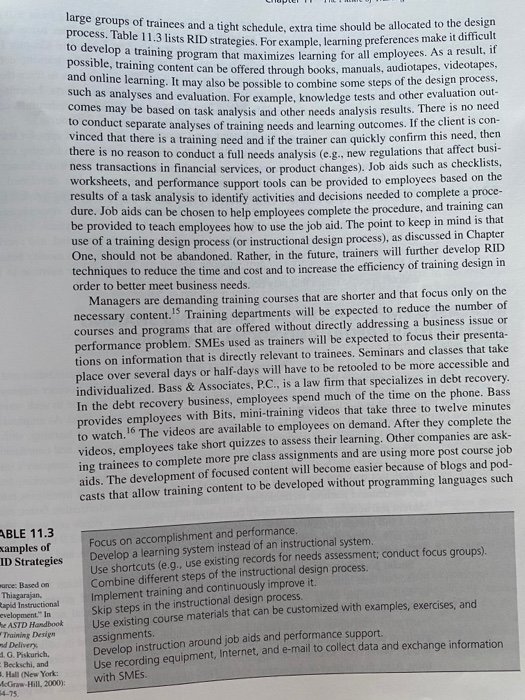
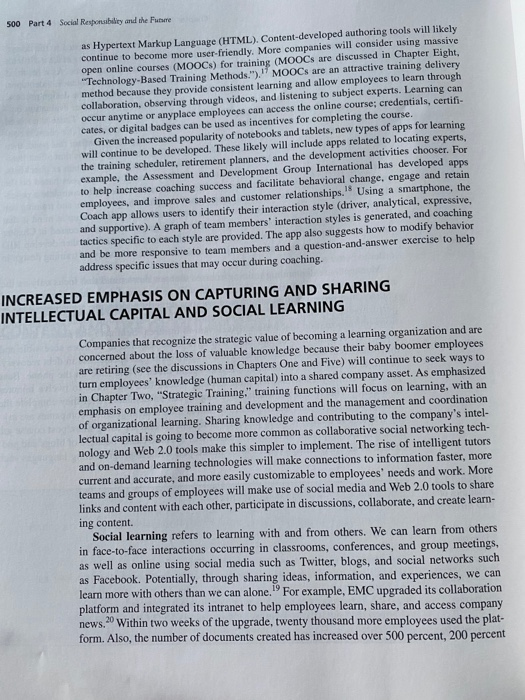
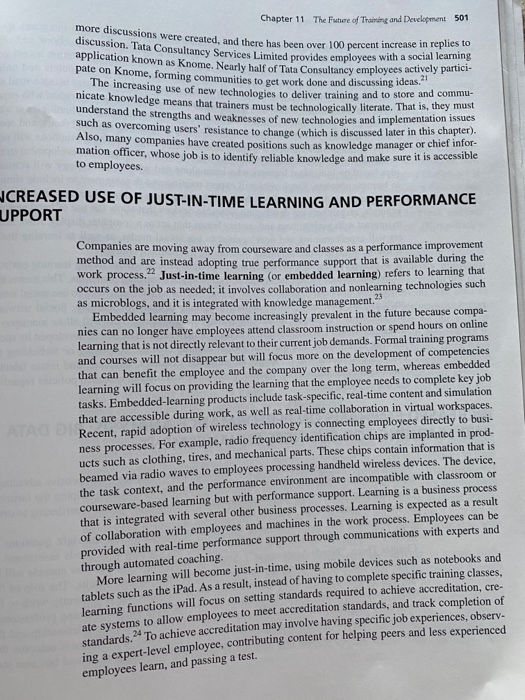
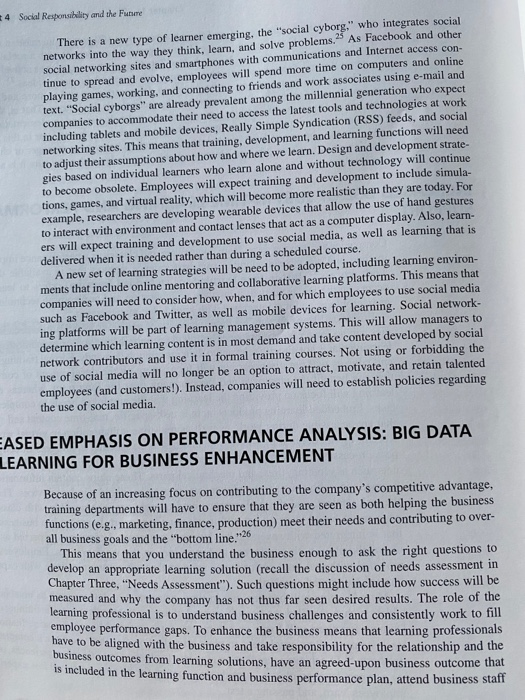
Part 4 Social Responsability and the Future Training for Sustainability Sustainability refers to a company's ability to make a profit without sacrificing the resources of its employees, the community, or the environment. A growing number of companies have made sustainability an important part of their business strategy. Train ing and development can contribute to companies' sustainability initiatives by providing learning opportunities for employees in organizations in developing countries that lack the resources, providing development experiences for employees in poor and emerging coun- tries that benefit the local community, and teaching employers to protect the environment. Consider how training at Novartis and Ingersoll Rand is helping these companies reach their sustainability goals, Novartis, the pharmaceutical company, is actively involved in improving health care in Africa by helping the fight against infectious diseases that have made life expectancy in Africa fifteen years less than the global average. The Novartis Malaria Initiative has delivered more than 500 million free treatments. To support health professionals work- ing with sick children, Novartis worked with the World Health Organization to develop e-learning for managing childhood illnesses. Alcon, the eve division of Novartis, has trained eye care professionals in Sierra Leone. Also, Novartis supports the Regional Psy- chosocial Support Initiative (REPSSI), an African-based philanthropic organization that provides emotional and psychological support to children affected by the HIV/AIDS epidemic. The company's trainers provide REPSSI's employees with leadership devel- opment training. To help meet the organization's goal of helping children and youth so that they can live with hope and dignity, REPSSI managers need training in communica- tion skills, providing feedback, intercultural skills, and project management. Novartis has transformed its corporate training programs into a form useful for REPSSI. The training content is delivered through instructor-led courses and e-learning. Novartis and training vendor partners, including business schools, send speakers at their own expense to Africa. Instructors are also available for follow-up after each course is completed. Ingersoll Rand, a global industrial company, wanted employees to understand how to reduce energy consumption and waste and to lower emissions. The company has sev- eral target goals for becoming more sustainable by 2020, including reducing greenhouse gas emissions of its operations 35 percent and a 50 percent reduction in the greenhouse gases produced by its heating, ventilation, air-conditioning, and refrigeration products To accomplish these goals, Ingersoll Rand developed the Design for Sustainability train- ing program. The training emphasizes understanding sustainability and incorporating it in product design and how to analyze and communicate the value of sustainability in product markets. Employees can receive two levels of credentials in the program. The silver level requires seven hours of self-paced online learning and focuses on understanding why Inger- soll Rand focuses on design sustainability. The gold level includes ten hours of self-paced online learning. It also includes three ninety-minute sessions led by a virtual instructor from UL Environment, a consulting firm. To receive either the silver- or gold-level certifi- cation requires employees to pass an exam. The first participants in the program included design and manufacturing engineers, product managers, and other employees working in product development. To evaluate the program, Ingersoll Rand is collecting data on the number of new products developed using materials to reduce greenhouse gases, the use of new material to reduce product weight (which reduces shipping costs and increases fuel Chapter 11 The Future of Training and Development 495 y), and employee engagement. Based on the positive feedback it received from the first participants in the program. Ingersoll Rand is planning to offer it to all employees NCREASED USE OF NEW TECHNOLOGIES FOR TRAINING DELIVERY AND INSTRUCTION TABLE 11.2 New Technological Advances That Will Influence Training The use of social media, smartphones, and other new technologies will likely increase in the future for several reasons. First, the cost of these technologies will decrease. Second, companies can use technology to better prepare employees to serve customers and genere ate new business. Third, use of these new technologies can substantially reduce the train- ing costs related to bringing geographically dispersed employees to one central training location (e.g., travel, food, and housing), Fourth, these technologies allow trainers to build into training many of the desirable features of a learning environment (e.g.. practice, feedback, reinforcement). Fifth, as companies employ more contingent employees (e.g.. part-timers and consultants) and offer more alternative work arrangements (e.g., flexible work schedules and working from home), technology will allow training to be delivered to any place and at any time. Sixth, new technologies will make it easier for training and performance support to be accessible to learners anytime and anyplace. Table 11.2 shows technological advances that will likely influence training delivery and instruction. Wearable technology is being used for consumer applications. For example, guests at Walt Disney World wear Magic Bands that substitute for their park tickets, charge cards, and hotel room keys.- MagicBands link to a phone app (My Disney Experience), which tracks groups visiting the park, allowing them to see the location of others in their group in order to arrange meeting places. Wearable bands such as FitBits allow us to track how many steps we walk each day, our heart rate before, during, and after exercise; and how many calories we burned. Smart eyewear allows images to be projected directly onto the retina of the eye. The technology takes what can be shown on a computer screen, reduces it, and projects it on the retina where it can be seen in full color. Wearables are just beginning to be developed and used for training and performance support solutions. Wear- able Intelligence provides smart eyewear technology and camera technology that gives emplovees hands-free, voice-activated access to procedures and checklists: live access to experts using tablet computers that allow data and live video sharing: the opportunity to review best practice videos before or during the performance of complex procedures Source: Based on K. Everson, "Special Report Learning is all in the wrist, Chief Learning icer (March 15, 2015). from www.clonedia .con, accessed March 18. 2015: "Overview Tin Can API," www tincanapi.com Roverview. accessed April 20, 2015: J. Food and T. Meyer. "Advances in training technology: Meeting the workplace challenges of talent development, deep specialization. and collaborative learning. In the Prychology of Workplace Technology eds. M. Coovert and L. Thompson, (New York: Routledge, 2014): 43-76. Wearables (smartwatches, bands, smart eyewear) Gamification Wireless Tablet-Based Technology Mobile Learning Augmented Reality Virtual Communications Tin Can API (or Experience API) Learning Records Store (LRS) Artificial Intelligence 6 Part 4 Social Responsibility and the Future and operations, and real-time notifications and alerts. The technology is currently being used in energy and health care. An operator who might be working on a remote oil rig or a surgeon in a sterile operating room can share live video with experts and get their advice needed to fix a broken valve or complete a medical procedure, while remaining focused on the equipment or patient. Wearable technologies can also potentially be used to provide useful needs assessment data by tracking what tasks employees perform the most. For example, a health club could track how much time fitness trainers spend in their offices, working in the gym providing personal training, or conducting group exercise classes. This helps managers and trainers identify how frequently tasks are performed, which is useful information for determining what tasks and skills should receive the most atten tion in training programs. Also, this information could be useful for evaluating if fitness trainers are spending too much time performing certain tasks, for example, administrative tasks in their offices. This could trigger further needs assessment to determine if this is a training problem. That is, fitness trainers may be spending more time on administrative tasks because they lack the sales and interpersonal skills needed to interact with custom- ers and convince them to sign up for personal training. Smartwatches, such as the Apple Watch, could be used to provide training and help make sure employees complete it. For example, an employee's smartwatch can deny them access to certain areas of a manufac- turing plant until they successfully complete a required safety compliance course. PlayerLync, a training and development software company, has developed wireless tablet-based technology. This technology shrinks video and documents with integrated, interactive messaging to miniscule sizes and delivers them quickly and automatically, even in low-bandwidth environments. Professional and college sports teams have used the tablet-based technology to develop digital playbooks and game preparation video, includ- ing the coaches' comments. This technology is beginning to be used in companies for training retail, construction, and restaurant teams. Augmented reality refers to a live direct or indirect view of a physical, real-world environment whose elements are supplemented by computer-generated sound, video, graphics, or GPS data. Augmented reality can allow a learner to enter books, magazines, and training rooms and experience them in three-dimensional form as in real life. An intel- ligent agent such as Apple's Siri can help the learner navigate their learning experience. On-demand learning and message boards allow employees to choose what they want to learn and to interact with their peers and experts. Employees will be able to see job open- ings and career paths and have the freedom to choose courses to develop the skills and knowledge required for these opportunities. They can share and communicate with peers about what they find fun and challenging in their positions. Artificial intelligence will become even more humanlike and accessible at a lower cost. Amelia is a computer who learns from textbooks, transcriptions of conversations, e-mail chains, and other texts. As long as the answer is in the data she receives, she can solve problems. She also has the ability to learn. Programmers have tried to provide her with the human ability to think. Amelia is already being tested at working in customer call centers. Customer service depends on providing the right answer to the same question, regardless of who calls. Amelia can provide the correct answer because prior to working on her own, she has worked alongside a human customer service rep, listening to every support request received and the answers given. Amelia helps automate tasks but she is not alive. How- ever, she does have three emotional states-arousal, dominance, and pleasure-that are Chapter 11 The Future of Training and Development 497 cuced by how customers communicate with her These emotions affect her decision 8th dealing with customers. Robots with artificial intelligence such as Amelia will likely provide perfe kely provide performance support increasingly in the future or entirely replace employ- ces in nonexpert repetitive jobs. The Tin Can API (or Experience API) is a specification for learning technology that makes it possible to collect data about an employee's or a team's online and face-to-face learning experiences. The Tin Can API allows the collection of data based in the reality that learning occurs everywhere using different tools and methods, including simulations, virtual worlds, serious games, social collaboration, and through real-world experiences and formal training programs. When an emplovee engages in learning, the Tin Can All sends statements in the form of a learner, an action, and an activity such as "I did this to a Learning Records Store. The Learning Records Store (LRS) collects and stores all of the learning experiences in the form of statements that can be organized and presented in a meaningful way. LRSs can communicate with each other, allowing data about learning activities to be easily shared across organizations. Also, LRSs can be accessed by learn- ing management systems and reporting tools. Employees can have their own personal lockers," which include their personal learning history. Enabled devices can automatically send Tin Can API statements when learning is ongoing and completed. The LRS can be used to show the relationship between learning experiences and business outcomes such as sales, revenue, customer satisfaction, safety, and employee engagement (recall our dis- cussion of Big Data in Chapter Six, Training Evaluation"). For example, Devereux is a nonprofit behavioral health-care organization that provides services for individuals with emotional, developmental, and educational disabilities. Devereux wanted to improve treatment outcomes for individuals served by enhancing employee performance. An LRS developed by Watershed allowed this by tracking the experiences that happen to employ- ces during training as well as during performance monitoring on the job, and correlating that experience data to the real world outcomes of individuals served The use of games and mobile learning is likely to increase as companies seek to make training fun, maximize the learning experience, and appeal to millennials and other learn- ers' expectations that learning is quick, includes short interactive lessons, is available at their fingertips, and allows them to ask their peers questions, share experiences, and seek advice. Several surveys of business and learning leaders have found that companies not currently using games for training are considering using them in the next few years and mobile learning is expected to contribute significantly to how their organizations learn in the future. 10 The gamification experience might include advanced simulations that learn- ers can explore in a three-dimensional environment. KTHROUGHS IN NEUROSCIENCE ABOUT LEARNING Advances in neuroscience are increasing researchers' ability to study the brain and its functioning. This is leading to a better understanding of how we learn which can be used to design more effective training and development programs. For example, researchers have shown that whether an idea can be easily recalled is linked to the strength of activat- ing the hippocampus, located in the lower section of the brain, during a learning task. The stronger the hippocampus is stimulated during learning, the greater the recall of the idea rt 4 Social Responsibility and the Future Further research on the hippocampus has identified the conditions that are necessary for learning to occur attention, generation, emotion, and spacing). From a training design perspective, this means that learners have to eliminate distractions, they need to make their own connections to new ideas, they need some but not overwhelming emotional stimula tion, and long-term recall of learning is better when we learn information over several dif- ferent time periods rather than all at once. Time Warner Cable Enterprises applied results of the hippocampus research to a leadership development program that included weekly videos, practice exercises, and a two-hour webinar. Learning in short, engaging bursts held managers' attention. Immediate, one-page practice tools were provided to help managers use what they saw in the videos. The entire program was spaced out over thirty days. The managers' emotions were stimulated by the communications about the sense of urgency for the program and the realization that thousands of their peers were participating in the program at the same time. There are many other areas of ongoing neuroscience research that can potentially influence training and development program design. For example, research is helping us understand the conditions that are necessary for learners to make creative insights between learning content and its application to work issues and prob- lems. Other research is investigating the biological markers of cognitive processes that are known to accelerate learning (e... self-explanation or other meaning-based processing methods), which can help us understand how feedback can be provided to learners to help them consistently use the most effective cognitive processes for learning." EASED EMPHASIS ON SPEED IN DESIGN, FOCUS ON ENT, AND USE OF MULTIPLE DELIVERY METHODS Because of new technology, trainers are being challenged to find new ways to use instruc- tional design." Shifts are taking place in who is leading the learning (from the instructor to the employee), as well as where learning is taking place (from workplace to mobile learning). For example, trainers need to determine the best way to design an effective training course for a smartphone. Despite the use of new technology for learning, the fundamental questions remain: Why is training occurring? Who is the audience? What resources are necessary so that employees can learn what they need to know? As discussed in Chapter One, "Introduction to Employee Training and Development." the traditional training design model has been criticized for several reasons. First, it is a linear approach driven by subject matter experts (SMEs). Second, the instructional sys- tem design model uses a rational, step-by-step approach that assumes that the training content is stable. Third, given the accelerated demand for training to be delivered just in time, traditional training takes too long. Rapid instructional design (RID) is a group of techniques that allows training to be built more quickly. RID modifies the training design model, which consists of needs analysis, design, development, and evaluation (recall the discussion of training design in Chapter One). There are two important principles in RID." One is that instructional content and process can be devel- oped independently of each other. The second is that resources that are devoted to design and delivery of instruction can be reallocated as appropriate. Design includes everything that happens before the training experience; delivery is what happens during the training experience. For example, if a company has limited resources for training delivery, such as large groups of trainees and a tight schedule, extra time ja be allocated to the design process. Table 11.3 lists RID strategies. For example, learning preferences to develop a training program that I es. For example, learning preferences make it difficult aining program that maximizes learning for all employees. As a result, if possible, training content can be offered through books, manuals, audiotapes, videotapes, and online learning. It may also be possible to combine some steps of the design process, such as analyses and evaluation. For example, knowledge tests and other evaluation out- comes may be based on task analysis and other needs analysis results. There is no need to conduct separate analyses of training needs and learning outcomes. If the client is con- Vinced that there is a training need and if the trainer can quickly confirm this need, then there is no reason to conduct a full needs analysis (eg, new regulations that affect busi- ness transactions in financial services, or product changes). Job aids such as checklists, worksheets, and performance support tools can be provided to employees based on the results of a task analysis to identify activities and decisions needed to complete a proce- dure. Job aids can be chosen to help employees complete the procedure, and training can be provided to teach employees how to use the job aid. The point to keep in mind is that use of a training design process (or instructional desien process), as discussed in Chapter One, should not be abandoned. Rather, in the future, trainers will further develop RID techniques to reduce the time and cost and to increase the efficiency of training design in order to better meet business needs. Managers are demanding training courses that are shorter and that focus only on the necessary content.'s Training departments will be expected to reduce the number of courses and programs that are offered without directly addressing a business issue or performance problem. SMEs used as trainers will be expected to focus their presenta tions on information that is directly relevant to trainees. Seminars and classes that take place over several days or half-days will have to be retooled to be more accessible and individualized. Bass & Associates, P.C., is a law firm that specializes in debt recovery. In the debt recovery business, employees spend much of the time on the phone. Bass provides employees with Bits, mini-training videos that take three to twelve minutes to watch. 16 The videos are available to employees on demand. After they complete the videos, employees take short quizzes to assess their learning. Other companies are ask- ine trainees to complete more pre class assignments and are using more post course iob aids. The development of focused content will become easier because of blogs and pod- casts that allow training content to be developed without programming languages such ABLE 11.3 examples of ID Strategies marce Based on Thiagarajan, Rapid Instructional evelopment." In he ASTD Handbook Training Design d Delivery 1.6. Piskurich, Beckschi, and Hall (New York: Gran Hill, 2000): 475 Focus on accomplishment and performance. Develop a learning system instead of an instructional system. Use shortcuts (e.g., use existing records for needs assessment: conduct focus groups). Combine different steps of the instructional design process. Implement training and continuously improve it. Skip steps in the instructional design process. Use existing course materials that can be customized with examples, exercises, and assignments Develop instruction around job aids and performance support equipment, Internet, and e-mail to collect data and exchange information with SMEs. 500 Part 4 Social Responsibility and the Future as Hypertext Markup Language (HTML). Content-developed authoring tools will likely continue to become more user-friendly. More companies will consider using massive open online courses (MOOCs) for training (MOOCs are discussed in Chapter Eight. "Technology-Based Training Methods.").17 MOOCs are an attractive training delivery method because they provide consistent learning and allow employees to learn through collaboration, observing through videos, and listening to subject experts. Learning can occur anytime or anyplace employees can access the online course; credentials, certin cates, or digital badges can be used as incentives for completing the course. Given the increased popularity of notebooks and tablets, new types of apps for learning will continue to be developed. These likely will include apps related to locating experts. the training scheduler, retirement planners, and the development activities chooser. For example, the Assessment and Development Group International has developed apps to help increase coaching success and facilitate behavioral change, engage and retain employees, and improve sales and customer relationships. Using a smartphone, the Coach app allows users to identify their interaction style (driver, analytical, expressive, and supportive). A graph of team members' interaction styles is generated, and coaching tacties specific to each style are provided. The app also suggests how to modify behavior and be more responsive to team members and a question-and-answer exercise to help address specific issues that may occur during coaching. INCREASED EMPHASIS ON CAPTURING AND SHARING INTELLECTUAL CAPITAL AND SOCIAL LEARNING Companies that recognize the strategic value of becoming a learning organization and are concerned about the loss of valuable knowledge because their baby boomer employees are retiring (see the discussions in Chapters One and Five) will continue to seek ways to turn employees' knowledge (human capital) into a shared company asset. As emphasized in Chapter Two, "Strategic Training." training functions will focus on learning, with an emphasis on employee training and development and the management and coordination of organizational learning. Sharing knowledge and contributing to the company's intel- lectual capital is going to become more common as collaborative social networking tech- nology and Web 2.0 tools make this simpler to implement. The rise of intelligent tutors and on-demand learning technologies will make connections to information faster, more current and accurate, and more easily customizable to employees' needs and work. More teams and groups of employees will make use of social media and Web 2.0 tools to share links and content with each other, participate in discussions, collaborate, and create learn ing content. Social learning refers to learning with and from others. We can learn from others in face-to-face interactions occurring in classrooms, conferences, and group meetings, as well as online using social media such as Twitter, blogs, and social networks such as Facebook. Potentially, through sharing ideas, information, and experiences, we can learn more with others than we can alone. For example, EMC upgraded its collaboration platform and integrated its intranet to help employees learn, share, and access company news. Within two weeks of the upgrade, twenty thousand more employees used the plat- form. Also, the number of documents created has increased over 500 percent, 200 percent Chapter 11 The Future of Training and Development 501 more discussions were created, and there has been over 100 pe ons were created, and there has been over 100 percent increase in replies to discussion. Tata Consultancy Services Limited provides emplo onsultancy Services Limited provides employees with a social learning application known as Knome. Nearly half of Tua Consultancy employees actively pa pate on Knome, forming communities to get work done and discussing uc The increasing use of new technologies to deliver training and to store and micute knowledge means that trainers must be technologically literate. That is, they understand the strengths and weaknesses of new technologies and implementation issue such as overcoming users' resistance to change (which is discussed later in this chapter). Also, many companies have created positions such as knowledge manager or chief infor mation officer, whose job is to identify reliable knowledge and make sure it is accessible to employees. nicate kn CREASED USE OF JUST-IN-TIME LEARNING AND PERFORMANCE UPPORT Companies are moving away from courseware and classes as a performance improvement method and are instead adopting true performance support that is available during the work process. Just-in-time learning (or embedded learning) refers to learning that occurs on the job as needed; it involves collaboration and nonlearning technologies such as microblogs, and it is integrated with knowledge management. Embedded learning may become increasingly prevalent in the future because compa- nies can no longer have employees attend classroom instruction or spend hours on online learning that is not directly relevant to their current job demands. Formal training programs and courses will not disappear but will focus more on the development of competencies that can benefit the employee and the company over the long term, whereas embedded learning will focus on providing the learning that the employee needs to complete key job tasks. Embedded-learning products include task-specific, real-time content and simulation that are accessible during work, as well as real-time collaboration in virtual workspaces. Recent, rapid adoption of wireless technology is connecting employees directly to busi- ness processes. For example, radio frequency identification chips are implanted in prod. ucts such as clothing, tires, and mechanical parts. These chips contain information that is beamed via radio waves to employees processing handheld wireless devices. The device, the task context, and the performance environment are incompatible with classroom or courseware-based learning but with performance support. Learning is a business process that is integrated with several other business processes. Learning is expected as a result of collaboration with employees and machines in the work process. Employees can be provided with real-time performance support through communications with experts and through automated coaching. More learning will become just-in-time, using mobile devices such as notebooks and tablets such as the iPad. As a result, instead of having to complete specific training classes. learning functions will focus on setting standards required to achieve accreditation, cre ate systems to allow employees to meet accreditation standards, and track completion of standards. 24 To achieve accreditation may involve having specific job experiences, obsery- ing a expert-level employee, contributing content for helping peers and less experienced employees learn, and passing a test. 4 Social Responsibility and the Future There is a new type of learner emerging, the social cyborg," who integrates social networks into the way they think, learn, and solve problems. As Facebook and other social networking sites and smartphones with communications and Internet access con- tinue to spread and evolve, employees will spend more time on computers and online playing games, working, and connecting to friends and work associates using e-mail and text. "Social cyborgs" are already prevalent among the millennial generation who expect companies to accommodate their need to access the latest tools and technologies at work including tablets and mobile devices, Really Simple Syndication (RSS) feeds, and social networking sites. This means that training, development, and learning functions will need to adjust their assumptions about how and where we learn. Design and development strate- gies based on individual learners who learn alone and without technology will continue to become obsolete. Employees will expect training and development to include simula- tions, games, and virtual reality, which will become more realistic than they are today. For example, researchers are developing wearable devices that allow the use of hand gestures to interact with environment and contact lenses that act as a computer display. Also, learn- ers will expect training and development to use social media, as well as learning that is delivered when it is needed rather than during a scheduled course, A new set of learning strategies will be need to be adopted, including learning environ- ments that include online mentoring and collaborative learning platforms. This means that companies will need to consider how, when, and for which employees to use social media such as Facebook and Twitter, as well as mobile devices for learning. Social network ing platforms will be part of learning management systems. This will allow managers to determine which learning content is in most demand and take content developed by social network contributors and use it in formal training courses. Not using or forbidding the use of social media will no longer be an option to attract, motivate, and retain talented employees and customers!). Instead, companies will need to establish policies regarding the use of social media. EASED EMPHASIS ON PERFORMANCE ANALYSIS: BIG DATA LEARNING FOR BUSINESS ENHANCEMENT Because of an increasing focus on contributing to the company's competitive advantage, training departments will have to ensure that they are seen as both helping the business functions (e.g., marketing, finance, production) meet their needs and contributing to over- all business goals and the "bottom line." This means that you understand the business enough to ask the right questions to develop an appropriate learning solution (recall the discussion of needs assessment in Chapter Three, "Needs Assessment"). Such questions might include how success will be measured and why the company has not thus far seen desired results. The role of the learning professional is to understand business challenges and consistently work to fill employee performance gaps. To enhance the business means that learning professionals have to be aligned with the business and take responsibility for the relationship and the business outcomes from learning solutions, have an agreed-upon business outcome that 15 included in the learning function and business performance plan, attend business stam Chapter 11 The Future of Training and Development 503 meetings and network with internal customers, and identify as a partner with with the joint goal of improving performance. omers, and identify as a partner with the business Consider how companies in three different industries expect training to influence the bottom line. The training offered a TRY company that provides transaction processing and data integration services is expected to have a direct influence on boosting custome satisfaction scores and agents' productivity, Metrics such as hours of training deliverica not as important as showing how training is contributing to customer service, productiv- ity, and profitability. Supply-chain training for Coca Cola must be tied in some way to the company's three-year business plan or it will not be sunported. At Ho-Chunk Casino in Wittenberg, Wisconsin, the director of training spends time educating managers on how the training unit adds value to the business. One of the director's biggest challenges is convincing first-line supervisors to support transfer of training. The training director has found that explaining Kirkpatrick's evaluation model (reaction, learning, behavior, results) to the supervisors helps them understand that training is a process, not an event, and man they play an important role in determining the success or failure of training. (Kirkpatrick's model is discussed in more detail in Chapter Six.) Training departments must shift the focus from training as the solution to business problems to a performance analysis approach. A performance analysis approach involves identifying performance gaps or deficiencies and examining training as one pose sible solution for the business units (the customers). Training departments will need to continue instructing managers to consider all potential causes of poor performance before deciding that training is the solution. Poor employee performance may be due to poor management, inefficient technologies, or outdated technology rather than deficiencies in skill or knowledge (recall the discussion of person analysis in Chapter Three). Three ways that training departments will need to be involved are (1) focusing on interventions related to performance improvement, (2) providing support for high-performance work systems, and (3) developing systems for training administration, development, and delivery that reduce costs and increase employees' access to learning. Training departments' responsibilities will likely include a greater focus on systems that employees can use for information (such as expert systems or electronic performance support systems) on an as-needed basis. This need is driven by the use of contingent employees and the increased flexibility necessary to adapt products and services to meet customers' needs. For example, companies do not want to spend money to train employees who may be with the company only a few weeks. Instead, through temporary employment agencies, companies can select employees with the exact skill set needed. Training depart- ments need to provide mechanisms to support the temporary employees once they are on the iob and encounter situations, problems, rules, and policies they are unfamiliar with because they are not yet knowledgeable about the company. As was discussed in Chapter One, more companies are striving to create high- nerformance workplaces because of the productivity gains that can be realized through this tune of design. High-performance work requires that employees have the interner sonal skills necessary to work in teams. High-performance work systems also require employees to have high levels of technical skills. Employees need to understand statistical process control and the Total Quality Management (TOM) philosophy. Employees also must understand the entire production and service system so that they can better serve + 4 Social Responsibility and the Future both internal and external customers. As more companies move to high-performance work systems, training departments will need to be prepared to provide effective training in interpersonal, quality, and technical skills, as well as to help employees understand all aspects of the customer-service or production system. Business competitiveness can be realized by quick change, speed in delivery, and reductions in costs and time constraints. LPL Financial uses a talent development coun- cil, composed of company leaders from across the company's functional areas, to evalu- ate new learning and requested learning based on its talent strategy. The group meets once a month to ensure that learning is provided by the learning department only when it is necessary. Because the council includes only senior-level managers, it helps align learning with the business strategy and outcomes. For learning to be approved, it has to support both the business and the employees. Establishing the talent council has helped get company leaders more involved in developing an overall business learning strategy and managers encourage employees to use available learning resources and programs for development. Just-in-time learning is many companies' answer to quick learning and the quick appli- cation of learning to the business." La Quinta's Q-Tubes are short, e-learning courses. The Q-Tubes use conversational language to make trainees feel as if they are being trained by their peers or a team leader. Each Q-Tube includes a knowledge check and provides feedback. Training completion rates have increased 92 percent for general managers and 484 percent for team members since the Q-Tubes were introduced. American Express designs its learning paths around behavioral outcomes and emphasizes the importance of how learners engage in learning, not just what they are supposed to learn. A learning path usually includes workshops, peer learning, and on-the-job learning. Also, American Express emphasizes teaching employees how to best participate in activities to maximize their learning. Because the direction in training is away from learning as the primary outcome and more toward learning as a way to enhance business performance, companies will continue to purchase learning management systems (LMS) that provide training administration, development tools, and online training. (LMSs are discussed in Chapter Eight.) LMS is moving from its historical emphasis on providing and track training to a broader focus on talent management. This means that LMS will include more career planning tools that will connect employees with many different development resources, including mentors, skills requirements for jobs, potential mentors, and competency models. LMS can also include performance evaluations that can be used by employees and managers to identify skill gaps. Also there will be increased demand for LMS software that includes learning analytics, or analysis tools, that can track learning activity and costs and can relate learning results to product revenues or sales goals." Today, most companies own their own software and hardware and keep them on site in their facilities. However, cloud computing allows companies to lease software and hard- ware, and employees don't know the location of computers, databases, and applications that they are using this is known as being in the cloud"). Cloud computing refers to a computing system that provides information technology infrastructure over a network in a self-service, modifiable, and on-demand. Clouds can be delivered on-demand via the Internet (public cloud) or restricted to use by a single company (private cloud). Cloud computing gives companies and their employeeg access to application and information









 Study Help