







Question: E 1 1 A Q1. a. Suppose that a TCP sender sends only five packets with SEQ=85, SEQ=95, SEQ=115, SEQ=125, SEQ=95 i. What is the
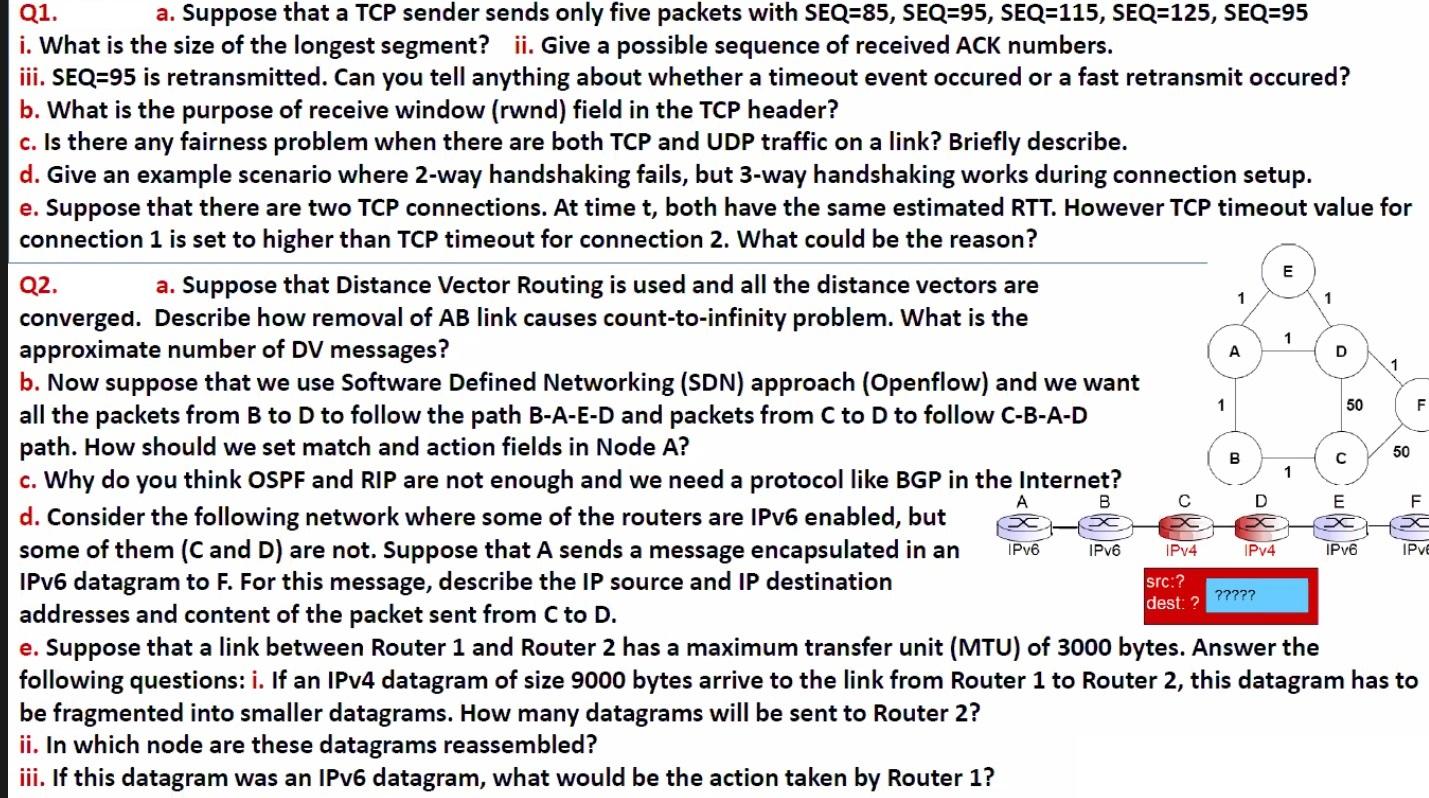
E 1 1 A Q1. a. Suppose that a TCP sender sends only five packets with SEQ=85, SEQ=95, SEQ=115, SEQ=125, SEQ=95 i. What is the size of the longest segment? ii. Give a possible sequence of received ACK numbers. iii. SEQ=95 is retransmitted. Can you tell anything about whether a timeout event occured or a fast retransmit occured? b. What is the purpose of receive window (rwnd) field in the TCP header? c. Is there any fairness problem when there are both TCP and UDP traffic on a link? Briefly describe. d. Give an example scenario where 2-way handshaking fails, but 3-way handshaking works during connection setup. e. Suppose that there are two TCP connections. At time t, both have the same estimated RTT. However TCP timeout value for connection 1 is set to higher than TCP timeout for connection 2. What could be the reason? Q2. a. Suppose that Distance Vector Routing is used and all the distance vectors are converged. Describe how removal of AB link causes count-to-infinity problem. What is the approximate number of DV messages? b. Now suppose that we use Software Defined Networking (SDN) approach (Openflow) and we want all the packets from B to D to follow the path B-A-E-D and packets from C to D to follow C-B-A-D path. How should we set match and action fields in Node A? c. Why do you think OSPF and RIP are not enough and we need a protocol like BGP in the Internet? d. Consider the following network where some of the routers are IPv6 enabled, but some of them (C and D) are not. Suppose that A sends a message encapsulated in an IPv6 datagram to F. For this message, describe the IP source and IP destination addresses and content of the packet sent from C to D. e. Suppose that a link between Router 1 and Router 2 has a maximum transfer unit (MTU) of 3000 bytes. Answer the following questions: i. If an IPv4 datagram of size 9000 bytes arrive to the link from Router 1 to Router 2, this datagram has to be fragmented into smaller datagrams. How many datagrams will be sent to Router 2? ii. In which node are these datagrams reassembled? iii. If this datagram was an IPv6 datagram, what would be the action taken by Router 1? 1 50 F B 50 A B D E F IPv6 IPV6 IPv4 IPv4 IPv6 IPVE src:? 77777 dest: ? E 1 1 A Q1. a. Suppose that a TCP sender sends only five packets with SEQ=85, SEQ=95, SEQ=115, SEQ=125, SEQ=95 i. What is the size of the longest segment? ii. Give a possible sequence of received ACK numbers. iii. SEQ=95 is retransmitted. Can you tell anything about whether a timeout event occured or a fast retransmit occured? b. What is the purpose of receive window (rwnd) field in the TCP header? c. Is there any fairness problem when there are both TCP and UDP traffic on a link? Briefly describe. d. Give an example scenario where 2-way handshaking fails, but 3-way handshaking works during connection setup. e. Suppose that there are two TCP connections. At time t, both have the same estimated RTT. However TCP timeout value for connection 1 is set to higher than TCP timeout for connection 2. What could be the reason? Q2. a. Suppose that Distance Vector Routing is used and all the distance vectors are converged. Describe how removal of AB link causes count-to-infinity problem. What is the approximate number of DV messages? b. Now suppose that we use Software Defined Networking (SDN) approach (Openflow) and we want all the packets from B to D to follow the path B-A-E-D and packets from C to D to follow C-B-A-D path. How should we set match and action fields in Node A? c. Why do you think OSPF and RIP are not enough and we need a protocol like BGP in the Internet? d. Consider the following network where some of the routers are IPv6 enabled, but some of them (C and D) are not. Suppose that A sends a message encapsulated in an IPv6 datagram to F. For this message, describe the IP source and IP destination addresses and content of the packet sent from C to D. e. Suppose that a link between Router 1 and Router 2 has a maximum transfer unit (MTU) of 3000 bytes. Answer the following questions: i. If an IPv4 datagram of size 9000 bytes arrive to the link from Router 1 to Router 2, this datagram has to be fragmented into smaller datagrams. How many datagrams will be sent to Router 2? ii. In which node are these datagrams reassembled? iii. If this datagram was an IPv6 datagram, what would be the action taken by Router 1? 1 50 F B 50 A B D E F IPv6 IPV6 IPv4 IPv4 IPv6 IPVE src:? 77777 dest
Step by Step Solution
There are 3 Steps involved in it

Get step-by-step solutions from verified subject matter experts
 Study Help