







Question: Getting and Inside Look: Given Imaging Pills Conduct a detailed SWOT anslysis and include macroeconomic issues (techhnology/political/ demographics/ social / issues.) In your financial analysis
"Getting and Inside Look: Given Imaging Pills"
Conduct a detailed SWOT anslysis and include macroeconomic issues (techhnology/political/ demographics/
social / issues.)
In your financial analysis pay attention to the following ratios:
profit ratios - return on invested capital- net profit/invested capital return on total assets- net profit/tptal assets
Liquidity ratios - current ratio - current assets/ current liabilities Quick ratio = current asssets-inventory /current liabilities
Leverage ratios - debt to assets = total debt / total assets debt to Equity = total debt / total equity
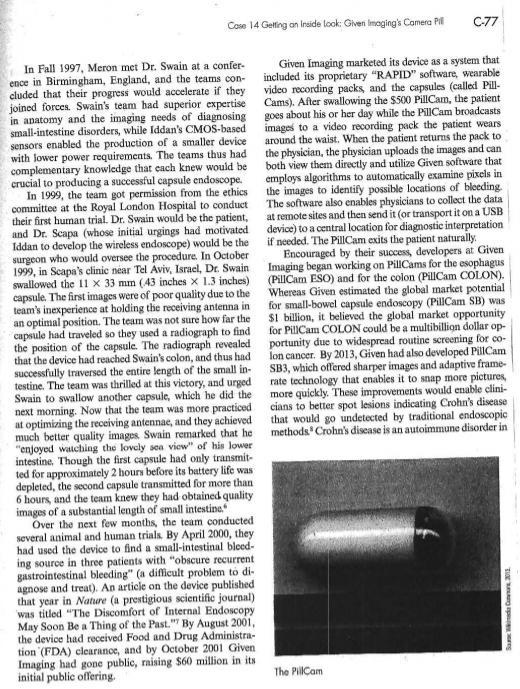
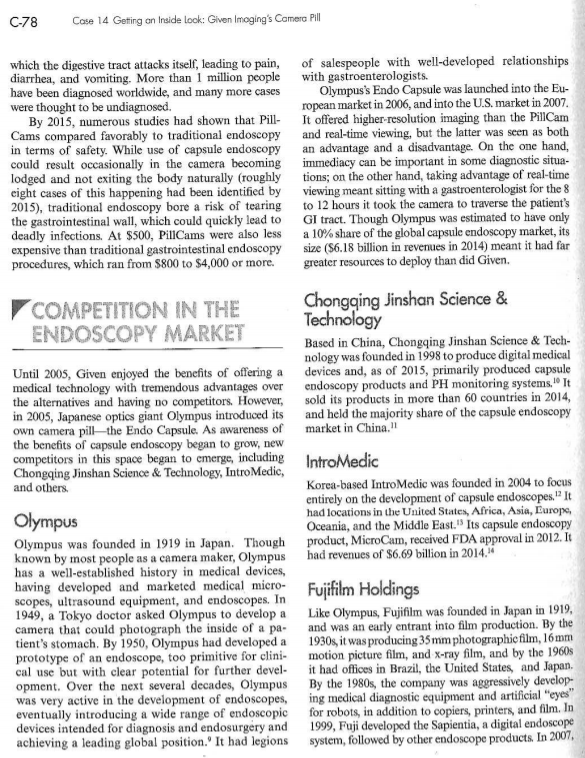
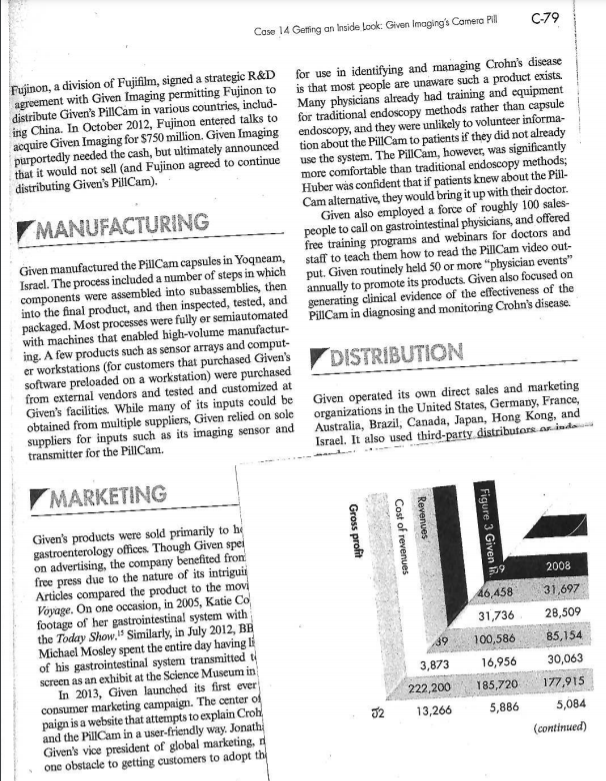
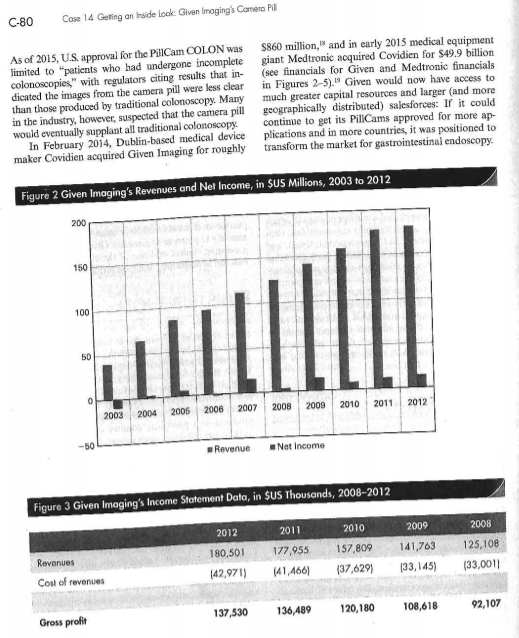
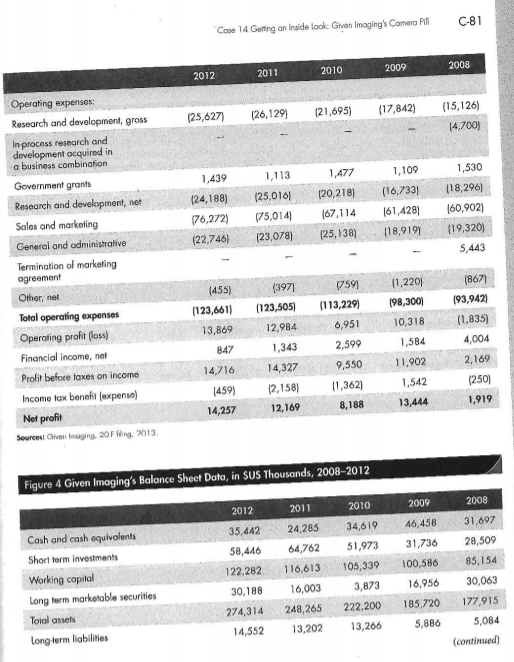
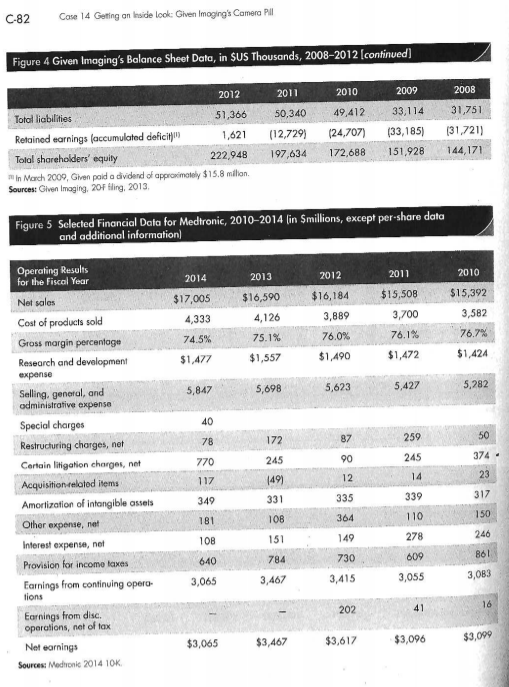
co 14 CASE # 249 210 GETTING AN INSIDE LOOK: GIVEN IMAGING'S CAMERA PILL THE HISTORY OF THE CAMERA PILL Founded in 1998, Given Imaging is an Israeli medical- device company that developed the "camera pill" - a tiny, capsule-shaped electronic device that, after being swallowed by a patient, sends visual images of the gastrointestinal tract to a video pack worn around the patient's waist. These images can be eval- uated to diagnose numerous small-intestine prob- lems that have been hitherto very difficult to locate and diagnose Though Given's product offered numerous ad- vantages in terms of both effectiveness and patient comfort, it was somewhat difficult to get doctors to adopt the product. Many physicians and hospitals already had the equipment and training required for traditional endoscopy techniques, and were also risk averse about trying the new method. Analysts won- dered if Given would be able to overcome physicians' aversion and reluctance to switching costs. Further complicating matters, new competitors had emerged: Japanese camera companies were developing their own camera pills, some with intriguing special fea- tures that Given's system did not possess. The race was on: How fast would the market emerge, and who would end up as leader? Gavriel Iddan was an electro-optical engineer at Israel's Rafael Armament Development Authority, the Israeli authority for the development of weapons and military technology. One of Iddan's projects was to develop the "eye" that leads a guided missile to its target. In 1981, Iddan traveled to Boston on sabbati- cal to work for a company that produced X-ray tubes and ultrasonic probes. While there, he befriended a gastroenterologist (a physician who focuses on diges- tive diseases), Eitan Scapa. During long conversations in which they discussed their respective fields, Scapa taught Iddan about the technologies used to view the interior lining of the digestive system. Scapa pointed out that the existing technologies had a number of sig- nificant limitations, particularly with respect to view- ing the small intestine.? The small intestine is the locale of a number of serious disorders. In the United States alone, approximately 19 million people suffer from disorders of the small intestine (including bleeding, C-75' C.76 Case 14 Gelling an Inside Look: Given Imaging's Camera Pili Crohn's disease, celiac disease, chronic diarrhea, without a lifeline leading to the outside of the body. irritable bowel syndrome, and small-bowel cancer). Like the missiles Iddan developed at Rafael, this de- Furthermore, the nature of the small intestine makes it vice would have a camera "eye." If designed well, the difficult to diagnose and treat such disorders. The small body's natural peristaltic action would propel the intestine (or small bowel") is about 5 to 6 meters long camera through the length of the intestine. in a typical person and is full of twists and turns (see When Iddan returned to Israel, he began working on Figure 1). X-rays do not enable a physician to view the a way to have a very small CCD camera introduced into lining of the intestine, and endoscopes (small cameras the digestive system and transmit images wirelessly to attached to long, thin, flexible poles) can only reach a receiver outside of the body. Initially unsure whether the first third of the small intestine and can be quite images could be transmitted through the body wall, uncomfortable for the patient. The remaining option, he conducted a rudimentary experiment with a store- surgery, is very invasive and can be impractical if the bought chicken. He placed a transmitting antenna in- physician does not know which part of the small intes- side the chicken and a receiving antenna outside of it. tine is affected. Scapa thus urged Iddan to come up The results indicated that it was possible to transmit with a better way to view the small intestine, but at that a clear video image. Encouraged by this, he set about time Iddan had no idea how to do it. overcoming the battery-life problem: The CCD sensors Ten years later, Iddan visited the United States consumed so much energy that their batteries were of again, and his old friend Scapa again inquired ten depleted within 10 minutes. Fortunately, advance- whether there was a technological solution that would ments in semiconductors promised to replace CCD im. provide a better solution for viewing the small intes- agers with a new generation of complementary metal tine. By this time, very small charge-coupled device oxide semiconductors (CMOS), which would consume (CCD) image sensors had been developed in the quest a fraction of the power of OCD imagers. Iddan began to build small videocameras. Iddan wondered if per- developing a prototype based on CMOS technology, haps it would be possible to create a very small, mis- and applied for an initial patent on the device in 1994 silelike device that could travel through the intestine In 1995, he presented his product idea to Gavriel Mer- on, CEO of Applitect Ltd., a company that made small, endoscopic cameras. Meron thought the project was a Figure 1 The Gastrointestinal Tract fascinating idea and founded Given Imaging ("Gi" for gastrointestinal, "v" for video, and "en" for endoscopy) to develop and market the technology. Unbeknownst to Iddan or Meron, a team of sci- entists in the United Kingdom was also working on a method for wireless endoscopy. This team included a physician, C. Paul Swain, a bioengineer, Tim Mills, and a doctoral student, Feng Gong. Swain, Mills, and Gong were exploring using commercially available miniature videocameras and processors. They scout- ed out miniature camera technology at "spy shops" in London that supplied small video cameras and transmitters to private detectives and other users? By 1994, they were developing crude devices to see if they could transmit moving images from within the gut using microwave frequencies. By 1996, they had succeeded in their first live animal trial. They surgi- cally inserted their prototype device into a pig's stom- ach, and demonstrated that they could see the pylorus valve of the stomach open and close. Their next hur dle was to develop a device that could be swallowed instead of being surgically inserted. Od Gary Two Cole Bu canding Color AC Aley Com 14 Gelfing an Inside look: Given Imaging Camera Pil C-77 In Fall 1997, Meron met Dr. Swain at a confer- ence in Birmingham, England, and the teams con- cluded that their progress would accelerate if they joined forces. Swain's team had superior expertise in anatomy and the imaging needs of diagnosing small intestine disorders, while Iddan's CMOS-based sensors enabled the production of a smaller device with lower power requirements. The teams thus had complementary knowledge that cach knew would be crucial to producing a successful capsule endoscope. In 1999, the team got permission from the ethics committee at the Royal London Hospital to conduct their first human trial. Dr. Swain would be the patient, and Dr. Scapa (whose initial urgings had motivated Iddan to develop the wireless endoscope) would be the surgeon who would oversee the procedure. In October 1999, in Scapa's clinic near Tel Aviv, Israel, De Swain swallowed the 11 x 33 mm (43 inches x 1.3 inches) capsule. The first images were of poor quality due to the team's inexperience at holding the receiving antenna in an optimal position. The team was not sure how far the capsule had traveled so they used a radiograph to find the position of the capsule. The radiograph revealed that the device had reached Swain's colon, and thus had successfully traversed the entire length of the small in- testine. The team was thrilled at this victory, and urged Swain to swallow another capsule, which he did the next morning. Now that the team was more practiced at optimizing the receiving antennae, and they achieved much better quality images. Swain remarked that he "enjoyed watching the lovely son viow" of his lower intestine. Though the first capsule had only transmit- ted for approximately 2 hours before its battery life was depleted, the second capsule transmitted for more than 6 hours, and the team knew they had obtained quality images of a substantial length of small intestine. Over the next few months, the team conducted several animal and human trials. By April 2000, they had used the device to find a small intestinal bleed- ing source in three patients with "obscure recurrent gastrointestinal bleeding" (a difficult problem to di agnose and treat). An article on the device published that year in Nature (a prestigious scientific journal) was titled "The Discomfort of Internal Endoscopy May Soon Be a Thing of the Past." By August 2001, the device had received Food and Drug Administra- tion (FDA) clearance, and by October 2001 Given Imaging had gone public, raising $60 million in its initial public offering Given Imaging marketed its device as a system that included its proprietary "RAPID" software, wearable video recording packs, and the capsules (called Pill- Cams). After swallowing the $500 PillCam, the patient goes about his or her day while the PillCam broadcasts images to a video recording pack the patient wears around the waist. When the patient returns the pack to the physician, the physician uploads the images and can both view them directly and utilize Given software that employs algorithms to automatically examine pixels in the images to identify possible locations of bleeding. The software also enables physicians to collect the data at remote sites and then send it (or transport it on a USB device) to a central location for diagnostic interpretation if needed. The PillCam exits the patient naturally Encouraged by their success, developers at Given Imaging began working on PillCams for the esophagus (PillCam ESO) and for the colon (PillCam COLON). Whereas Given estimated the global market potential for small-bowel capsule endoscopy (PillCam SB) was $1 billion, it believed the global market opportunity for PillCam COLON could be a multibillion dollar op- portunity due to widespread routine screening for co- lon cancer. By 2013, Given had also developed PillCam SB3, which offered sharper images and adaptive frame- rate technology that enables it to snap more pictures, more quickly. These improvements would enable clini- cians to better spot lesions indicating Crohn's disease that would go undetected by traditional endoscopic methods. "Crohn's disease is an autoimmune disorder in SCL The PillCom C-78 Case 14 Getting on Inside Lock: Given Imaging's Camera Pill which the digestive tract attacks itself, leading to painof salespeople with well-developed relationships diarrhea, and vomiting. More than 1 million people with gastroenterologists. have been diagnosed worldwide, and many more cases Olympus's Endo Capsule was launched into the Eu- were thought to be undiagnosed. ropean market in 2006, and into the U.S. market in 2007. By 2015, numerous studies had shown that Pill It offered higher resolution imaging than the PillCam Cams compared favorably to traditional endoscopy and real-time viewing, but the latter was seen as both in terms of safety. While use of capsule endoscopy an advantage and a disadvantage. On the one hand, could result occasionally in the camera becoming immediacy can be important in some diagnostic situa- lodged and not exiting the body naturally (roughly tions; on the other hand, taking advantage of real-time eight cases of this happening had been identified by viewing meant sitting with a gastroenterologist for the 8 2015), traditional endoscopy bore a risk of tearing to 12 hours it took the camera to traverse the patient's the gastrointestinal wall, which could quickly lead to GI tract. Though Olympus was estimated to have only deadly infections. At $500, PillCams were also less a 10% share of the global capsule endoscopy market, its expensive than traditional gastrointestinal endoscopy size ($6.18 billion in revenues in 2014) meant it had far procedures, which ran from $800 to $4,000 or more greater resources to deploy than did Given. COMPETITION IN THE Chongqing Jinshan Science & ENDOSCOPY MARKET Technology Based in China, Chongqing Jinshan Science & Tech- nology was founded in 1998 to produce digital medical Until 2005, Given enjoyed the benefits of offering a devices and, as of 2015, primarily produced capsule medical technology with tremendous advantages over endoscopy products and PH monitoring systems. It the alternatives and having no competitors. However, sold its products in more than 60 countries in 2014, in 2005, Japanese optics giant Olympus introduced its and held the majority share of the capsule endoscopy own camera pill-the Endo Capsule. As awareness of market in China." the benefits of capsule endoscopy began to grow, new competitors in this space began to emerge, including Intro Medic Chongqing Jinshan Science & Technology, Intro Medic, and others Korca-based Intro Medic was founded in 2004 to focus entirely on the development of capsule endoscopes. It Olympus had locations in the United States, Africa, Asia, Europe Oceania, and the Middle East." Its capsule endoscopy Olympus was founded in 1919 in Japan. Though product, MicroCam, received FDA approval in 2012. It known by most people as a camera maker, Olympus had revenues of $6.69 billion in 2014. has a well-established history in medical devices, having developed and marketed medical micro- Fujifilm Holdings 1949, a Tokyo doctor asked Olympus to develop a Like Olympus, Fujifilm was founded in Japan in 1919, camera that could photograph the inside of a pa- and was an early entrant into film production. By the tient's stomach. By 1950, Olympus had developed a 1930s, it was producing 35mm photographicfilm, 16mm prototype of an endoscope, too primitive for clini- motion picture film, and X-ray film, and by the 1960s cal use but with clear potential for further devel- it had offices in Brazil, the United States, and Japan. opment. Over the next several decades, Olympus By the 1980s, the company was aggressively develop- was very active in the development of endoscopes, ing medical diagnostic equipment and artificial Weyes" eventually introducing a wide range of endoscopic for robots, in addition to copiers, printers, and film. In devices intended for diagnosis and endosurgery and 1999, Fuji developed the Sapientia, a digital endoscope achieving a leading global position. It had legions system, followed by other endoscope products. In 2007, C.79 Case 14 Geting an Inside Look: Given imaging's Camera Pill Fujinon, a division of Fujifilm, signed a strategic R&D agreement with Given Imaging permitting Fujinon to distribute Given's PillCam in various countries, includ- ing China. In October 2012, Fujinon entered talks to acquire Given Imaging for $750 million. Given Imaging purportedly needed the cash, but ultimately announced that it would not sell (and Fujinon agreed to continue distributing Given's PillCam). for use in identifying and managing Crohn's disease is that most people are unaware such a product exists. Many physicians already had training and equipment for traditional endoscopy methods rather than capsule endoscopy, and they were unlikely to volunteer informa- tion about the PillCam to patients if they did not already use the system. The PillCam, however, was significantly more comfortable than traditional endoscopy methods; Huber was confident that if patients knew about the Pill- Cam alternative, they would bring it up with their doctor. Given also employed a force of roughly 100 sales- people to call on gastrointestinal physicians, and offered free training programs and webinars for doctors and staff to teach them how to read the PillCam video out- put. Given routinely held 50 or more "physician events" annually to promote its products. Given also focused on generating clinical evidence of the effectiveness of the PillCum in diagnosing and monitoring Crohn's disease. MANUFACTURING Given manufactured the PillCam capsules in Yoqneam, Israel. The process included a number of steps in which components were assembled into subassemblies, then into the final product, and then inspected, tested, and packaged. Most processes were fully er semiautomated with machines that enabled high-volume manufactur- ing. A few products such as sensor arrays and comput- er workstations (for customers that purchased Given's software preloaded on a workstation) were purchased from external vendors and tested and customized at Given's facilities. While many of its inputs could be obtained from multiple suppliers, Given relied on sole suppliers for inputs such as its imaging sensor and transmitter for the PillCam. DISTRIBUTION Given operated its own direct sales and marketing organizations in the United States, Germany, France, Australia, Brazil, Canada, Japan, Hong Kong, and Israel. It also used third-party distributors.or.id MARKETING Gross profit Cost of revenues Revenues Figure 3 Given in 2008 46,458 99 Given's products were sold primarily to h gastroenterology offices. Though Given spel on advertising, the company benefited from free press due to the nature of its intrigui Articles compared the product to the movi Voyage. On one occasion, in 2005, Katie Co footage of her gastrointestinal system with the Today Show. Similarly, in July 2012, BB Michael Mosley spent the entire day having li of his gastrointestinal system transmitted screen as an exhibit at the Science Museum in In 2013, Given launched its first ever consumer marketing campaign. The center of paign is a website that attempts to explain Crohy and the Pillam in a user-friendly way. Jonath Given's vice president of global marketing, one obstacle to getting customers to adopt thi 3,873 222,200 13,266 31,736 100,586 16,956 185,720 5,886 31,697 28,509 85,154 30,063 177,915 5,084 (continued) 02 C-80 Cose 14 Getting on Inside Look Given Imaging Camera P1 As of 2015, US approval for the PillCam COLON was limited to "patients who had undergone incomplete colonoscopies" with regulators citing results that in- dicated the images from the camera pill were less clear than those produced by traditional colonoscopy. Many in the industry, however, suspected that the camera pill would eventually supplant all traditional colonoscopy. In February 2014, Dublin-based medical device maker Covidien acquired Given Imaging for roughly $860 million, and in early 2015 medical equipment giant Medtronic acquired Covidien for $49.9 billion (see financials for Given and Medtronic financials in Figures 2-5). Given would now have access to much greater capital resources and larger (and more geographically distributed) salesforces: If it could continue to get its PillCams approved for more ap- plications and in more countries, it was positioned to transform the market for gastrointestinal endoscopy. Figure 2 Given Imaging's Revenues and Net Income, in SUS Millions, 2003 to 2012 200 150 100 50 0 2008 2009 2010 2011 2012 2006 2007 2004 2005 2003 Revenue Not Income Figure 3 Given Imaging's Income Statement Data, in $US Thousands, 2008-2012 2011 2010 2009 2012 2008 141,763 180,501 42,971) Revenues 177,955 (41,466) 157,809 (37,6291 125,108 (33,0011 133,145) Cost of revenues 136,489 137,530 120,180 108,618 92, 107 Gross profit C-81 Cose 14 Getting on Inside look. Given Imaging Camera Pih 2010 2011 2009 2008 2012 (26,129) (25,627) (21,695) (17,842) (15,126) 14,700) 1,477 1,439 (24,188) (76,272) (22,746) 1,113 (25,016) 175,014 (23,078) (20,218) 167,114 125,138) 1,109 (16,733) (61,4281 118,9191 1,530 118,2961 (60,9021 119,320) 5,443 Operating expenses Research and development, gross In process research and development acquired in a business combination Government grants Research and development, net Sales and marketing General and administrative Termination of marketing agreement Other, net Total operating expenses Operating profit (los) Financial income, net Profit before taxes on incomo Income tax benefit (expense) Net profit Sources Give rogina, 20Filing, 2013. 1867) (3971 193,942) (455) 1123,6611 13,869 847 14716 (459) 14,257 (123,505) 12,984 1,343 (1,835) 4,004 (1,220) 198,3001 10,318 1,584 11.902 1,542 13,444 17591 (113,229) 6,951 2,599 9,550 11,362) 8,188 2,169 14,327 12,158) 12, 169 (250) 1,919 Figure 4 Given Imaging's Balance Sheet Data, in SUS Thousands, 2008-2012 2010 2009 2008 2012 46,458 35,442 31,736 58,446 34,619 51,973 105,339 3,873 31,697 28,509 85,154 30,063 100,586 2011 24,285 64,762 116,613 16,003 248,265 13,202 Cash and cash equivalents Short term investments Working capital Long term marketable securities Total assets Long term liabilities 122.282 30,188 16,956 185.720 5,886 274,314 222,200 13,266 177,915 5,084 (continued) 14,552 C-82 Cose 14 Getting on Inside look: Given Imaging Camera Pill Figure 4 Given Imaging's Balance Sheet Data, in $US Thousands, 2008-2012 [continued] 2012 2011 2010 2009 2008 50,340 33,114 Total liabilities 51,366 Retoined earnings (accumulated deficit 1,621 Tolal shareholders' equity 222,948 in March 2009, Glen paid a dividend of approximately $15.8 milion. Sources: Given imaging, 20F fling, 2013, (12,729) 197,634 49,412 (24,707) 172,688 (33,185) 151,928 31,751 (31,721) 144,171 Figure 5 Selected Financial Data for Medtronic, 2010-2014 lin Smillions, except per-share data and additional information 2014 2013 2012 2010 2011 $16,590 $16,184 $15,508 $17,005 $15,392 4,333 3,889 3,582 4,126 75.1% 3,700 76.1% 74.5% 76.7% 76.0% $1,490 $1,477 $1,557 $1,472 $1,424 5,847 5,698 5,623 5,427 5,282 40 78 172 87 50 259 770 90 374 - 245 245 Operating Results for the Fiscal Year Net sales Cost of products sold Gross margin percentage Research and development expense Selling, general, and administrative expense Special charges Restructuring charges, net Certain litigation charges, net Acquisition celotod items Amortization of intangible assets Other expense, net Interest expense, not Provision for income taxes Earnings from continuing opero tions Earnings from disc operations, net of tax Net earnings SourcesMedtronic 2014 10K 14 12 23 117 (49) 349 331 335 317 339 10B 181 364 150 110 278 108 246 151 149 640 784 730 861 609 3,065 3,467 3,415 3,055 3,083 202 41 16 $3,065 $3,617 $3,099 $3,467 $3,096 co 14 CASE # 249 210 GETTING AN INSIDE LOOK: GIVEN IMAGING'S CAMERA PILL THE HISTORY OF THE CAMERA PILL Founded in 1998, Given Imaging is an Israeli medical- device company that developed the "camera pill" - a tiny, capsule-shaped electronic device that, after being swallowed by a patient, sends visual images of the gastrointestinal tract to a video pack worn around the patient's waist. These images can be eval- uated to diagnose numerous small-intestine prob- lems that have been hitherto very difficult to locate and diagnose Though Given's product offered numerous ad- vantages in terms of both effectiveness and patient comfort, it was somewhat difficult to get doctors to adopt the product. Many physicians and hospitals already had the equipment and training required for traditional endoscopy techniques, and were also risk averse about trying the new method. Analysts won- dered if Given would be able to overcome physicians' aversion and reluctance to switching costs. Further complicating matters, new competitors had emerged: Japanese camera companies were developing their own camera pills, some with intriguing special fea- tures that Given's system did not possess. The race was on: How fast would the market emerge, and who would end up as leader? Gavriel Iddan was an electro-optical engineer at Israel's Rafael Armament Development Authority, the Israeli authority for the development of weapons and military technology. One of Iddan's projects was to develop the "eye" that leads a guided missile to its target. In 1981, Iddan traveled to Boston on sabbati- cal to work for a company that produced X-ray tubes and ultrasonic probes. While there, he befriended a gastroenterologist (a physician who focuses on diges- tive diseases), Eitan Scapa. During long conversations in which they discussed their respective fields, Scapa taught Iddan about the technologies used to view the interior lining of the digestive system. Scapa pointed out that the existing technologies had a number of sig- nificant limitations, particularly with respect to view- ing the small intestine.? The small intestine is the locale of a number of serious disorders. In the United States alone, approximately 19 million people suffer from disorders of the small intestine (including bleeding, C-75' C.76 Case 14 Gelling an Inside Look: Given Imaging's Camera Pili Crohn's disease, celiac disease, chronic diarrhea, without a lifeline leading to the outside of the body. irritable bowel syndrome, and small-bowel cancer). Like the missiles Iddan developed at Rafael, this de- Furthermore, the nature of the small intestine makes it vice would have a camera "eye." If designed well, the difficult to diagnose and treat such disorders. The small body's natural peristaltic action would propel the intestine (or small bowel") is about 5 to 6 meters long camera through the length of the intestine. in a typical person and is full of twists and turns (see When Iddan returned to Israel, he began working on Figure 1). X-rays do not enable a physician to view the a way to have a very small CCD camera introduced into lining of the intestine, and endoscopes (small cameras the digestive system and transmit images wirelessly to attached to long, thin, flexible poles) can only reach a receiver outside of the body. Initially unsure whether the first third of the small intestine and can be quite images could be transmitted through the body wall, uncomfortable for the patient. The remaining option, he conducted a rudimentary experiment with a store- surgery, is very invasive and can be impractical if the bought chicken. He placed a transmitting antenna in- physician does not know which part of the small intes- side the chicken and a receiving antenna outside of it. tine is affected. Scapa thus urged Iddan to come up The results indicated that it was possible to transmit with a better way to view the small intestine, but at that a clear video image. Encouraged by this, he set about time Iddan had no idea how to do it. overcoming the battery-life problem: The CCD sensors Ten years later, Iddan visited the United States consumed so much energy that their batteries were of again, and his old friend Scapa again inquired ten depleted within 10 minutes. Fortunately, advance- whether there was a technological solution that would ments in semiconductors promised to replace CCD im. provide a better solution for viewing the small intes- agers with a new generation of complementary metal tine. By this time, very small charge-coupled device oxide semiconductors (CMOS), which would consume (CCD) image sensors had been developed in the quest a fraction of the power of OCD imagers. Iddan began to build small videocameras. Iddan wondered if per- developing a prototype based on CMOS technology, haps it would be possible to create a very small, mis- and applied for an initial patent on the device in 1994 silelike device that could travel through the intestine In 1995, he presented his product idea to Gavriel Mer- on, CEO of Applitect Ltd., a company that made small, endoscopic cameras. Meron thought the project was a Figure 1 The Gastrointestinal Tract fascinating idea and founded Given Imaging ("Gi" for gastrointestinal, "v" for video, and "en" for endoscopy) to develop and market the technology. Unbeknownst to Iddan or Meron, a team of sci- entists in the United Kingdom was also working on a method for wireless endoscopy. This team included a physician, C. Paul Swain, a bioengineer, Tim Mills, and a doctoral student, Feng Gong. Swain, Mills, and Gong were exploring using commercially available miniature videocameras and processors. They scout- ed out miniature camera technology at "spy shops" in London that supplied small video cameras and transmitters to private detectives and other users? By 1994, they were developing crude devices to see if they could transmit moving images from within the gut using microwave frequencies. By 1996, they had succeeded in their first live animal trial. They surgi- cally inserted their prototype device into a pig's stom- ach, and demonstrated that they could see the pylorus valve of the stomach open and close. Their next hur dle was to develop a device that could be swallowed instead of being surgically inserted. Od Gary Two Cole Bu canding Color AC Aley Com 14 Gelfing an Inside look: Given Imaging Camera Pil C-77 In Fall 1997, Meron met Dr. Swain at a confer- ence in Birmingham, England, and the teams con- cluded that their progress would accelerate if they joined forces. Swain's team had superior expertise in anatomy and the imaging needs of diagnosing small intestine disorders, while Iddan's CMOS-based sensors enabled the production of a smaller device with lower power requirements. The teams thus had complementary knowledge that cach knew would be crucial to producing a successful capsule endoscope. In 1999, the team got permission from the ethics committee at the Royal London Hospital to conduct their first human trial. Dr. Swain would be the patient, and Dr. Scapa (whose initial urgings had motivated Iddan to develop the wireless endoscope) would be the surgeon who would oversee the procedure. In October 1999, in Scapa's clinic near Tel Aviv, Israel, De Swain swallowed the 11 x 33 mm (43 inches x 1.3 inches) capsule. The first images were of poor quality due to the team's inexperience at holding the receiving antenna in an optimal position. The team was not sure how far the capsule had traveled so they used a radiograph to find the position of the capsule. The radiograph revealed that the device had reached Swain's colon, and thus had successfully traversed the entire length of the small in- testine. The team was thrilled at this victory, and urged Swain to swallow another capsule, which he did the next morning. Now that the team was more practiced at optimizing the receiving antennae, and they achieved much better quality images. Swain remarked that he "enjoyed watching the lovely son viow" of his lower intestine. Though the first capsule had only transmit- ted for approximately 2 hours before its battery life was depleted, the second capsule transmitted for more than 6 hours, and the team knew they had obtained quality images of a substantial length of small intestine. Over the next few months, the team conducted several animal and human trials. By April 2000, they had used the device to find a small intestinal bleed- ing source in three patients with "obscure recurrent gastrointestinal bleeding" (a difficult problem to di agnose and treat). An article on the device published that year in Nature (a prestigious scientific journal) was titled "The Discomfort of Internal Endoscopy May Soon Be a Thing of the Past." By August 2001, the device had received Food and Drug Administra- tion (FDA) clearance, and by October 2001 Given Imaging had gone public, raising $60 million in its initial public offering Given Imaging marketed its device as a system that included its proprietary "RAPID" software, wearable video recording packs, and the capsules (called Pill- Cams). After swallowing the $500 PillCam, the patient goes about his or her day while the PillCam broadcasts images to a video recording pack the patient wears around the waist. When the patient returns the pack to the physician, the physician uploads the images and can both view them directly and utilize Given software that employs algorithms to automatically examine pixels in the images to identify possible locations of bleeding. The software also enables physicians to collect the data at remote sites and then send it (or transport it on a USB device) to a central location for diagnostic interpretation if needed. The PillCam exits the patient naturally Encouraged by their success, developers at Given Imaging began working on PillCams for the esophagus (PillCam ESO) and for the colon (PillCam COLON). Whereas Given estimated the global market potential for small-bowel capsule endoscopy (PillCam SB) was $1 billion, it believed the global market opportunity for PillCam COLON could be a multibillion dollar op- portunity due to widespread routine screening for co- lon cancer. By 2013, Given had also developed PillCam SB3, which offered sharper images and adaptive frame- rate technology that enables it to snap more pictures, more quickly. These improvements would enable clini- cians to better spot lesions indicating Crohn's disease that would go undetected by traditional endoscopic methods. "Crohn's disease is an autoimmune disorder in SCL The PillCom C-78 Case 14 Getting on Inside Lock: Given Imaging's Camera Pill which the digestive tract attacks itself, leading to painof salespeople with well-developed relationships diarrhea, and vomiting. More than 1 million people with gastroenterologists. have been diagnosed worldwide, and many more cases Olympus's Endo Capsule was launched into the Eu- were thought to be undiagnosed. ropean market in 2006, and into the U.S. market in 2007. By 2015, numerous studies had shown that Pill It offered higher resolution imaging than the PillCam Cams compared favorably to traditional endoscopy and real-time viewing, but the latter was seen as both in terms of safety. While use of capsule endoscopy an advantage and a disadvantage. On the one hand, could result occasionally in the camera becoming immediacy can be important in some diagnostic situa- lodged and not exiting the body naturally (roughly tions; on the other hand, taking advantage of real-time eight cases of this happening had been identified by viewing meant sitting with a gastroenterologist for the 8 2015), traditional endoscopy bore a risk of tearing to 12 hours it took the camera to traverse the patient's the gastrointestinal wall, which could quickly lead to GI tract. Though Olympus was estimated to have only deadly infections. At $500, PillCams were also less a 10% share of the global capsule endoscopy market, its expensive than traditional gastrointestinal endoscopy size ($6.18 billion in revenues in 2014) meant it had far procedures, which ran from $800 to $4,000 or more greater resources to deploy than did Given. COMPETITION IN THE Chongqing Jinshan Science & ENDOSCOPY MARKET Technology Based in China, Chongqing Jinshan Science & Tech- nology was founded in 1998 to produce digital medical Until 2005, Given enjoyed the benefits of offering a devices and, as of 2015, primarily produced capsule medical technology with tremendous advantages over endoscopy products and PH monitoring systems. It the alternatives and having no competitors. However, sold its products in more than 60 countries in 2014, in 2005, Japanese optics giant Olympus introduced its and held the majority share of the capsule endoscopy own camera pill-the Endo Capsule. As awareness of market in China." the benefits of capsule endoscopy began to grow, new competitors in this space began to emerge, including Intro Medic Chongqing Jinshan Science & Technology, Intro Medic, and others Korca-based Intro Medic was founded in 2004 to focus entirely on the development of capsule endoscopes. It Olympus had locations in the United States, Africa, Asia, Europe Oceania, and the Middle East." Its capsule endoscopy Olympus was founded in 1919 in Japan. Though product, MicroCam, received FDA approval in 2012. It known by most people as a camera maker, Olympus had revenues of $6.69 billion in 2014. has a well-established history in medical devices, having developed and marketed medical micro- Fujifilm Holdings 1949, a Tokyo doctor asked Olympus to develop a Like Olympus, Fujifilm was founded in Japan in 1919, camera that could photograph the inside of a pa- and was an early entrant into film production. By the tient's stomach. By 1950, Olympus had developed a 1930s, it was producing 35mm photographicfilm, 16mm prototype of an endoscope, too primitive for clini- motion picture film, and X-ray film, and by the 1960s cal use but with clear potential for further devel- it had offices in Brazil, the United States, and Japan. opment. Over the next several decades, Olympus By the 1980s, the company was aggressively develop- was very active in the development of endoscopes, ing medical diagnostic equipment and artificial Weyes" eventually introducing a wide range of endoscopic for robots, in addition to copiers, printers, and film. In devices intended for diagnosis and endosurgery and 1999, Fuji developed the Sapientia, a digital endoscope achieving a leading global position. It had legions system, followed by other endoscope products. In 2007, C.79 Case 14 Geting an Inside Look: Given imaging's Camera Pill Fujinon, a division of Fujifilm, signed a strategic R&D agreement with Given Imaging permitting Fujinon to distribute Given's PillCam in various countries, includ- ing China. In October 2012, Fujinon entered talks to acquire Given Imaging for $750 million. Given Imaging purportedly needed the cash, but ultimately announced that it would not sell (and Fujinon agreed to continue distributing Given's PillCam). for use in identifying and managing Crohn's disease is that most people are unaware such a product exists. Many physicians already had training and equipment for traditional endoscopy methods rather than capsule endoscopy, and they were unlikely to volunteer informa- tion about the PillCam to patients if they did not already use the system. The PillCam, however, was significantly more comfortable than traditional endoscopy methods; Huber was confident that if patients knew about the Pill- Cam alternative, they would bring it up with their doctor. Given also employed a force of roughly 100 sales- people to call on gastrointestinal physicians, and offered free training programs and webinars for doctors and staff to teach them how to read the PillCam video out- put. Given routinely held 50 or more "physician events" annually to promote its products. Given also focused on generating clinical evidence of the effectiveness of the PillCum in diagnosing and monitoring Crohn's disease. MANUFACTURING Given manufactured the PillCam capsules in Yoqneam, Israel. The process included a number of steps in which components were assembled into subassemblies, then into the final product, and then inspected, tested, and packaged. Most processes were fully er semiautomated with machines that enabled high-volume manufactur- ing. A few products such as sensor arrays and comput- er workstations (for customers that purchased Given's software preloaded on a workstation) were purchased from external vendors and tested and customized at Given's facilities. While many of its inputs could be obtained from multiple suppliers, Given relied on sole suppliers for inputs such as its imaging sensor and transmitter for the PillCam. DISTRIBUTION Given operated its own direct sales and marketing organizations in the United States, Germany, France, Australia, Brazil, Canada, Japan, Hong Kong, and Israel. It also used third-party distributors.or.id MARKETING Gross profit Cost of revenues Revenues Figure 3 Given in 2008 46,458 99 Given's products were sold primarily to h gastroenterology offices. Though Given spel on advertising, the company benefited from free press due to the nature of its intrigui Articles compared the product to the movi Voyage. On one occasion, in 2005, Katie Co footage of her gastrointestinal system with the Today Show. Similarly, in July 2012, BB Michael Mosley spent the entire day having li of his gastrointestinal system transmitted screen as an exhibit at the Science Museum in In 2013, Given launched its first ever consumer marketing campaign. The center of paign is a website that attempts to explain Crohy and the Pillam in a user-friendly way. Jonath Given's vice president of global marketing, one obstacle to getting customers to adopt thi 3,873 222,200 13,266 31,736 100,586 16,956 185,720 5,886 31,697 28,509 85,154 30,063 177,915 5,084 (continued) 02 C-80 Cose 14 Getting on Inside Look Given Imaging Camera P1 As of 2015, US approval for the PillCam COLON was limited to "patients who had undergone incomplete colonoscopies" with regulators citing results that in- dicated the images from the camera pill were less clear than those produced by traditional colonoscopy. Many in the industry, however, suspected that the camera pill would eventually supplant all traditional colonoscopy. In February 2014, Dublin-based medical device maker Covidien acquired Given Imaging for roughly $860 million, and in early 2015 medical equipment giant Medtronic acquired Covidien for $49.9 billion (see financials for Given and Medtronic financials in Figures 2-5). Given would now have access to much greater capital resources and larger (and more geographically distributed) salesforces: If it could continue to get its PillCams approved for more ap- plications and in more countries, it was positioned to transform the market for gastrointestinal endoscopy. Figure 2 Given Imaging's Revenues and Net Income, in SUS Millions, 2003 to 2012 200 150 100 50 0 2008 2009 2010 2011 2012 2006 2007 2004 2005 2003 Revenue Not Income Figure 3 Given Imaging's Income Statement Data, in $US Thousands, 2008-2012 2011 2010 2009 2012 2008 141,763 180,501 42,971) Revenues 177,955 (41,466) 157,809 (37,6291 125,108 (33,0011 133,145) Cost of revenues 136,489 137,530 120,180 108,618 92, 107 Gross profit C-81 Cose 14 Getting on Inside look. Given Imaging Camera Pih 2010 2011 2009 2008 2012 (26,129) (25,627) (21,695) (17,842) (15,126) 14,700) 1,477 1,439 (24,188) (76,272) (22,746) 1,113 (25,016) 175,014 (23,078) (20,218) 167,114 125,138) 1,109 (16,733) (61,4281 118,9191 1,530 118,2961 (60,9021 119,320) 5,443 Operating expenses Research and development, gross In process research and development acquired in a business combination Government grants Research and development, net Sales and marketing General and administrative Termination of marketing agreement Other, net Total operating expenses Operating profit (los) Financial income, net Profit before taxes on incomo Income tax benefit (expense) Net profit Sources Give rogina, 20Filing, 2013. 1867) (3971 193,942) (455) 1123,6611 13,869 847 14716 (459) 14,257 (123,505) 12,984 1,343 (1,835) 4,004 (1,220) 198,3001 10,318 1,584 11.902 1,542 13,444 17591 (113,229) 6,951 2,599 9,550 11,362) 8,188 2,169 14,327 12,158) 12, 169 (250) 1,919 Figure 4 Given Imaging's Balance Sheet Data, in SUS Thousands, 2008-2012 2010 2009 2008 2012 46,458 35,442 31,736 58,446 34,619 51,973 105,339 3,873 31,697 28,509 85,154 30,063 100,586 2011 24,285 64,762 116,613 16,003 248,265 13,202 Cash and cash equivalents Short term investments Working capital Long term marketable securities Total assets Long term liabilities 122.282 30,188 16,956 185.720 5,886 274,314 222,200 13,266 177,915 5,084 (continued) 14,552 C-82 Cose 14 Getting on Inside look: Given Imaging Camera Pill Figure 4 Given Imaging's Balance Sheet Data, in $US Thousands, 2008-2012 [continued] 2012 2011 2010 2009 2008 50,340 33,114 Total liabilities 51,366 Retoined earnings (accumulated deficit 1,621 Tolal shareholders' equity 222,948 in March 2009, Glen paid a dividend of approximately $15.8 milion. Sources: Given imaging, 20F fling, 2013, (12,729) 197,634 49,412 (24,707) 172,688 (33,185) 151,928 31,751 (31,721) 144,171 Figure 5 Selected Financial Data for Medtronic, 2010-2014 lin Smillions, except per-share data and additional information 2014 2013 2012 2010 2011 $16,590 $16,184 $15,508 $17,005 $15,392 4,333 3,889 3,582 4,126 75.1% 3,700 76.1% 74.5% 76.7% 76.0% $1,490 $1,477 $1,557 $1,472 $1,424 5,847 5,698 5,623 5,427 5,282 40 78 172 87 50 259 770 90 374 - 245 245 Operating Results for the Fiscal Year Net sales Cost of products sold Gross margin percentage Research and development expense Selling, general, and administrative expense Special charges Restructuring charges, net Certain litigation charges, net Acquisition celotod items Amortization of intangible assets Other expense, net Interest expense, not Provision for income taxes Earnings from continuing opero tions Earnings from disc operations, net of tax Net earnings SourcesMedtronic 2014 10K 14 12 23 117 (49) 349 331 335 317 339 10B 181 364 150 110 278 108 246 151 149 640 784 730 861 609 3,065 3,467 3,415 3,055 3,083 202 41 16 $3,065 $3,617 $3,099 $3,467 $3,096
Step by Step Solution
There are 3 Steps involved in it

Get step-by-step solutions from verified subject matter experts
 Study Help