







Question: Given NFA N = (K, Sigma, Delta, q_0, F), in which K = {q_0, q_1, q_2, q_3, q_4}, Sigma = {a, b}. Delta = {(q_0,
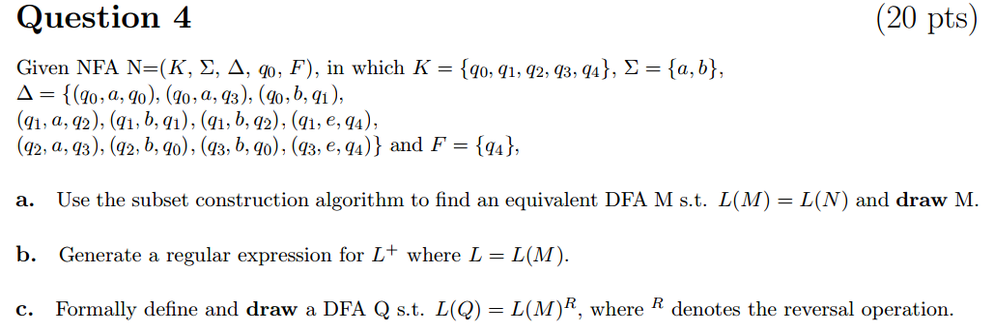
Given NFA N = (K, Sigma, Delta, q_0, F), in which K = {q_0, q_1, q_2, q_3, q_4}, Sigma = {a, b}. Delta = {(q_0, a, q_0), (q_0, 0, q_3), (q_0, b, q_1), (q_l. a q_2), (q_1, b, q_1), (q_1, b, q_2)i (q_1, e q_4), (q_2, a, q_3), (q_2, b q_0), (q_3, b q_0), (q_3, e, q_4)} and F= {q_4}, Use the subset construction algorithm to find an equivalent DFA M s. T. L(M) = L(N) and draw M. Generate a regular expression for L+ where L = L(M). Formally define and draw a DFA Q s. T. L(Q) = L(M)^R, where R denotes the reversal operation
Step by Step Solution
There are 3 Steps involved in it
1 Expert Approved Answer
Step: 1 Unlock

Question Has Been Solved by an Expert!
Get step-by-step solutions from verified subject matter experts
Step: 2 Unlock
Step: 3 Unlock
 Study Help