







Question: hello please i don't have enough time those questions are the single choice i need only answers please fill th table with the correct answer
hello please i don't have enough time those questions are the single choice i need only answers

please fill th table with the correct answer
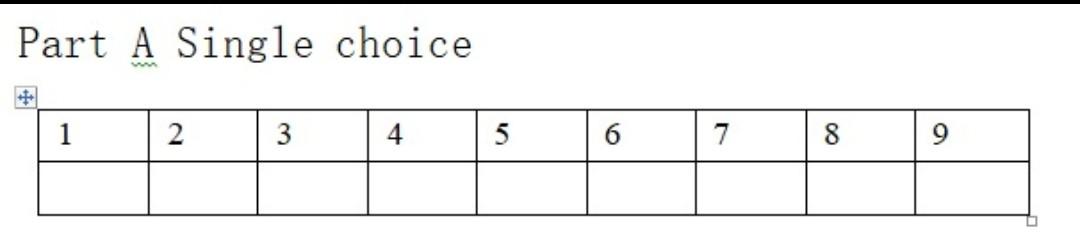
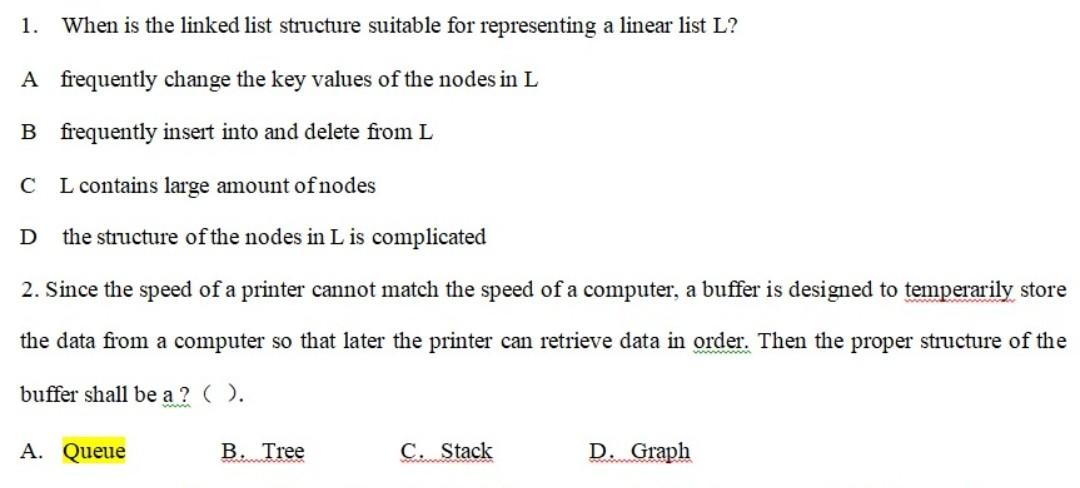
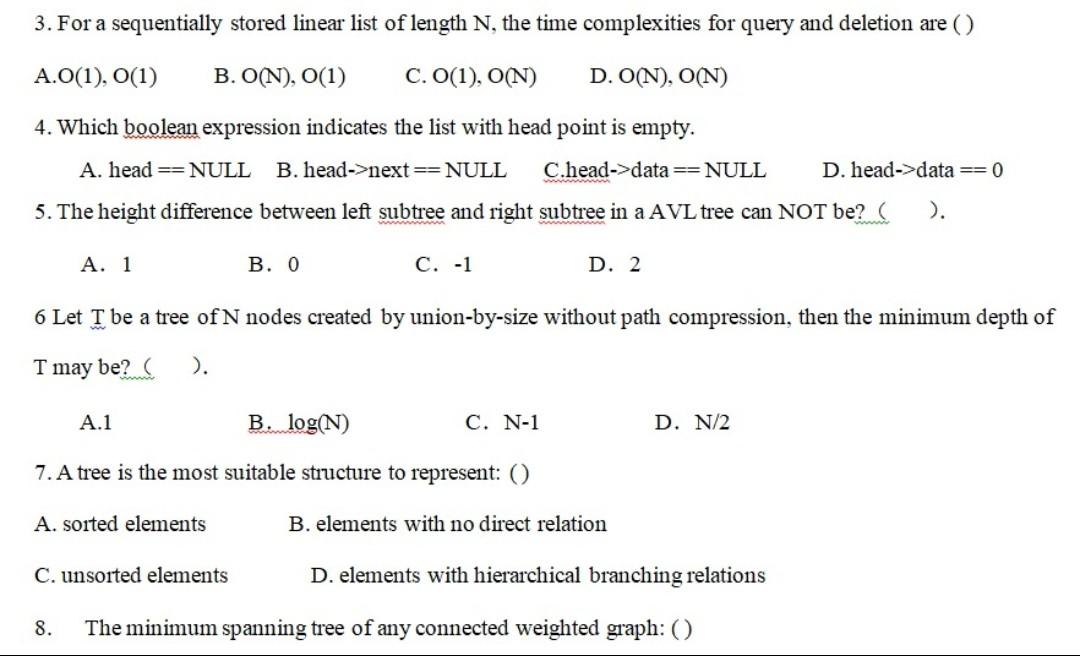
1. When is the linked list structure suitable for representing a linear list L? A frequently change the key values of the nodes in L B frequently insert into and delete from L L contains large amount ofnodes D the structure of the nodes in L is complicated 2. Since the speed of a printer cannot match the speed of a computer, a buffer is designed to temperarily store the data from a computer so that later the printer can retrieve data in order. Then the proper structure of the buffer shall be a ? ( ). A. Queue B. Tree C. Stack D. Graph 3. For a sequentially stored linear list of length N, the time complexities for query and deletion are () A.O(1), O(1) B. O(N), O(1) C. 0,1), ON) D. ON), ON) 4. Which boolean expression indicates the list with head point is empty. A. head == NULL B. head->next == NULL C.head->data == NULL D. head->data == 0 5. The height difference between left subtree and right subtree in a AVL tree can NOT be?( ). A. 1 B. 0 C. -1 D. 2 6 Let I be a tree of N nodes created by union-by-size without path compression, then the minimum depth of T may be? ( ). A.1 B. log(N) C. N-1 D. N/2 7. A tree is the most suitable structure to represent: () A. sorted elements B. elements with no direct relation C. unsoited elements D. elements with hierarchical branching relations 8. The minimum spanning tree of any connected weighted graph: () A. is unique B. is not unique c. may not be unique D. may not exist 9. To search a key in a complete binary search tree with N nodes, the average number of comparisons is: ( )? A. O(N) B. OlogN) C. O(NlogN) D.ON^2) Part A Single choice + 1 2 3 4 5 6 7 8 9
Step by Step Solution
There are 3 Steps involved in it

Get step-by-step solutions from verified subject matter experts
 Study Help