







Question: heres 1,2,3 is this better? Many linear systems that derive from physical applications exhibit special structure, i.e., spe. cific zeroonzero patterns, that may be exploited
 is this better?
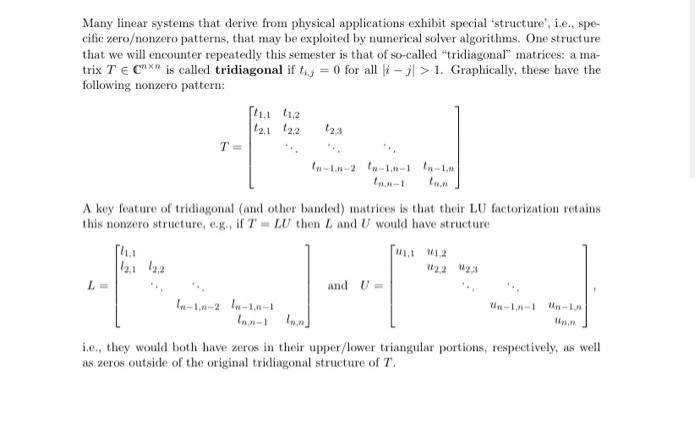
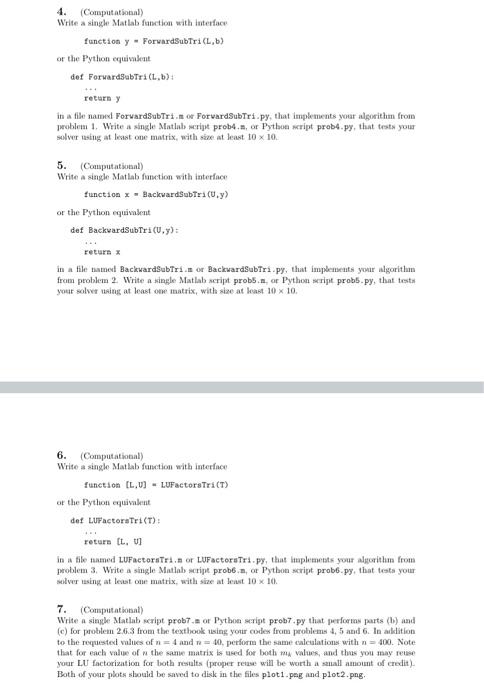
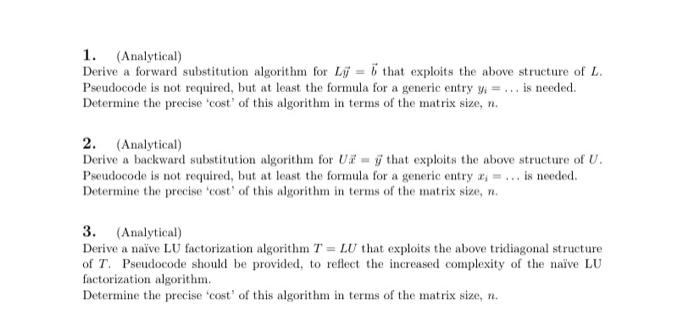
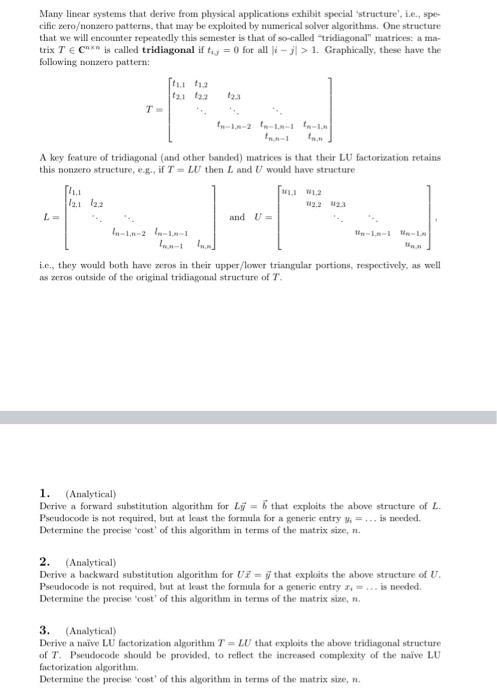
Many linear systems that derive from physical applications exhibit special structure, i.e., spe. cific zeroonzero patterns, that may be exploited by numerical solver algorithms. One structure that we will encounter repeatedly this semester is that of so-called "tridiagonal" matrices: a ma- trix T E C is called tridiagonal iftis = 0 for all | - | > 1. Graphically, these have the following nonzero pattern: 4.1 112 123 T= A key feature of tridingonal (and other banded) matrices is that their LU factorization retains this nonzero structure, eg, if - LU then Land U would have structure 12.1 121 122 162,2 2,3 -- and U = - und ic, they would both have zeros in their upper/lower triangular portions, respectively, as well as zeros outside of the original tridiagonal structure of T. (Computational) Write a single Matlab function with interface function y - ForvardSubTricl.b) or the Python equivalent det Forwardsubiri (1.b): return y in a file named ForwardSubTri.tor ForvardSubTri.pythat implements your algorithm from problem 1. Write a single Matlab script prob4... or Python ript prob4.py, that test your solver asing at least one matrix, with size at least 10 x 10 5. (Computational) Write a single Matlab function with interface function. Backwardsubira (U.y) of the Python equivalent def BackwardSubTra (U.y): in file tinted BackwardSubtri or BackwardSubtra.py, that implements your algorithm from problem 2. Write a single Matlab script probs... or Python script probs.py, that test your solver using at least one matrix, with size at least 10 x 10. 6. (Computational) Write a single Matlab function with interface function (L.U] - LUFactors TriCT) of the Python equivalent det LUFactoratetet): return tl. U in a file named LUFactorsrin or LUFactor Tri.py, that implements your algorithm from problem 3. Write a single Matlab script probo.n, or Python script prob6.py, that test your weilver using at least one matrix, with size at least 10 x 10 7. Computational) Write a single Matlab script prob?.. or Python script prob7.py that performan parts (1) and (c) for problem 2.6.3 from the textbook using your codes from problems 4, 5 and 6. In addition to the requested values of n = 4 and n = 40, perform the same calculation with n = 400. Note that for each value of the same matrix is used for both my values, and thus you may reuse your LU factorization for both results (proper retse will be worth a small amount of credit) Both of your plots should be saved to disk in the files plot1.png and plot2.png 1. (Analytical) Derive a forward substitution algorithm for Lj = 6 that exploits the above structure of L. Pseudocode is not required, but at least the formula for a generic entry w= ... is needed. Determine the precise cost' of this algorithm in terms of the matrix size, n. 2. (Analytical) Derive a backward substitution algorithm for UX = that exploits the above structure of U. Pseudocode is not required, but at least the formula for a generic entry w;= ... is needed. Determine the precise cost of this algorithm in terms of the matrix size, 1. 3. (Analytical) Derive a naive LU factorization algorithm T = LU that exploits the above tridiagonal structure of T. Pseudocode should be provided, to reflect the increased complexity of the nave LU factorization algorithm Determine the precise cost' of this algorithm in terms of the matrix size, 1. Many linear systems that derive from physical applications exhibit special structure, ie, sp cific wroonzero patterns, that may be exploited by numerical solver algorithms. One structure that we will encounter repeatedly this semester is that of so-called tridiagonal" matrices a ma- trix T E CHX is called tridiagonal if ty = 0 for all -> 1. Graphically, these have the following nonzero pattern: 12.12 A key feature of tridingotul (and other kinded) matrices is that their LU factorization retains this nonzero structure, eg, if T = LU then Land U would have structure L= and a i.c., they would both have mores in their upper/lower triangular portions, respectively, as well is eros outside of the original tridiagonal structure of T. 1. (Analytical) Derive a forward stubstitution algorithm for Lj = 6 that exploits the above structure of L. Pseudocode is not required, but at least the formula for a generic entry .... is needed. Determine the precise cost of this algorithm in terms of the matrix size, 1. 2. (Analytical) Derive a backward substitution algorithm for Uf = that expkrits the above structure of U. Pseudocode is not required, but at least the formula for a generic entry 1, = ... is needed. Determine the precise cost of this algorithm in terms of the matrix size, n, 3. (Analytical) Derive a naive LU factorization algorithm 7 = LU that exploits the above tridiagonal structure of T. Pseudocode should be provided to reflect the increased complexity of the naive LU factorization algorithm Determine the precise cost of this algorithm in terms of the matrix site, *. Many linear systems that derive from physical applications exhibit special structure, i.e., spe. cific zeroonzero patterns, that may be exploited by numerical solver algorithms. One structure that we will encounter repeatedly this semester is that of so-called "tridiagonal" matrices: a ma- trix T E C is called tridiagonal iftis = 0 for all | - | > 1. Graphically, these have the following nonzero pattern: 4.1 112 123 T= A key feature of tridingonal (and other banded) matrices is that their LU factorization retains this nonzero structure, eg, if - LU then Land U would have structure 12.1 121 122 162,2 2,3 -- and U = - und ic, they would both have zeros in their upper/lower triangular portions, respectively, as well as zeros outside of the original tridiagonal structure of T. (Computational) Write a single Matlab function with interface function y - ForvardSubTricl.b) or the Python equivalent det Forwardsubiri (1.b): return y in a file named ForwardSubTri.tor ForvardSubTri.pythat implements your algorithm from problem 1. Write a single Matlab script prob4... or Python ript prob4.py, that test your solver asing at least one matrix, with size at least 10 x 10 5. (Computational) Write a single Matlab function with interface function. Backwardsubira (U.y) of the Python equivalent def BackwardSubTra (U.y): in file tinted BackwardSubtri or BackwardSubtra.py, that implements your algorithm from problem 2. Write a single Matlab script probs... or Python script probs.py, that test your solver using at least one matrix, with size at least 10 x 10. 6. (Computational) Write a single Matlab function with interface function (L.U] - LUFactors TriCT) of the Python equivalent det LUFactoratetet): return tl. U in a file named LUFactorsrin or LUFactor Tri.py, that implements your algorithm from problem 3. Write a single Matlab script probo.n, or Python script prob6.py, that test your weilver using at least one matrix, with size at least 10 x 10 7. Computational) Write a single Matlab script prob?.. or Python script prob7.py that performan parts (1) and (c) for problem 2.6.3 from the textbook using your codes from problems 4, 5 and 6. In addition to the requested values of n = 4 and n = 40, perform the same calculation with n = 400. Note that for each value of the same matrix is used for both my values, and thus you may reuse your LU factorization for both results (proper retse will be worth a small amount of credit) Both of your plots should be saved to disk in the files plot1.png and plot2.png 1. (Analytical) Derive a forward substitution algorithm for Lj = 6 that exploits the above structure of L. Pseudocode is not required, but at least the formula for a generic entry w= ... is needed. Determine the precise cost' of this algorithm in terms of the matrix size, n. 2. (Analytical) Derive a backward substitution algorithm for UX = that exploits the above structure of U. Pseudocode is not required, but at least the formula for a generic entry w;= ... is needed. Determine the precise cost of this algorithm in terms of the matrix size, 1. 3. (Analytical) Derive a naive LU factorization algorithm T = LU that exploits the above tridiagonal structure of T. Pseudocode should be provided, to reflect the increased complexity of the nave LU factorization algorithm Determine the precise cost' of this algorithm in terms of the matrix size, 1. Many linear systems that derive from physical applications exhibit special structure, ie, sp cific wroonzero patterns, that may be exploited by numerical solver algorithms. One structure that we will encounter repeatedly this semester is that of so-called tridiagonal" matrices a ma- trix T E CHX is called tridiagonal if ty = 0 for all -> 1. Graphically, these have the following nonzero pattern: 12.12 A key feature of tridingotul (and other kinded) matrices is that their LU factorization retains this nonzero structure, eg, if T = LU then Land U would have structure L= and a i.c., they would both have mores in their upper/lower triangular portions, respectively, as well is eros outside of the original tridiagonal structure of T. 1. (Analytical) Derive a forward stubstitution algorithm for Lj = 6 that exploits the above structure of L. Pseudocode is not required, but at least the formula for a generic entry .... is needed. Determine the precise cost of this algorithm in terms of the matrix size, 1. 2. (Analytical) Derive a backward substitution algorithm for Uf = that expkrits the above structure of U. Pseudocode is not required, but at least the formula for a generic entry 1, = ... is needed. Determine the precise cost of this algorithm in terms of the matrix size, n, 3. (Analytical) Derive a naive LU factorization algorithm 7 = LU that exploits the above tridiagonal structure of T. Pseudocode should be provided to reflect the increased complexity of the naive LU factorization algorithm Determine the precise cost of this algorithm in terms of the matrix site, *
Step by Step Solution
There are 3 Steps involved in it

Get step-by-step solutions from verified subject matter experts
 Study Help