







Question: Hi can someone please help me with the conclusion and a source of error for this lab Data Table 1 Observation do (cm) 1/do (cm-!)
Hi can someone please help me with the conclusion and a source of error for this lab
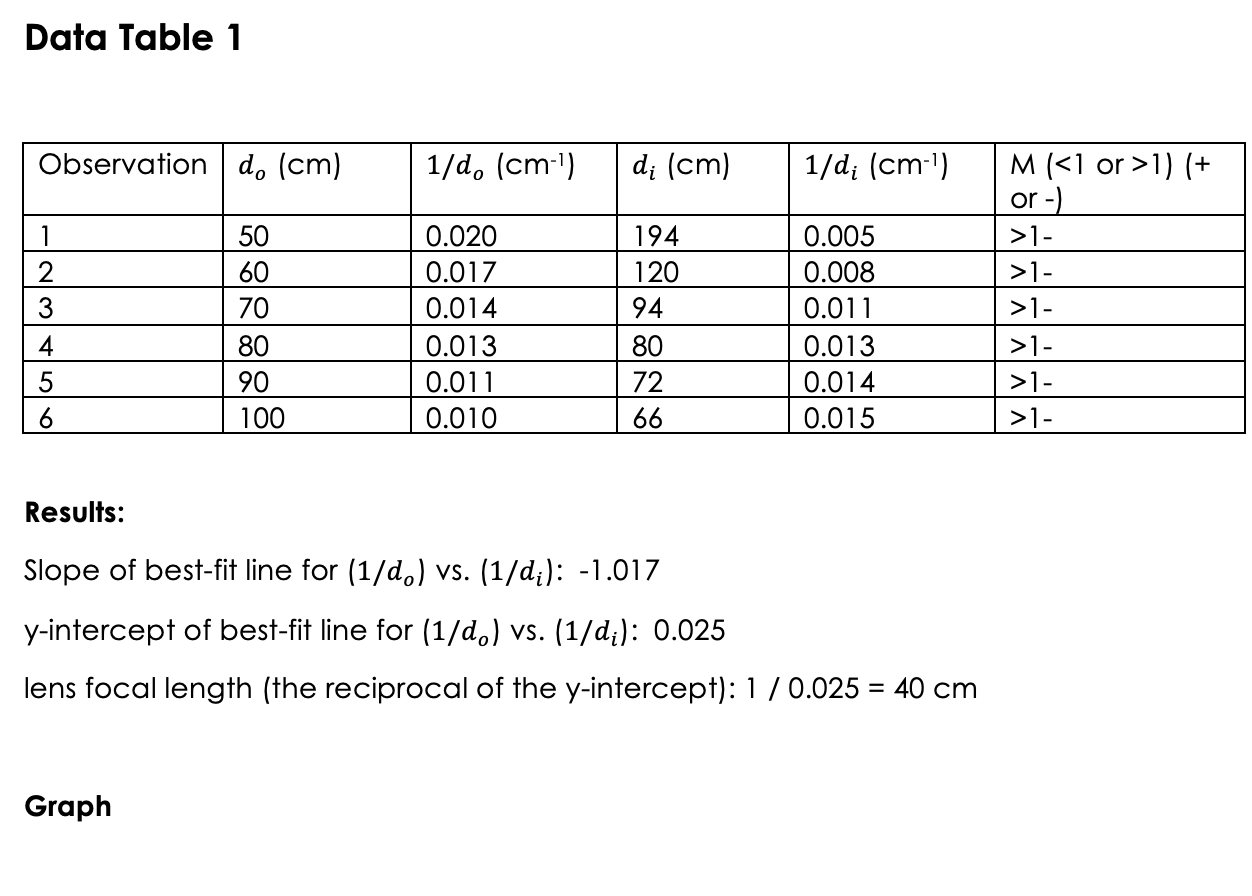
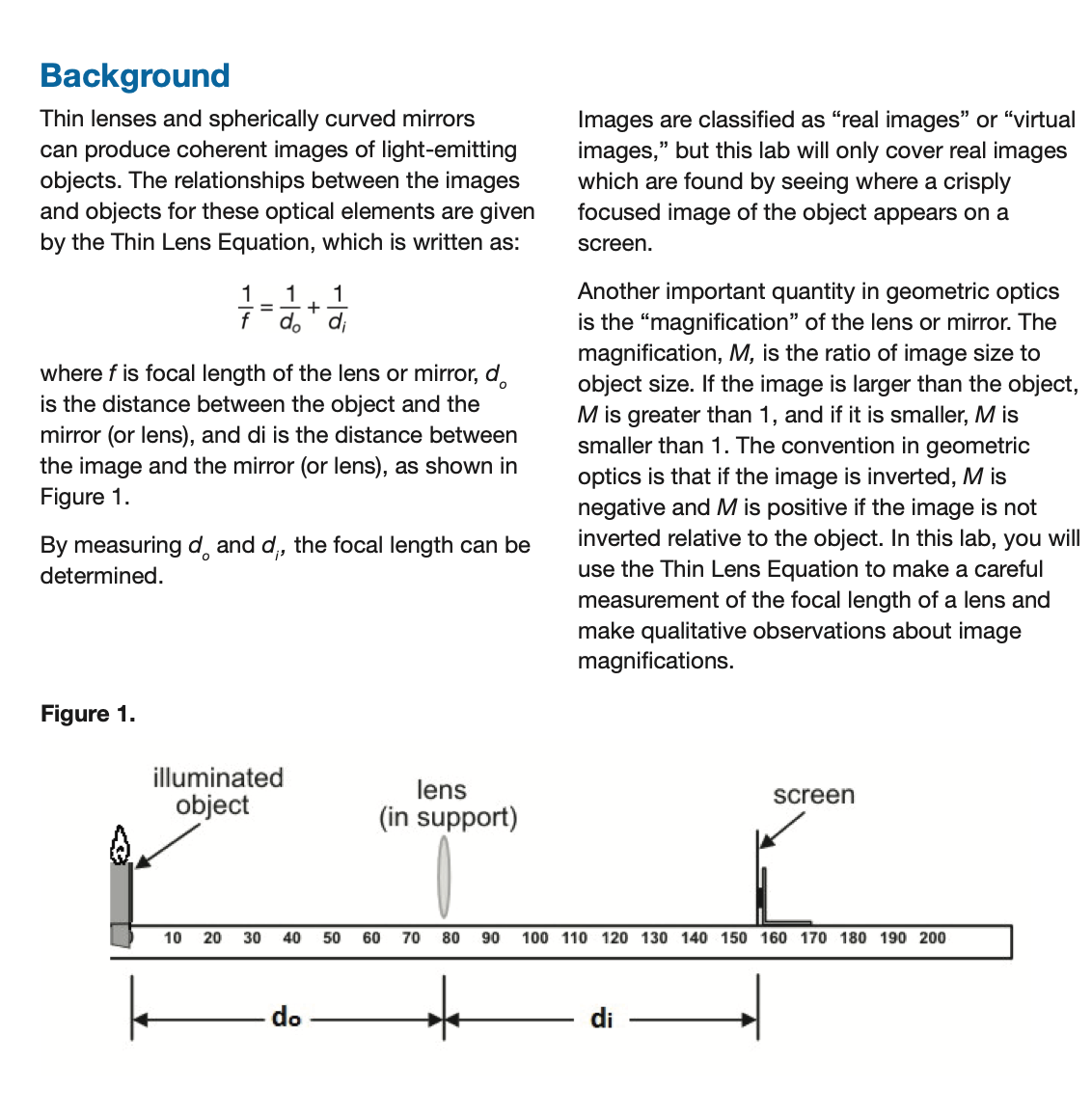
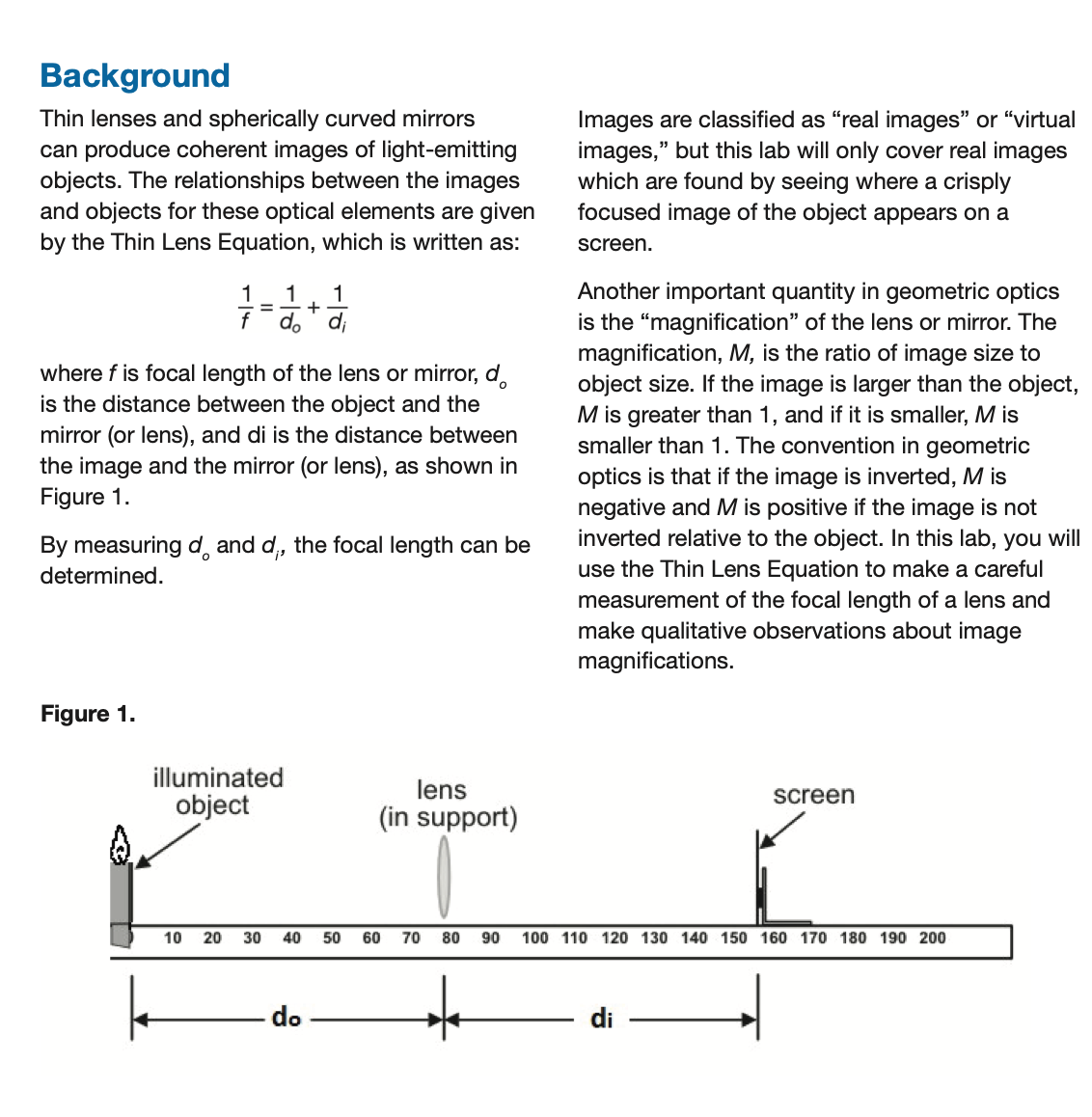
Data Table 1 Observation do (cm) 1/do (cm-!) d; (cm) 1/d; (cm-1) M (1) (+ or -) 50 0.020 194 0.005 >1- 2 60 0.017 120 0.008 >1- 3 70 0.014 94 0.011 >1- 4 80 0.013 80 0.013 >1- 5 90 0.011 72 0.014 >1- 6 100 0.010 66 0.015 >1- Results: Slope of best-fit line for (1/d) vs. (1/d;): -1.017 y-intercept of best-fit line for (1/d.) vs. (1/d;): 0.025 lens focal length (the reciprocal of the y-intercept): 1 / 0.025 = 40 cm GraphBackground Thin lenses and spherically curved mirrors Images are classified as "real images" or "virtual can produce coherent images of light-emitting images," but this lab will only cover real images objects. The relationships between the images which are found by seeing where a crisply and objects for these optical elements are given focused image of the object appears on a by the Thin Lens Equation, which is written as: screen. Another important quantity in geometric optics do di is the "magnification" of the lens or mirror. The magnification, M, is the ratio of image size to where f is focal length of the lens or mirror, do object size. If the image is larger than the object, is the distance between the object and the M is greater than 1, and if it is smaller, M is mirror (or lens), and di is the distance between smaller than 1. The convention in geometric the image and the mirror (or lens), as shown in optics is that if the image is inverted, M is Figure 1. negative and M is positive if the image is not By measuring d. and d,, the focal length can be inverted relative to the object. In this lab, you will determined. use the Thin Lens Equation to make a careful measurement of the focal length of a lens and make qualitative observations about image magnifications. Figure 1. illuminated lens object screen (in support) 10 20 30 40 50 60 70 80 90 100 110 120 130 140 150 160 170 180 190 200 do di
Step by Step Solution
There are 3 Steps involved in it

Get step-by-step solutions from verified subject matter experts
 Study Help