Question: I have a assignment where I need to write a Capstone Project Proposal. The course is COMM163 - Business Decision Models. Here is the rubric:
I have a assignment where I need to write a Capstone Project Proposal.
The course is COMM163 - Business Decision Models.
Here is the rubric:
1. Understanding the organization - Goals, current DM process. This should help you identify the areas where analytics can add the most value.
2. Problem Definition - identify specific decision problems that can be addressed using analytics
3. Identify data sources - determine the types of data that are available and relevant to the problem. This could include internal data, external data, or public data sources. Be prepared to recommend additional data collection requirements.
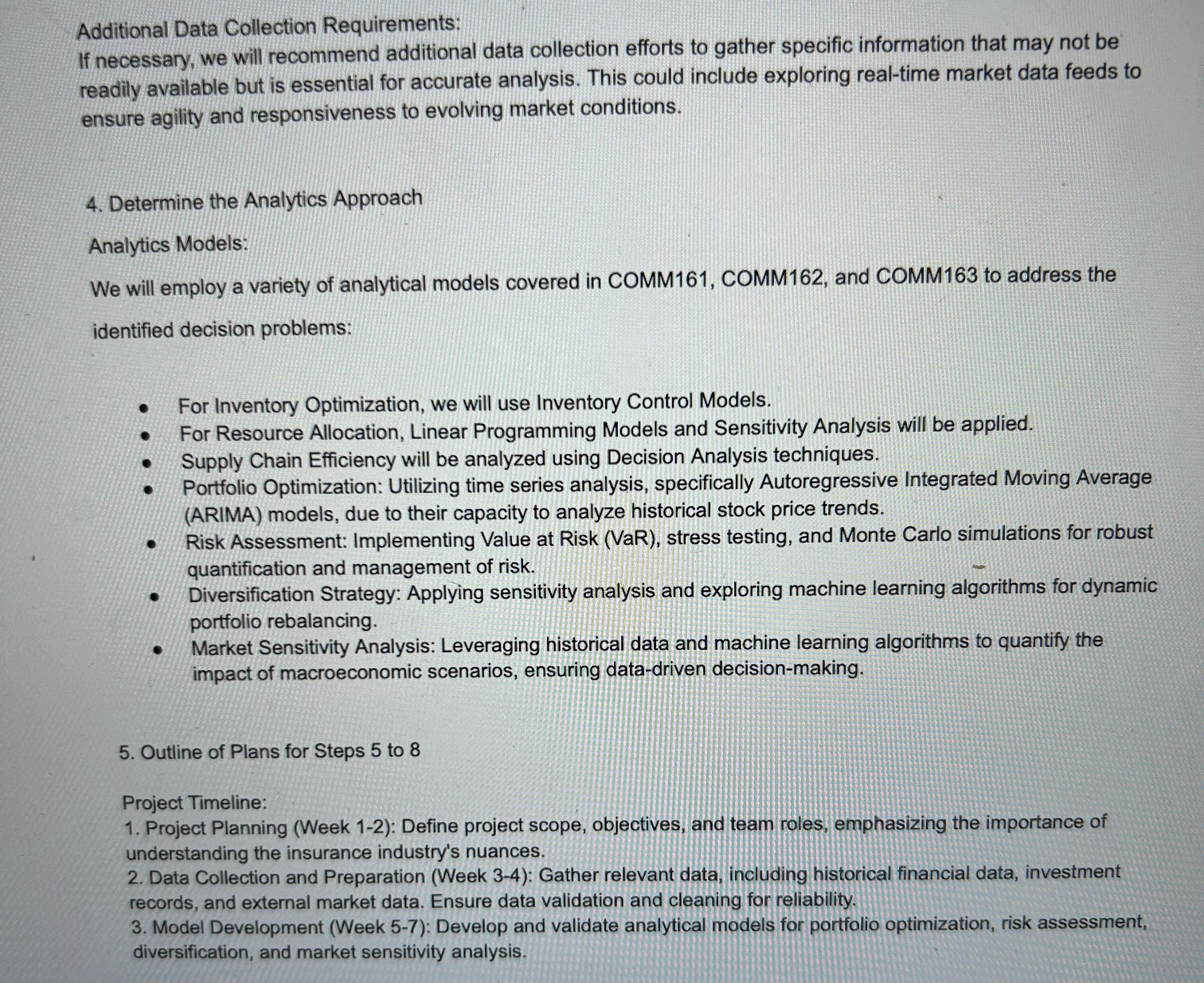
4. Determine the analytics approach - which models from across COMM161 (Introduction to mathematical analysis), COMM162 (Managerial Statistics), and COMM163 (Business Decision Models) are most appropriate to help analyze the problem. This could involve descriptive analytics, predictive analytics, or descriptive analytics.
5. Outline of plans for steps 5 to 8.
Here is a list of the main topics we have covered in class so far:
- Introduction to Quantitative Analysis and probability review
- Decision Analysis
- Inventory Control Models
- Linear Programming Models and Sensitivity Analysis
MY QUESTION FOR YOU:
I have uploaded pictures below of my proposal.
Please state a few changes that need to be made to ensure I achieve a high degree of effectiveness in each category of the rubric.
***After the changes have been stated, please rewrite a proposal with the revised changes.
Please be very specific with stating the changes that need to be made (for example, rewrite exactly what I would put instead of my original)
NOTE: I do not intend to claim this work as my own, it is a simply a good exemplar to use.
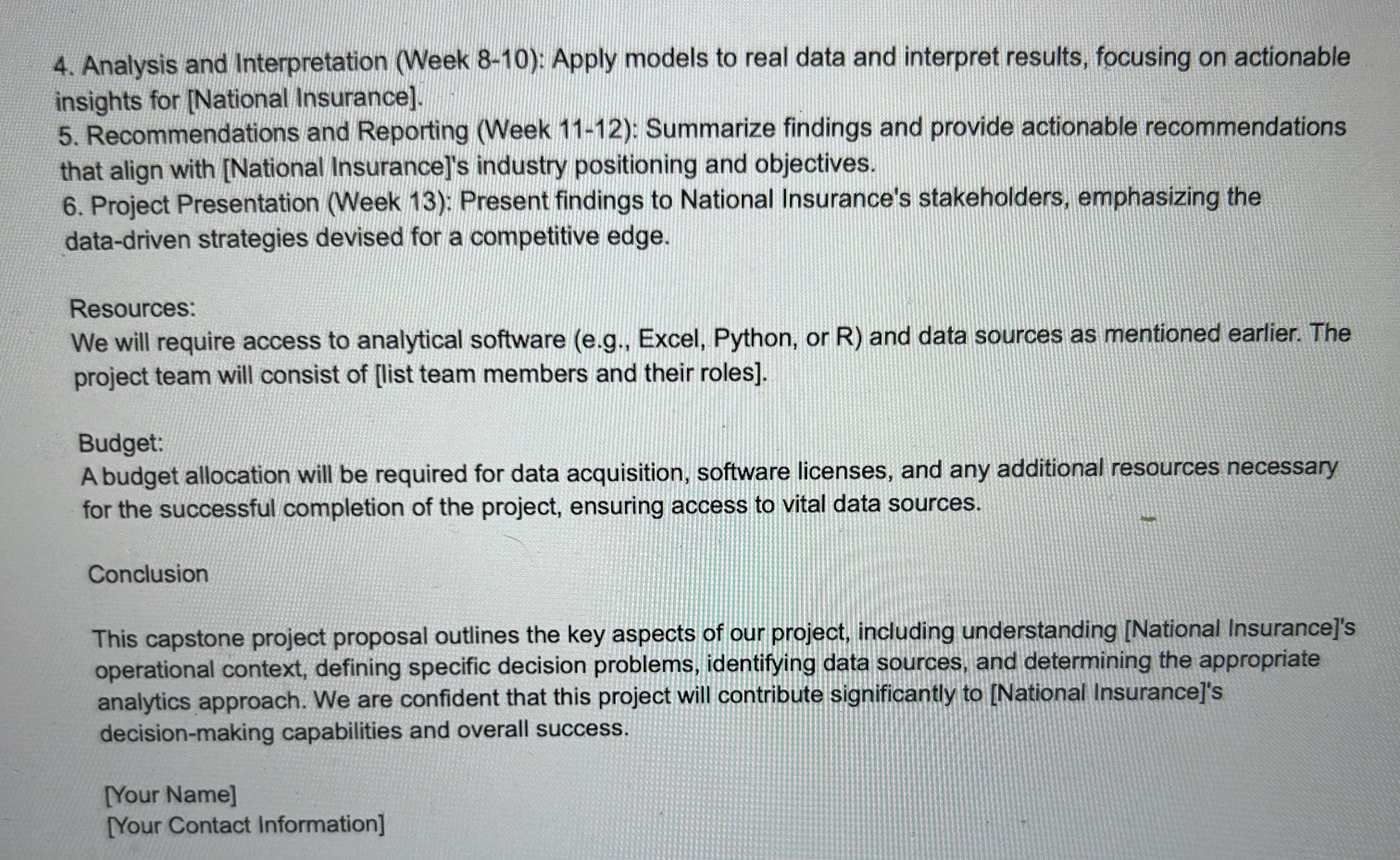
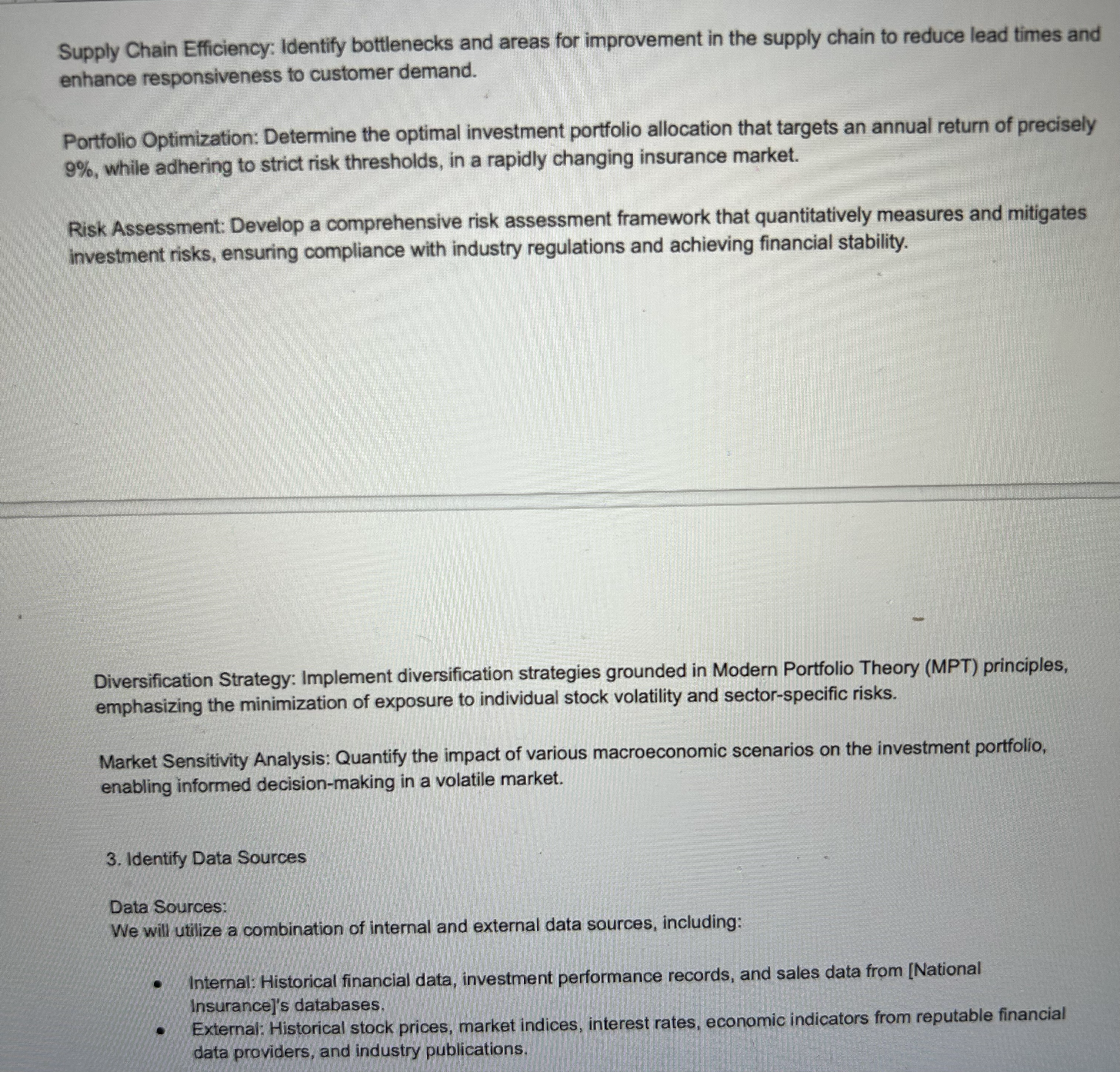
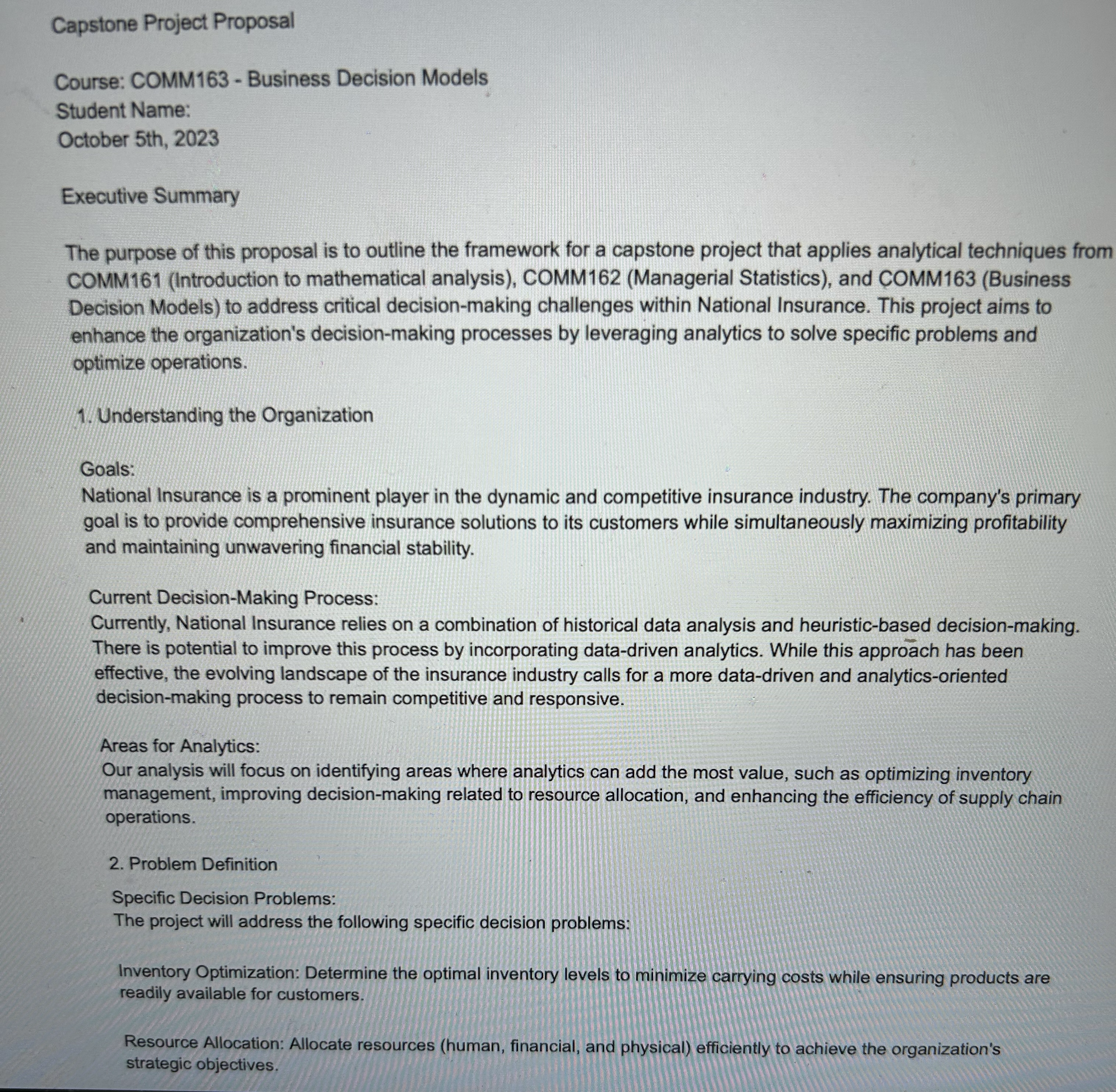
Additional Data Collection Requirements: If necessary, we will recommend additional data collection efforts to gather specific information that may not be readily available but is essential for accurate analysis. This could include exploring real-time market data feeds to ensure agility and responsiveness to evolving market conditions. 4. Determine the Analytics Approach Analytics Models: We will employ a variety of analytical models covered in COMM161, COMM162, and COMM163 to address the identified decision problems: For Inventory Optimization, we will use Inventory Control Models. For Resource Allocation, Linear Programming Models and Sensitivity Analysis will be applied. Supply Chain Efficiency will be analyzed using Decision Analysis techniques. Portfolio Optimization: Utilizing time series analysis, specifically Autoregressive Integrated Moving Average (ARIMA) models, due to their capacity to analyze historical stock price trends. Risk Assessment: Implementing Value at Risk (VaR), stress testing, and Monte Carlo simulations for robust quantification and management of risk. Diversification Strategy: Applying sensitivity analysis and exploring machine learning algorithms for dynamic portfolio rebalancing. Market Sensitivity Analysis: Leveraging historical data and machine learning algorithms to quantify the impact of macroeconomic scenarios, ensuring data-driven decision-making 5. Outline of Plans for Steps 5 to 8 Project Timeline: 1. Project Planning (Week 1-2): Define project scope, objectives, and team roles, emphasizing the importance of understanding the insurance industry's nuances. 2. Data Collection and Preparation (Week 3-4): Gather relevant data, including historical financial data, investment records, and external market data. Ensure data validation and cleaning for reliability. 3. Model Development (Week 5-7): Develop and validate analytical models for portfolio optimization, risk assessment, diversification, and market sensitivity analysis.4. Analysis and Interpretation (Week 8-10): Apply models to real data and interpret results, focusing on actionable insights for [National Insurance]. 5. Recommendations and Reporting (Week 11-12): Summarize findings and provide actionable recommendations that align with [National Insurance]'s industry positioning and objectives. 6. Project Presentation (Week 13): Present findings to National Insurance's stakeholders, emphasizing the data-driven strategies devised for a competitive edge. Resources: We will require access to analytical software (e.g., Excel, Python, or R) and data sources as mentioned earlier. The project team will consist of [list team members and their roles]. Budget: A budget allocation will be required for data acquisition, software licenses, and any additional resources necessary for the successful completion of the project, ensuring access to vital data sources. Conclusion This capstone project proposal outlines the key aspects of our project, including understanding [ National Insurance]'s operational context, defining specific decision problems, identifying data sources, and determining the appropriate analytics approach. We are confident that this project will contribute significantly to [National Insurance]'s decision-making capabilities and overall success. [Your Name] [Your Contact Information]Supply Chain Efficiency: Identify bottlenecks and areas for improvement in the supply chain to reduce lead times and enhance responsiveness to customer demand. Portfolio Optimization: Determine the optimal investment portfolio allocation that targets an annual return of precisely 9%, while adhering to strict risk thresholds, in a rapidly changing insurance market. Risk Assessment: Develop a comprehensive risk assessment framework that quantitatively measures and mitigates investment risks, ensuring compliance with industry regulations and achieving financial stability. Diversification Strategy: Implement diversification strategies grounded in Modern Portfolio Theory (MPT) principles, emphasizing the minimization of exposure to individual stock volatility and sector-specific risks. Market Sensitivity Analysis: Quantify the impact of various macroeconomic scenarios on the investment portfolio, enabling informed decision-making in a volatile market. 3. Identify Data Sources Data Sources: We will utilize a combination of internal and external data sources, including: Internal: Historical financial data, investment performance records, and sales data from [National Insurance]'s databases. External: Historical stock prices, market indices, interest rates, economic indicators from reputable financial data providers, and industry publications.Capstone Project Proposal Course: COMM163 - Business Decision Models Student Name: October 5th, 2023 Executive Summary The purpose of this proposal is to outline the framework for a capstone project that applies analytical techniques from COMM161 (Introduction to mathematical analysis), COMM162 (Managerial Statistics), and COMM163 (Business Decision Models) to address critical decision-making challenges within National Insurance. This project aims to enhance the organization's decision-making processes by leveraging analytics to solve specific problems and optimize operations. 1. Understanding the Organization Goals: National Insurance is a prominent player in the dynamic and competitive insurance industry. The company's primary goal is to provide comprehensive insurance solutions to its customers while simultaneously maximizing profitability and maintaining unwavering financial stability. Current Decision-Making Process: Currently, National Insurance relies on a combination of historical data analysis and heuristic-based decision-making. There is potential to improve this process by incorporating data-driven analytics. While this approach has been effective, the evolving landscape of the insurance industry calls for a more data-driven and analytics-oriented decision-making process to remain competitive and responsive. Areas for Analytics: Our analysis will focus on identifying areas where analytics can add the most value, such as optimizing inventory management, improving decision-making related to resource allocation, and enhancing the efficiency of supply chain operations. 2. Problem Definition Specific Decision Problems: The project will address the following specific decision problems: Inventory Optimization: Determine the optimal inventory levels to minimize carrying costs while ensuring products are readily available for customers. Resource Allocation: Allocate resources (human, financial, and physical) efficiently to achieve the organization's strategic objectives
Step by Step Solution
There are 3 Steps involved in it
1 Expert Approved Answer
Step: 1 Unlock
Question Has Been Solved by an Expert!
Get step-by-step solutions from verified subject matter experts
Step: 2 Unlock
Step: 3 Unlock
Students Have Also Explored These Related General Management Questions!









 Study Help