







Question: I need help with part e! Sorry that the pictures are out of order. I will not use your work as my own, I just
I need help with part e! Sorry that the pictures are out of order. I will not use your work as my own, I just need help figuring out the answer.
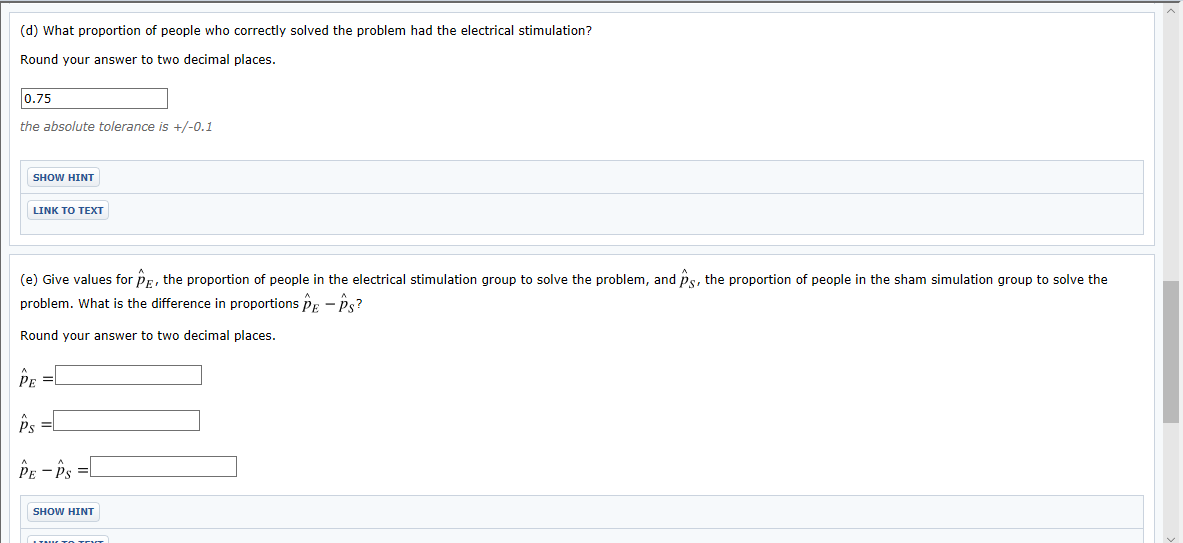
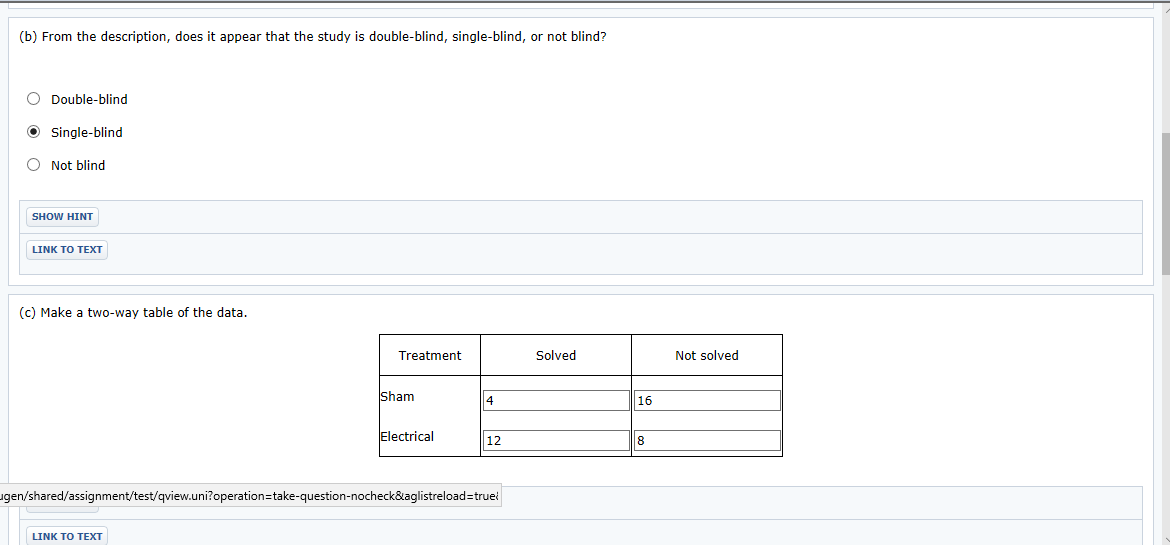
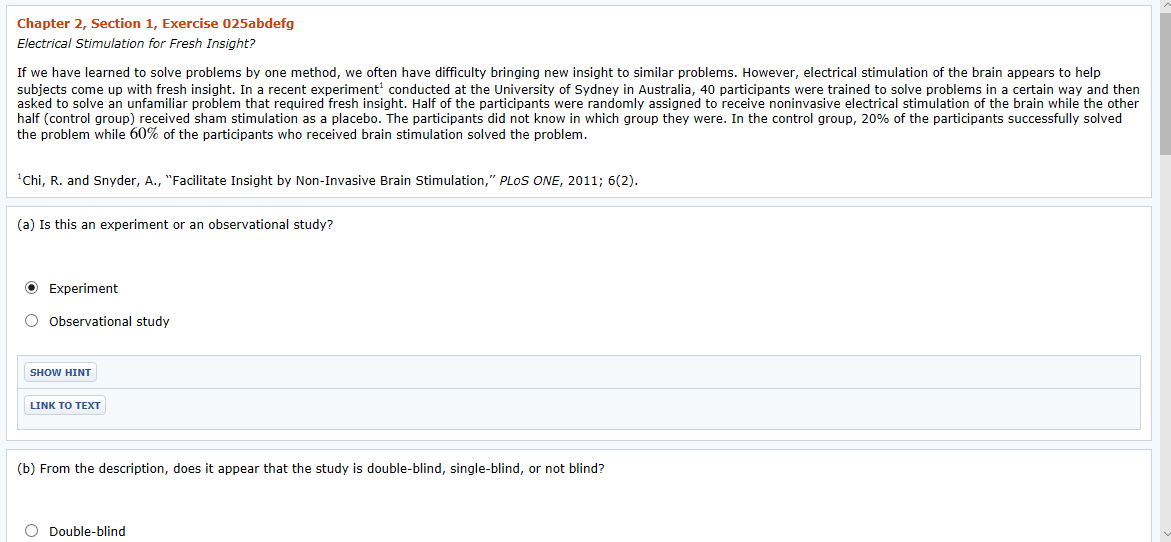
(d) What proportion of people who correctly solved the problem had the electrical stimulation? Round your answer to two decimal places. 0.75 the absolute tolerance is +;'.1 (e) Give values for $5, the proportion of people in the electrical stimulation group to solve the problem, and ts, the proportion of people in the sham simulation group to solve the problem. What is the difference in proponjons $5 135? Round your answer to two decimal places. (b) From the description, does it appear that the studyr is doubleblind. singleblind, or not blind? O Doubleblind Sin gIe-biind 0 Not blind SHOW HINT LINK TO TEXT (c) Make a twoway table of the data. Treatment Solved Net solved Sham 4 15 Electrical 12 3 Igenfshareda'assig nmentfhtfqviewm ni?opemtion :ta lee-q ulion-nochedctaglislreioad :truei LINK TO TENT Chapter 2, Section 1, Exercise zsabdefg Electrics! Stimulation for Fresh Insight? If we have learned to solve problems by one method, we often have difculty bringing new insightto similar problems. However, electrical stimulation of the brain appears to help subjects come up with fresh insight. In a recent experiment1 conducted at the University of Sydney in Australia, 40 participants were trained to solve problems in a certain way and then asked to solve an unfamiliar problem that required fresh insight. Half of the participants were randomly assigned to receive noninvasive electrical stimulation of the brain Iwhile the other half(control group] received sham stimulation as a placebo. The participants did not know in which group they were. In the control group. 20% of the participants successfully solved the problem while 60% of the participants who received brain stimulation solved the problem. 1Chi, R. and Snyder, A\" \"Facilitate Insight by NonInvasive Brain Stimulation," PLoS ONE, 2011: 6(2). (a) Is this an experiment or an observational study? Experi rn ent O Observational study SHOW HINT LINK'I'D TEXT (b) From the description, does it appear that the study is double-blindr singleblind, or not blind? O Doubleblind )
Step by Step Solution
There are 3 Steps involved in it

Get step-by-step solutions from verified subject matter experts
 Study Help