







Question: I need the ERD (Entity Relationship Diagram) in third nominal form. All information I have is provided. MILESTONE 3 - DATA MODEL NORMALIZATION Synopsis In
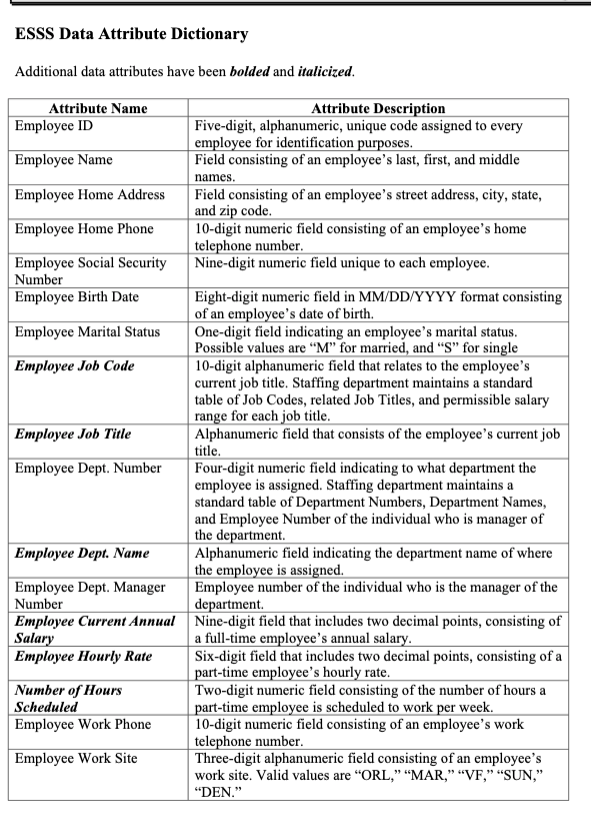
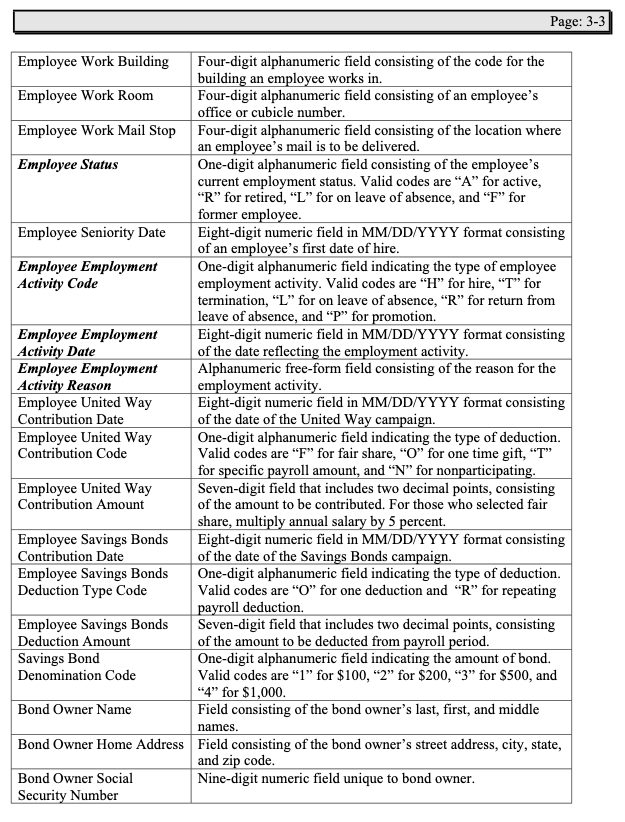
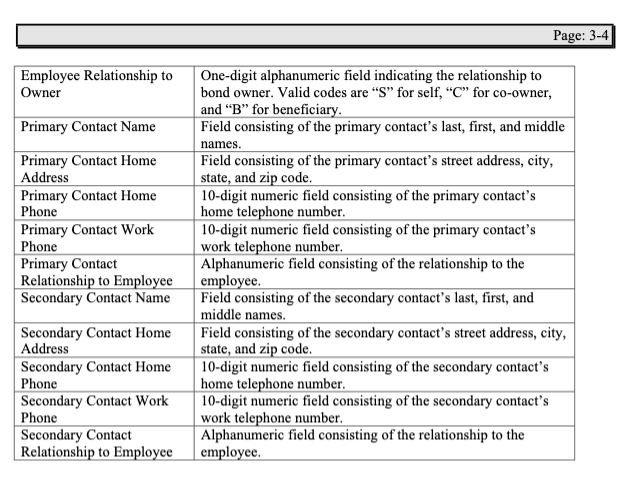
I need the ERD (Entity Relationship Diagram) in third nominal form. All information I have is provided.
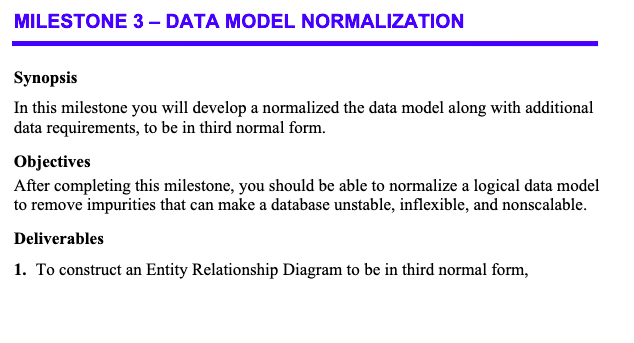
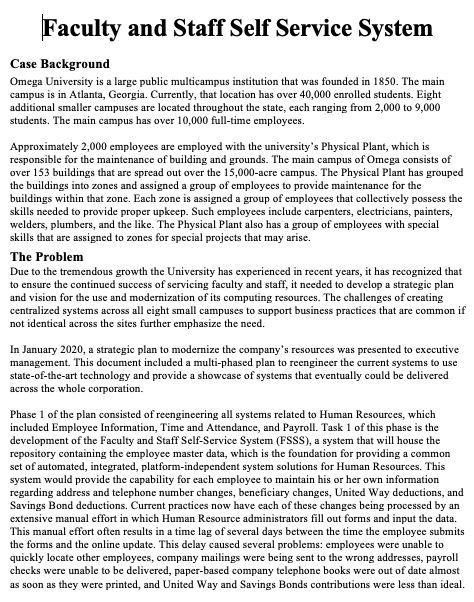
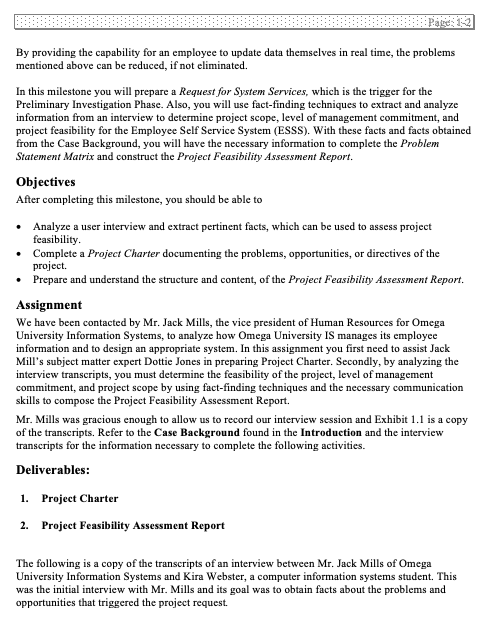
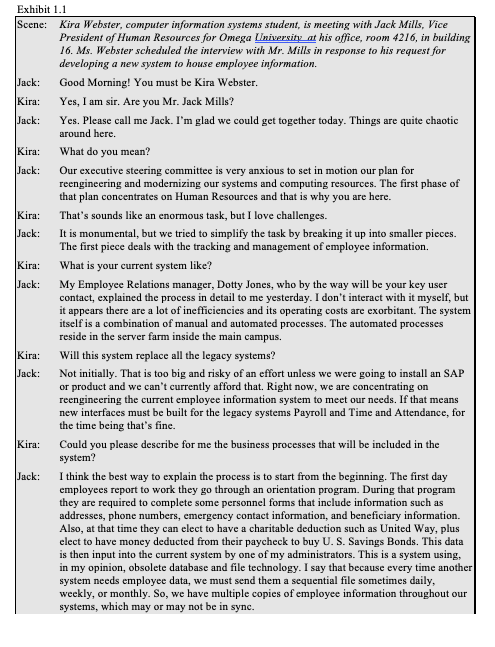
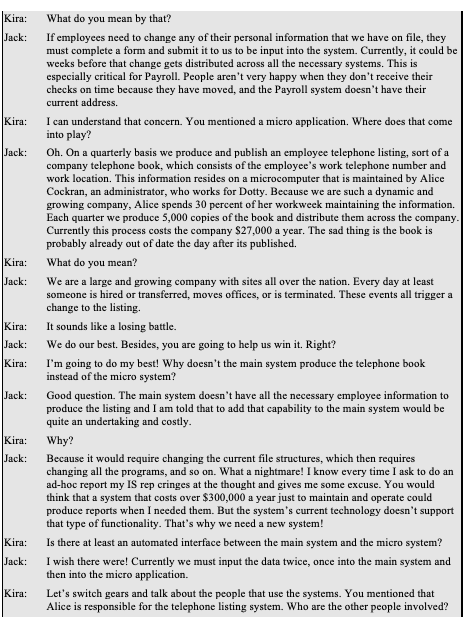
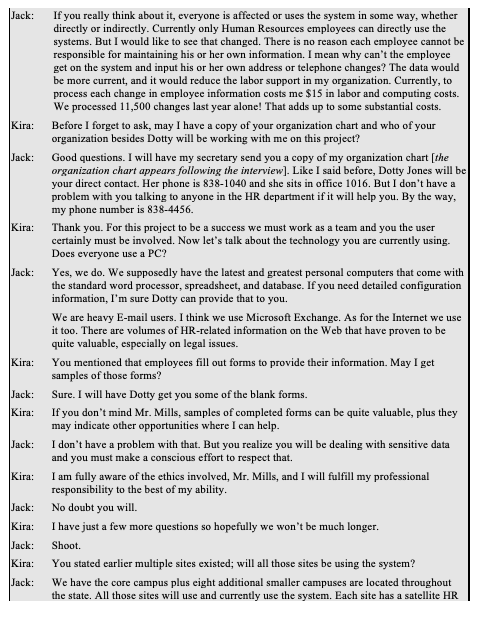
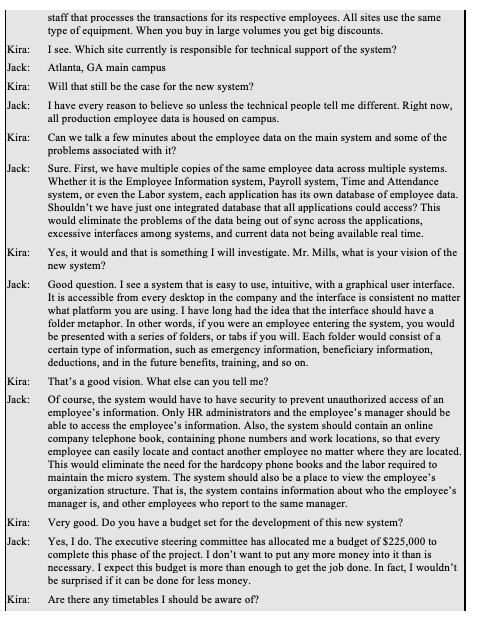
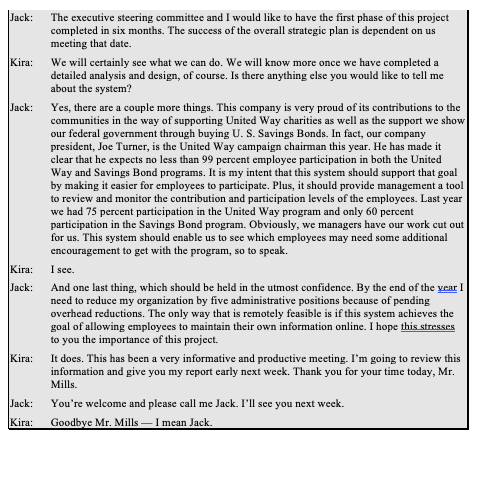
MILESTONE 3 - DATA MODEL NORMALIZATION Synopsis In this milestone you will develop a normalized the data model along with additional data requirements, to be in third normal form. Objectives After completing this milestone, you should be able to normalize a logical data model to remove impurities that can make a database unstable, inflexible, and nonscalable. Deliverables 1. To construct an Entity Relationship Diagram to be in third normal form, Faculty and Staff Self Service System Case Background Omega University is a large public multicampus institution that was founded in 1850. The main campus is in Atlanta, Georgia. Currently, that location has over 40,000 enrolled students. Eight additional smaller campuses are located throughout the state, each ranging from 2,000 to 9,000 students. The main campus has over 10,000 full-time employees. Approximately 2,000 employees are employed with the university's Physical Plant, which is responsible for the maintenance of building and grounds. The main campus of Omega consists of over 153 buildings that are spread out over the 15,000-acre campus. The Physical Plant has grouped the buildings into zones and assigned a group of employees to provide maintenance for the buildings within that zone. Each zone is assigned a group of employees that collectively possess the skills needed to provide proper upkeep. Such employees include carpenters, electricians, painters, welders, plumbers, and the like. The Physical Plant also has a group of employees with special skills that are assigned to zones for special projects that may arise. The Problem Due to the tremendous growth the University has experienced in recent years, it has recognized that to ensure the continued success of servicing faculty and staff, it needed to develop a strategic plan and vision for the use and modernization of its computing resources. The challenges of creating centralized systems across all eight small campuses to support business practices that are common if not identical across the sites further emphasize the need. In January 2020, a strategic plan to modernize the company's resources was presented to executive management. This document included a multi-phased plan to reengineer the current systems to use state-of-the-art technology and provide a showcase of systems that eventually could be delivered across the whole corporation. Phase 1 of the plan consisted of reengineering all systems related to Human Resources, which included Employee Information, Time and Attendance, and Payroll. Task 1 of this phase is the development of the Faculty and Staff Self-Service System (FSSS), a system that will house the repository containing the employee master data, which is the foundation for providing a common set of automated, integrated, platform-independent system solutions for Human Resources. This system would provide the capability for each employee to maintain his or her own information regarding address and telephone number changes, beneficiary changes, United Way deductions, and Savings Bond deductions. Current practices now have each of these changes being processed by an extensive manual effort in which Human Resource administrators fill out forms and input the data. This manual effort often results in a time lag of several days between the time the employee submits the forms and the online update. This delay caused several problems: employees were unable to quickly locate other employees, company mailings were being sent to the wrong addresses, payroll checks were unable to be delivered, paper-based company telephone books were out of date almost as soon as they were printed, and United Way and Savings Bonds contributions were less than ideal. Pat 12 By providing the capability for an employee to update data themselves in real time, the problems mentioned above can be reduced, if not eliminated. In this milestone you will prepare a Request for System Services, which is the trigger for the Preliminary Investigation Phase. Also, you will use fact-finding techniques to extract and analyze information from an interview to determine project scope, level of management commitment, and project feasibility for the Employee Self Service System (ESSS). With these facts and facts obtained from the Case Background, you will have the necessary information to complete the Problem Statement Matrix and construct the Project Feasibility Assessment Report. Objectives After completing this milestone, you should be able to Analyze a user interview and extract pertinent facts, which can be used to assess project feasibility. Complete a Project Charter documenting the problems, opportunities, or directives of the project. Prepare and understand the structure and content, of the Project Feasibility Assessment Report. Assignment We have been contacted by Mr. Jack Mills, the vice president of Human Resources for Omega University Information Systems, to analyze how Omega University IS manages its employee information and to design an appropriate system. In this assignment you first need to assist Jack Mill's subject matter expert Dottie Jones in preparing Project Charter. Secondly, by analyzing the interview transcripts, you must determine the feasibility of the project, level of management commitment, and project scope by using fact-finding techniques and the necessary communication skills to compose the Project Feasibility Assessment Report. Mr. Mills was gracious enough to allow us to record our interview session and Exhibit 1.1 is a copy of the transcripts. Refer to the Case Background found in the Introduction and the interview transcripts for the information necessary to complete the following activities. Deliverables: 1. Project Charter 2. Project Feasibility Assessment Report The following is a copy of the transcripts of an interview between Mr. Jack Mills of Omega University Information Systems and Kira Webster, a computer information systems student. This was the initial interview with Mr. Mills and its goal was to obtain facts about the problems and opportunities that triggered the project request. Exhibit 1.1 Scene: Kira Webster, computer information systems student, is meeting with Jack Mills, Vice President of Human Resources for Omega University at his office, room 4216, in building 16. Ms. Webster scheduled the interview with Mr. Mills in response to his request for developing a new system to house employee information. Jack: Good Morning! You must be Kira Webster. Kira: Yes, I am sir. Are you Mr. Jack Mills? Jack: Yes. Please call me Jack. I'm glad we could get together today. Things are quite chaotic around here. Kira: What do you mean? Jack: Our executive steering committee is very anxious to set in motion our plan for reengineering and modernizing our systems and computing resources. The first phase of that plan concentrates on Human Resources and that is why you are here. Kira: That's sounds like an enormous task, but I love challenges. Jack: It is monumental, but we tried to simplify the task by breaking it up into smaller pieces. The first piece deals with the tracking and management of employee information. Kira: What is your current system like? Jack: My Employee Relations manager, Dotty Jones, who by the way will be your key user contact, explained the process in detail to me yesterday. I don't interact with it myself, but it appears there are a lot of inefficiencies and its operating costs are exorbitant. The system itself is a combination of manual and automated processes. The automated processes reside in the server farm inside the main campus. Kira: Will this system replace all the legacy systems? Jack: Not initially. That is too big and risky of an effort unless we were going to install an SAP or product and we can't currently afford that. Right now, we are concentrating on reengineering the current employee information system to meet our needs. If that means new interfaces must be built for the legacy systems Payroll and Time and Attendance, for the time being that's fine. Kira: Could you please describe for me the business processes that will be included in the system? Jack: I think the best way to explain the process is to start from the beginning. The first day employees report to work they go through an orientation program. During that program they are required to complete some personnel forms that include information such as addresses, phone numbers, emergency contact information, and beneficiary information. Also, at that time they can elect to have a charitable deduction such as United Way, plus elect to have money deducted from their paycheck to buy U. S. Savings Bonds. This data is then input into the current system by one of my administrators. This is a system using, in my opinion, obsolete database and file technology. I say that because every time another system needs employee data, we must send them a sequential file sometimes daily, weekly, or monthly. So, we have multiple copies of employee information throughout our systems, which may or may not be in sync. Kira: Jack: Kira: Jack: Kira: Jack: What do you mean by that? If employees need to change any of their personal information that we have on file, they must complete a form and submit it to us to be input into the system. Currently, it could be weeks before that change gets distributed across all the necessary systems. This is especially critical for Payroll. People aren't very happy when they don't receive their checks on time because they have moved, and the Payroll system doesn't have their current address. I can understand that concern. You mentioned a micro application. Where does that come into play? Oh. On a quarterly basis we produce and publish an employee telephone listing, sort of a company telephone book, which consists of the employee's work telephone number and work location. This information resides on a microcomputer that is maintained by Alice Cockran, an administrator, who works for Dotty. Because we are such a dynamic and growing company, Alice spends 30 percent of her workweek maintaining the information. Each quarter we produce 5,000 copies of the book and distribute them across the company. Currently this process costs the company $27,000 a year. The sad thing is the book is probably already out of date the day after its published. What do you mean? We are a large and growing company with sites all over the nation. Every day at least someone is hired or transferred, moves offices, or is terminated. These events all trigger a change to the listing. It sounds like a losing battle. We do our best. Besides, you are going to help us win it. Right? I'm going to do my best! Why doesn't the main system produce the telephone book instead of the micro system? Good question. The main system doesn't have all the necessary employee information to produce the listing and I am told that to add that capability to the main system would be quite an undertaking and costly. Why? Because it would require changing the current file structures, which then requires changing all the programs, and so on. What a nightmare! I know every time I ask to do an ad-hoc report my IS rep cringes at the thought and gives me some excuse. You would think that a system that costs over $300,000 a year just to maintain and operate could produce reports when I needed them. But the system's current technology doesn't support that type of functionality. That's why we need a new system! Is there at least an automated interface between the main system and the micro system? I wish there were! Currently we must input the data twice, once into the main system and then into the micro application. Let's switch gears and talk about the people that use the systems. You mentioned that Alice is responsible for the telephone listing system. Who are the other people involved? Kira: Jack: Kira: Jack: Kira: Jack: Kira: Jack: Kira: Jack: Kira: Jack: Kira: Jack: If you really think about it, everyone is affected or uses the system in some way, whether directly or indirectly. Currently only Human Resources employees can directly use the systems. But I would like to see that changed. There is no reason each employee cannot be responsible for maintaining his or her own information. I mean why can't the employee get on the system and input his or her own address or telephone changes? The data would be more current, and it would reduce the labor support in my organization. Currently, to process each change in employee information costs me $15 in labor and computing costs. We processed 11,500 changes last year alone! That adds up to some substantial costs. Before I forget to ask, may I have a copy of your organization chart and who of your organization besides Dotty will be working with me on this project? Good questions. I will have my secretary send you a copy of my organization chart (the organization chart appears following the interview]. Like I said before, Dotty Jones will be your direct contact. Her phone is 838-1040 and she sits in office 1016. But I don't have a problem with you talking to anyone in the HR department if it will help you. By the way, my phone number is 838-4456. Thank you. For this project to be a success we must work as a team and you the user certainly must be involved. Now let's talk about the technology you are currently using. Does everyone use a PC? Yes, we do. We supposedly have the latest and greatest personal computers that come with the standard word processor, spreadsheet, and database. If you need detailed configuration information, I'm sure Dotty can provide that to you. We are heavy E-mail users. I think we use Microsoft Exchange. As for the Internet we use it too. There are volumes of HR-related information on the Web that have proven to be quite valuable, especially on legal issues. You mentioned that employees fill out forms to provide their information. May I get samples of those forms? Sure. I will have Dotty get you some of the blank forms. If you don't mind Mr. Mills, samples of completed forms can be quite valuable, plus they may indicate other opportunities where I can help. I don't have a problem with that. But you realize you will be dealing with sensitive data and you must make a conscious effort to respect that. I am fully aware of the ethics involved, Mr. Mills, and I will fulfill my professional responsibility to the best of my ability. No doubt you will I have just a few more questions so hopefully we won't be much longer. Kira: Jack: Kira: Jack: Kira: Jack: Kira: Jack: Shoot. Kira: Jack: You stated earlier multiple sites existed; will all those sites be using the system? We have the core campus plus eight additional smaller campuses are located throughout the state. All those sites will use and currently use the system. Each site has a satellite HR Kira: Jack: Kira: Jack: Kira: Jack: Kira: Jack: staff that processes the transactions for its respective employees. All sites use the same type of equipment. When you buy in large volumes you get big discounts. I see. Which site currently is responsible for technical support of the system? Atlanta, GA main campus Will that still be the case for the new system? I have every reason to believe so unless the technical people tell me different. Right now, all production employee data is housed on campus. Can we talk a few minutes about the employee data on the main system and some of the problems associated with it? Sure. First, we have multiple copies of the same employee data across multiple systems. Whether it is the Employee Information system, Payroll system, Time and Attendance system, or even the Labor system, each application has its own database of employee data. Shouldn't we have just one integrated database that all applications could access? This would eliminate the problems of the data being out of sync across the applications, excessive interfaces among systems, and current data not being available real time. Yes, it would and that is something I will investigate. Mr. Mills, what is your vision of the new system? Good question. I see a system that is easy to use, intuitive, with a graphical user interface. It is accessible from every desktop in the company and the interface is consistent no matter what platform you are using. I have long had the idea that the interface should have a folder metaphor. In other words, if you were an employee entering the system, you would be presented with a series of folders, or tabs if you will. Each folder would consist of a certain type of information, such as emergency information, beneficiary information, deductions, and in the future benefits, training, and so on. That's a good vision. What else can you tell me? Of course, the system would have to have security to prevent unauthorized access of an employee's information. Only HR administrators and the employee's manager should be able to access the employee's information. Also, the system should contain an online company telephone book, containing phone numbers and work locations, so that every employee can easily locate and contact another employee no matter where they are located. This would eliminate the need for the hardcopy phone books and the labor required to maintain the micro system. The system should also be a place to view the employee's organization structure. That is, the system contains information about who the employee's manager is, and other employees who report to the same manager. Very good. Do you have a budget set for the development of this new system? Yes, I do. The executive steering committee has allocated me a budget of $225,000 to complete this phase of the project. I don't want to put any more money into it than is necessary. I expect this budget is more than enough to get the job done. In fact, I wouldn't be surprised if it can be done for less money. Are there any timetables I should be aware of? Kira: Jack: Kira: Jack: Kira: Jack: Kira: Jack: The executive steering committee and I would like to have the first phase of this project completed in six months. The success of the overall strategic plan is dependent on us meeting that date. We will certainly see what we can do. We will know more once we have completed a detailed analysis and design, of course. Is there anything else you would like to tell me about the system? Yes, there are a couple more things. This company is very proud of its contributions to the communities in the way of supporting United Way charities as well as the support we show our federal government through buying U.S. Savings Bonds. In fact, our company president, Joe Turner, is the United Way campaign chairman this year. He has made it clear that he expects no less than 99 percent employee participation in both the United Way and Savings Bond programs. It is my intent that this system should support that goal by making it easier for employees to participate. Plus, it should provide management a tool to review and monitor the contribution and participation levels of the employees. Last year we had 75 percent participation in the United Way program and only 60 percent participation in the Savings Bond program. Obviously, we managers have our work cut out for us. This system should enable us to see which employees may need some additional encouragement to get with the program, so to speak. I see. And one last thing, which should be held in the utmost confidence. By the end of the year I need to reduce my organization by five administrative positions because of pending overhead reductions. The only way that is remotely feasible is if this system achieves the goal of allowing employees to maintain their own information online. I hope this stresses to you the importance of this project. It does. This has been a very informative and productive meeting. I'm going to review this information and give you my report early next week. Thank you for your time today, Mr. Mills. You're welcome and please call me Jack. I'll see you next week. Goodbye Mr. Mills I mean Jack. Kira: Jack: Kira: Jack: Kira: ESSS Data Attribute Dictionary Additional data attributes have been bolded and italicized. Attribute Name Attribute Description Employee ID Five-digit, alphanumeric, unique code assigned to every employee for identification purposes. Employee Name Field consisting of an employee's last, first, and middle names. Employee Home Address Field consisting of an employee's street address, city, state, and zip code. Employee Home Phone 10-digit numeric field consisting of an employee's home telephone number Employee Social Security Nine-digit numeric field unique to each employee. Number Employee Birth Date Eight-digit numeric field in MM/DD/YYYY format consisting of an employee's date of birth. Employee Marital Status One-digit field indicating an employee's marital status. Possible values are "M" for married, and S for single Employee Job Code 10-digit alphanumeric field that relates to the employee's current job title. Staffing department maintains a standard table of Job Codes, related Job Titles, and permissible salary range for each job title. Employee Job Title Alphanumeric field that consists of the employee's current job title. Employee Dept. Number Four-digit numeric field indicating to what department the employee is assigned. Staffing department maintains a standard table of Department Numbers, Department Names, and Employee Number of the individual who is manager of the department Employee Dept. Name Alphanumeric field indicating the department name of where the employee is assigned. Employee Dept. Manager Employee number of the individual who is the manager of the Number department Employee Current Annual Nine-digit field that includes two decimal points, consisting of Salary a full-time employee's annual salary. Employee Hourly Rate Six-digit field that includes two decimal points, consisting of a part-time employee's hourly rate. Number of Hours Two-digit numeric field consisting of the number of hours a Scheduled part-time employee is scheduled to work per week. Employee Work Phone 10-digit numeric field consisting of an employee's work telephone number. Employee Work Site Three-digit alphanumeric field consisting of an employee's work site. Valid values are "ORL," "MAR," "VF," SUN," "DEN." Page: 3-3 Employee Work Building Four-digit alphanumeric field consisting of the code for the building an employee works in. Employee Work Room Four-digit alphanumeric field consisting of an employee's office or cubicle number. Employee Work Mail Stop Four-digit alphanumeric field consisting of the location where an employee's mail is to be delivered. Employee Status One-digit alphanumeric field consisting of the employee's current employment status. Valid codes are "A" for active, "R" for retired, L for on leave of absence, and F for former employee. Employee Seniority Date Eight-digit numeric field in MM/DD/YYYY format consisting of an employee's first date of hire. Employee Employment One-digit alphanumeric field indicating the type of employee Activity Code employment activity. Valid codes are "H" for hire, "T" for termination, "L" for on leave of absence, R for return from leave of absence, and P" for promotion. Employee Employment Eight-digit numeric field in MM/DD/YYYY format consisting Activity Date of the date reflecting the employment activity. Employee Employment Alphanumeric free-form field consisting of the reason for the Activity Reason employment activity. Employee United Way Eight-digit numeric field in MM/DD/YYYY format consisting Contribution Date of the date of the United Way campaign. Employee United Way One-digit alphanumeric field indicating the type of deduction. Contribution Code Valid codes are "F" for fair share, "O" for one time gift, "T" for specific payroll amount, and N for nonparticipating. Employee United Way Seven-digit field that includes two decimal points, consisting Contribution Amount of the amount to be contributed. For those who selected fair share, multiply annual salary by 5 percent. Employee Savings Bonds Eight-digit numeric field in MM/DD/YYYY format consisting Contribution Date of the date of the Savings Bonds campaign. Employee Savings Bonds One-digit alphanumeric field indicating the type of deduction. Deduction Type Code Valid codes are "O" for one deduction and R for repeating payroll deduction Employee Savings Bonds Seven-digit field that includes two decimal points, consisting Deduction Amount of the amount to be deducted from payroll period. Savings Bond One-digit alphanumeric field indicating the amount of bond. Denomination Code Valid codes are l for $100, "2" for $200,"3" for $500, and "54" for $1,000 Bond Owner Name Field consisting of the bond owner's last, first, and middle names. Bond Owner Home Address Field consisting of the bond owner's street address, city, state, and zip code. Bond Owner Social Nine-digit numeric field unique to bond owner. Security Number Page: 3-4 Employee Relationship to Owner Primary Contact Name Primary Contact Home Address Primary Contact Home Phone Primary Contact Work Phone Primary Contact Relationship to Employee Secondary Contact Name One-digit alphanumeric field indicating the relationship to bond owner. Valid codes are "S" for self, "C" for co-owner, and "B" for beneficiary. Field consisting of the primary contact's last, first, and middle names. Field consisting of the primary contact's street address, city, state, and zip code. 10-digit numeric field consisting of the primary contact's home telephone number. 10-digit numeric field consisting of the primary contacts work telephone number. Alphanumeric field consisting of the relationship to the employee. Field consisting of the secondary contact's last first, and middle names. Field consisting of the secondary contact's street address, city, state, and zip code. 10-digit numeric field consisting of the secondary contact's home telephone number. 10-digit numeric field consisting of the secondary contact's work telephone number. Alphanumeric field consisting of the relationship to the employee. Secondary Contact Home Address Secondary Contact Home Phone Secondary Contact Work Phone Secondary Contact Relationship to EmployeeStep by Step Solution
There are 3 Steps involved in it
1 Expert Approved Answer
Step: 1 Unlock

Question Has Been Solved by an Expert!
Get step-by-step solutions from verified subject matter experts
Step: 2 Unlock
Step: 3 Unlock
 Study Help