







Question: it's a report but i don't know how to do it. please help me. we use australian standard. thank you please help asap because i
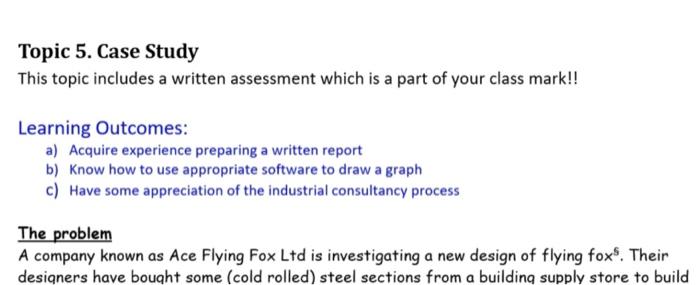
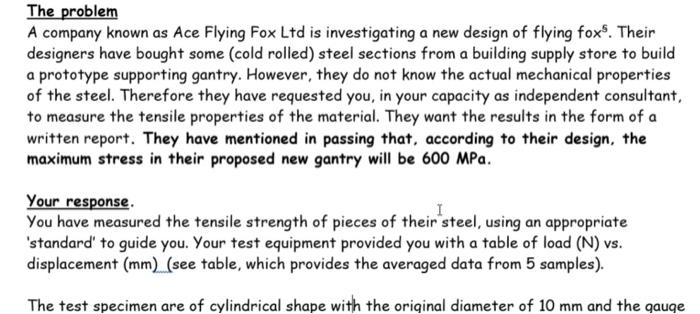
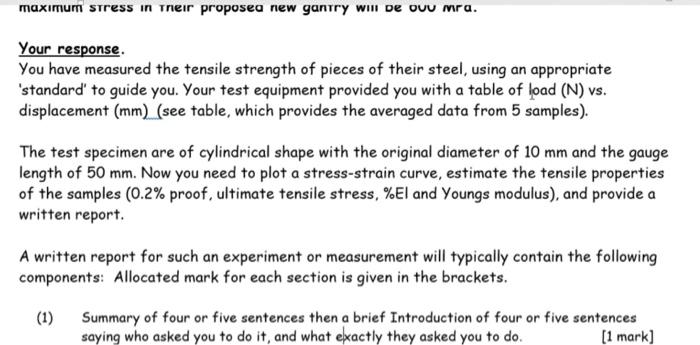
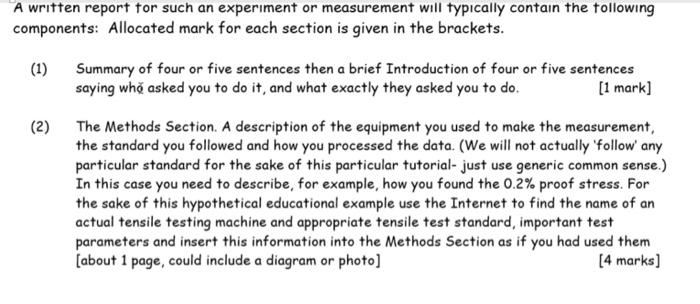
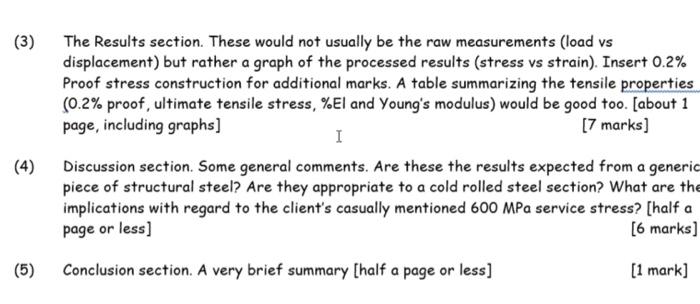
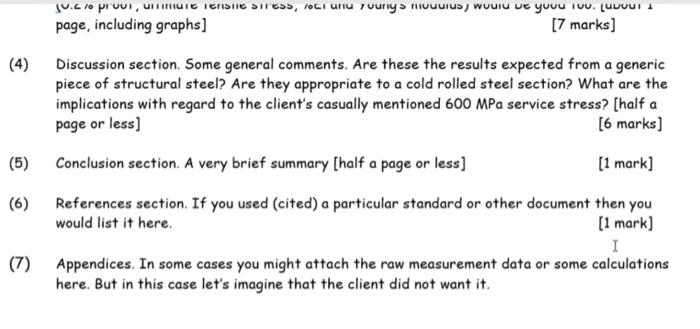
Topic 5. Case Study This topic includes a written assessment which is a part of your class mark!! Learning Outcomes: a) Acquire experience preparing a written report b) Know how to use appropriate software to draw a graph c) Have some appreciation of the industrial consultancy process The problem A company known as Ace Flying Fox Ltd is investigating a new design of flying fox. Their designers have bought some (cold rolled) steel sections from a building supply store to build The problem A company known as Ace Flying Fox Ltd is investigating a new design of flying fox. Their designers have bought some (cold rolled) steel sections from a building supply store to build a prototype supporting gantry. However, they do not know the actual mechanical properties of the steel. Therefore they have requested you, in your capacity as independent consultant, to measure the tensile properties of the material. They want the results in the form of a written report. They have mentioned in passing that, according to their design, the maximum stress in their proposed new gantry will be 600 MPa. Your response. 1 You have measured the tensile strength of pieces of their steel, using an appropriate 'standard' to guide you. Your test equipment provided you with a table of load (N) vs. displacement (mm) (see table, which provides the averaged data from 5 samples). The test specimen are of cylindrical shape with the original diameter of 10 mm and the gauge maximum stress in their proposea new gantry will be ovu mra. Your response. You have measured the tensile strength of pieces of their steel, using an appropriate 'standard' to guide you. Your test equipment provided you with a table of load (N) vs. displacement (mm) (see table, which provides the averaged data from 5 samples). The test specimen are of cylindrical shape with the original diameter of 10 mm and the gauge length of 50 mm. Now you need to plot a stress-strain curve, estimate the tensile properties of the samples (0.2% proof, ultimate tensile stress, %El and Youngs modulus), and provide a written report. A written report for such an experiment or measurement will typically contain the following components: Allocated mark for each section is given in the brackets. (1) Summary of four or five sentences then a brief Introduction of four or five sentences saying who asked you to do it, and what exactly they asked you to do. [1 mark] A written report for such an experiment or measurement will typically contain the following components: Allocated mark for each section is given in the brackets. (1) Summary of four or five sentences then a brief Introduction of four or five sentences saying who asked you to do it, and what exactly they asked you to do. [1 mark] (2) The Methods Section. A description of the equipment you used to make the measurement, the standard you followed and how you processed the data. (We will not actually 'follow' any particular standard for the sake of this particular tutorial- just use generic common sense.) In this case you need to describe, for example, how you found the 0.2% proof stress. For the sake of this hypothetical educational example use the Internet to find the name of an actual tensile testing machine and appropriate tensile test standard, important test parameters and insert this information into the Methods Section as if you had used them [about 1 page, could include a diagram or photo) [4 marks] (3) The Results section. These would not usually be the raw measurements (load vs displacement) but rather a graph of the processed results (stress vs strain). Insert 0.2% Proof stress construction for additional marks. A table summarizing the tensile properties (0.2% proof, ultimate tensile stress, %El and Young's modulus) would be good too. (about 1 page, including graphs] [7 marks] 1 Discussion section. Some general comments. Are these the results expected from a generic piece of structural steel? Are they appropriate to a cold rolled steel section? What are the implications with regard to the client's casually mentioned 600 MPa service stress? (half a page or less] [6 marks] (4) (5) Conclusion section. A very brief summary [half a page or less] [1 mark] 10.clo proui, MIE IETSIE SITES, locIuniu roury mouuius) Woulu ve yuuu Tou, LUDOUI: page, including graphs] [7 marks] Discussion section. Some general comments. Are these the results expected from a generic piece of structural steel? Are they appropriate to a cold rolled steel section? What are the implications with regard to the client's casually mentioned 600 MPa service stress? (half a page or less) [6 marks) Conclusion section. A very brief summary [half a page or less] [1 mark] (5) (6) References section. If you used (cited) a particular standard or other document then you would list it here. [1 mark] 1 Appendices. In some cases you might attach the raw measurement data or some calculations here. But in this case let's imagine that the client did not want it. Topic 5. Case Study This topic includes a written assessment which is a part of your class mark!! Learning Outcomes: a) Acquire experience preparing a written report b) Know how to use appropriate software to draw a graph c) Have some appreciation of the industrial consultancy process The problem A company known as Ace Flying Fox Ltd is investigating a new design of flying fox. Their designers have bought some (cold rolled) steel sections from a building supply store to build The problem A company known as Ace Flying Fox Ltd is investigating a new design of flying fox. Their designers have bought some (cold rolled) steel sections from a building supply store to build a prototype supporting gantry. However, they do not know the actual mechanical properties of the steel. Therefore they have requested you, in your capacity as independent consultant, to measure the tensile properties of the material. They want the results in the form of a written report. They have mentioned in passing that, according to their design, the maximum stress in their proposed new gantry will be 600 MPa. Your response. 1 You have measured the tensile strength of pieces of their steel, using an appropriate 'standard' to guide you. Your test equipment provided you with a table of load (N) vs. displacement (mm) (see table, which provides the averaged data from 5 samples). The test specimen are of cylindrical shape with the original diameter of 10 mm and the gauge maximum stress in their proposea new gantry will be ovu mra. Your response. You have measured the tensile strength of pieces of their steel, using an appropriate 'standard' to guide you. Your test equipment provided you with a table of load (N) vs. displacement (mm) (see table, which provides the averaged data from 5 samples). The test specimen are of cylindrical shape with the original diameter of 10 mm and the gauge length of 50 mm. Now you need to plot a stress-strain curve, estimate the tensile properties of the samples (0.2% proof, ultimate tensile stress, %El and Youngs modulus), and provide a written report. A written report for such an experiment or measurement will typically contain the following components: Allocated mark for each section is given in the brackets. (1) Summary of four or five sentences then a brief Introduction of four or five sentences saying who asked you to do it, and what exactly they asked you to do. [1 mark] A written report for such an experiment or measurement will typically contain the following components: Allocated mark for each section is given in the brackets. (1) Summary of four or five sentences then a brief Introduction of four or five sentences saying who asked you to do it, and what exactly they asked you to do. [1 mark] (2) The Methods Section. A description of the equipment you used to make the measurement, the standard you followed and how you processed the data. (We will not actually 'follow' any particular standard for the sake of this particular tutorial- just use generic common sense.) In this case you need to describe, for example, how you found the 0.2% proof stress. For the sake of this hypothetical educational example use the Internet to find the name of an actual tensile testing machine and appropriate tensile test standard, important test parameters and insert this information into the Methods Section as if you had used them [about 1 page, could include a diagram or photo) [4 marks] (3) The Results section. These would not usually be the raw measurements (load vs displacement) but rather a graph of the processed results (stress vs strain). Insert 0.2% Proof stress construction for additional marks. A table summarizing the tensile properties (0.2% proof, ultimate tensile stress, %El and Young's modulus) would be good too. (about 1 page, including graphs] [7 marks] 1 Discussion section. Some general comments. Are these the results expected from a generic piece of structural steel? Are they appropriate to a cold rolled steel section? What are the implications with regard to the client's casually mentioned 600 MPa service stress? (half a page or less] [6 marks] (4) (5) Conclusion section. A very brief summary [half a page or less] [1 mark] 10.clo proui, MIE IETSIE SITES, locIuniu roury mouuius) Woulu ve yuuu Tou, LUDOUI: page, including graphs] [7 marks] Discussion section. Some general comments. Are these the results expected from a generic piece of structural steel? Are they appropriate to a cold rolled steel section? What are the implications with regard to the client's casually mentioned 600 MPa service stress? (half a page or less) [6 marks) Conclusion section. A very brief summary [half a page or less] [1 mark] (5) (6) References section. If you used (cited) a particular standard or other document then you would list it here. [1 mark] 1 Appendices. In some cases you might attach the raw measurement data or some calculations here. But in this case let's imagine that the client did not want it
Step by Step Solution
There are 3 Steps involved in it

Get step-by-step solutions from verified subject matter experts
 Study Help