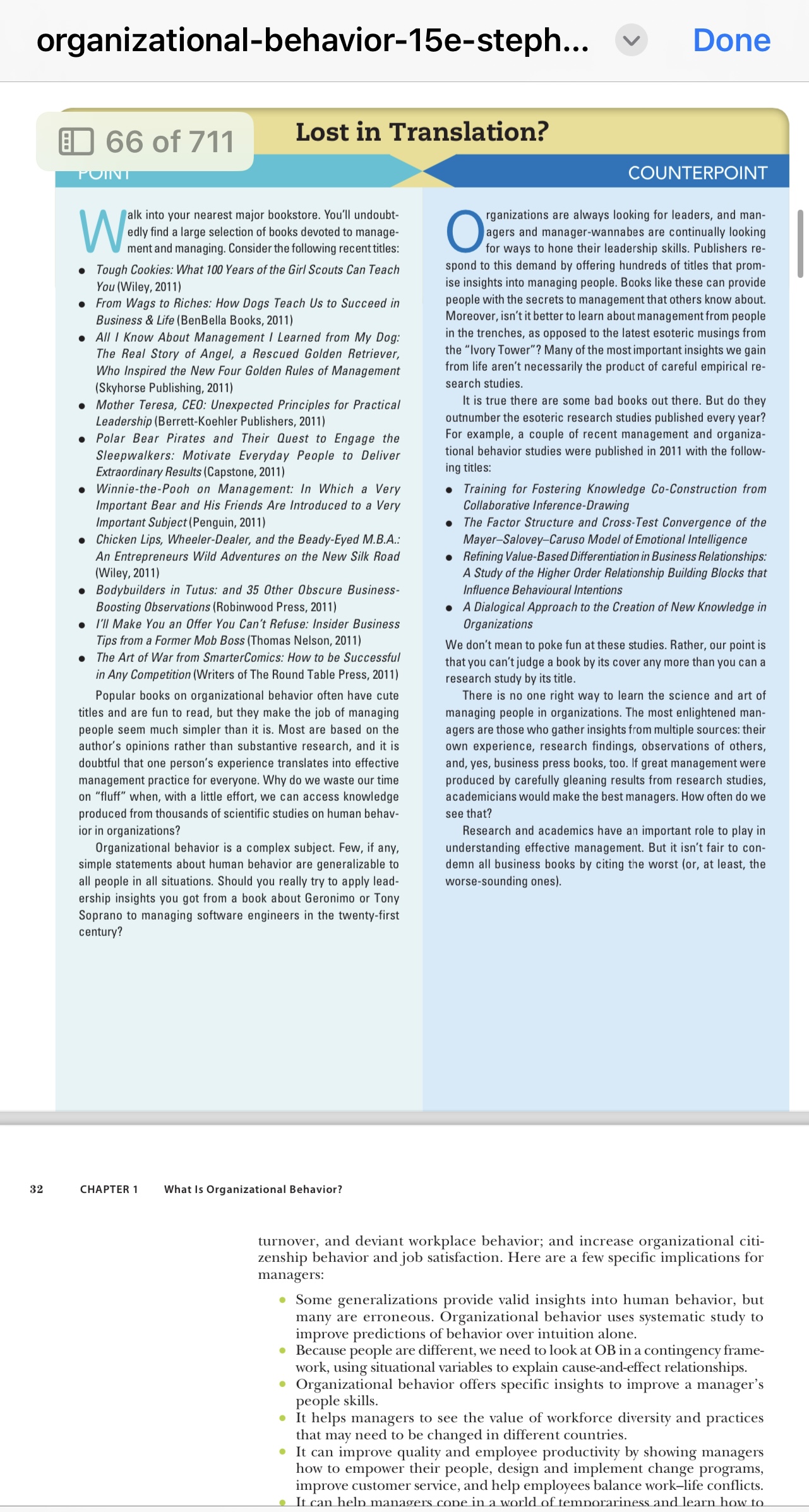
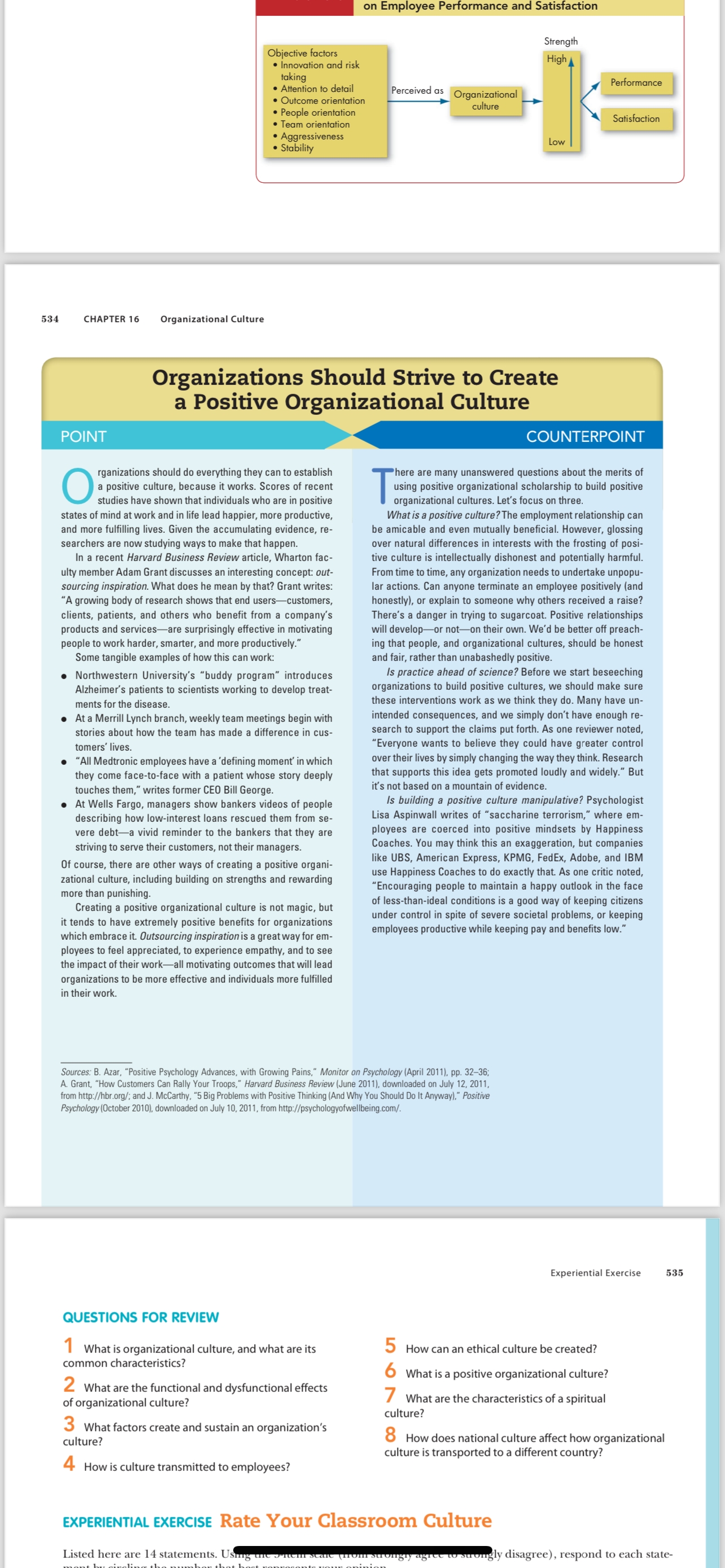
Question: Label Each Question and Section: Read the Point/Counterpoint on page 534 of the text: Organizations Should Strive to Create Positive Organizational Culture Should organizations do
Label Each Question and Section:
Read the Point/Counterpoint on page 534 of the text:
Organizations Should Strive to Create Positive Organizational Culture
Should organizations do everything they can to establish a positive culture, because it works, or is building positive culture manipulative?
Write eight page paper arguing both points and ending with the role of management in the establishment of the organizational culture, incorporating the four functions of management (as described in chapter 1 of your textbook) into this portion of the discussion.
The first section should argue that an organization should do everything they can to establish a positive culture.
The next section should argue that building a positive culture is manipulative.
This section should discuss the role of management in creating an organization's culture. Incorporate the four functions of management into this section of your paper.
Additionally, although global managers perform the same basic functions as domestic managers (planning, organizing, leading, controlling), in what ways might they need to adjust for more variables and environments when operating in a foreign market (e.g., planning to export; planning stages of different cultures; controlling language barriers or differing legal requirements)
Supporting documentation is required: A minimum of six peer-reviewed references must be cited within the paper - two peer-reviewed references for each of the three sections listed above. The peer-reviewed references should be cited within the paper using PA format for the citations within the paper and on the reference. May provide as many additional references as like, as long as meet the minimum number listed above. Again, the paper should be eight pages in length. The reference will count as page number nine.
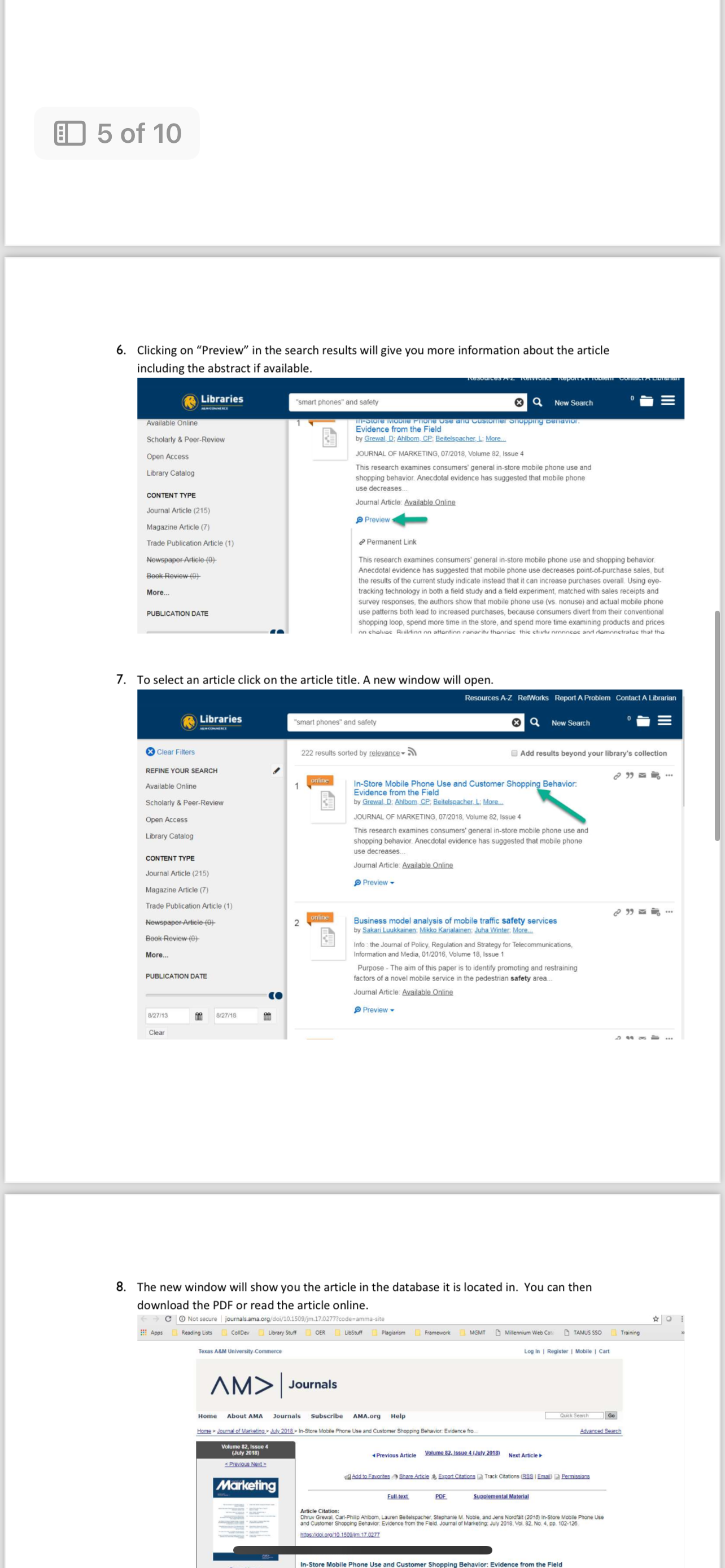
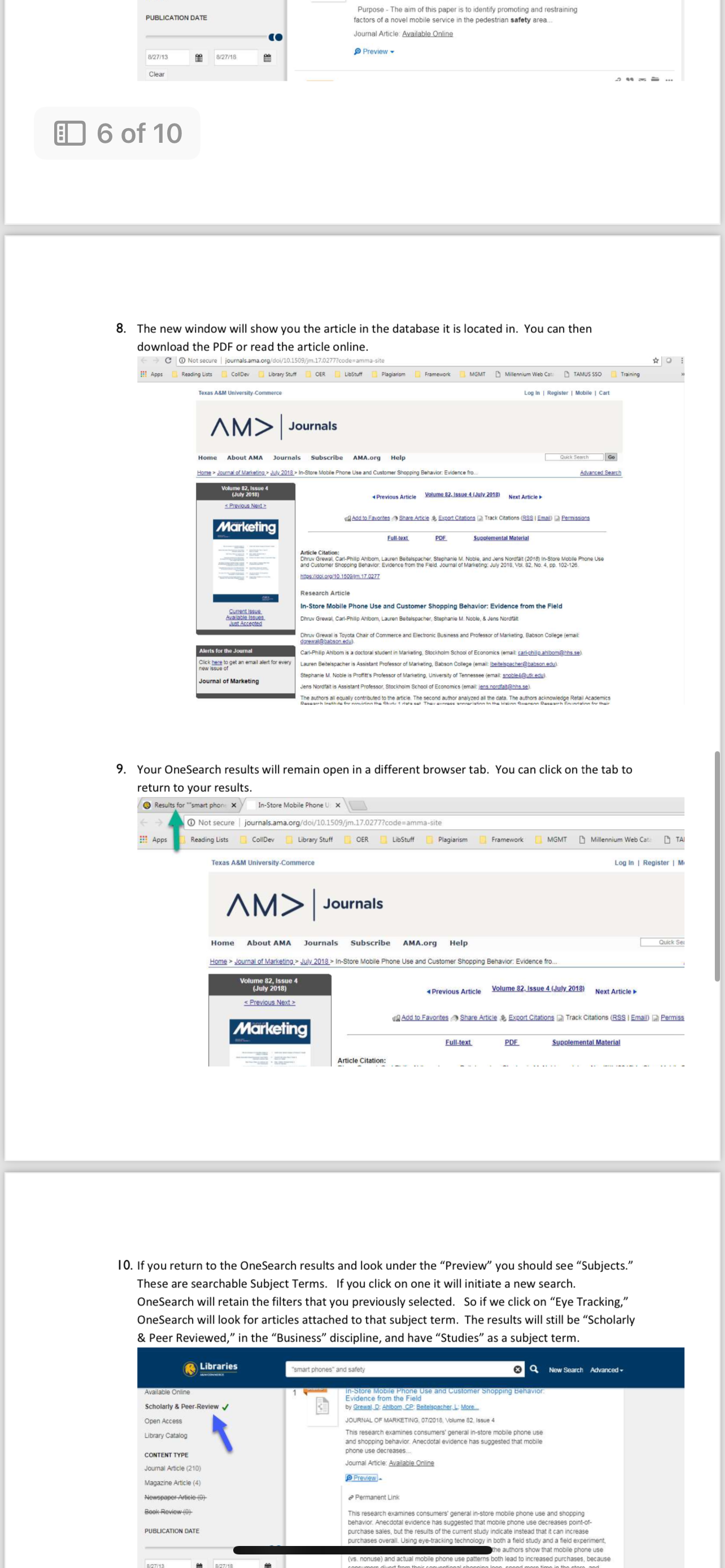
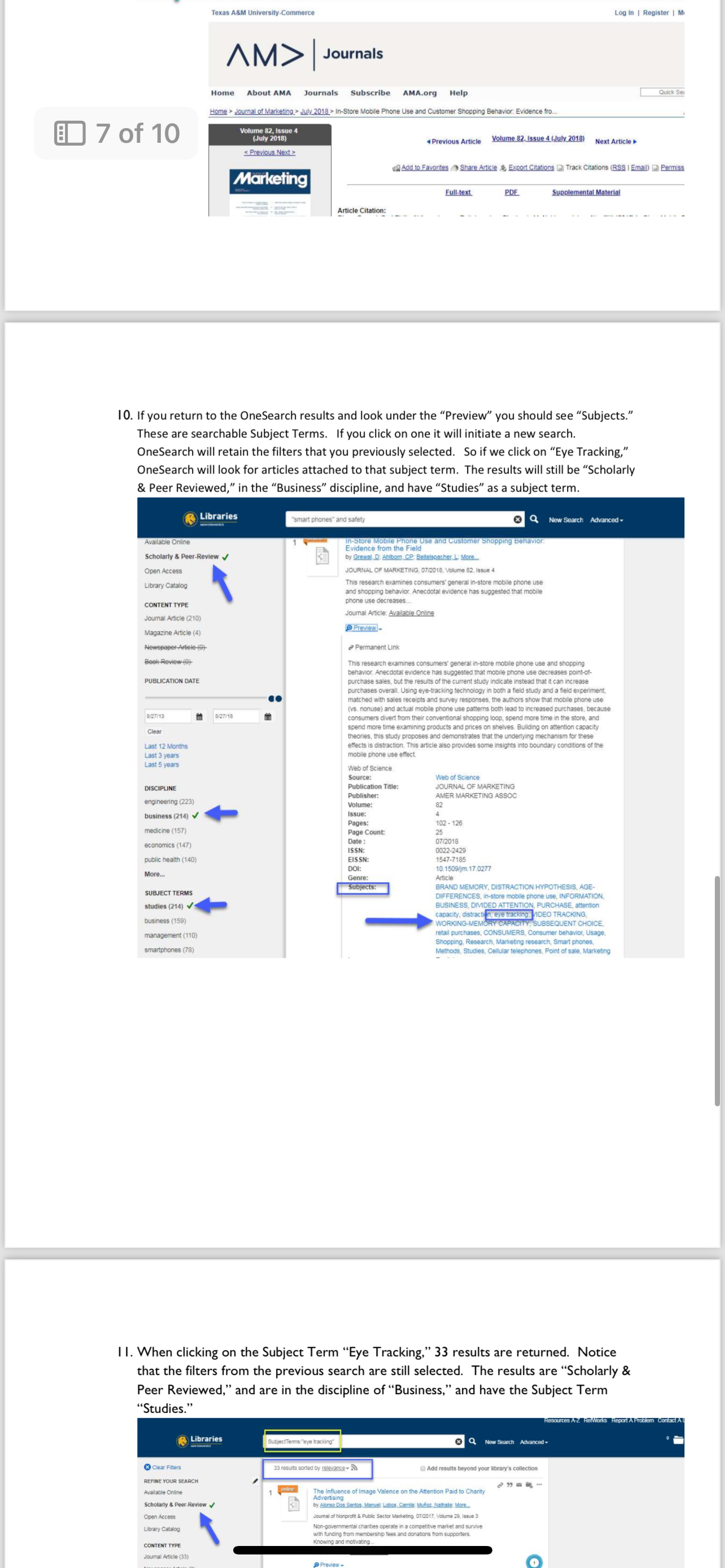
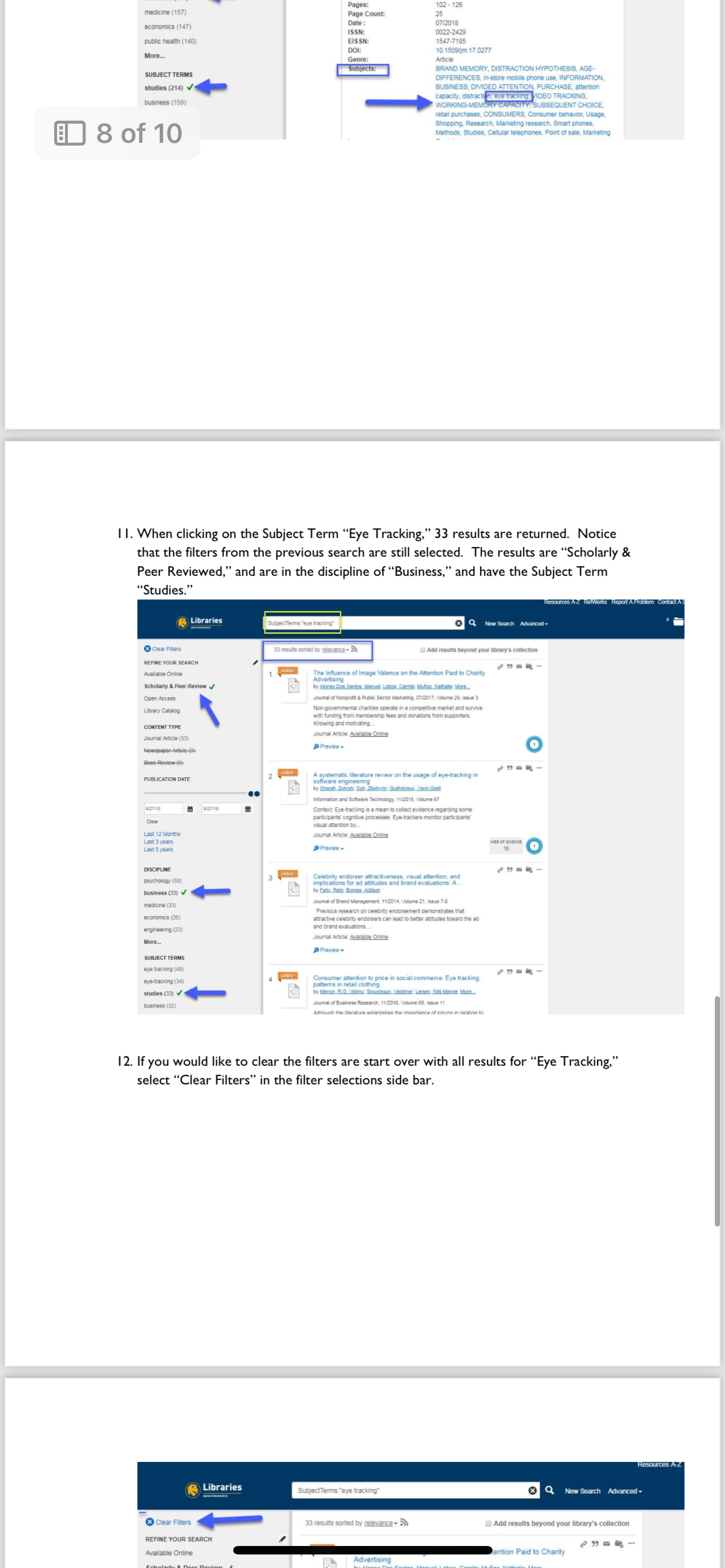
Finding a peer-reviewed reference: Go to linthe link labeled 'Gee Library
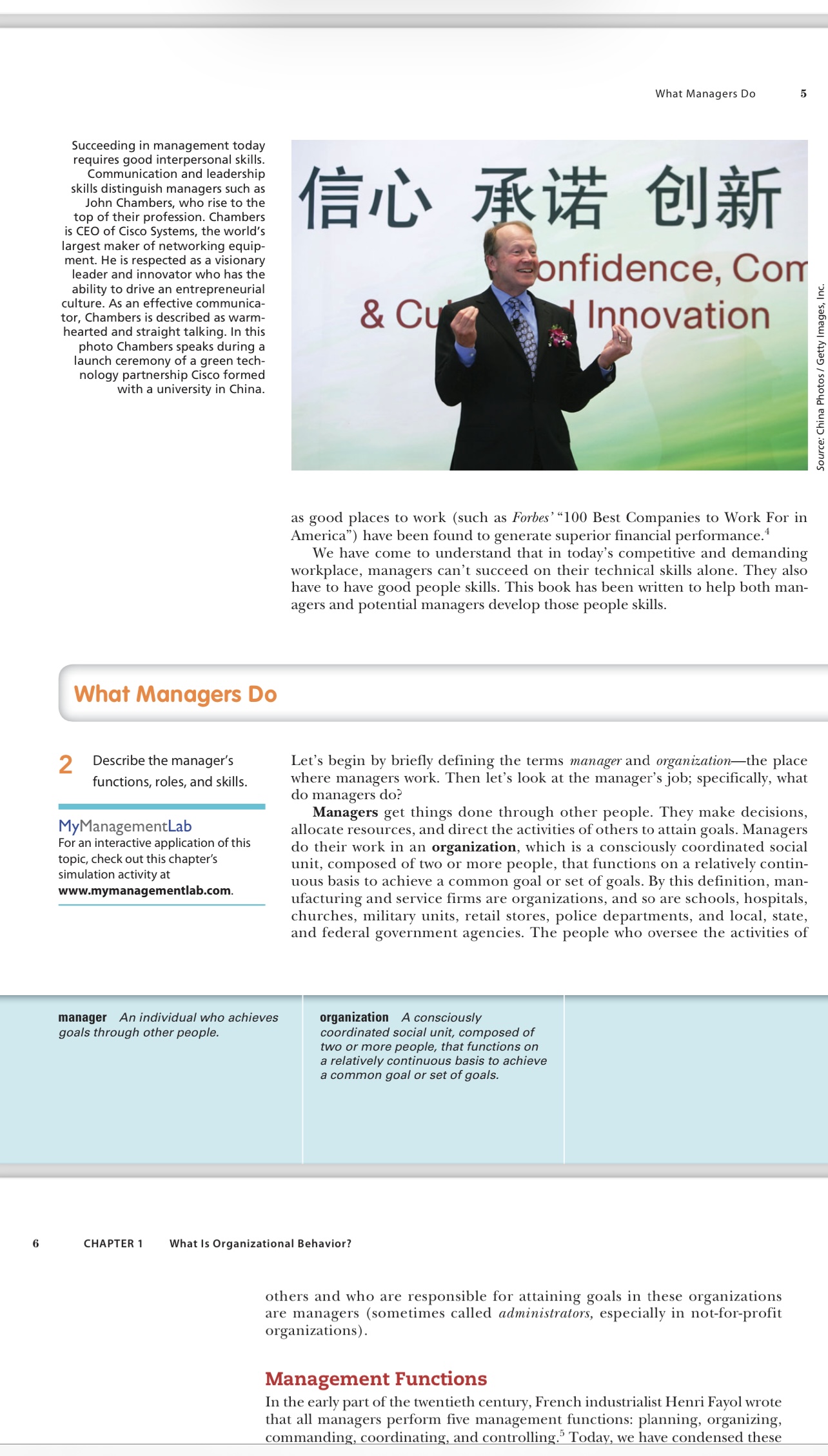
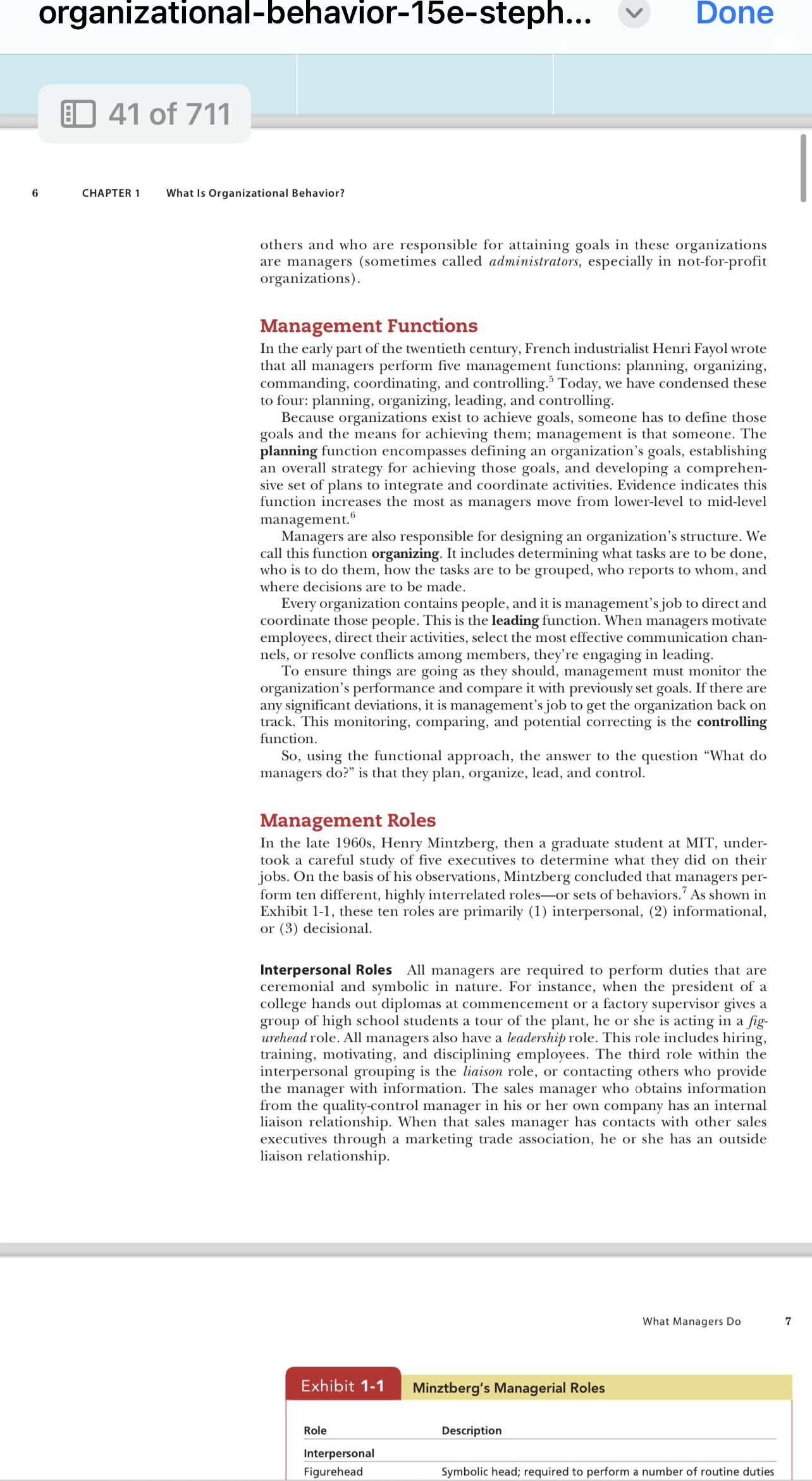
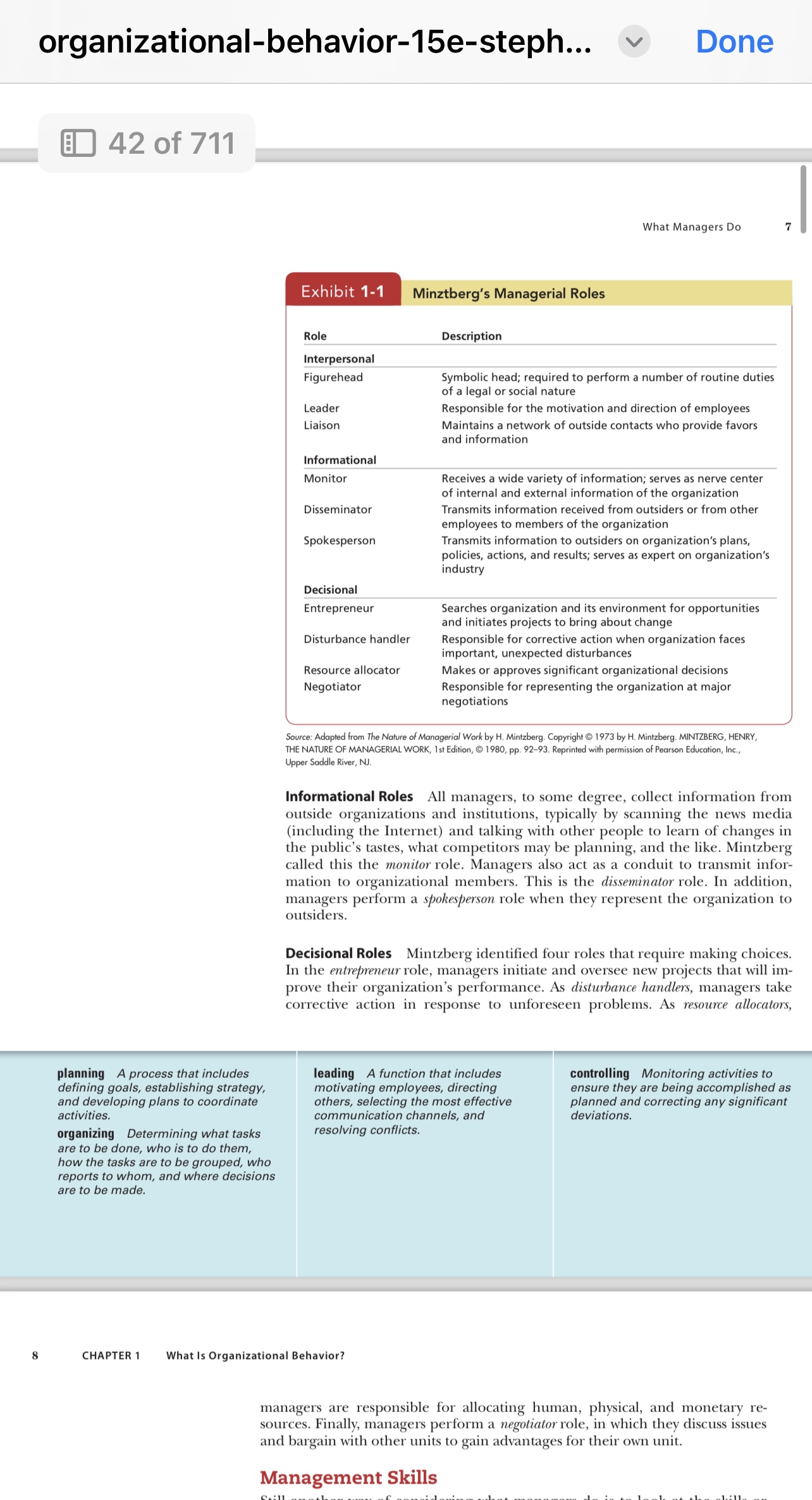
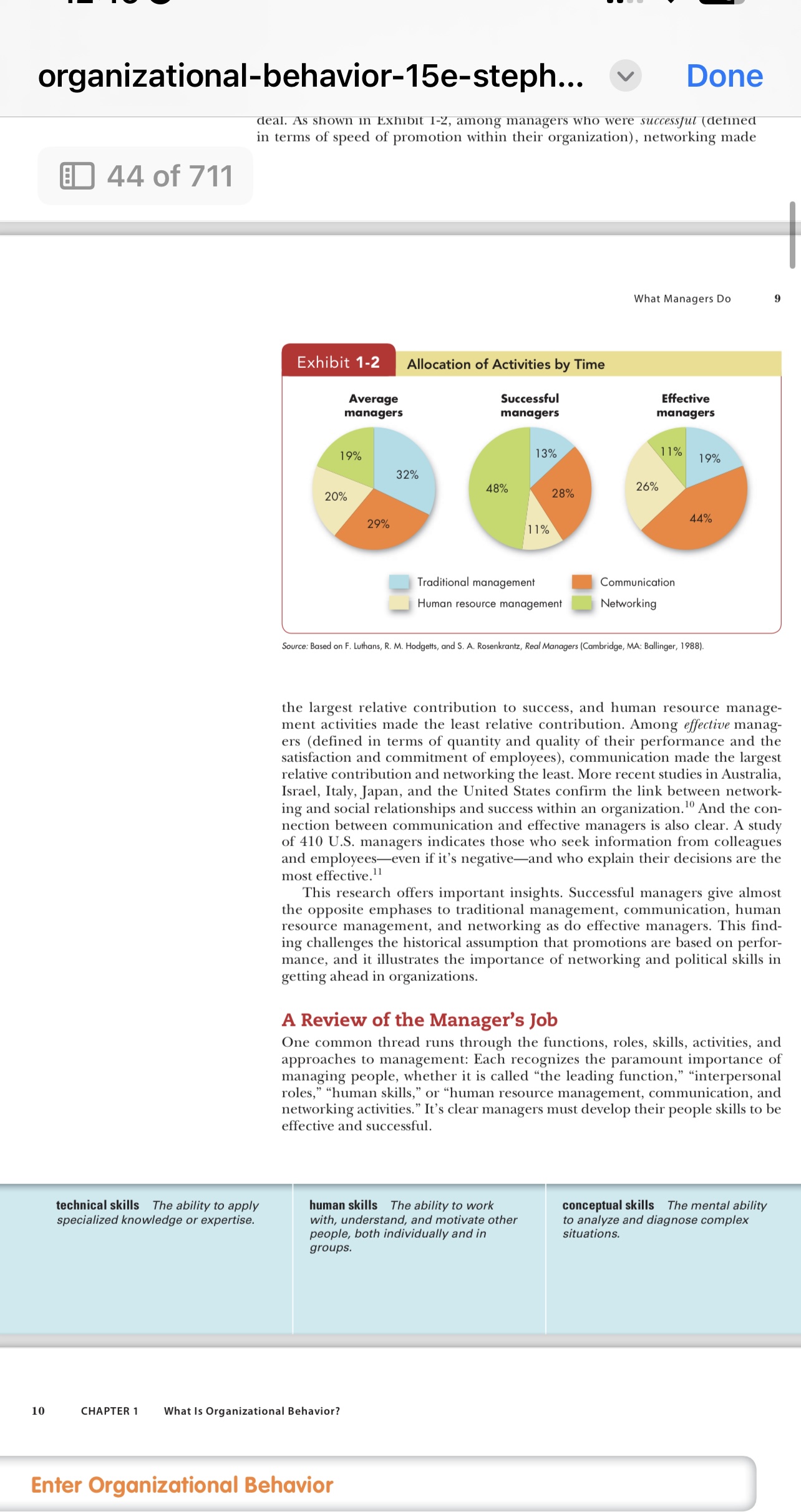
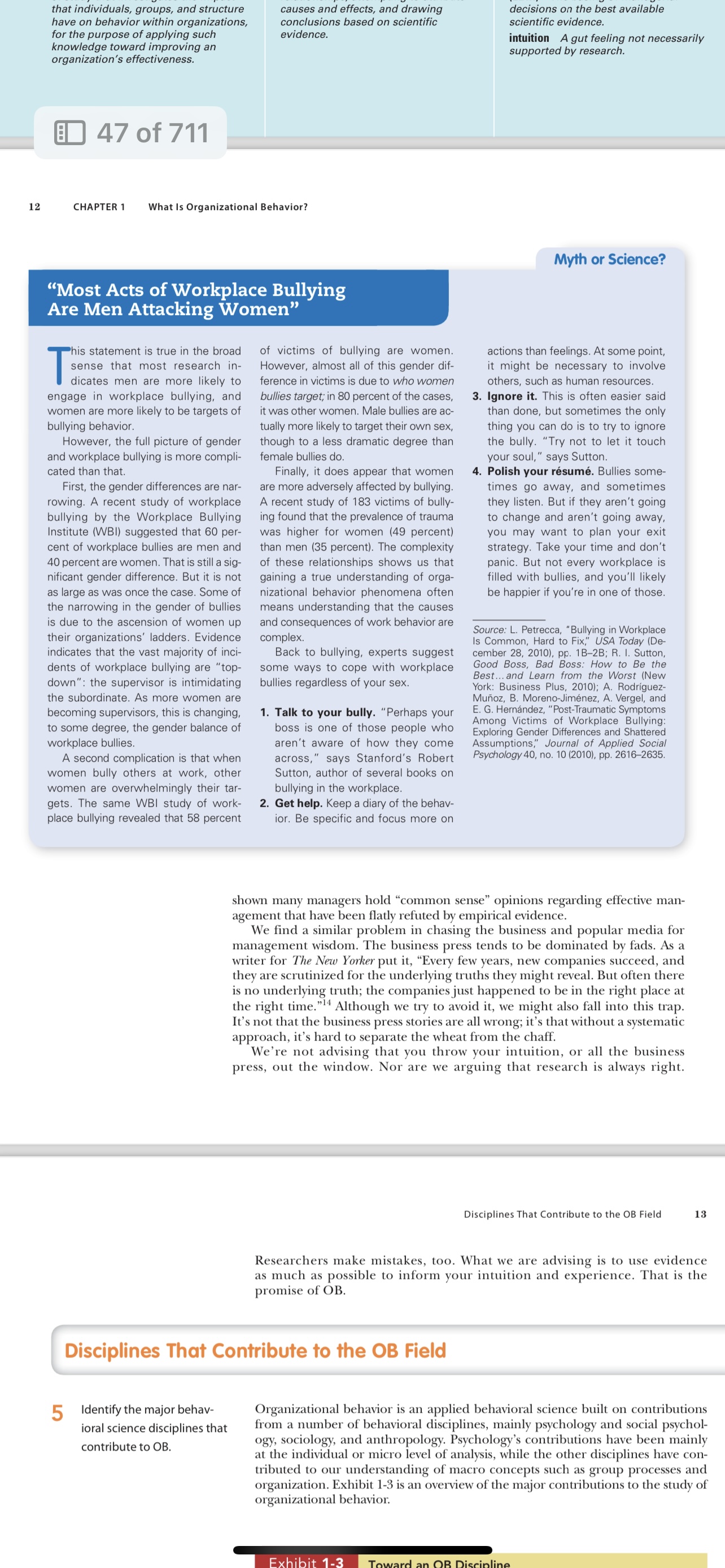
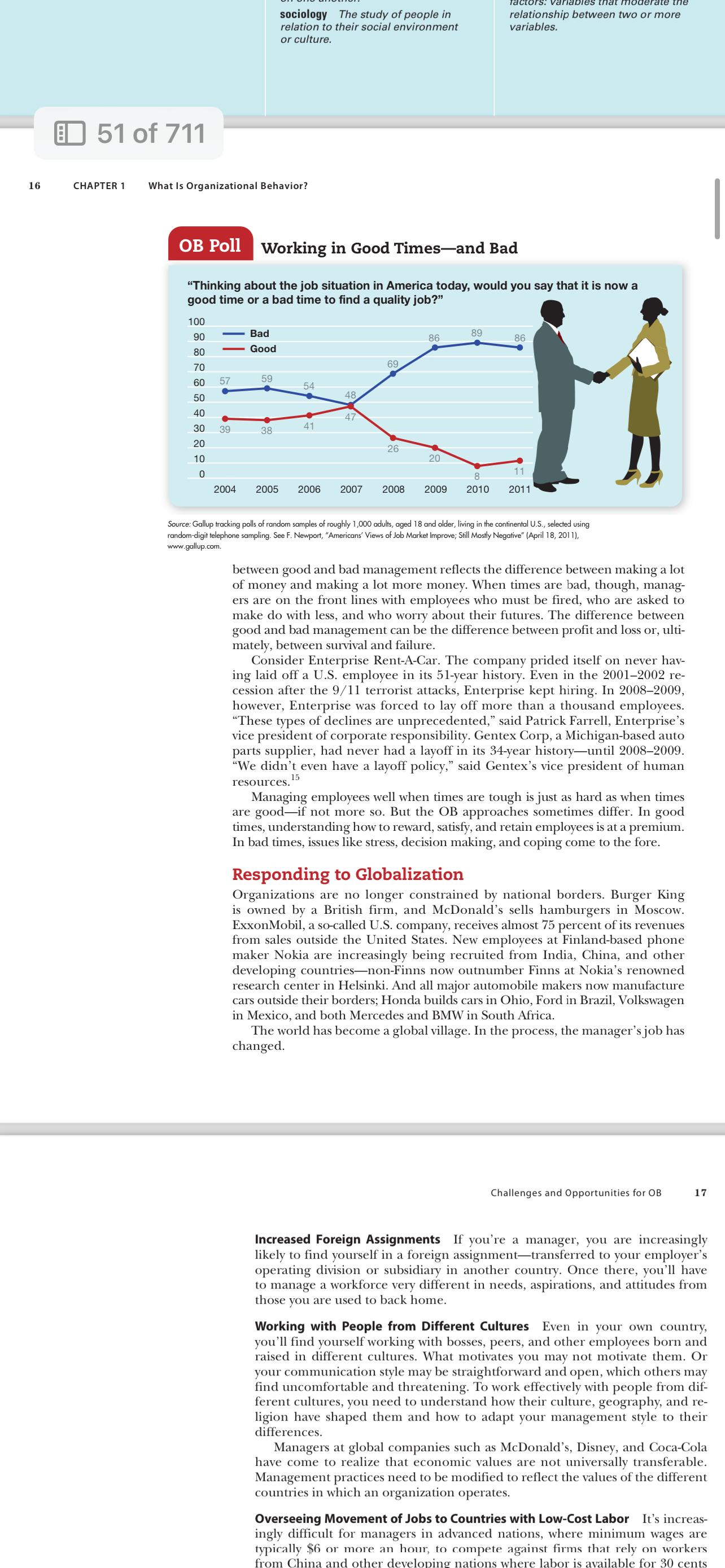
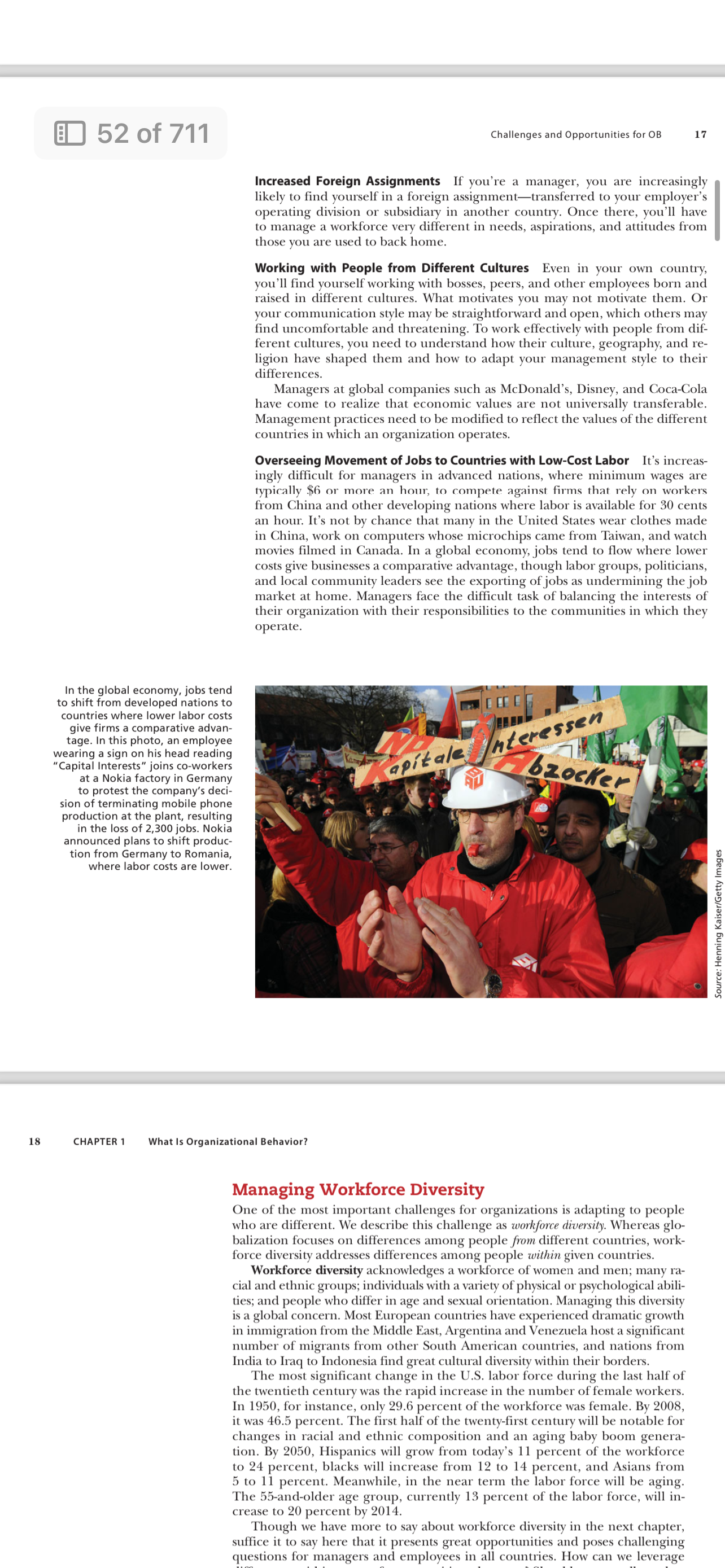
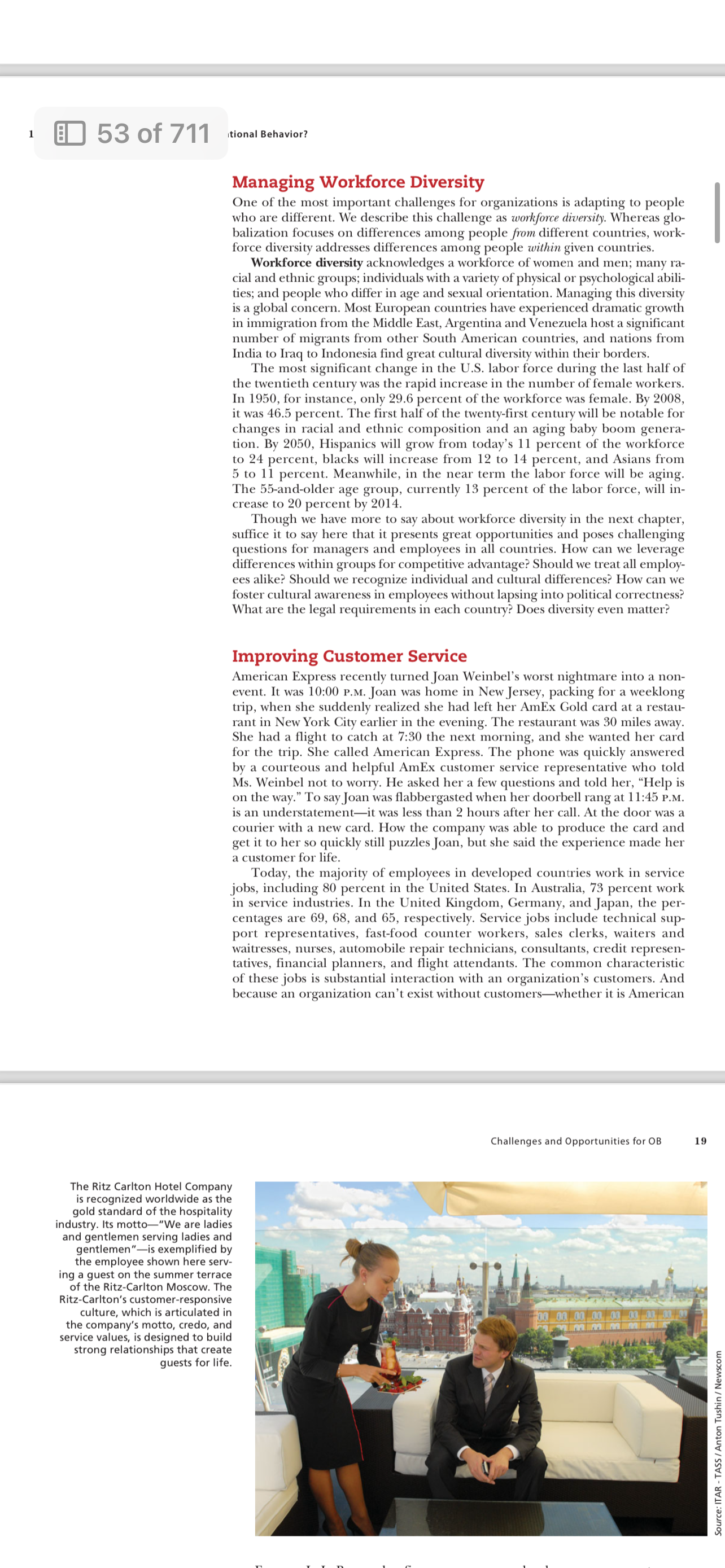
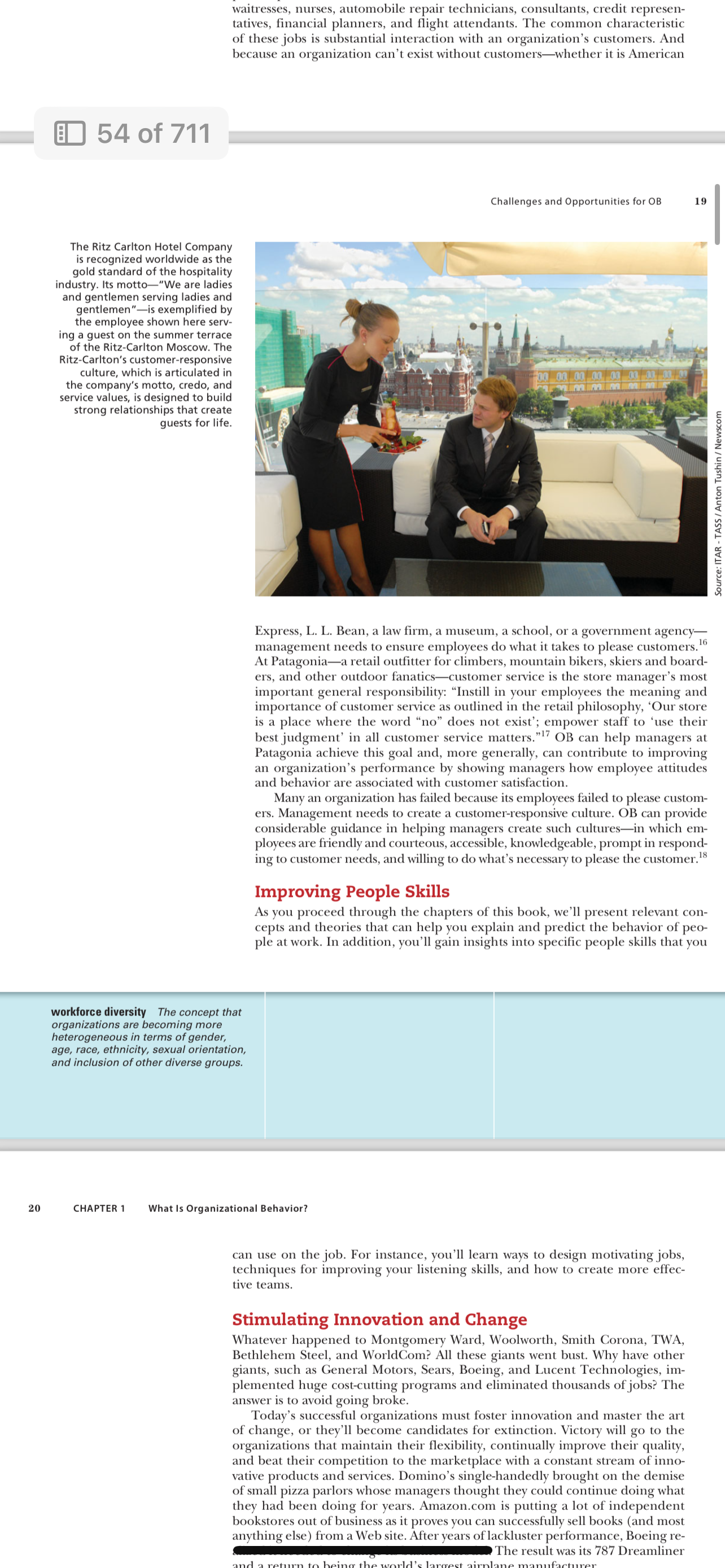
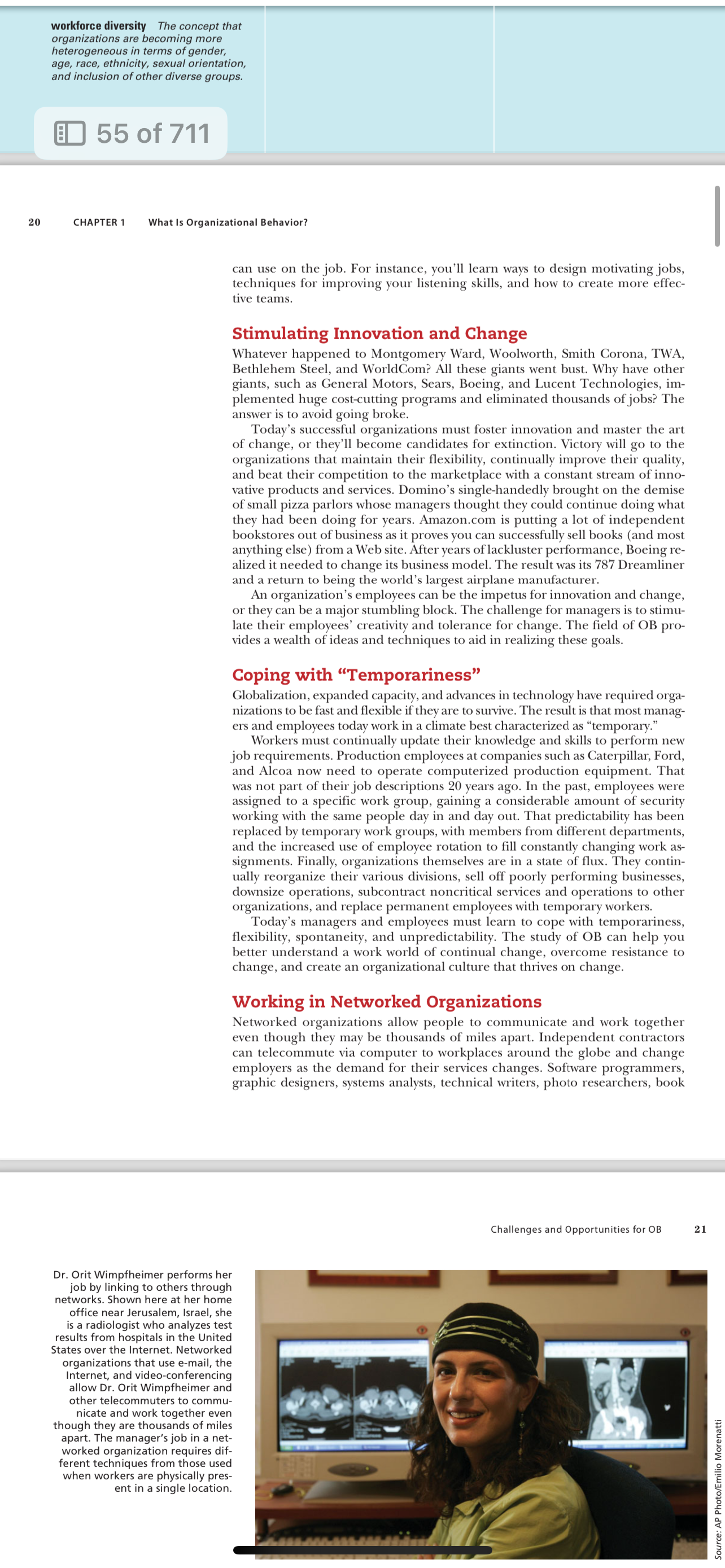
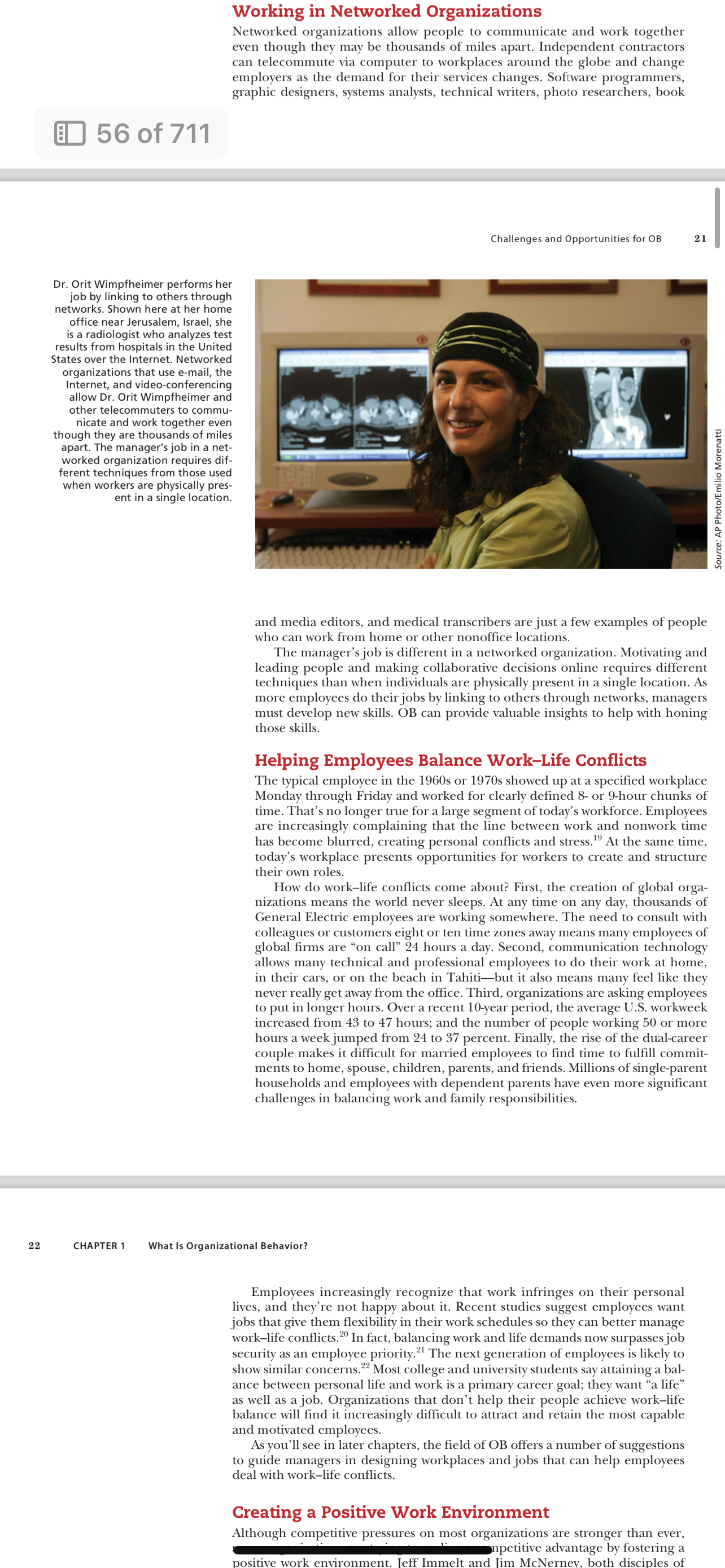
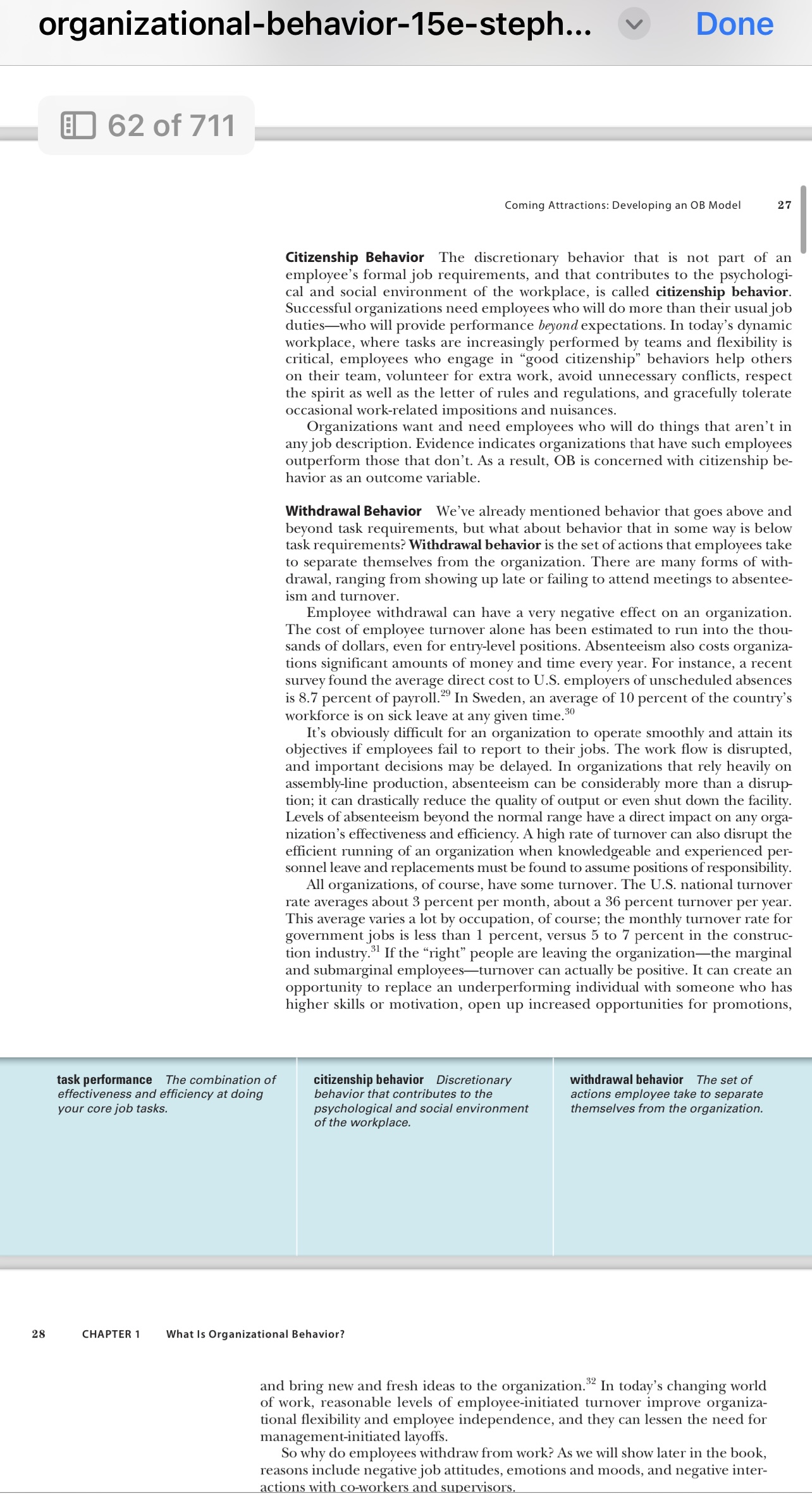
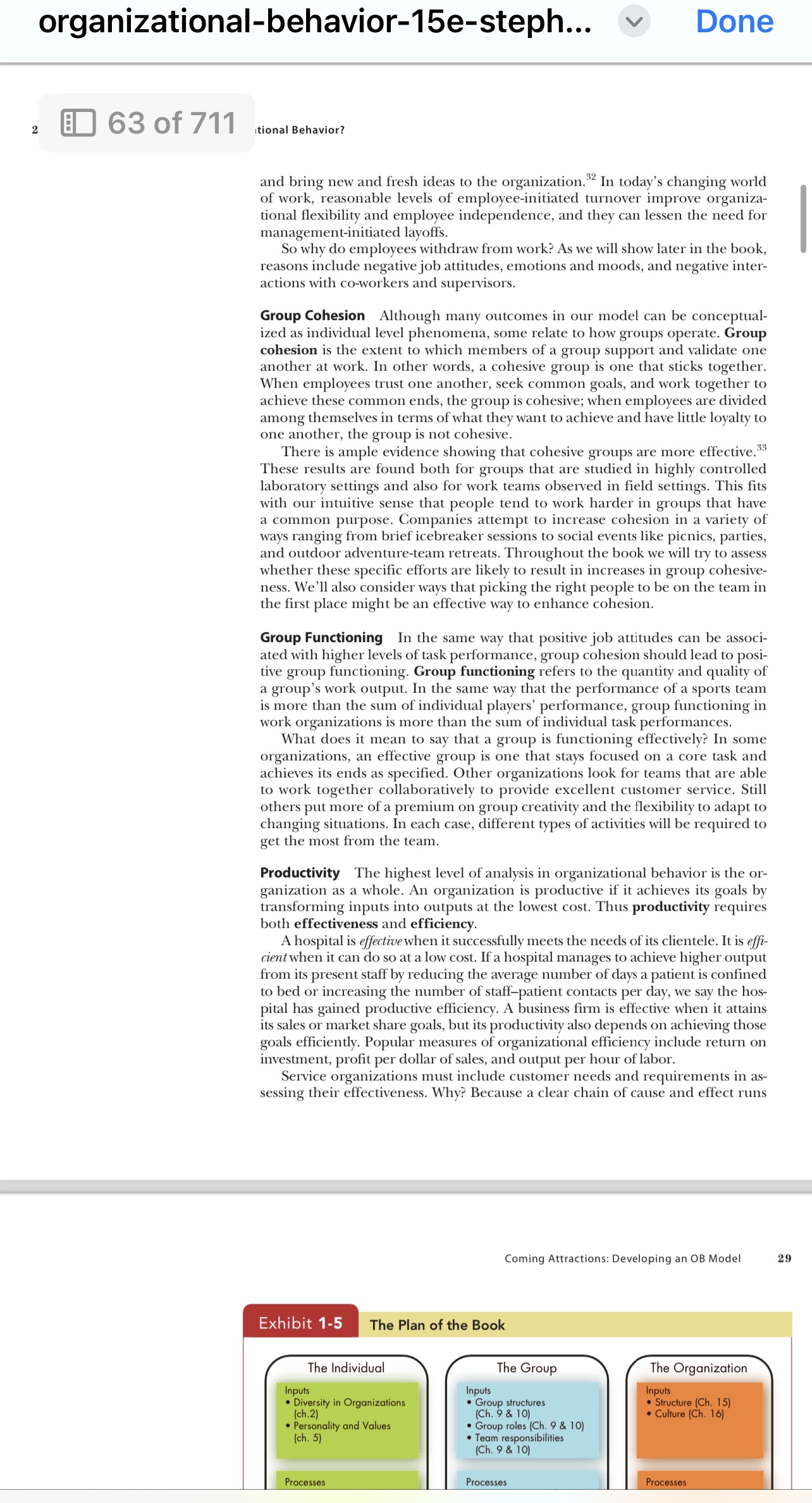
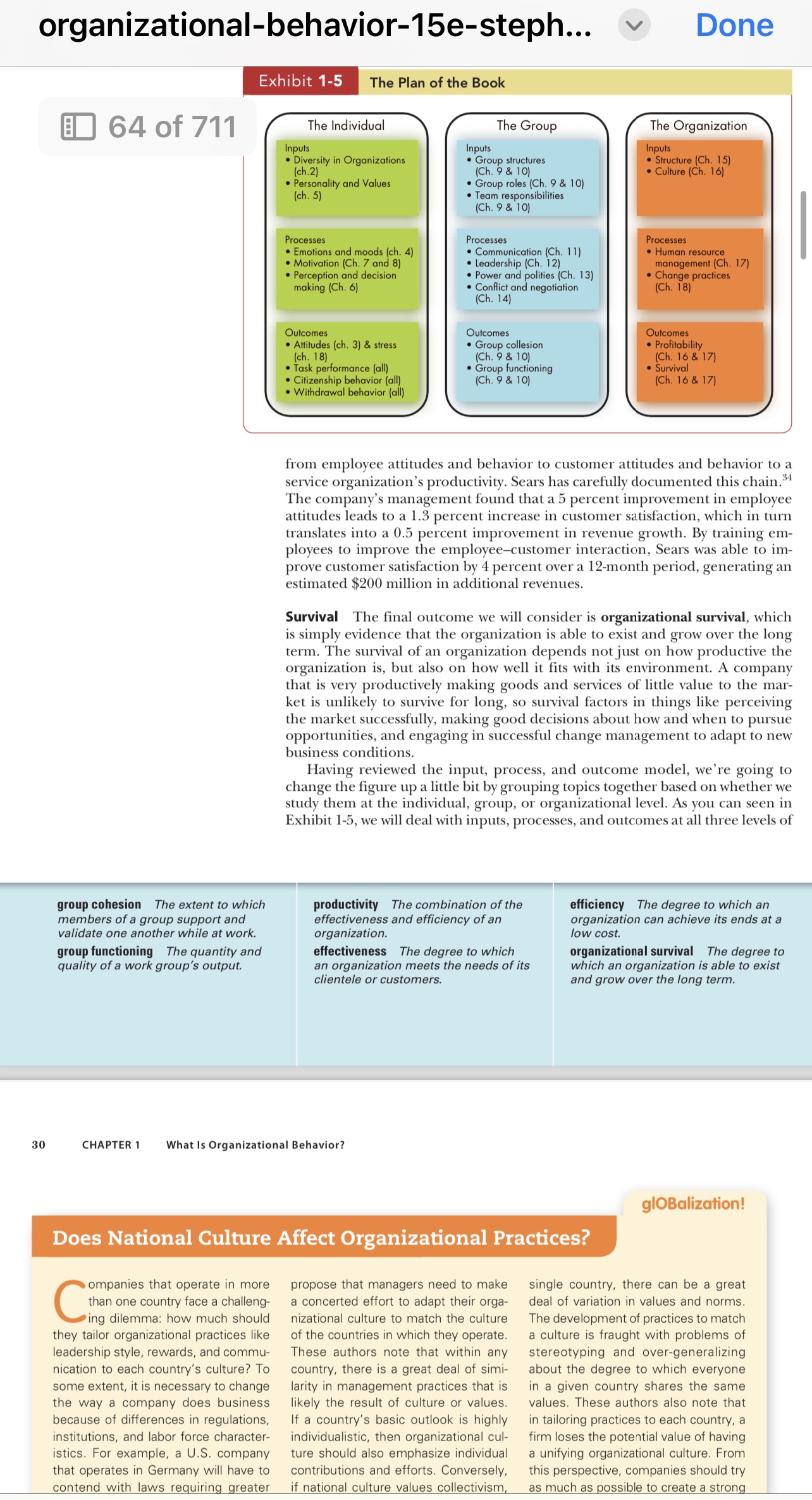
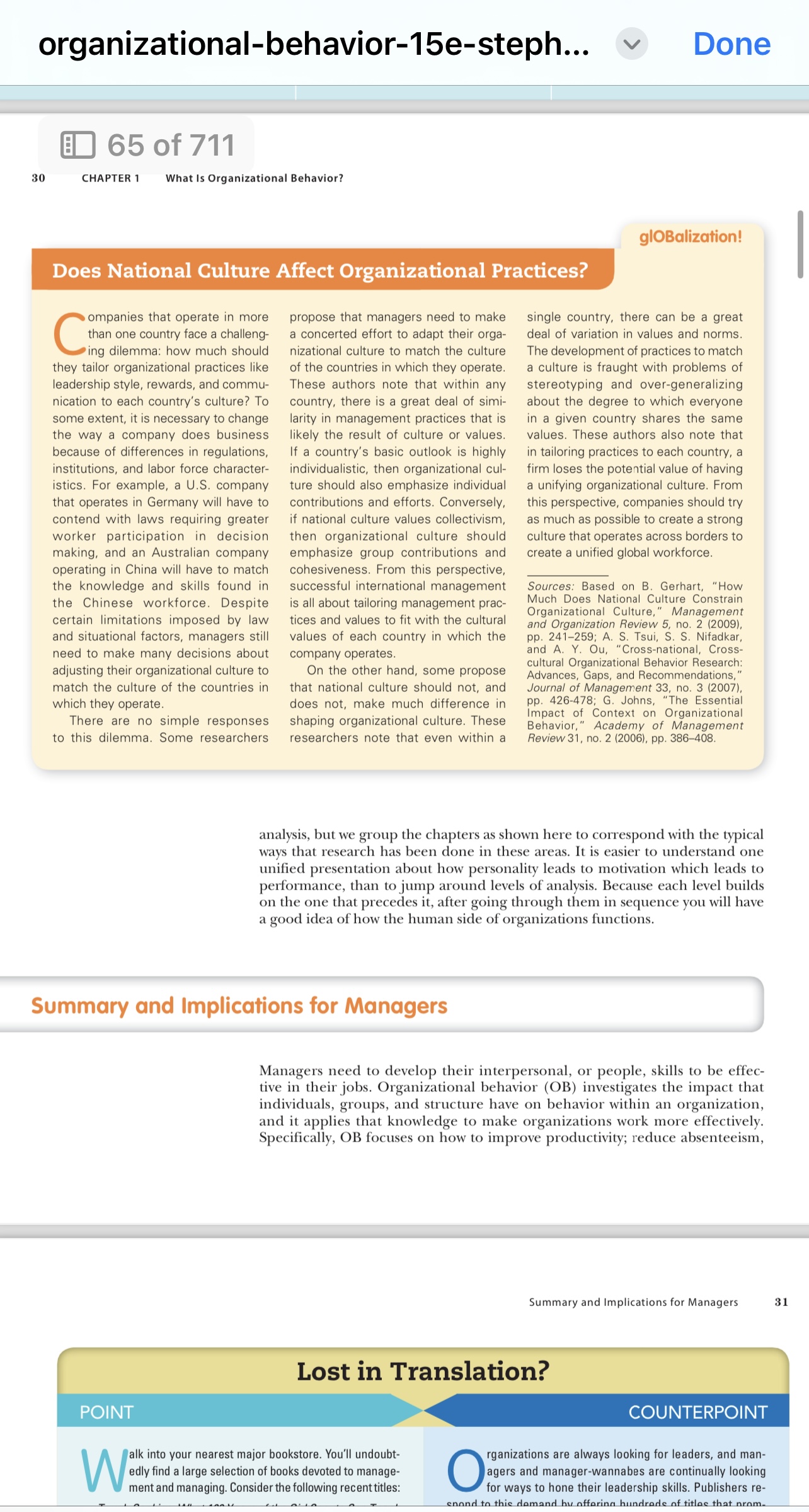
organizational-behavior-15e-steph... ~ Done 4 Photo: Scott Nichokon. Sour CHAPTER 1 What Is Organizational Behavior? 00 SELF-ASSESSMENT LIBRARY he details of this story might be disheartening to read, but they accurately reflect some of the problems faced by the contemporary workforce. The story also highlights several issues of interest to organizational behavior researchers, including motivation, emotions, personality, and communication. Through the course of this book, you'll learn how all these elements can be studied systematically. You've probably made many observations about people's behavior in your life. In a way, you are already proficient at seeing some of the major themes in organizational behavior. At the same time, you probably have not had the tools is where organizational behavior to make these observations systematically. This comes into play. And, as we'll learn, it is much more than common sense, intu- ition, and soothsaying. To see how far common sense gets you, try the following from the Self- Assessment Library. In the Self-Assessment Library (available on CD and online), take assessment IV.G.1 (How Much Do I Know About OB?) and answer the following questions: 1. How did you score? Are you surprised by your score? 2. How much of effective management do you think is common sense? Did your score on the test change your answer to this question? The Importance of Interpersonal Skills 1 Demonstrate the impor- tance of interpersonal skills in the workplace. Until the late 1980s, business school curricula emphasized the technical aspects of management, focusing on economics, accounting, finance, and quantitative techniques. Course work in human behavior and people skills received rela- tively less attention. Over the past three decades, however, business faculty have come to realize the role that understanding human behavior plays in determin- ing a manager's effectiveness, and required courses on people skills have been added to many curricula. As the director of leadership at MIT's Sloan School of Management put it, \"M.B.A. students may get by on their technical and quan- titative skills the first couple of years out of school. But soon, leadership and communication skills come to the fore in distinguishing the managers whose careers really take 5 Developing managers' interpersonal skills also helps organizations attract and keep high-performing employees. Regardless of labor market conditions, outstanding employees are always in short supply.\" Companies known as good places to worksuch as Starbucks, Adobe Systems, Cisco, Whole Foods, Google, American Express, Amgen, Pfizer, and Marriotthave a big advantage. A recent survey of hundreds of workplaces, and more than 200,000 respondents, showed the social relationships among co-workers and supervisors were strongly related to overall job satisfaction. Positive social relationships also were associated with lower stress at work and lower intentions to quil.\"" So having managers with good interpersonal skills is likely to make the workplace more pleasant, which in turn makes it easier to hire and keep qualified people. Creating a pleasant work- place also appears to make good economic sense. Companies with reputations What Managers Do Succeeding in management today Succeeding in management today requires good interpersonal skills. Communication and leadership skills distinguish managers such as John Chambers, who rise to the top of their profession. Chambers is CEO of Cisco Systems, the world's largest maker of networking equip- ment. He is respected as a visionary leader and innovator who has the ability to drive an entrepreneurial culture. As an effective communica- tor, Chambers is described as warm- hearted and straight talking. In this photo Chambers speaks during a launch ceremony of a green tech- nology partnership Cisco formed with a university in China. What Managers Do 2 Describe the manager's functions, roles, and skills. MyManagementLab For an interactive application of this topic, check out this chapter's simulation activity at www.mymanagementlab.com. What Managers Do 5 Bl nfidence, Conr Innovation as good places to work (such as Forbes' \"100 Best Companies to Work For in America\") have been found to generate superior financial pel'f()rnum::e.4 We have come to understand that in today's competitive and demanding workplace, managers can't succeed on their technical skills alone. They also have to have good people skills. This book has been written to help both man- agers and potential managers develop those people skills. Let's begin by briefly defining the terms manager and organizationthe place where managers work. Then let's look at the manager's job; specifically, what do managers do? Managers get things done through other people. They make decisions, allocate resources, and direct the activities of others to attain goals. Managers do their work in an organization, which is a conscicusly coordinated social unit, composed of two or more people, that functions on a relatively contin- uous basis to achieve a common goal or set of goals. By this definition, man- ufacturing and service firms are organizations, and so are schools, hospitals, churches, military units, retail stores, police departments, and local, state, and federal government agencies. The people who oversee the activities of Source: China Photos / Getty Images, Inc manager An individual who achieves goals through other people. CHAPTER 1 organization A consciously coordinated social unit, composed of two or more people, that functions on a relatively continuous basis to achieve a common goal or set of goals. What Is Organizational Behavior? others and who are responsible for attaining goals in these organizations are managers (sometimes called administrators, especially in not-for-profit organizations). Management Functions In the early part of the twentieth century, French industrialist Henri Fayol wrote that all managers perform five management functions: planning, organizing, commanding, coordinating, and controlling.\" Today, we have condensed these organizational-behavior-15e-steph... ~ Done 6 0 41 of 711 CHAPTER 1 What Is Organizational Behavior? others and who are responsible for attaining goals in these organizations are managers (sometimes called administrators, especially in not-for-profit organizations). Management Functions In the early part of the twentieth century, French industrialist Henri Fayol wrote that all managers perform five management functions: planning, organizing, commanding, coordinating, and contr()lling."' Today, we have condensed these to four: planning, organizing, leading, and controlling. Because organizations exist to achieve goals, someone has to define those goals and the means for achieving them; management is that someone. The planning function encompasses defining an organization's goals, establishing an overall strategy for achieving those goals, and developing a comprehen- sive set of plans to integrate and coordinate activities. Evidence indicates this function increases the most as managers move from lower-level to mid-level management.\" Managers are also responsible for designing an organization's structure. We call this function organizing. It includes determining what tasks are to be done, who is to do them, how the tasks are to be grouped, who reports to whom, and where decisions are to be made. Every organization contains people, and it is management's job to direct and coordinate those people. This is the leading function. When managers motivate employees, direct their activities, select the most effective communication chan- nels, or resolve conflicts among members, they're engaging in leading. To ensure things are going as they should, management must monitor the organization's performance and compare it with previously set goals. If there are any significant deviations, it is management's job to get the organization back on track. This monitoring, comparing, and potential correcting is the controlling function. So, using the functional approach, the answer to the question \"What do managers do?\" is that they plan, organize, lead, and control. Management Roles In the late 1960s, Henry Mintzberg, then a graduate student at MIT, under- took a careful study of five executives to determine what they did on their Jobs. On the basis of his observations, Mintzberg concluded that managers per- form ten different, highly interrelated rolesor sets of behaviors.\" As shown in Exhibit 1-1, these ten roles are primarily (1) interpersonal, (2) informational, or (3) decisional. Interpersonal Roles All managers are required to perform duties that are ceremonial and symbolic in nature. For instance, when the president of a college hands out diplomas at commencement or a factory supervisor gives a group of high school students a tour of the plant, he or she is acting in a fig- urehead role. All managers also have a leadership role. This role includes hiring, training, motivating, and disciplining employees. The third role within the interpersonal grouping is the liaison role, or contacting others who provide the manager with information. The sales manager who obtains information from the quality-control manager in his or her own company has an internal liaison relationship. When that sales manager has contacts with other sales executives through a marketing trade association, he or she has an outside liaison relationship. What Managers Do Minztberg's Managerial Roles Role Description Interpersonal Figurehead Symbolic head; required to perform a number of routine duties organizational-behavior-15e-steph... v Done 0 42 of 711 What Managers Do 7 SGUTIR R B Minztberg's Managerial Roles Role Description Interpersonal Figurehead Symbolic head; required to perform a number of routine duties of a legal or social nature Leader Responsible for the motivation and direction of employees Liaison Maintains a network of outside contacts who provide favors and information Informational Monitor Receives a wide variety of information; serves as nerve center of internal and external information of the organization Disseminator Transmits information received from outsiders or from other employees to members of the organization Spokesperson Transmits information to outsiders on organization's plans, policies, actions, and results; serves as expert on organization's industry Decisional Entrepreneur Searches organization and its environment for opportunities and initiates projects to bring about change Disturbance handler Responsible for corrective action when organization faces important, unexpected disturbances Resource allocator Makes or approves significant organizational decisions Negotiator Responsible for representing the organization at major negotiations N Source: Adapted from The Nature of Managerial Work by H. Mintzberg. Copyright 1973 by H. Mintzberg. MINTZBERG, HENRY, THE NATURE OF MANAGERIAL WORK, 15t Edition, 1980, pp. 92-93. Reprinted with permission of Pearson Education, Inc., Upper Saddle River, NJ. Informational Roles All managers, to some degree, collect information from outside organizations and institutions, typically by scanning the news media (including the Internet) and talking with other people to learn of changes in the public's tastes, what competitors may be planning, and the like. Mintzberg called this the monitor role. Managers also act as a conduit to transmit infor- mation to organizational members. This is the disseminator role. In addition, managers perform a spokesperson role when they represent the organization to outsiders. Decisional Roles Mintzberg identified four roles that require making choices. In the entrepreneur role, managers initiate and oversee new p]'qje('ls that will im- prove their ()rganizati(m's perform;\ cc. As disturbance handlers, managers take corrective action in response to unforeseen problems. As resource allocators, planning A process that includes leading A function that includes controlling Monitoring activities to defining goals, establishing strategy, motivating employees, directing ensure they are being accomplished as and developing plans to coordinate others, selecting the most effective planned and correcting any significant activities. communication channels, and deviations. organizing Determining what tasks resolving conflicts. are to be done, who is to do them, how the tasks are to be grouped, who reports to whom, and where decisions are to be made. CHAPTER 1 What Is Organizational Behavior? managers are responsible for allocating human, physical, and monetary re- sources. Finally, managers perform a negotiator role, in which they discuss issues and bargain with other units to gain advantages for their own unit. Management Skills cuin - e oalan organizational-behavior-15e-steph... -~ Done (0] 43 of 711 CHAPTER 1 What Is Organizational Behavior? managers are responsible for allocating human, physical, and moneta sources. Finally, managers perform a negotiator role, in which they discuss issues and bargain with other units to gain advantages for their own unit. Management Skills Still another way of considering what managers do is to look at the skills or competencies they need to achieve their goals. Researchers have identified a number of skills that differentiate effective from ineffective managers.\" Technical Skills Technical skills encompass the ability to apply specialized knowledge or expertise. When you think of the skills of professionals such as civil engineers or oral surgeons, you typically focus on the technical skills they have learned through extensive formal education. Of course, professionals don't have a monopoly on technical skills, and not all technical skills have to be learned in schools or other formal training programs. All jobs require some specialized expertise, and many people develop their technical skills on the job. Human Skills The ability to understand, communicate with, motivate, and support other people, both individually and in groups, defines hu- man skills. Many people are technically proficient but poor listeners, un- able to understand the needs of others, or weak at managing conflicts. Because managers get things done through other people, they must have good human skills. Conceptual Skills Managers must have the mental ability to analyze and diag- nose complex situations. These tasks require conceptual skills. Decision mak- ing, for instance, requires managers to identify problems, develop alternative solutions to correct those problems, evaluate those alternative solutions, and select the best one. After they have selected a course of action, managers must be able to organize a plan of action and then execute it. The ability to integrate new ideas with existing processes and innovate on the job are also crucial con- ceptual skills for today's managers. Effective versus Successful Managerial Activities Fred Luthans and his associates looked at what managers do from a somewhat different perspective.\" They asked, \"Do managers who move up the quickest in an organization do the same activities and with the same emphasis as managers who do the best job?\" You might think the answer is yes, but that's not always the case. Luthans and his associates studied more than 450 managers. All engaged in four managerial activities: 1. Traditional management. Decision making, planning, and controlling. 2. Communication. Exchanging routine information and processing paperwork. 3. Human resource management. Motivating, disciplining, managing con- flict, staffing, and training. 4. Networking. Socializing, politicking, and interacting with outsiders. The *average\" manager spent 32 percent of his or her time in traditional management activities, 29 percent communicating, 20 percent in human resource management activities, and 19 percent networking. However, the time and effort different individual managers spent on those activities varied a great deal. As shown in Exhibit 1-2, among managers who were successful (defined in terms of speed of promotion within their organization), networking made What Managers Do Allocation of Activities by Time Average Successful Effective managers managers managers organizational-behavior-15e-steph... ~ Done 10 deal. As shown m EXhibit 1-Z, among managers who were su in terms of speed of promotion within their organization), networking made 0 44 of 711 technical skills The ability to apply specialized knowledge or expertise. What Managers Do 9 S GTl T Allocation of Activities by Time Average Successful Effective managers managers managers 1% 19% 13% 32% 19% 26% 20% 48% 1% Traditional management B Communication Human resource management ~ Networking Source: Based on F. Luhans, R. M. Hodgetts, and S. A. Rosenkrantz, Real Managers (Cambridge, MA: Ballinger, 1988). the largest relative contribution to success, and human resource manage- ment activities made the least relative contribution. Among effeclive manag- ers (defined in terms of quantity and quality of their performance and the satisfaction and commitment of employees), communication made the largest relative contribution and networking the least. More recent studies in Australia, Israel, Italy, Japan, and the United States confirm the link between network- ing and social relationships and success within an organization."\" And the con- nection between communication and effective managers is also clear. A study of 410 U.S. managers indicates those who seek information from colleagues and employeeseven if it's negativeand who explain their decisions are the most effective.! This research offers important insights. Successful managers give almost the opposite emphases to traditional management, communication, human resource management, and networking as do effective managers. This find- ing challenges the historical assumption that promotions are based on perfor- mance, and it illustrates the importance of networking and political skills in getting ahead in organizations. A Review of the Manager's Job One common thread runs through the functions, roles, skills, activities, and approaches to management: Each recognizes the paramount importance of managing people, whether it is called \"the leading function,\" \"interpersonal roles,\" \"human skills,\" or \"human resource management, communication, and networking activities.\" It's clear managers must develop their people skills to be effective and successful. human skills The ability to work conceptual skills The mental ability with, understand, and motivate other to analyze and diagnose complex people, both individually and in situations. groups. CHAPTER 1 What Is Organizational Behavior? Enter Organizational Behavior cessjul (delimed organizational-behavior-15e-steph... Done v fJ 45 of 711 10 CHAPTER 1 What Is Organizational Behavior? Enter Organizational Behavior Define organizational behavior (OB). Online shoe retailer Zappos.com understands how organizational behavior affects an organization's performance. Zappos maintains good employee relationships by providing generous benefits, exten- sive customer service training, and a positive, fun-loving work environ- ment. Employees are empowered to make decisions that increase cus- tomer satisfaction and are encour- aged to create fun and a little weirdness.\" At Zappos, employee loyalty, job satisfaction, and produc- tivity are high, contributing to the company''s growth. In this photo, employees view a line of shoes in one of the company's quirky offices. We've made the case for the importance of people skills. But neither this book nor the discipline on which it is based is called \"people skills.\" The term that is widely used to describe the discipline is organizational behavior. Organizational behavior (often abbreviated OB) is a field of study that investigates the impact that individuals, groups, and structure have on behav- ior within organizations, for the purpose of applying such knowledge toward improving an organization's effectiveness. That's a mouthful, so let's break it down. Organizational behavior is a field of study, meaning that it is a distinct area of expertise with a common body of knowledge. What does it study? It studies three determinants of behavior in organizations: individuals, groups, and struc- ture. In addition, OB applies the knowledge gained about individuals, groups, and the effect of structure on behavior in order to make organizations work more effectively. To sum up our definition, OB is the study of what people do in an orga- nization and how their behavior affects the organization's performance. And because OB is concerned specifically with employment-related situations, you should not be surprised that it emphasizes behavior as related to concerns such as jobs, work, absenteeism, employment turnover, productivity, human performance, and management. Although debate exists about the relative importance of each, OB in- cludes the core topics of motivation, leader behavior and power, interper- sonal communication, group structure and processes, learning, attitude development and perception, change processes, conflict, work design, and work stress.'? Complementing Intuition with Systematic Study Complementing Intuition with Systematic Study Show the value to OB of systematic study. 4 Each of us is a student of behavior. Whether you've explicitly thought abou Source: Isaac Brekken/The New York Times/Redux Pictures 11 tit before, you've been \"reading\" people almost all your life, watching their actions organizational-behavior-15e-steph... (O 46 of 711 v Done Complementing Intuition with Systematic Study 11 Complementing Intuition with Systematic Study Show the value to OB of systematic study. 4 Each of us is a student of behavior. Whether you've explicitly thought about it before, you've been \"reading\" people almost all your life, watching their actions and trying to interpret what you see or predict what people might do under different conditions. Unfortunately, the casual or common sense approach to reading others can often lead to erroneous predictions. However, you can im- prove your predictive ability by supplementing intuition with a more systematic approach. The systematic approach in this book will uncover important facts and relationships and provide a base from which to make more accurate predictions of behavior. Underlying this systematic approach is the belief that behavior is not random. Rather, we can identify fundamental consistencies underlying the behavior of all individuals and modify them to reflect individual differences. These fundamental consistencies are very important. Why? Because they allow predictability. Behavior is generally predictable, and the systematic study of behavior is a means to making reasonably accurate predictions. When we use the term systematic study, we mean looking at relationships, attempt- ing to attribute causes and effects, and basing our conclusions on scientific evidencethat is, on data gathered under controlled conditions and mea- sured and interpreted in a reasonably rigorous manner. (See Appendix A for a basic review of research methods used in studies of organizational behavior.) Evidence-based management (EBM) complements systematic study by bas- ing managerial decisions on the best available scientific evidence. For example, we want doctors to make decisions about patient care based on the latest avail- able evidence, and EBM argues that managers should do the same, becoming more scientific in how they think about management problems. A manager might pose a managerial question, search for the best available evidence, and apply the relevant information to the question or case at hand. You might think it difficult to argue against this (what manager would say decisions shouldn't be based on evidence?), but the vast majority of management decisions are still made \"on the fly,\" with little or systematic study of available evidence."\" Systematic study and EBM add to intuition, or those \"gut feelings\" about what makes others (and ourselves) \"tick.\" Of course, the things you have come to believe in an unsystematic way are not necessarily incorrect. Jack Welch (for- mer CEO of GE) noted, \"The trick, of course, is to know when to go with your gut.\" But if we make all decisions with intuition or gut instinct, we're likely working with incomplete informationlike making an investment decision with only half the data. Relying on intuition is made worse because we tend to overestimate the accuracy of what we think we know. In a recent survey, 86 percent of managers thought their organization was treating their employees well, but only 55 percent of the employees thought so. Surveys of human resource managers have also 12 organizational behavior (0B) A field of study that investigates the impact that individuals, groups, and structure have on behavior within organizations, for the purpose of applying such knowledge toward improving an organization's effectiveness. CHAPTER 1 systematic study Looking at relationships, attempting to attribute causes and effects, and drawing conclusions based on scientific evidence. evidence-based management (EBM) The basing of managerial decisions on the best available scientific evidence. intuition A gut feeling not necessarily supported by research. What Is Organizational Behavior? Myth or Science? \"Most Acts of Workplace Bullying Are Men Attacking Women\" his statement is true in the broad sense that most research in- of victims of bullying are women. However, almost all of this gender dif- actions than feelings. At some point, it might be necessary to involve 12 that individuals, groups, and structure have on behavior within organizations, for the purpose of applying such knowledge toward improving an organization's effectiveness. (D) 47 of 711 CHAPTER 1 causes and effects, and drawing conclusions based on scientific evidence. What Is Organizational Behavior? \"Most Acts of Workplace Bullying Are Men Attacking Women\" his statement is true in the broad Tsense that most research in- dicates men are more likely to engage in workplace bullying, and women are more likely to be targets of bullying behavior. However, the full picture of gender and workplace bullying is more compli- cated than that. First, the gender differences are nar- rowing. A recent study of workplace bullying by the Workplace Bullying Institute (WBI) suggested that 60 per- cent of workplace bullies are men and 40 percent are women. That is still a sig- nificant gender difference. But it is not as large as was once the case. Some of the narrowing in the gender of bullies is due to the ascension of women up their organizations' ladders. Evidence indicates that the vast majority of inci- dents of workplace bullying are \"top- down\": the supervisor is intimidating the subordinate. As more women are becoming supervisors, this is changing, to some degree, the gender balance of workplace bullies. A second complication is that when women bully others at work, other women are overwhelmingly their tar- gets. The same WBI study of work- place bullying revealed that 58 percent of victims of bullying are women. However, almost all of this gender dif- ference in victims is due to who women bullies target; in 80 percent of the cases, it was other women. Male bullies are ac- tually more likely to target their own sex, though to a less dramatic degree than female bullies do. Finally, it does appear that women are more adversely affected by bullying. A recent study of 183 victims of bully- ing found that the prevalence of trauma was higher for women (49 percent) than men (35 percent). The complexity of these relationships shows us that gaining a true understanding of orga- nizational behavior phenomena often means understanding that the causes and consequences of work behavior are complex. Back to bullying, experts suggest some ways to cope with workplace bullies regardless of your sex. 1. Talk to your bully. \""Perhaps your boss is one of those people who aren't aware of how they come across,\" says Stanford's Robert Sutton, author of several books on bullying in the workplace. 2. Get help. Keep a diary of the behav- ior. Be specific and focus more on decisions on the best available scientific evidence. intuition A gut feeling not necessarily supported by research. Myth or Science? actions than feelings. At some point, it might be necessary to involve others, such as human resources. 3. Ignore it. This is often easier said than done, but sometimes the only thing you can do is to try to ignore the bully. \"Try not to let it touch your soul,\" says Sutton. Polish your rsum. Bullies some- times go away, and sometimes they listen. But if they aren't going to change and aren't going away, you may want to plan your exit strategy. Take your time and don't panic. But not every workplace is filled with bullies, and you'll likely be happier if you're in one of those. 4 Source: L. Petrecca, \"Bullying in Workplace Is Common, Hard to Fix," USA Today (De- cember 28, 2010), pp. 1B-2B; R. I. Sutton, Good Boss, Bad Boss: How to Be the Best...and Learn from the Worst (New York: Business Plus, 2010); A. Rodriguez- Munoz, B. Moreno-Jimnez, A. Vergel, and E. G. Hernandez, \"Post-Traumatic Symptoms Among Victims of Workplace Bullying: Exploring Gender Differences and Shattered Assumptions; Journal of Applied Social Psychology 40, no. 10 (2010), pp. 2616-2635. shown many managers hold \"common sense\" opinions regarding effective man- agement that have been flatly refuted by empirical evidence. We find a similar problem in chasing the business and popular media for management wisdom. The business press tends to be dominated by fads. As a writer for The New Yorker put it, \"Every few years, new companies succeed, and they are scrutinized for the underlying truths they might reveal. But often there is no underlying truth; the companies just happened to be in the right place at the right time.\""* Although we try to avoid it, we might also fall into this trap. It's not that the business press stories are all wrong; it's that without a systematic approach, it's hard to separate the wheat from the chaff. We're not advising that you throw your intuition, or all the business press, out the window. Nor are we arguing that research is always right. Disciplines That Contribute to the OB Field 13 Researchers make mistakes, too. What we are advising is to use evidence as much as possible to inform your intuition and experience. That is the promise of OB. Disciplines That Contribute to the OB Field 5 Identify the major behav- ioral science disciplines that contribute to OB. Organizational behavior is an applied behavioral science built on contributions from a number of behavioral disciplines, mainly psychology and social psychol- ogy, sociology, and anthropology. Psychology's contributions have been mainly at the individual or micro level of analysis, while the other disciplines have con- tributed to our understanding of macro concepts such as group processes and organization. Exhibit 1-3 is an overview of the major contributions to the study of organizational behavior. .!. lll'll!!. Toward an OR Discinline e Taclors: varapies nat moderare e sociology The study of people in relationship between two or more relation to their social environment variables. or culture. 16 CHAPTER 1 What Is Organizational Behavior? 0):3:0|8 Working in Good Timesand Bad \"Thinking about the job situation in America today, would you say that it is now a 100 920 80 70 60 50 40 30 20 10 0 Bad = Good &7 good time or a bad time to find a quality job?\" . 89 86 86 59 20 8 11 2004 2005 2006 2007 2008 2009 2010 2011 Source: Gallup tracking polk of random samples of roughly 1,000 adults, aged 18 and older,lving in the confinental LS., selected using random-digit telephone sampling. See F. Newport, \"Americans' Views of Job Market Improve; Sill Mostly Negative\" (April 18, 201 1), weunw.gallup.com between good and bad management reflects the difference between making a lot of money and making a lot more money. When times are bad, though, manag- ers are on the front lines with employees who must be fired, who are asked to make do with less, and who worry about their futures. The difference between good and bad management can be the difference between profit and loss or, ulti- mately, between survival and failure. Consider Enterprise Rent-A-Car. The company prided itself on never hav- ing laid off a U.S. employee in its 51-year history. Even in the 2001-2002 re- cession after the 9/11 terrorist attacks, Enterprise kept hiring. In 2008-2009, however, Enterprise was forced to lay off more than a thousand employees. \"These types of declines are unprecedented,\" said Patrick Farrell, Enterprise's vice president of corporate responsibility. Gentex Corp, a Michigan-based auto parts supplier, had never had a layoff in its 34-year historyuntil 2008-2009. \"We didn't even have a layoff policy,\" said Gentex's vice president of human resources.\" Managing employees well when times are tough is just as hard as when times are goodif not more so. But the OB approaches sometimes differ. In good times, understanding how to reward, satisfy, and retain employees is at a premium. In bad times, issues like stress, decision making, and coping come to the fore. Responding to Globalization Organizations are no longer constrained by national borders. Burger King is owned by a British firm, and McDonald's sells hamburgers in Moscow. ExxonMobil, a so-called U.S. company, receives almost 75 percent of its revenues from sales outside the United States. New employees at Finland-based phone maker Nokia are increasingly being recruited from India, China, and other developing countriesnon-Finns now outnumber Finns at Nokia's renowned research center in Helsinki. And all major automobile makers now manufacture cars outside their borders; Honda builds cars in Ohio, Ford in Brazil, Volkswagen in Mexico, and both Mercedes and BMW in South Africa. The world has become a global village. In the process, the manager's job has changed. Challenges and Opportunities for OB Increased Foreign Assignments If you're a manager, you are increasingly likely to find yourself in a foreign assignmenttransferred to your employer's operating division or subsidiary in another country. Once there, you'll have to manage a workforce very different in needs, aspirations, and attitudes from those you are used to back home. Working with People from Different Cultures Even in your own country, you'll find yourself working with bosses, peers, and other employees born and raised in different cultures. What motivates you may not motivate them. Or your communication style may be straightforward and open, which others may find uncomfortable and threatening. To work effectively with people from dif- ferent cultures, you need to understand how their culture, geography, and re- ligion have shaped them and how to adapt your management style to their differences. Managers at global companies such as McDonald's, Disney, and Coca-Cola have come to realize that economic values are not universally transferable. Management practices need to be modified to reflect the values of the different countries in which an organization operates. Overseeing Movement of Jobs to Countries with Low-Cost Labor It's increas- ingly difficult for managers in advanced nations, where minimum wages are typically $6 or more an hour, to compete against firms that rely on workers from China and other developing nations where labor is available for 30 cents @ 52 of 711 Challenges and Opportunities for OB 17 Increased Foreign Assignments If you're a manager, you are increasingly likely to find yourself in a foreign assignmenttransferred to your employer's operating division or subsidiary in another country. Once there, you'll have to manage a workforce very different in needs, aspirations, and attitudes from those you are used to back home. Working with People from Different Cultures Even in your own country, you'll find yourself working with bosses, peers, and other employees born and raised in different cultures. What motivates you may not motivate them. Or your communication style may be straightforward and open, which others may find uncomfortable and threatening. To work effectively with people from dif- ferent cultures, you need to understand how their culture, geography, and re- ligion have shaped them and how to adapt your management style to their differences. Managers at global companies such as McDonald's, Disney, and Coca-Cola have come to realize that economic values are not universally transferable. Management practices need to be modified to reflect the values of the different countries in which an organization operates. Overseeing Movement of Jobs to Countries with Low-Cost Labor It's increas- ingly difficult for managers in advanced nations, where minimum wages are typically $6 or more an hour, to compete against firms that rely on workers from China and other developing nations where labor is available for 30 cents an hour. It's not by chance that many in the United States wear clothes made in China, work on computers whose microchips came from Taiwan, and watch movies filmed in Canada. In a global economy, jobs tend to flow where lower costs give businesses a comparative advantage, though labor groups, politicians, and local community leaders see the exporting of jobs as undermining the job market at home. Managers face the difficult task of balancing the interests of their organization with their responsibilities to the communities in which they operate. In the global economy, jobs tend to shift from developed nations to countries where lower labor costs give firms a comparative advan- tage. In this photo, an employee wearing a sign on his head reading \"Capital Interests\" joins co-workers at a Nokia factory in Germany to protest the company's deci- sion of terminating mobile phone production at the plant, resulting in the loss of 2,300 jobs. Nokia announced plans to shift produc- tion from Germany to Romania, where labor costs are lower. 18 CHAPTER 1 What Is Organizational Behavior? Managing Workforce Diversity One of the most important challenges for organizations is adapting to people who are different. We describe this challenge as workforce diversity. Whereas glo- balization focuses on differences among people from different countries, work- force diversity addresses differences among people within given countries. Workforce diversity m'ku()wlcclgrs a workforce of women and men; many ra- cial and ethnic groups; individuals with a variety of physical or psychological abili- ties; and people who differ in age and sexual orientation. Managing this diversity is a global concern. Most European countries have experienced dramatic growth in immigration from the Middle East, Argentina and Venezuela host a significant number of migrants from other South American countries, and nations from India to Iraq to Indonesia find great cultural diversity within their borders. The most significant change in the U.S. labor force during the last half of the twentieth century was the rapid increase in the number of female workers. In 1950, for instance, (m]y 29.6 percent of the workforce was female. By 2008, it was 46.5 percent. The first half of the twenty-first century will be notable for changes in racial and ethnic composition and an aging baby boom genera- tion. By 2050, Hispanics will grow from today's 11 percent of the workforce to 24 percent, blacks will increase from 12 to 14 percent, and Asians from 5 to 11 percent. Meanwhile, in the near term the labor force will be aging. The 55-and-older age group, currently 13 percent of the labor force, will in- crease to 20 percent by 2014. Though we have more to say about workforce diversity in the next chapter, suffice it to say here that it presents great opportunities and poses challenging questions for managers and employees in all countries. How can we leverage Source: Henning Kaiser/Getty Images 1l Ej 53 of 711 itional Behavior? Managing Workforce Diversity i One of the most important challenges for organizations is adapting to people who are different. We describe this challenge as workforce diversity. Whereas glo- balization focuses on differences among pr()ple from different countries, work- force diversity addresses differences among people within given countries. Workforce diversity acknowledges a workforce of women and men; many ra- cial and ethnic groups; individuals with a variety of physical or psychological abili- ties; and people who differ in age and sexual orientation. Managing this diversity is a global concern. Most European countries have experienced dramatic growth in immigration from the Middle East, Argentina and Venezuela host a significant number of migrants from other South American countries, and nations from India to Iraq to Indonesia find great cultural diversity within their borders. The most significant change in the U.S. labor force during the last half of the twentieth century was the rapid increase in the number of female workers. In 1950, for instance, only 29.6 percent of the workforce was female. By 2008, it was 46.5 percent. The first half of the twenty-first century will be notable for changes in racial and ethnic composition and an aging baby boom genera- tion. By 2050, Hispanics will grow from today's 11 percent of the workforce to 24 percent, blacks will increase from 12 to 14 percent, and Asians from 5 to 11 percent. Meanwhile, in the near term the labor force will be aging. The 55-and-older age group, currently 13 percent of the labor force, will in- crease to 20 percent by 2014. Though we have more to say about workforce diversity in the next chapter, suffice it to say here that it presents great opportunities and poses challenging questions for managers and employees in all countries. How can we leverage differences within groups for competitive advantage? Should we treat all employ- ees alike? Should we recognize individual and cultural differences? How can we foster cultural awareness in employees without lapsing into political correctness? What are the legal requirements in each country? Does diversity even matter? Improving Customer Service American Express recently turned Joan Weinbel's worst nightmare into a non- event, It was 10:00 p.m. Joan was home in New Jersey, packing for a weeklong trip, when she suddenly realized she had left her AmEx Gold card at a restau- rant in New York City earlier in the evening. The restaurant was 30 miles away. She had a flight to catch at 7:30 the next morning, and she wanted her card for the trip. She called American Express. The phone was quickly answered by a courteous and helpful AmEx customer service representative who told Ms. Weinbel not to worry. He asked her a few questions and told her, \"Help is on the way.\" To say Joan was flabbergasted when her doorbell rang at 11:45 .m. is an understatementit was less than 2 hours after her call. At the door was a courier with a new card. How the company was able to produce the card and get it to her so quickly still puzzles Joan, but she said the experience made her a customer for life. Today, the majority of employees in developed countries work in service jobs, including 80 percent in the United States. In Australia, 73 percent work in service industries. In the United Kingdom, Germany, and Japan, the per- centages are 69, 68, and 65, respectively. Service jobs include technical sup- port representatives, fast-food counter workers, sales clerks, waiters and waitresses, nurses, automobile repair technicians, consultants, credit represen- tatives, financial planners, and flight attendants. The common characteristic of these jobs is substantial interaction with an organization's customers. And because an organization can't exist without customerswhether it is American Challenges and Opportunities for OB 19 The Ritz Carlton Hotel Company v is recognized worldwide as the gold standard of the hospitality industry. Its motto"We are ladies and gentlemen serving ladies and gentlemen\"is exemplified by the employee shown here serv- ing a guest on the summer terrace of the Ritz-Carlton Moscow. The Ritz-Carlton's customer-responsive culture, which is articulated in the company's motto, credo, and service values, is designed to build strong relationships that create guests for life. Source: ITAR - TASS / Anton Tushin/ Newscom (D) 54 of 711 waitresses, nurses, automobile repair technicians, consultants, credit represen- tatives, financial planners, and flight attendants. The common characteristic of these jobs is substantial interaction with an organization's customers. And because an organization can't exist without customerswhether it is American Challenges and Opportunities for OB 19 The Ritz Carlton Hotel Company w is recognized worldwide as the gold standard of the hospitality industry. Its motto"We are ladies and gentlemen serving ladies and gentlemen\"is exemplified by the employee shown here serv- ing a guest on the summer terrace of the Ritz-Carlton Moscow. The Ritz-Carlton's customer-responsive culture, which is articulated in the company's motto, credo, and service values, is designed to build strong relationships that create guests for life. Express, L. L. Bean, a law firm, a museum, a school, or a government agenc management needs to ensure employees do what it takes to please customers, At Patagoniaa retail outfitter for climbers, mountain bikers, skiers and board- ers, and other outdoor fanaticscustomer service is the store manager's most important general responsibility: \"Instill in your employees the meaning and importance of customer service as outlined in the retail philosophy, 'Our store is a place where the word \"no\" does not exist'; empower staff to 'use their best judgment' in all customer service matters.\"'\" OB can help managers at Patagonia achieve this goal and, more generally, can contribute to improving an organization's performance by showing managers how employee attitudes and behavior are associated with customer satisfaction. Many an organization has failed because its employees failed to please custom- ers. Management needs to create a customer-responsive culture. OB can provide considerable guidance in helping managers create such culturesin which em- ployees are friendly and courteous, accessible, knowledgeable, prompt in respond- 8 ing to customer needs, and willing to do what's necessary to please the customer." Improving People Skills As you proceed through the chapters of this book, we'll present relevant con- cepts and theories that can help you explain and predict the behavior of peo- ple at work. In addition, you'll gain insights into specific people skills that you Source: ITAR - TASS / Anton Tushin / Newscom 20 workforce diversity The concept th. organizations are becoming more heterogeneous in terms of gender, at age, race, ethnicity, sexual orientation, and inclusion of other diverse groups. CHAPTER 1 What Is Organizational Behavior? can use on the job. For instance, you'll learn ways to design motivating jobs, techniques for improving your listening skills, and how to create more effec- tive teams. Stimulating Innovation and Change Whatever happened to Montgomery Ward, Woolworth, Smith Corona, TWA, Bethlehem Steel, and WorldCom? All these giants went bust. Why have other giants, such as General Motors, Sears, Boeing, and Lucent Technologies, im- plemented huge cost-cutting programs and eliminated thousands of jobs? The answer is to avoid going broke. Today's successful organizations must foster innovation and master the art of change, or they'll become candidates for extinction. Victory will go to the organizations that maintain their flexibility, continually improve their quality, and beat their competition to the marketplace with a constant stream of inno- vative products and services. Domino's single-handedly brought on the demise of small pizza parlors whose managers thought they could continue doing what they had been doing for years. Amazon.com is putting a lot of independent bookstores out of business as it proves you can successfully sell books (and most anything else) from a Web site. After years of lackluster performance, Boeing re- A || result was its 787 Dreamliner and a retirn ta heinag the warld'c laraest airnlane manufactirer workforce diversity The concept that organizations are becoming more heterogeneous in terms of gender, age, race, ethnicity, sexual orientation, and inclusion of other diverse groups. D) 55 of 711 20 CHAPTER 1 What Is Organizational Behavior? can use on the job. For instance, you'll learn ways to design motivating jobs, techniques for improving your listening skills, and how to create more effec- tive teams. Stimulating Innovation and Change Whatever happened to Montgomery Ward, Woolworth, Smith Corona, TWA, Bethlehem Steel, and WorldCom? All these giants went bust. Why have other giants, such as General Motors, Sears, Boeing, and Lucent Technologies, im- plemented huge cost-cutting programs and eliminated thousands of jobs? The answer is to avoid going broke. Today's successful organizations must foster innovation and master the art of change, or they'll become candidates for extinction. Victory will go to the organizations that maintain their flexibility, continually improve their quality, and beat their competition to the marketplace with a constant stream of inno- vative products and services. Domino's single-handedly brought on the demise of small pizza parlors whose managers thought they could continue doing what they had been doing for years. Amazon.com is putting a lot of independent bookstores out of business as it proves you can successfully sell books (and most anything else) from a Web site. After years of lackluster performance, Boeing re- alized it needed to change its business model. The result was its 787 Dreamliner and a return to being the world's largest airplane manufacturer. An organization's employees can be the impetus for innovation and change, or they can be a major stumbling block. The challenge for managers is to stimu- late their employees' creativity and tolerance for change. The field of OB pro- vides a wealth of ideas and techniques to aid in realizing these goals. Coping with \"Temporariness\" Globalization, expanded capacity, and advances in technology have required orga- nizations to be fast and flexible if they are to survive. The result is that most manag- ers and employees today work in a climate best characterized as \"temporary.\" Workers must continually update their knowledge and skills to perform new job requirements. Production employees at companies such as Caterpillar, Ford, and Alcoa now need to operate computerized production equipment. That was not part of their job descriptions 20 years ago. In the past, employees were assigned to a specific work group, gaining a considerable amount of security working with the same people day in and day out. That predictability has been replaced by temporary work groups, with members from different departments, and the increased use of employee rotation to fill constantly changing work as signments. Finally, organizations themselves are in a state of flux. They contin- ually reorganize their various divisions, sell off poorly performing businesses, downsize operations, subcontract noncritical services and operations to other organizations, and replace permanent employees with temporary workers. 1y's managers and employees must learn to cope with temporariness, ity, spontaneity, and unpredictability. The study of OB can help you better understand a work world of continual change, overcome resistance to change, and create an organizational culture that thrives on change. Working in Networked Organizations Networked organizations allow people to communicate and work together even though they may be thousands of miles apart. Independent contractors can telecommute via computer to workplaces around the globe and change employers as the demand for their services changes. Software programmers, graphic designers, systems analysts, technical writers, photo researchers, book Challenges and Opportunities for OB 21 Dr. Orit Wimpfheimer performs her job by linking to others through networks. Shown here at her home office near Jerusalem, Israel, she is a radiologist who analyzes test results from hospitals in the United States over the Internet. Networked organizations that use e-mail, the Internet, and video-conferencing allow Dr. Orit Wimpfheimer and other telecommuters to commu- nicate and work together even though they are thousands of miles apart. The manager's job in a net- worked organization requires dif- ferent techniques from those used when workers are physically pres- ent in a single location. Morenatti & s s 2 & =
Step by Step Solution
There are 3 Steps involved in it
1 Expert Approved Answer
Step: 1 Unlock
Question Has Been Solved by an Expert!
Get step-by-step solutions from verified subject matter experts
Step: 2 Unlock
Step: 3 Unlock
Students Have Also Explored These Related General Management Questions!









 Study Help