







Question: Learning outcomes assessed in this assessment: Thoroughly understand the analysis phase of the SDLC . Grasp Information and Requirements Gathering concepts and techniques. Analyze and
Learning outcomes assessed in this assessment:
Thoroughly understand the analysis phase of the SDLC
Grasp Information and Requirements Gathering concepts and techniques.
Analyze and model actual system requirements using Data Flow Diagrams
DFD and Use Case Models.
Utilize Communication Diagrams, Activity Diagrams, State Machine Diagram,
Class Diagram, Component, and Deployment Diagrams for requirements
analysis.
HPXSJulDecSAODV
Understand the three different levels of systems design.
Identify different aspects of design for an information system.
Explain user interface design principles and considerations.
Apply key database design concepts using Entity Relationship Diagrams ERD
Demonstrate knowledge of system control design, including password and user
access control.
Become familiar with working with Text Files and MySQL DBMS
Determine how to use MySQL and examine its features.
Apply knowledge to relevant questions.
Create HTML forms.
Retrieve and submit data via forms.
Utilize HTML enhancements in form handling, including new attributes and input
types.
Manipulate functions in JavaScript.
Manipulate objects with multiple values and within functions.
Manipulate arrays.
Query a MySQL database with PHP
Manipulate a MySQL database with PHP
Implement security measures to prevent HTML injection.
Resources:
th Edition Learning PHP MySQL JavaScript A StepbyStep Guide to Creating
Dynamic Websites by Robin Nixon
HPXN and HPXS: Cyber Law Study Guide
Systems Development A Boston City Campus. Study Guide
Systems Analysis and Design Boston City Campus. Study Guide
Project Introduction: Online Task Management System
HPXSJulDecSAODV
Project Question: Develop an Online Task Management System that allows users to
create, assign, and track tasks within a team or organisation. The system should include
features for user authentication, task creation, assignment, progress tracking and basic
task management functionalities.
Requirements for the Online Task Management System Project
Analysis Phase
Data Flow Diagrams DFDs: Create DFDs to illustrate the flow of information
within the system.
Use Case Models: Develop use case models to identify and represent the
interactions between users and the system.
Communication Diagrams: Design communication diagrams to show how
system components interact with each other.
Activity Diagrams: Produce activity diagrams to visualise the sequence of
activities and workflows.
System Design
Three Levels of Design:
HighLevel Design HLD: Outline the system architecture and major
components.
MidLevel Design MLD: Detail the subsystems and their interactions.
LowLevel Design LLD: Provide indepth specifications for each module
and component.
User Interface Development:
Design intuitive and responsive UI using HTML and CSS
Ensure UI components are userfriendly and accessible.
Database Structuring:
Design database schema using MySQL
Define tables, relationships, and indexes to optimise data storage and
retrieval.
Practical Implementation
HPXSJulDecSAODV
Data Storage with MySQL:
Implement database creation scripts.
Use MySQL for storing user data, tasks, and other related information.
HTML Forms:
Create forms for user inputs such as task creation, editing and deletion.
Ensure forms are properly validated and sanitized.
Form Handling with PHP:
Write PHP scripts to handle form submissions securely
Implement backend logic for CRUD operations Create Read, Update,
Delete
Enhancing User Experience with JavaScript:
Use JavaScript for dynamic content updates and improved user interaction.
Implement clientside validation and interactive features eg draganddrop task management
Security Measures
User Authentication:
Implement secure login and registration mechanisms.
Use hashing and salting for password storage.
Authorisation Controls:
Define user roles and permissions.
Ensure access control to sensitive functionalities and data.
Validation and Testing
ScenarioBased Practical Approach:
Validate system functionality through realworld scenarios and use cases.
Perform comprehensive testing to identify and fix bugs.
Coding:
Adhere to coding standards and best practices while implementing the
system using Java, PHP JavaScript, HTML CSS and MySQL
HPXSJulDecSAODV
Documentation:
Document all phases of the project comprehensively.
Include visual representations like diagrams, screen captures, and
flowcharts.
Provide detailed user and developer documentation for future reference and
maintenance.
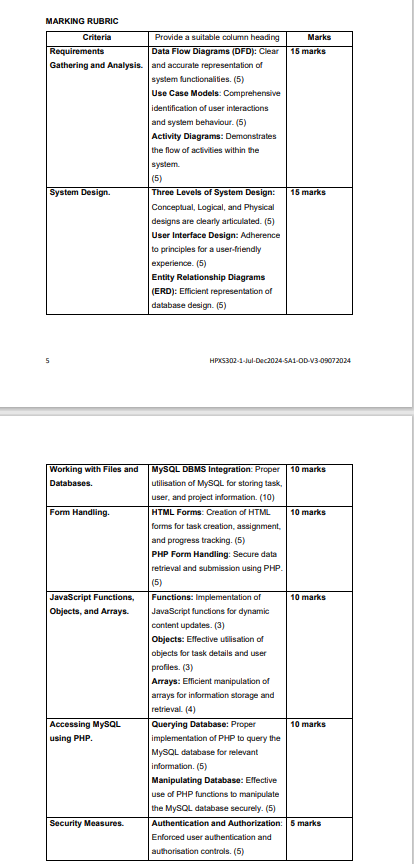
MARKING RUBRIC
Criteria Provide a suitable column heading Marks
Requirements
Gathering and AnalyMARIKING RUBRIC
Step by Step Solution
There are 3 Steps involved in it
1 Expert Approved Answer
Step: 1 Unlock

Question Has Been Solved by an Expert!
Get step-by-step solutions from verified subject matter experts
Step: 2 Unlock
Step: 3 Unlock
 Study Help