







Question: More data about the packages volumes, weights, transporting cost per kilometer is given in Table (3) Table (3): Volumes, weights and transporting cost of each
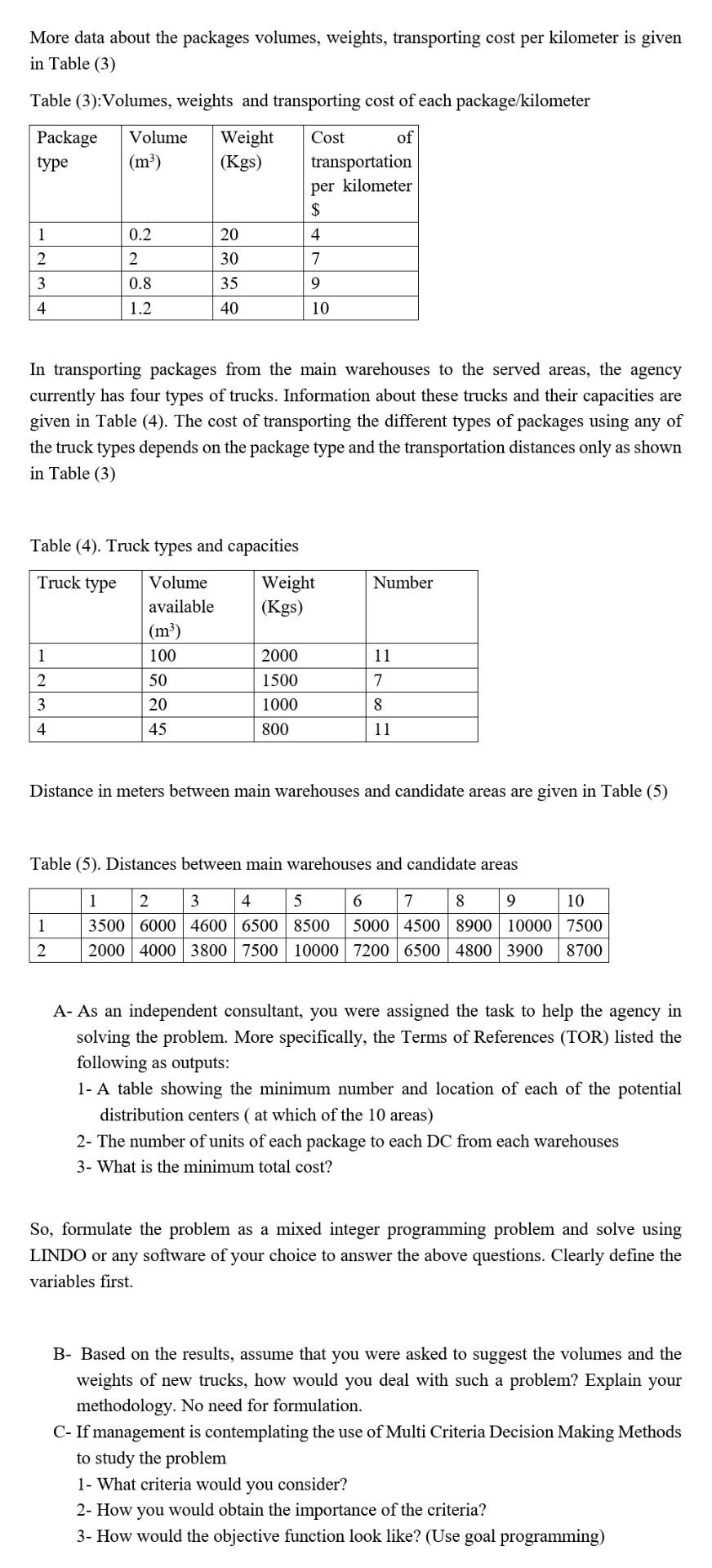
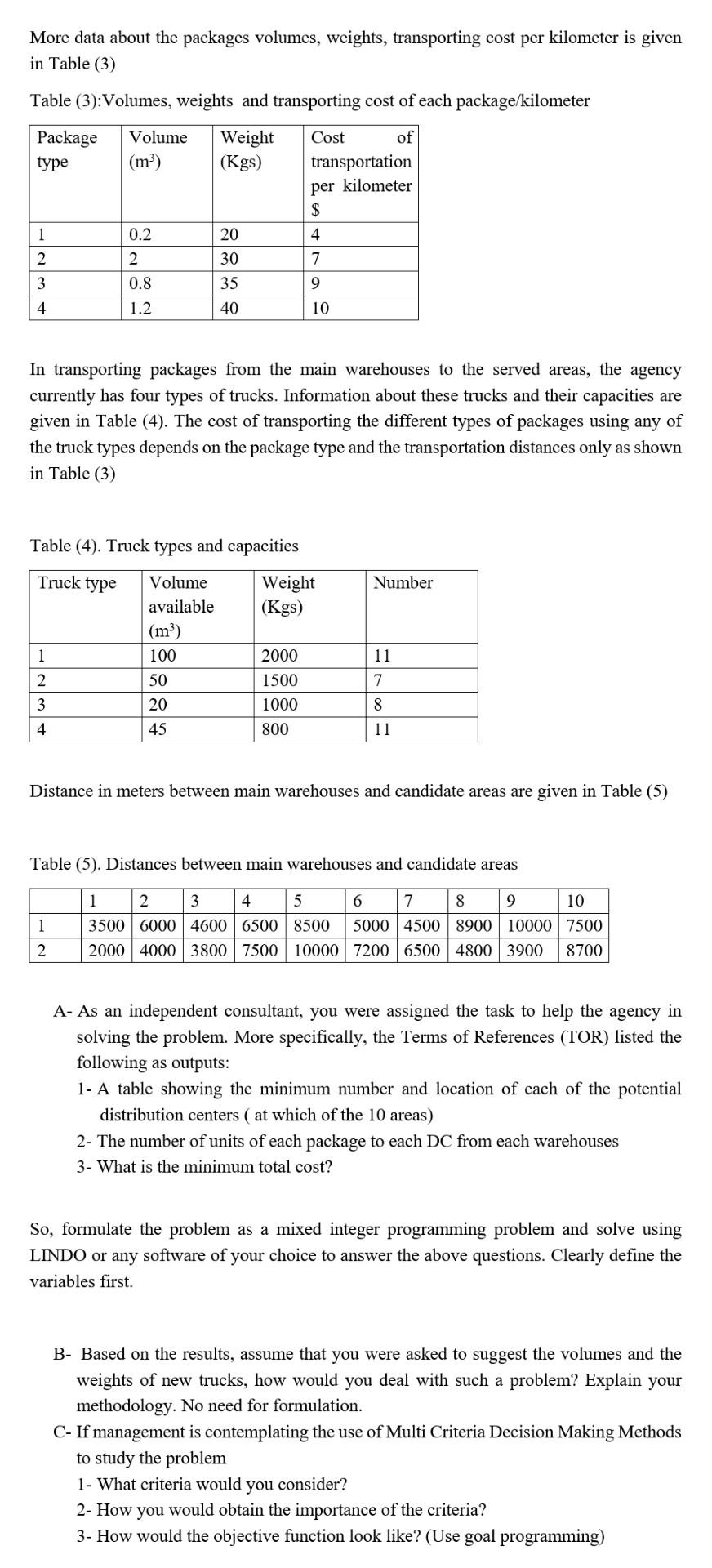
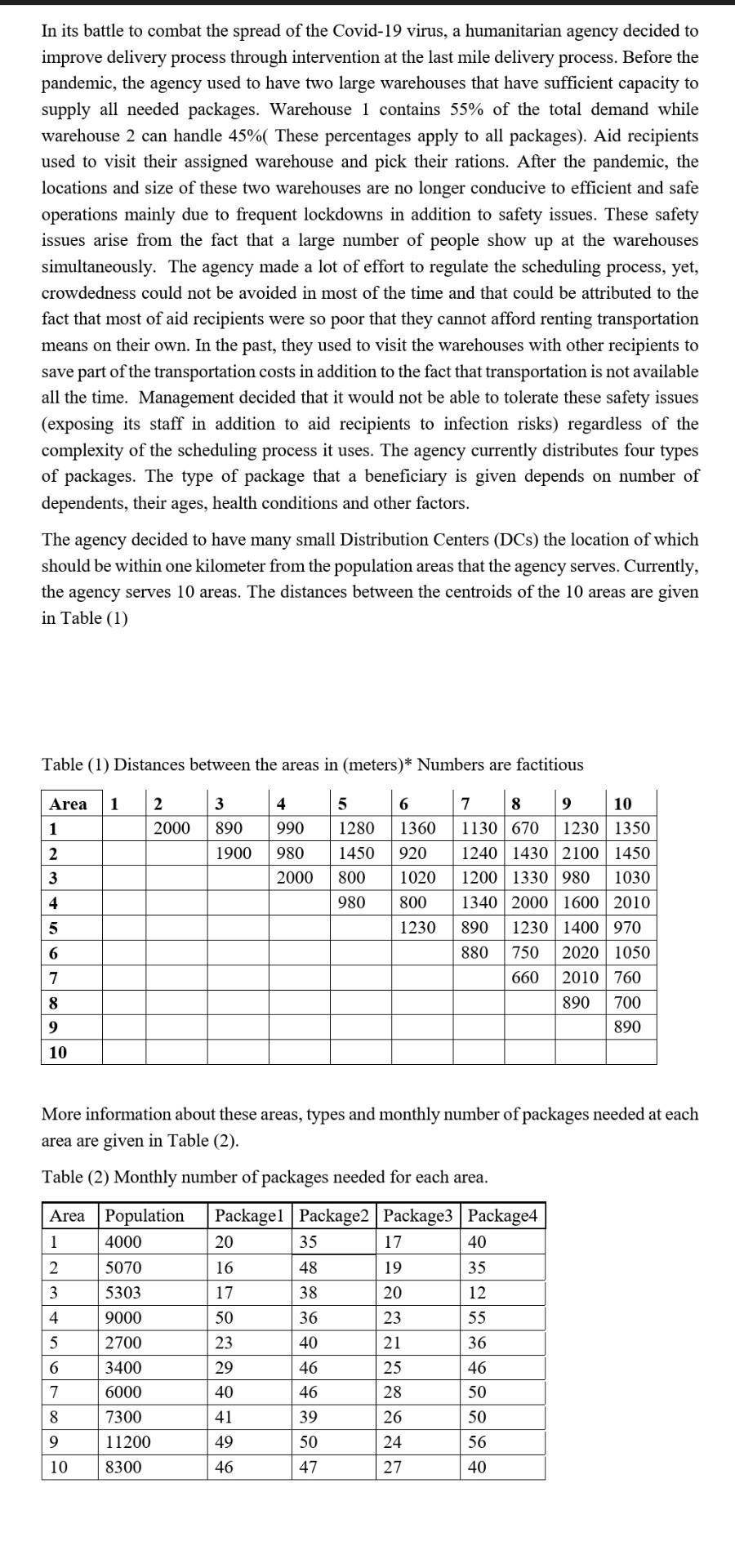
More data about the packages volumes, weights, transporting cost per kilometer is given in Table (3) Table (3): Volumes, weights and transporting cost of each package/kilometer Package Volume Weight Cost of type (m) (Kgs) transportation per kilometer $ 1 0.2 20 4 2 2 30 7 3 0.8 35 9 4 1.2 40 10 In transporting packages from the main warehouses to the served areas, the agency currently has four types of trucks. Information about these trucks and their capacities are given in Table (4). The cost of transporting the different types of packages using any of the truck types depends on the package type and the transportation distances only as shown in Table (3) Table (4). Truck types and capacities Truck type Volume Weight Number available (Kgs) (m) 1 100 2000 11 2 50 1500 7 3 20 1000 8 4 45 800 11 Distance in meters between main warehouses and candidate areas are given in Table (5) Table (5). Distances between main warehouses and candidate areas 6 1 1 2 3 4 5 7 8 9 10 3500 6000 4600 6500 8500 5000 4500 8900 10000 7500 2000 4000 3800 7500 10000 7200 6500 4800 3900 8700 2 A- As an independent consultant, you were assigned the task to help the agency in solving the problem. More specifically, the Terms of References (TOR) listed the following as outputs: 1- A table showing the minimum number and location of each of the potential distribution centers (at which of the 10 areas) 2- The number of units of each package to each DC from each warehouses 3- What is the minimum total cost? So, formulate the problem as a mixed integer programming problem and solve using LINDO or any software of your choice to answer the above questions. Clearly define the variables first. B- Based on the results, assume that you were asked to suggest the volumes and the weights of new trucks, how would you deal with such a problem? Explain your methodology. No need for formulation. C- If management is contemplating the use of Multi Criteria Decision Making Methods to study the problem 1- What criteria would you consider? 2- How you would obtain the importance of the criteria? 3- How would the objective function look like? (Use goal programming) More data about the packages volumes, weights, transporting cost per kilometer is given in Table (3) Table (3): Volumes, weights and transporting cost of each package/kilometer Package Volume Weight Cost of type (m) (Kgs) transportation per kilometer $ 1 0.2 20 4 2 2 30 7 3 0.8 35 9 4 1.2 40 10 In transporting packages from the main warehouses to the served areas, the agency currently has four types of trucks. Information about these trucks and their capacities are given in Table (4). The cost of transporting the different types of packages using any of the truck types depends on the package type and the transportation distances only as shown in Table (3) Table (4). Truck types and capacities Truck type Volume Weight Number available (Kgs) (m) 1 100 2000 11 2 50 1500 7 3 20 1000 8 4 45 800 11 Distance in meters between main warehouses and candidate areas are given in Table (5) Table (5). Distances between main warehouses and candidate areas 6 1 1 2 3 4 5 7 8 9 10 3500 6000 4600 6500 8500 5000 4500 8900 10000 7500 2000 4000 3800 7500 10000 7200 6500 4800 3900 8700 2 A- As an independent consultant, you were assigned the task to help the agency in solving the problem. More specifically, the Terms of References (TOR) listed the following as outputs: 1- A table showing the minimum number and location of each of the potential distribution centers (at which of the 10 areas) 2- The number of units of each package to each DC from each warehouses 3- What is the minimum total cost? So, formulate the problem as a mixed integer programming problem and solve using LINDO or any software of your choice to answer the above questions. Clearly define the variables first. B- Based on the results, assume that you were asked to suggest the volumes and the weights of new trucks, how would you deal with such a problem? Explain your methodology. No need for formulation. C- If management is contemplating the use of Multi Criteria Decision Making Methods to study the problem 1- What criteria would you consider? 2- How you would obtain the importance of the criteria? 3- How would the objective function look like? (Use goal programming) In its battle to combat the spread of the Covid-19 virus, a humanitarian agency decided to improve delivery process through intervention at the last mile delivery process. Before the pandemic, the agency used to have two large warehouses that have sufficient capacity to supply all needed packages. Warehouse 1 contains 55% of the total demand while warehouse 2 can handle 45% ( These percentages apply to all packages). Aid recipients used to visit their assigned warehouse and pick their rations. After the pandemic, the locations and size of these two warehouses are no longer conducive to efficient and safe operations mainly due to frequent lockdowns in addition to safety issues. These safety issues arise from the fact that a large number of people show up at the warehouses simultaneously. The agency made a lot of effort to regulate the scheduling process, yet, crowdedness could not be avoided in most of the time and that could be attributed to the fact that most of aid recipients were so poor that they cannot afford renting transportation means on their own. In the past, they used to visit the warehouses with other recipients to save part of the transportation costs in addition to the fact that transportation is not available all the time. Management decided that it would not be able to tolerate these safety issues (exposing its staff in addition to aid recipients to infection risks) regardless of the complexity of the scheduling process it uses. The agency currently distributes four types of packages. The type of package that a beneficiary is given depends on number of dependents, their ages, health conditions and other factors. The agency decided to have many small Distribution Centers (DCs) the location of which should be within one kilometer from the population areas that the agency serves. Currently, the agency serves 10 areas. The distances between the centroids of the 10 areas are given in Table (1) Table (1) Distances between the areas in (meters)* Numbers are factitious Area 1 2 3 4 5 6 7 8 9 10 1130 670 1230 1350 1 890 990 1280 1360 920 2 1900 980 1450 1240 1430 2100 1450 3 2000 800 1020 1200 1330 980 1030 4 980 800 1340 2000 1600 2010 5 1230 890 1230 1400 970 6 880 750 2020 1050 7 660 2010 760 8 890 700 9 890 10 More information about these areas, types and monthly number of packages needed at each area are given in Table (2). Table (2) Monthly number of packages needed for each area. Area Population Packagel Package2 Package3 Package4 1 4000 20 35 17 40 2 5070 16 48 19 35 3 5303 17 38 20 12 4 9000 50 36 23 55 5 2700 23 40 21 36 6 3400 29 46 25 46 7 6000 40 46 28 50 8 7300 41 39 26 50 9 11200 49 50 24 56 8300 46 47 27 40 10 2000
Step by Step Solution
There are 3 Steps involved in it
1 Expert Approved Answer
Step: 1 Unlock

Question Has Been Solved by an Expert!
Get step-by-step solutions from verified subject matter experts
Step: 2 Unlock
Step: 3 Unlock
 Study Help