



Question: Name: 1. The variables typically involved in a reactivity balance include: the basic reactivity; direct and indirect xenon reactivity; reactivity; and control rod reactivity. Multiple
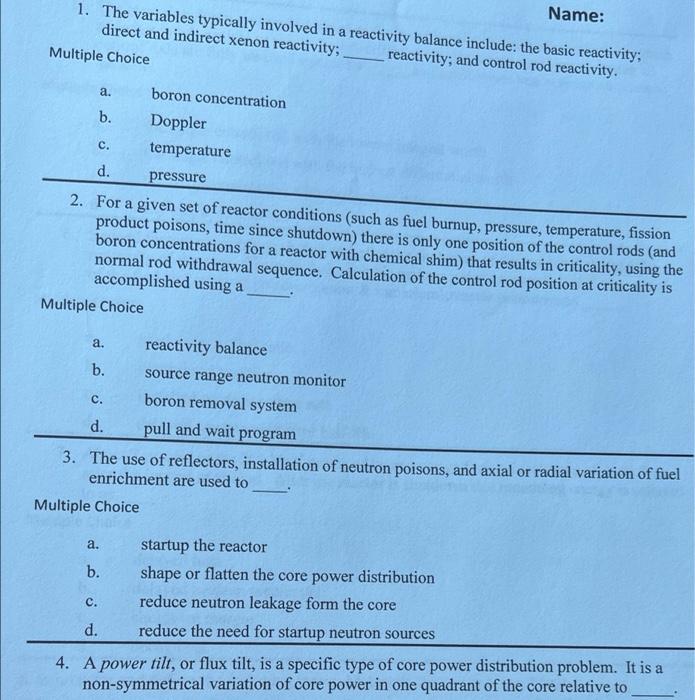
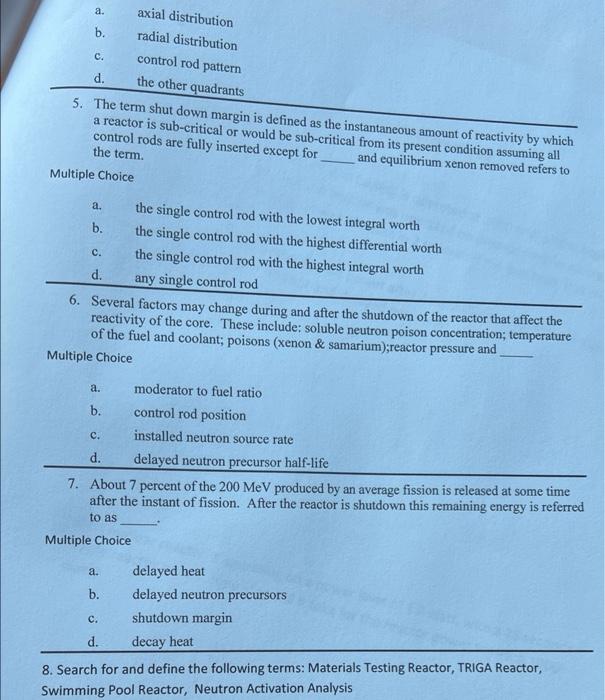
Name: 1. The variables typically involved in a reactivity balance include: the basic reactivity; direct and indirect xenon reactivity; reactivity; and control rod reactivity. Multiple Choice a. boron concentration b. Doppler C. temperature d. pressure 2. For a given set of reactor conditions (such as fuel burnup, pressure, temperature, fission product poisons, time since shutdown) there is only one position of the control rods (and boron concentrations for a reactor with chemical shim) that results in criticality, using the normal rod withdrawal sequence. Calculation of the control rod position at criticality is accomplished using a Multiple Choice a. reactivity balance b. source range neutron monitor C. boron removal system d. pull and wait program 3. The use of reflectors, installation of neutron poisons, and axial or radial variation of fuel enrichment are used to Multiple Choice a. startup the reactor b. shape or flatten the core power distribution C. reduce neutron leakage form the core d. reduce the need for startup neutron sources 4. A power tilt, or flux tilt, is a specific type of core power distribution problem. It is a non-symmetrical variation of core power in one quadrant of the core relative to axial distribution radial distribution C. control rod pattern d. the other quadrants 5. The term shut down margin is defined as the instantaneous amount of reactivity by which a reactor is sub-critical or would be sub-critical from its present condition assuming all control rods are fully inserted except for the term. and equilibrium xenon removed refers to Multiple Choice a. the single control rod with the lowest integral worth b. the single control rod with the highest differential worth the single control rod with the highest integral worth C. d. any single control rod 6. Several factors may change during and after the shutdown of the reactor that affect the reactivity of the core. These include: soluble neutron poison concentration; temperature of the fuel and coolant; poisons (xenon & samarium);reactor pressure and Multiple Choice a. moderator to fuel ratio b. control rod position C. installed neutron source rate d. delayed neutron precursor half-life 7. About 7 percent of the 200 MeV produced by an average fission is released at some time after the instant of fission. After the reactor is shutdown this remaining energy is referred to as Multiple Choice a. delayed heat b. delayed neutron precursors shutdown margin C. d. decay heat 8. Search for and define the following terms: Materials Testing Reactor, TRIGA Reactor, Swimming Pool Reactor, Neutron Activation Analysis a
Step by Step Solution
There are 3 Steps involved in it

Get step-by-step solutions from verified subject matter experts