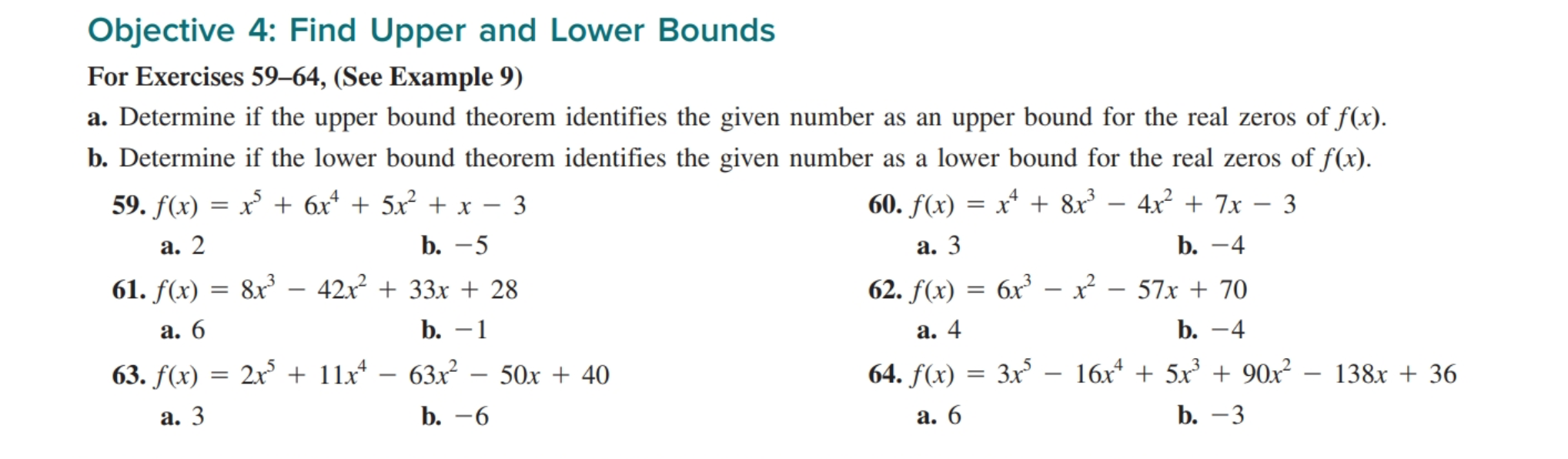
Question: Objective 4: Find Upper and Lower Bounds For Exercises 5964, (See Example 9) 2. Determine if the upper bound theorem identies the given number as
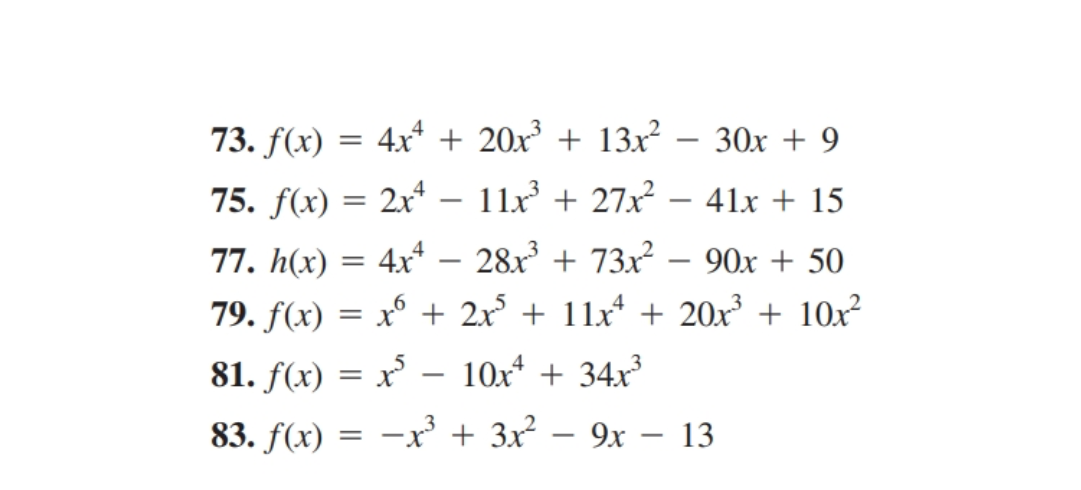
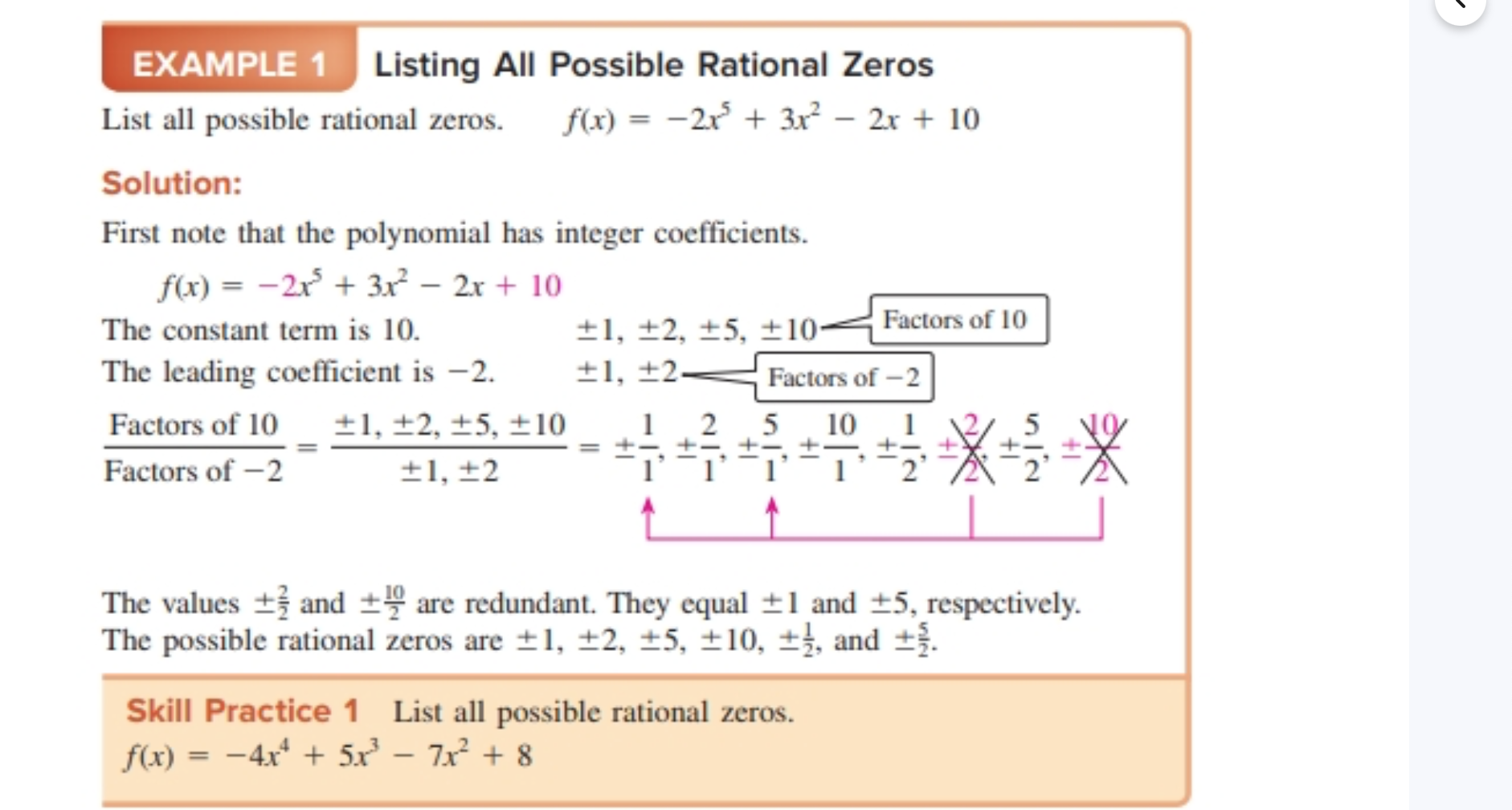
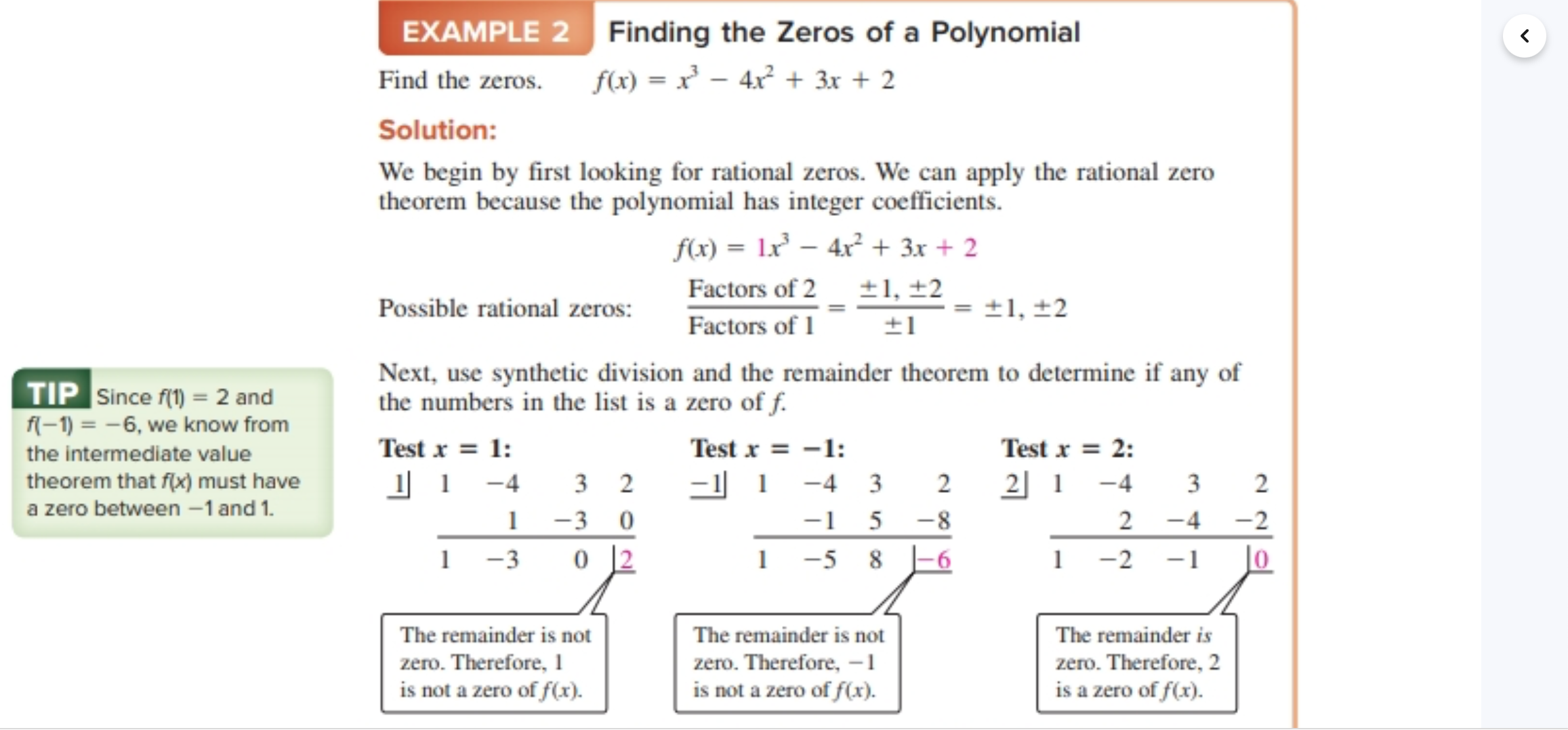
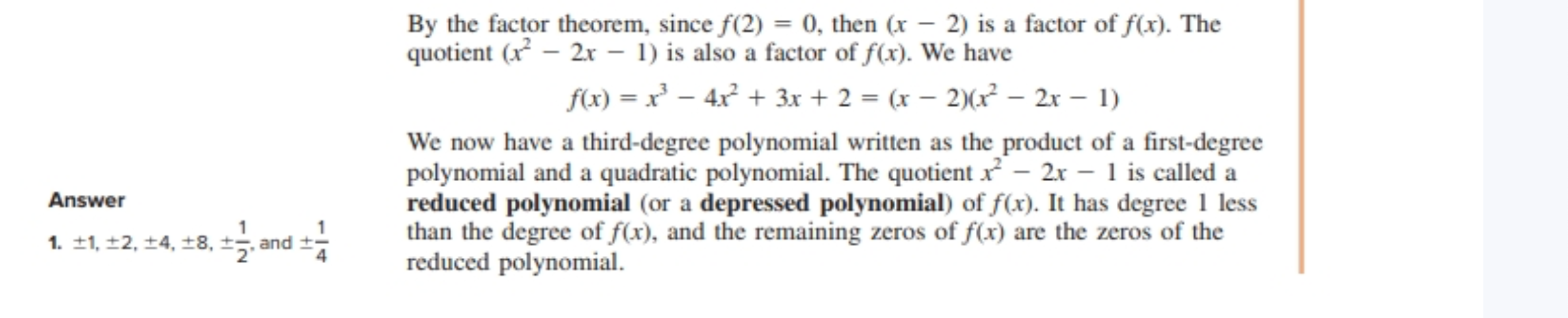
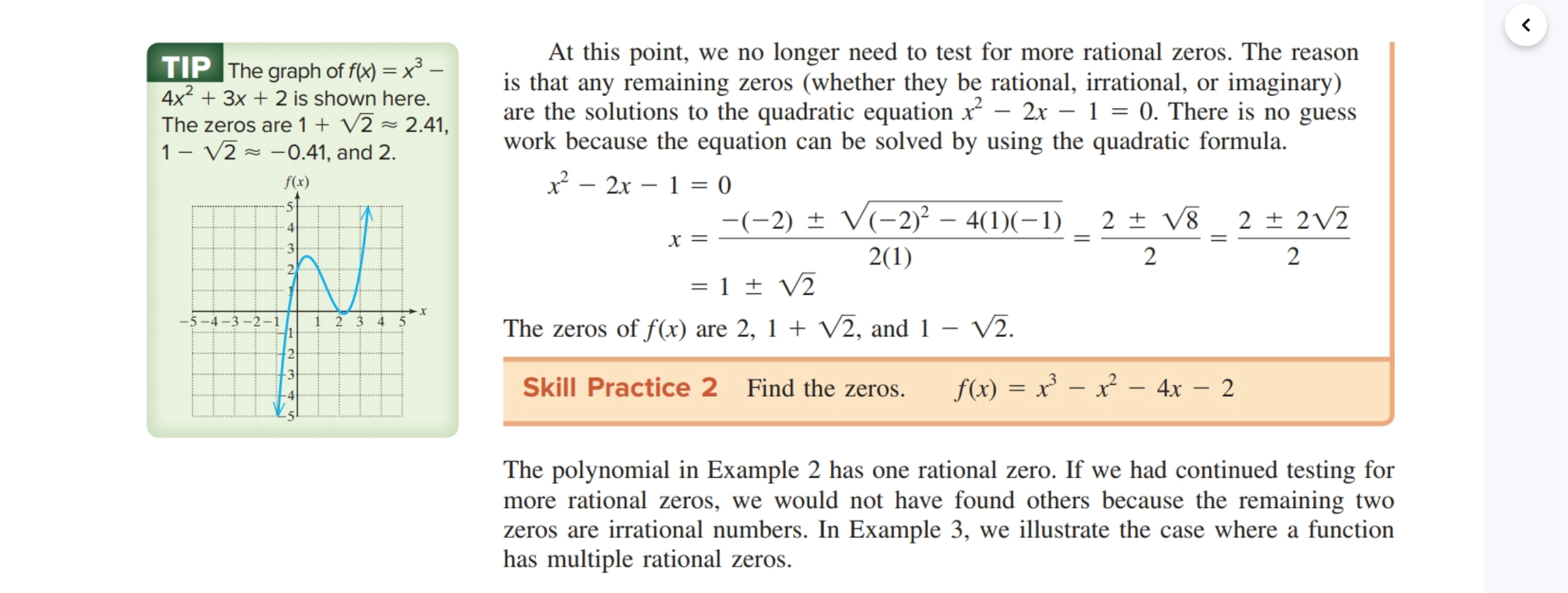
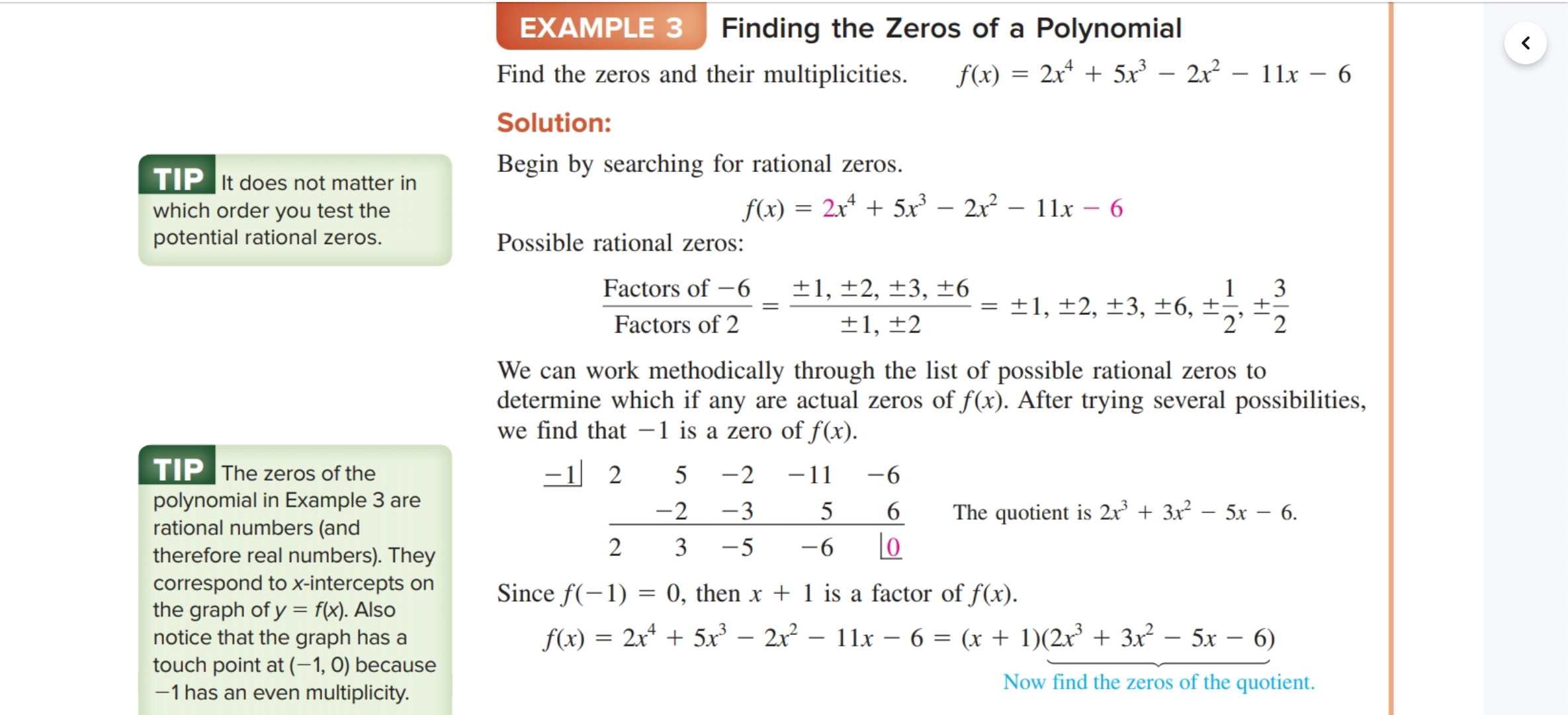
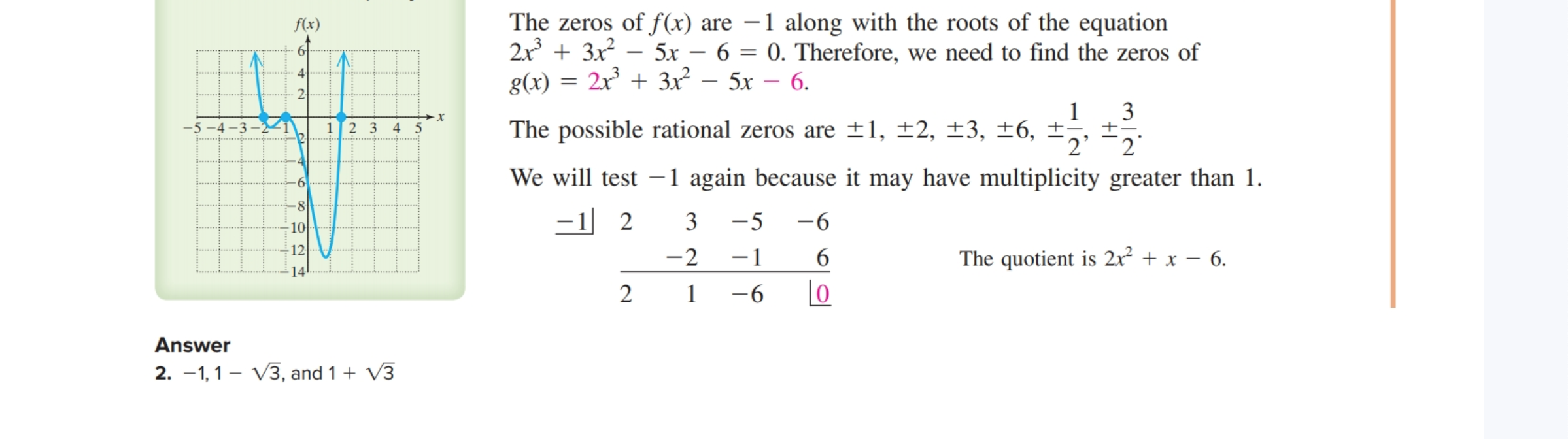
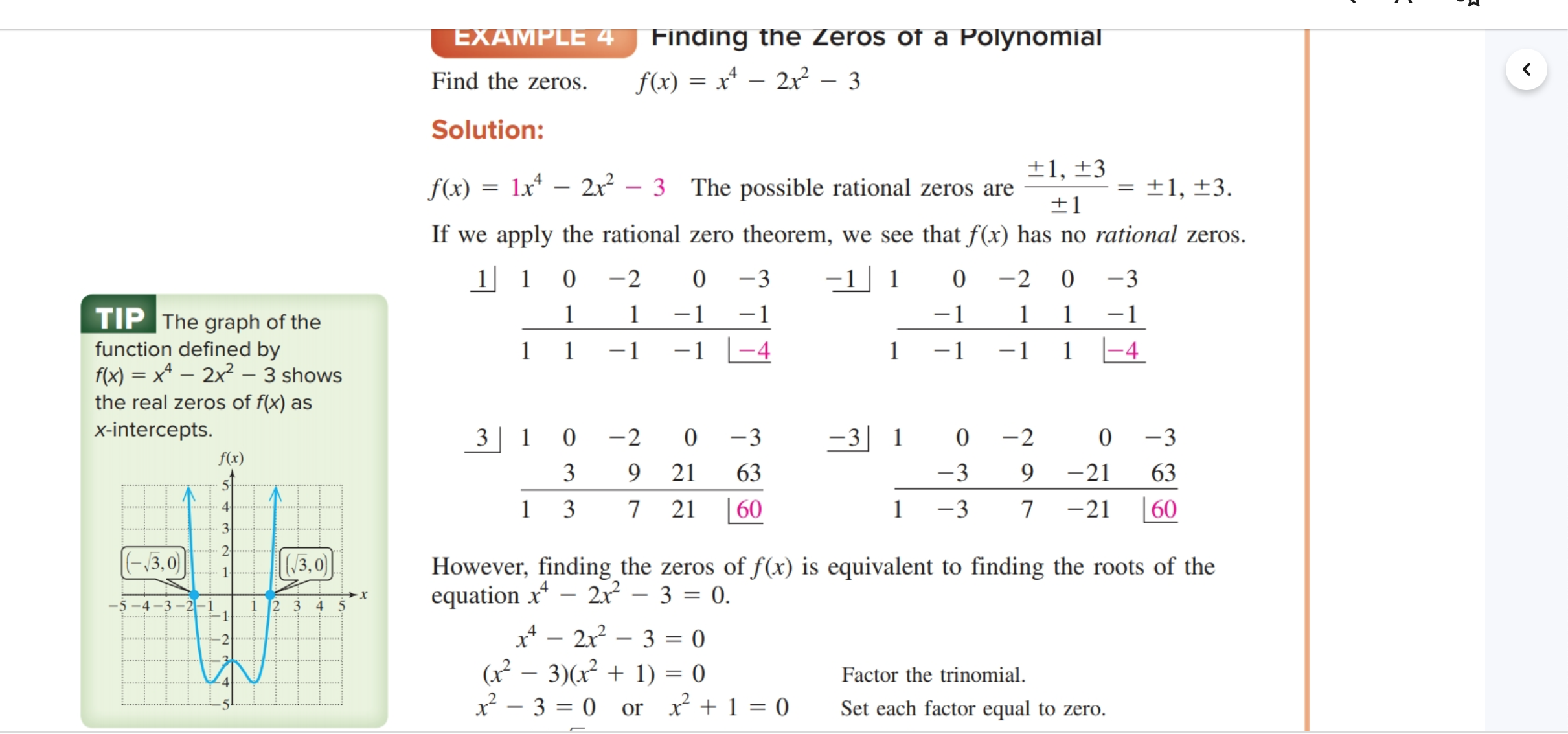
Objective 4: Find Upper and Lower Bounds For Exercises 5964, (See Example 9) 2. Determine if the upper bound theorem identies the given number as an upper bound for the real zeros of f(x). b. Determine if the lower bound theorem identies the given number as a lower bound for the real zeros of for). 59.f(x)=x5+6x4+5x2+x 3 60.f(x)=x4+8x34x2+7x 3 a. 2 b. 5 a. 3 b. 4 61. f(x) = 8x3 426:2 + 33x + 28 62. for) = 6x3 x?- 57x + 70 a. 6 b. 1 a. 4 b. 4 63. f(x) = 2x5 + 11x4 63x2 50x + 40 64. f(x) = 3x5 16x4 + 5x3 + 90x2 138x + 36 a. 3 b. 6 a. 6 b. -3 For Exercises 6984, nd the zeros and their multiplicities. Consider using Descartes' rule of signs and the upper and lower bound theorem to limit your search for rational zeros. (See Example 10) 69. f(x) = 8x' 42x2 + 33x + 28 70. f(x) = 6x3 x2 57x + 70 (Him: See Exercise 61.) (Him: See Exercise 62.) 7l.f(x) = 2x5 + 11x4 63x2 50x + 40 72. f(x) = 3x5 16x4 + 5x3 + 90x2 1381 + 36 (Hint: See Exercise 63.) (Hint: See Exercise 64.) \fEXAMPLE 1 Listing All Possible Rational Zeros List all possible rational zeros. f(x) = -2x + 3x2 - 2x + 10 Solution: First note that the polynomial has integer coefficients. f(x) = -2x + 3x2 - 2x + 10 The constant term is 10. +1, +2, +5, +10 Factors of 10 The leading coefficient is -2. +1, +2. Factors of -2 Factors of 10 +1, +2, +5, +10 10 Factors of -2 +1, +2 The values + and + are redundant. They equal +1 and +5, respectively. The possible rational zeros are +1, +2, +5, +10, +3, and #. Skill Practice 1 List all possible rational zeros. f(x) = -4x* + 5x3 - 7x2+ 8EXAMPLE 2 Finding the Zeros of a Polynomial Find the zeros. f (x) = x - 4x + 3x + 2 Solution: We begin by first looking for rational zeros. We can apply the rational zero theorem because the polynomial has integer coefficients. f(x) = 1x - 4x2 + 3x + 2 Factors of 2 +1, +2 Possible rational zeros: Factors of 1 = +1, +2 +1 Next, use synthetic division and the remainder theorem to determine if any of TIP Since f(1) = 2 and the numbers in the list is a zero of f. f(-1) = -6, we know from the intermediate value Test x = 1: Test x = -1: Test x = 2: theorem that f(x) must have 1 1 - 3 2 -1 1 -4 3 2 2 1 -4 3 2 a zero between -1 and 1. 3 0 5 -8 2 -4 -3 0 2 -5 8 -6 -2 -1 The remainder is not The remainder is not The remainder is zero. Therefore, 1 zero. Therefore, -1 zero. Therefore, 2 is not a zero of f(x). is not a zero of f(x). is a zero of f(x).By the factor theorem, since f(2) = 0, then (x - 2) is a factor of f(x). The quotient (x - 2x - 1) is also a factor of f(x). We have f(x) = x - 4x + 3x+ 2 = (x -2)(x -2x - 1) We now have a third-degree polynomial written as the product of a first-degree polynomial and a quadratic polynomial. The quotient x - 2x - 1 is called a Answer reduced polynomial (or a depressed polynomial) of f(x). It has degree 1 less 1. +1, +2, +4, +8, ty. and + than the degree of f(x), and the remaining zeros of f(x) are the zeros of the reduced polynomial.TIP The graph of f(x) = x3 4x2 + 3x + 2 is shown here. The zeros are1 + V ~ 2.41, 1 v2 = o.41, and 2. f0) At this point, we no longer need to test for more rational zeros. The reason is that any remaining zeros (whether they be rational, irrational, or imaginary) are the solutions to the quadratic equation x2 2.x l = 0. There is no guess work because the equation can be solved by using the quadratic formula. x2 - 2x 1 = o x (2) : \\/(2)2 4(1)(1) 2 : \\/ 2 : 2V2 2(1) 2 2 = 1 : V5 The zeros off(x) are 2, l + V5, and l V5. Skill Practice 2 Find the zeros. f(x) = x3 x2 4x 2 The polynomial in Example 2 has one rational zero. If we had continued testing for more rational zeros, we would not have found others because the remaining two zeros are irrational numbers. In Example 3, we illustrate the case where a function has multiple rational zeros. TIP It does not matter in which order you test the potential rational zeros. TIP The zeros of the polynomial in Example 3 are rational numbers (and therefore real numbers). They correspond to x-intercepts on the graph of y = f(x). Also notice that the graph has a touch point at (1, 0) because 1 has an even multiplicity. EXAMPLE 3 Finding the Zeros of a Polynomial Find the zeros and their multiplicities. f(x) = 2x4 + 5x3 2x2 11x 6 Solution: Begin by searching for rational zeros. f(x)=2x4+5x32xz llx6 Possible rational zeros: Factors of 6 _ :1, :2, :3, :6 1 3 _ = :1, :2, :3, :6, i, i Factors of2 :1, :2 2 2 We can work methodically through the list of possible rational zeros to determine which if any are actual zeros of f(x). After trying several possibilities, we find that 1 is a zero of f(x). _1] 2 5 2 11 6 2 3 5 6 The quotient is 22.; + 3x2 5x 6. 2 3 5 6 m Since f(l) = 0, then x + l is a factor off(x). f(x)=2.x4+5x32xzllx6=(x+1)(2.x3+3x25x6) Now nd the zeros oi~ the quotient. The zeros of f(x) are 1 along with the roots of the equation 2A} + 3x2 5x 6 = 0. Therefore, we need to nd the zeros of g(x)=2x7'+3x25x6. 3 The possible rational zeros are :1, :2, :3, :6, :5, :5. We will test 1 again because it may have multiplicity greater than 1. 2 3 5 6 2 1 6 The quotient is 2x2 + x 6. 2 1 6 lo Answer 2. 1,1 \\/,and1+ \\/ EXAMPLE 4 Finding the Zeros of a Polynomial
Step by Step Solution
There are 3 Steps involved in it
1 Expert Approved Answer
Step: 1 Unlock
Question Has Been Solved by an Expert!
Get step-by-step solutions from verified subject matter experts
Step: 2 Unlock
Step: 3 Unlock
Students Have Also Explored These Related Mathematics Questions!










 Study Help