



Question: other lines remains unchanged. Calculate the optimal dispatch and the nodal prices for these conditions. [ Hint: the optimal solution involves a redispatch of generating
other lines remains unchanged. Calculate the optimal dispatch and the nodal prices for these conditions. Hint: the optimal solution involves a redispatch of generating units at all three buses
Consider the twobus power system of Problem Given that KR VmathrmMW for the line connecting buses A and B and that there is no limit on the capacity of this line, calculate the value of the flow that minimizes the total variable cost of production. Assuming that a competitive electricity market operates at both buses, calculate the nodal marginal prices and the merchandising surplus. Hint: use a spreadsheet
Repeat Problem for several values of K ranging from to Plot the optimal flow and the losses in the line, as well as the marginal cost of electrical energy at both buses. Discuss your results.
Using the linearized mathematical formulation dc power flow approximation calculate the nodal prices and the marginal cost of the inequality constraint for the optimal redispatch that you obtained in Problem Check that your results are identical to those that you obtained in Problem Use bus as the slack bus.
Show that the choice of slack bus does not influence the nodal prices for the dc power flow approximation by repeating Problem using bus and then bus as the slack bus.
Using the linearized mathematical formulation dc power flow approximation calculate the marginal costs of the inequality constraints for the conditions of Problem
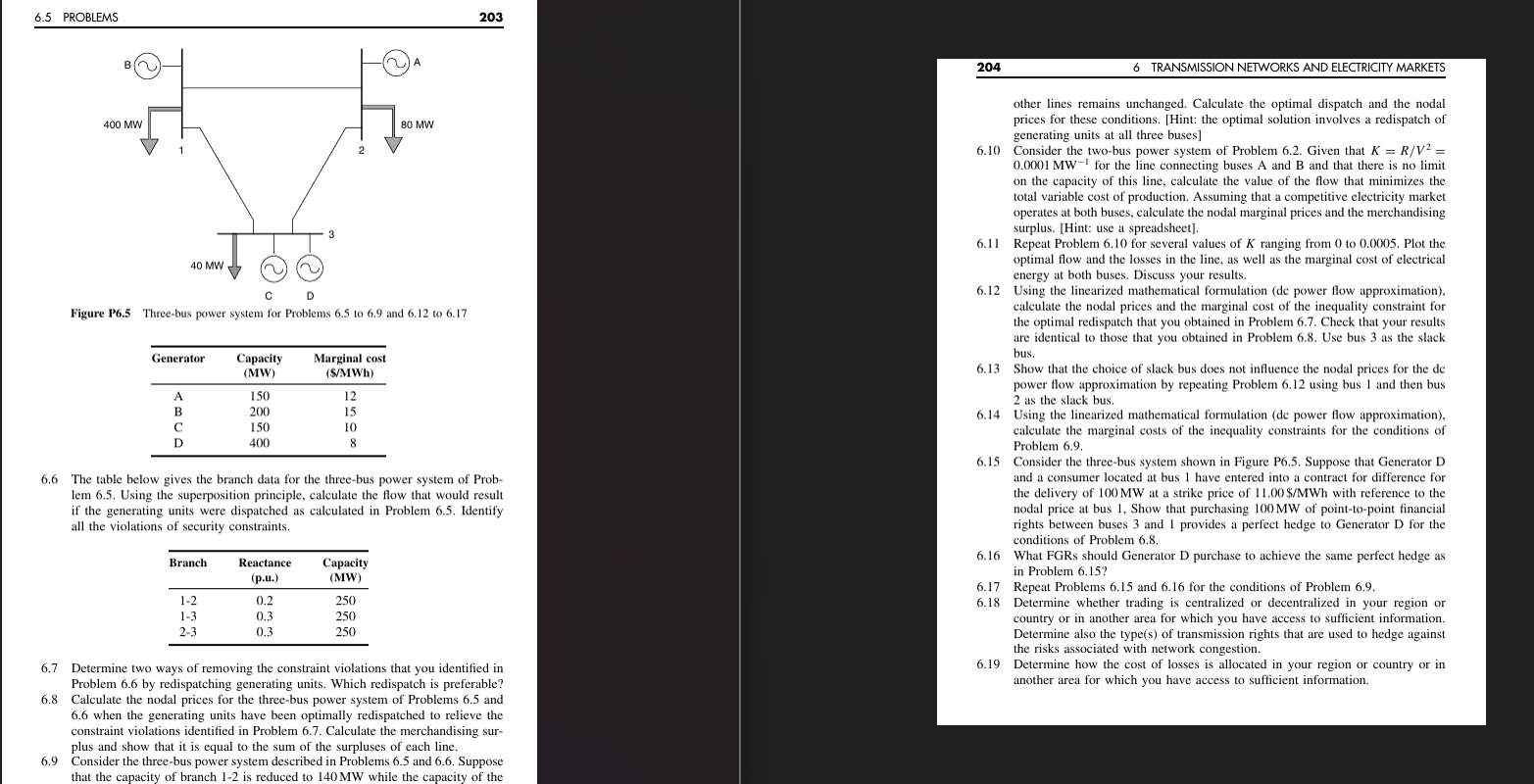
Consider the threebus system shown in Figure P Suppose that Generator D and a consumer located at bus have entered into a contract for difference for the delivery of MW at a strike price of $ mathrmMWh with reference to the nodal price at bus Show that purchasing MW of pointtopoint financial rights between buses and provides a perfect hedge to Generator D for the conditions of Problem
What FGRs should Generator D purchase to achieve the same perfect hedge as in Problem
Repeat Problems and for the conditions of Problem
Determine whether trading is centralized or decentralized in your region or country or in another area for which you have access to sufficient information. Determine also the types of transmission rights that are used to hedge against the risks associated with network congestion.
Determine how the cost of losses is allocated in your region or country or in another area for which you have access to sufficient information. Figure P Threebus power system for Problems to and to
The table below gives the branch data for the threebus power system of Problem Using the superposition principle, calculate the flow that would result if the generating units were dispatched as calculated in Problem Identify all the violations of security constraints.
Determine two ways of removing the constraint violations that you identified in Problem by redispatching generating units. Which redispatch is preferable?
Calculate the nodal prices for the threebus power system of Problems and when the generating units have been optimally redispatched to relieve the constraint violations identified in Problem Calculate the merchandising sur
other lines remains unchanged. Calculate the optimal dispatch and the nodal prices for these conditions. Hint: the optimal solution involves a redispatch of generating units at all three buses
Consider the twobus power system of Problem Given that KR VmathrmMW for the line connecting buses A and B and that there is no limit on the capacity of this line, calculate the value of the flow that minimizes the total variable cost of production. Assuming that a competitive electricity market operates at both buses, calculate the nodal marginal prices and the merchandising surplus. Hint: use a spreadsheet
Repeat Problem for several values of K ranging from to Plot the optimal flow and the losses in the line, as well as the marginal cost of electrical energy at both buses. Discuss your results.
Using the linearized mathematical formulation dc power flow approximation calculate the nodal prices and the marginal cost of the inequality constraint for the optimal redispatch that you obtained in Problem Check that your results are identical to those that you obtained in Problem Use bus as the slack bus.
Show that the choice of slack bus does not influence the nodal prices for the dc power flow approximation by repeating Problem using bus and then bus as the slack bus.
Using the linearized mathematical formulation dc power flow approximation calculate the marginal costs of the inequality constraints for the conditions of Problem
Consider the threebus system shown in Figure P Suppose that G
Step by Step Solution
There are 3 Steps involved in it
1 Expert Approved Answer
Step: 1 Unlock

Question Has Been Solved by an Expert!
Get step-by-step solutions from verified subject matter experts
Step: 2 Unlock
Step: 3 Unlock