







Question: Part 1-4 are done, I need help with 5-8. Thanks Use K-Map to Simplify a 4-Variable Function with Dont-Care Conditions In this part of the
Part 1-4 are done, I need help with 5-8.
Thanks
Use K-Map to Simplify a 4-Variable Function with Dont-Care Conditions

In this part of the procedure, you will use K-Map to simplify a 4-variable function and verify your results following the same flow of Verilog.
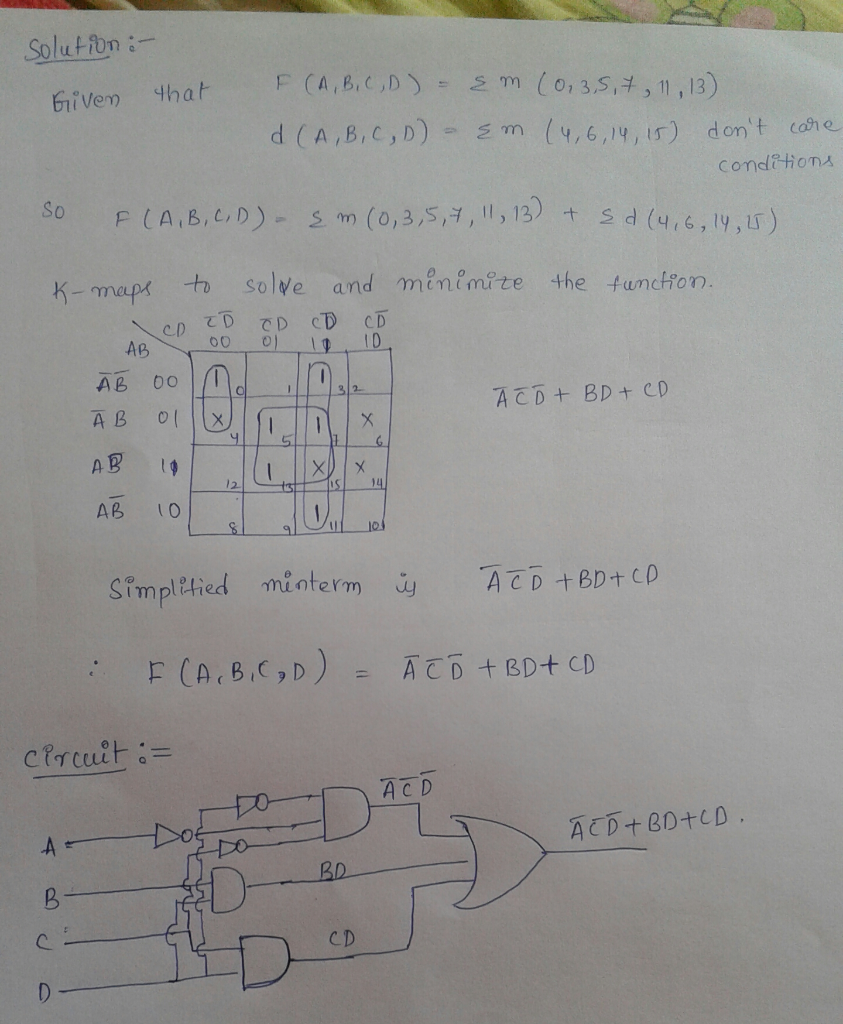
- Write the function F in the form of sum of proper minterms.
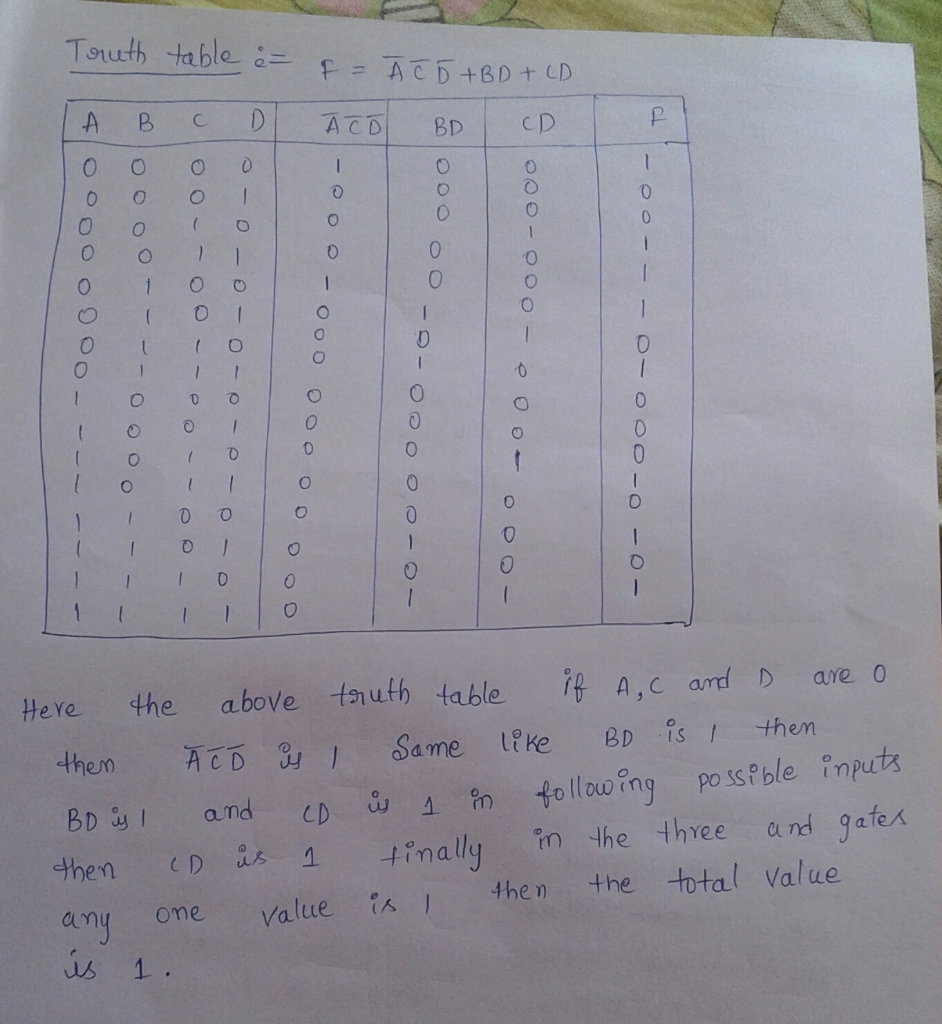
- Make a truth table to evaluate the function F for all input combinations use Boolean Algebraic.
- Write a Verilog module called original to implement the original circuit with all the minterms.
- Use 4-Variable K-Map to simplify the function. You need to include the details of this step in your lab report.
- Write a Verilog module called simplified to implement the simplified circuit you obtained from the K-Map simplification process.
- Write a test bench to apply the same inputs to both the original module and simplified module. Name the output for the original function origin, and name the output for the simplified function simple. In your test bench, make sure all the possible value combinations that the inputs can have for the original and simplified functions are included. In this case, we have 4 inputs and will have 24 = 16 input combinations.
- Simulate the circuit using ISim and analyze the resulting waveform.
- Take full screenshots of all Verilog source codes and the resulting simulation waveform to be included in the lab report. Compare the outputs (origin and simple) according to the input combination. Verify that the simplified function is equivalent to the original function. You should also compare the simulation results of origin (and simple) with the evaluation of function F in step 4. If you have correctly completed all the above steps (step 5 through step 8), then your origin, simple and the function evaluation from step 4 should show that all three values are the same for the same input combination.
Given that solution :- F (A, B, C, D) - & m (0,3,5,7, 11, 13) d (A, B, C, D) - um (4,6, 14, 15) don't care conditions So F (A, B, C, D) - & m (0,3,5, 7, 11, 13 & &d (4, 6, 14, 15) the function. K-maps to cp TD AB 00 B oo solve and minimize TD CD co 0 10 10 A o + BD + CD AB 0 With ABC AB 100 Simplified minterm ; TO + BD + CD : F (A, B, C, D) = TO + BD + CD circuit : ACD + BD+CD. TI BD B- Toruth table i= = TO+BD + CD ACO BD CD LA B 0 0 0 0 0 0 0 0 0 1 Looooooo OOOO C D 0 0 0 1 1 0 1 1 0 0 0 I 10 0 1 1 1 1 0 0 0 -0-0000-0-00 000 OOOOO OOO 000-000- --eo- -oo-- -ooo ooo - ooo-oool -0-0-000-0---00- 1 0 o-o-o o 1 - Here the above truth table if A,C and I are o then to i I same like Bo is I then BD is I and co i 1 in following possible inputs. then CD is 1 finally in the three and gates, any one value is I then the total value is 1. Given that solution :- F (A, B, C, D) - & m (0,3,5,7, 11, 13) d (A, B, C, D) - um (4,6, 14, 15) don't care conditions So F (A, B, C, D) - & m (0,3,5, 7, 11, 13 & &d (4, 6, 14, 15) the function. K-maps to cp TD AB 00 B oo solve and minimize TD CD co 0 10 10 A o + BD + CD AB 0 With ABC AB 100 Simplified minterm ; TO + BD + CD : F (A, B, C, D) = TO + BD + CD circuit : ACD + BD+CD. TI BD B- Toruth table i= = TO+BD + CD ACO BD CD LA B 0 0 0 0 0 0 0 0 0 1 Looooooo OOOO C D 0 0 0 1 1 0 1 1 0 0 0 I 10 0 1 1 1 1 0 0 0 -0-0000-0-00 000 OOOOO OOO 000-000- --eo- -oo-- -ooo ooo - ooo-oool -0-0-000-0---00- 1 0 o-o-o o 1 - Here the above truth table if A,C and I are o then to i I same like Bo is I then BD is I and co i 1 in following possible inputs. then CD is 1 finally in the three and gates, any one value is I then the total value is 1
Step by Step Solution
There are 3 Steps involved in it

Get step-by-step solutions from verified subject matter experts
 Study Help