







Question: Part I. (40%) Multiple Choice Questions (only one answer) 1. What is the organization that specifies the standards for HTTP? A. ISO B. ITU-T C.
Part I. (40%) Multiple Choice Questions (only one answer)
1. What is the organization that specifies the standards for HTTP?
A. ISO
B. ITU-T
C. IETF
D. IEEE
E. DoD
2. The network span (maximum distance) of a 1GBaseT network (25 meters) is approximately one tenth (1/100) of the network span of a 10BaseT network (2500 meters) because
A. Higher-speed data signals attenuate (lose power) more quickly, so it cannot be transmitted as far.
B. Both networks have minimum frame sizes and the network spans are tied directly to the minimum frame transmission time to detect collisions.
C. 1GBaseT signals travel 100 times faster (in meters per second) over network cable as compared with 10BaseT signals.
D. 1GBaseT uses higher frequency which has shorter wave length, so the span is shorter.
E. None of the above
3. Which of the following Ethernet cable standards has the LONGEST segment length (without any extension using repeaters)?
A. 10Base2
B. 10Base5
C. 10BaseT
D. 100BaseTX
E. 1000BaseT
4. Which of the following is NOT a data link layer networking technology for LAN?
A. Wireless Ethernet
B. Token Ring
C. Frame Relay
D. FDDI
E. Token Bus
5. Ethernet is specified in:
A. IEEE 802.1
B. IEEE 802.3
C. IEEE 802.5
D. IEEE 802.11
E. IEEE 802.12
6. Which information is used by an Ethernet switch to build its MAC forwarding table?
A. Source MAC address in each received Ethernet frame
B. Destination MAC address in each received Ethernet frame
C. Source IP address in each received Ethernet frame
D. Destination IP address in each received Ethernet frame
E. Data type in each received Ethernet frame
7. From the technology perspective, FDDI is similar to
A. IEEE 802.3
B. IEEE 802.5
C. IEEE 802.11
D. IEEE 802.12
E. ATM
8. Media Access Control (MAC) is a sublayer of
A. Data Link Layer
B.Transport Layer
C. Network Layer
D. Physical Layer
E. Application Layer
9. Which Ethernet network technology does not support CSMA/CD?
A. Ethernet in 10Mbps
B. Ethernet in 100Mbps
C. Ethernet in 1Gbps
D. Ethernet in 10Gbps
E. None
10. What is the purpose of the jamming signal in CSMA/CD?
A. To inform the sender that the network is free.
B. To inform the sender of network congestion
C. To indicate network intrusion.
D. To acknowledge the reception of a frame
E. To inform other network nodes of a collision and to discard the previous frame
11. Why do we often assign an IP address to an Ethernet switch?
A. Because the switch relies on the assigned IP to function properly
B. Because we need remotely manage the device
C. Because a switch is a network device
D. Because we can secure the device
E. None of above
12. Ethernet network switch is: (refer to 7-layer OSI network model)
A. A layer 1 device
B. A layer 2 device
C. A layer 3 device
D. A layer 4 device
E. A layer 7 device
13. What are minimum and maximum sizes for the data in an Ethernet frame (IEEE 802.3)?
A. 46 and 64 bytes
B. 46 and 1500 bytes
C. 64 and 1518 bytes
D. 64 and 1600 bytes
E. 128 and 1600 bytes
14. How do you connect a PC directly to another PC (using Ethernet) without a hub/switch?
A. Use a straight through UTP cable
B. Use a crossover UTP cable
C. Use a parallel cable
D. Use a serial cable
E. Use a USB cable
15. Within an Ethernet collision domain, the 5-4-3 rule limits 10M Ethernet networks to ___________________ between any two nodes.
A. 5 populated segments, 4 repeaters, and 3 hubs
B. 5 segments, 4 repeaters, and 3 populated segments
C. 5 segments, 4 switches, and 3 repeaters
D. 5 collision domains, 4 devices, and 3 broadcast domains
E. 5 workstations, 4 repeaters, and 3 active users
16. What is the size of Media Access Control (MAC) address?
A. 2 bytes
B. 4 bytes
C. 8 bytes
D. 48 bits
E. variable size
17. From the network reliability perspective, which of the following network topologies provides the highest redundancy?
A. Star
B. Bus
C. Ring
D. Full Meshed
E. All are the same
18. A full-meshed network has 10 nodes, how many links are needed?
A. 10
B. 100
C. 45
D. 50
E. Depend on other requirements
19. What is the network connector for 10Base2?
A. AUI
B. BNC-T
C. RJ-11
D. RJ-45
E. SC
20. Which of the following has the best support for prioritized traffic?
A. 10Base5
B. 10baseT
C. FDDI
D. 100VG (802.12)
E. StarLAN
Part II Short Answer (28%)
1. What is a collision in a shared wired medium? When a sender detects a collision during its transmission, what will the sender do? Why is a jam signal 32 bits?
2. What are the differences between a collision domain and a broadcast domain? Please show examples.
3. Two stations A and B are attached to a shared Ethernet network. If the third collision occurred between A and B, what is the probability of the fourth collision? Show the detail steps after detecting the first collision.
4. What is the mechanism in CSMA/CD to guarantee a sender can always detection any potential collision? Please explain your answer.
Part III Network Configuration (24%)
Populate the MAC forwarding table for Ethernet switches (SW1, SW2, SW3). You can ignore age information for each entry.
How many collision domains and broadcast domains in the network below?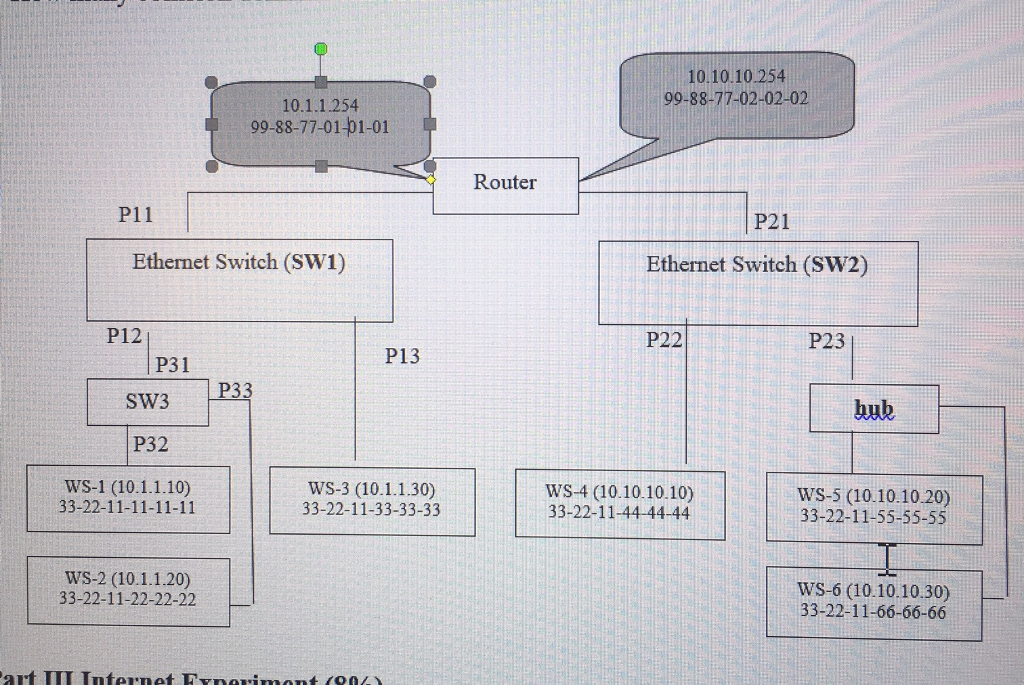
Part III Internet Experiment (8%)
Assume your PC is on ISU campus network. Please use any available network tools to show with at least two evidences (with relevant screenshots) that www.ilstu.edu is on the same LAN as your PC; and www.cnn.com is on the different LAN. (Hint: you may consider the difference on delay and if an ISP is involved)
10.10.10.254 99-88-77-02-02-02 10.1.1.254 99-88-77-011-01 Router P11 P21 Ethernet switch (SW1 Ethernet Switch (sw2) P12 P22 P23 P13 P31 P33 SW3 but a P32 ws-1 (101110) 33-22-11-11-11-11 WS-3 (10.1.1.30) 33-22-11-33-33-33 WS-4 10.10.10.10) 33-22-11-4444-44 WS-5 (10.10.10.20) 33-22-11-55-55-55 WS-2 (10.1.1.20) 33-22-11-22-22-22 SL WS-6 (10.10. 10.30) 33-22-11-66-66-66 Prmoimont Tool
Step by Step Solution
There are 3 Steps involved in it

Get step-by-step solutions from verified subject matter experts
 Study Help