







Question: Please answer all parts if the question. Yes, this is all one problem This is all the information given 1. Give numerical answers to 6
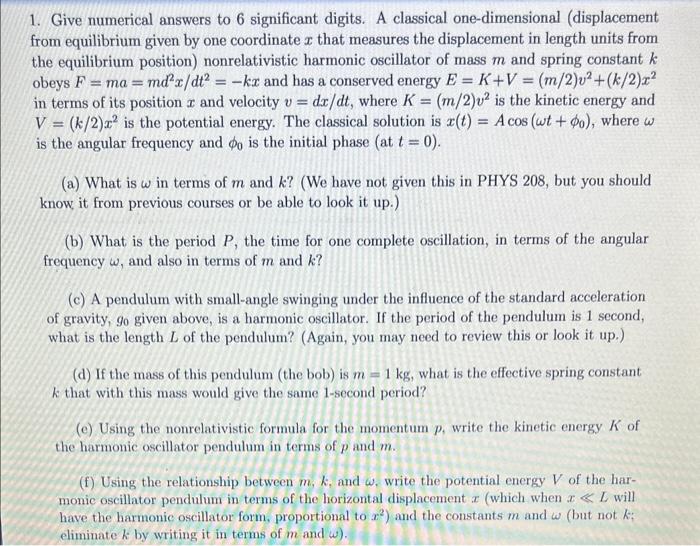
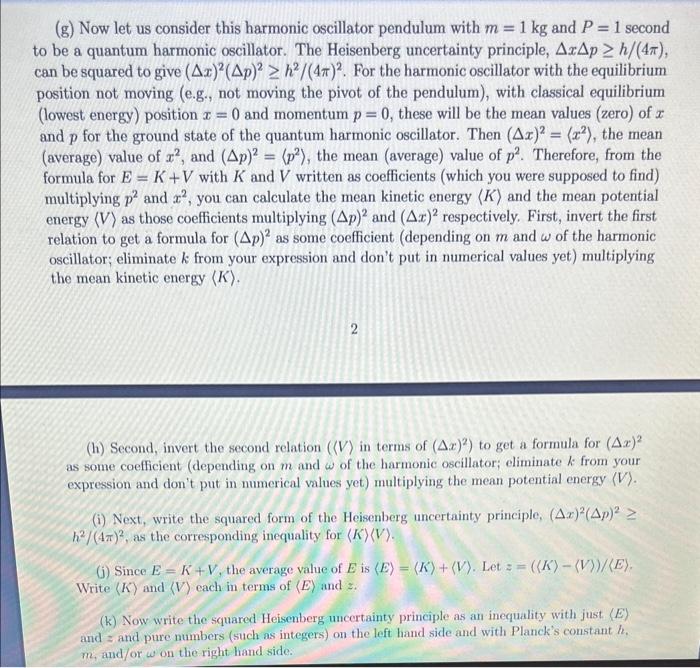
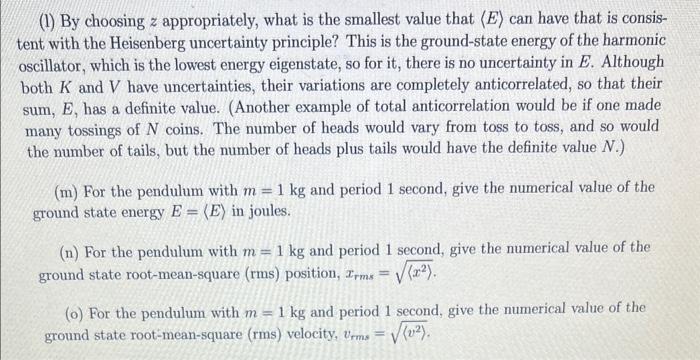
1. Give numerical answers to 6 significant digits. A classical one-dimensional (displacement from equilibrium given by one coordinate x that measures the displacement in length units from the equilibrium position) nonrelativistic harmonic oscillator of mass m and spring constant k obeys F=ma=md2x/dt2=kx and has a conserved energy E=K+V=(m/2)v2+(k/2)x2 in terms of its position x and velocity v=dx/dt, where K=(m/2)v2 is the kinetic energy and V=(k/2)x2 is the potential energy. The classical solution is x(t)=Acos(t+0), where is the angular frequency and 0 is the initial phase (at t=0 ). (a) What is in terms of m and k ? (We have not given this in PHYS 208, but you should know it from previous courses or be able to look it up.) (b) What is the period P, the time for one complete oscillation, in terms of the angular frequency , and also in terms of m and k ? (c) A pendulum with small-angle swinging under the influence of the standard acceleration of gravity, g0 given above, is a harmonic oscillator. If the period of the pendulum is 1 second, what is the length L of the pendulum? (Again, you may need to review this or look it up.) (d) If the mass of this pendulum (the bob) is m=1kg, what is the effective spring constant k that with this mass would give the same 1 -second period? (e) Using the nonrelativistic formula for the momentum p, write the kinetic energy K of the harmonic oscillator pendulum in terms of p and m. (f) Using the relationship between m,k, and , write the potential energy V of the harmonic oscillator pendulum in terms of the horizontal displacement x (which when xL will have the harmonic oscillator form, proportional to x2 ) and the constants m and (but not k; (g) Now let us consider this harmonic oscillator pendulum with m=1kg and P=1 second to be a quantum harmonic oscillator. The Heisenberg uncertainty principle, xph/(4), can be squared to give (x)2(p)2h2/(4)2. For the harmonic oscillator with the equilibrium position not moving (e.g., not moving the pivot of the pendulum), with classical equilibrium (lowest energy) position x=0 and momentum p=0, these will be the mean values (zero) of x and p for the ground state of the quantum harmonic oscillator. Then (x)2=x2, the mean (average) value of x2, and (p)2=p2, the mean (average) value of p2. Therefore, from the formula for E=K+V with K and V written as coefficients (which you were supposed to find) multiplying p2 and x2, you can calculate the mean kinetic energy K and the mean potential energy V as those coefficients multiplying (p)2 and (x)2 respectively. First, invert the first relation to get a formula for (p)2 as some coefficient (depending on m and of the harmonic oscillator; eliminate k from your expression and don't put in numerical values yet) multiplying the mean kinetic energy K. (h) Second, invert the second relation (V in terms of (x)2) to get a formula for (x)2 as some coefficient (depending on m and of the harmonic oscillator; eliminate k from your expression and don't put in numerical values yet) multiplying the mean potential energy V. (i) Next, write the squared form of the Heisenberg uncertainty principle, (x)2(p)2 h2/(4)2, as the corresponding inequality for KV. (j) Since E=K+V, the average value of E is E=K+V. Let z=(KV)/E. Write K and V each in terms of E and z. (k) Now write the squared Heisenberg uncertainty principle as an inequality with just. E and z and pure numbers (such as integers) on the left hand side and with Planck's constant h, m, and/or on the right hand side. (1) By choosing z appropriately, what is the smallest value that E can have that is consistent with the Heisenberg uncertainty principle? This is the ground-state energy of the harmonic oscillator, which is the lowest energy eigenstate, so for it, there is no uncertainty in E. Although both K and V have uncertainties, their variations are completely anticorrelated, so that their sum, E, has a definite value. (Another example of total anticorrelation would be if one made many tossings of N coins. The number of heads would vary from toss to toss, and so would the number of tails, but the number of heads plus tails would have the definite value N.) (m) For the pendulum with m=1kg and period 1 second, give the numerical value of the ground state energy E=E in joules. (n) For the pendulum with m=1kg and period 1 second, give the numerical value of the ground state root-mean-square (rms) position, xrms=x2. (o) For the pendulum with m=1kg and period 1 second, give the numerical value of the ground state root-mean-square ( rms) velocity, vrms=v2. 1. Give numerical answers to 6 significant digits. A classical one-dimensional (displacement from equilibrium given by one coordinate x that measures the displacement in length units from the equilibrium position) nonrelativistic harmonic oscillator of mass m and spring constant k obeys F=ma=md2x/dt2=kx and has a conserved energy E=K+V=(m/2)v2+(k/2)x2 in terms of its position x and velocity v=dx/dt, where K=(m/2)v2 is the kinetic energy and V=(k/2)x2 is the potential energy. The classical solution is x(t)=Acos(t+0), where is the angular frequency and 0 is the initial phase (at t=0 ). (a) What is in terms of m and k ? (We have not given this in PHYS 208, but you should know it from previous courses or be able to look it up.) (b) What is the period P, the time for one complete oscillation, in terms of the angular frequency , and also in terms of m and k ? (c) A pendulum with small-angle swinging under the influence of the standard acceleration of gravity, g0 given above, is a harmonic oscillator. If the period of the pendulum is 1 second, what is the length L of the pendulum? (Again, you may need to review this or look it up.) (d) If the mass of this pendulum (the bob) is m=1kg, what is the effective spring constant k that with this mass would give the same 1 -second period? (e) Using the nonrelativistic formula for the momentum p, write the kinetic energy K of the harmonic oscillator pendulum in terms of p and m. (f) Using the relationship between m,k, and , write the potential energy V of the harmonic oscillator pendulum in terms of the horizontal displacement x (which when xL will have the harmonic oscillator form, proportional to x2 ) and the constants m and (but not k; (g) Now let us consider this harmonic oscillator pendulum with m=1kg and P=1 second to be a quantum harmonic oscillator. The Heisenberg uncertainty principle, xph/(4), can be squared to give (x)2(p)2h2/(4)2. For the harmonic oscillator with the equilibrium position not moving (e.g., not moving the pivot of the pendulum), with classical equilibrium (lowest energy) position x=0 and momentum p=0, these will be the mean values (zero) of x and p for the ground state of the quantum harmonic oscillator. Then (x)2=x2, the mean (average) value of x2, and (p)2=p2, the mean (average) value of p2. Therefore, from the formula for E=K+V with K and V written as coefficients (which you were supposed to find) multiplying p2 and x2, you can calculate the mean kinetic energy K and the mean potential energy V as those coefficients multiplying (p)2 and (x)2 respectively. First, invert the first relation to get a formula for (p)2 as some coefficient (depending on m and of the harmonic oscillator; eliminate k from your expression and don't put in numerical values yet) multiplying the mean kinetic energy K. (h) Second, invert the second relation (V in terms of (x)2) to get a formula for (x)2 as some coefficient (depending on m and of the harmonic oscillator; eliminate k from your expression and don't put in numerical values yet) multiplying the mean potential energy V. (i) Next, write the squared form of the Heisenberg uncertainty principle, (x)2(p)2 h2/(4)2, as the corresponding inequality for KV. (j) Since E=K+V, the average value of E is E=K+V. Let z=(KV)/E. Write K and V each in terms of E and z. (k) Now write the squared Heisenberg uncertainty principle as an inequality with just. E and z and pure numbers (such as integers) on the left hand side and with Planck's constant h, m, and/or on the right hand side. (1) By choosing z appropriately, what is the smallest value that E can have that is consistent with the Heisenberg uncertainty principle? This is the ground-state energy of the harmonic oscillator, which is the lowest energy eigenstate, so for it, there is no uncertainty in E. Although both K and V have uncertainties, their variations are completely anticorrelated, so that their sum, E, has a definite value. (Another example of total anticorrelation would be if one made many tossings of N coins. The number of heads would vary from toss to toss, and so would the number of tails, but the number of heads plus tails would have the definite value N.) (m) For the pendulum with m=1kg and period 1 second, give the numerical value of the ground state energy E=E in joules. (n) For the pendulum with m=1kg and period 1 second, give the numerical value of the ground state root-mean-square (rms) position, xrms=x2. (o) For the pendulum with m=1kg and period 1 second, give the numerical value of the ground state root-mean-square ( rms) velocity, vrms=v2
Step by Step Solution
There are 3 Steps involved in it

Get step-by-step solutions from verified subject matter experts
 Study Help