







Question: please answer all parts of the question. Problem 2 Defects (10 points) a) Pure copper has a higher ultimate tensile strength than pure zinc. The
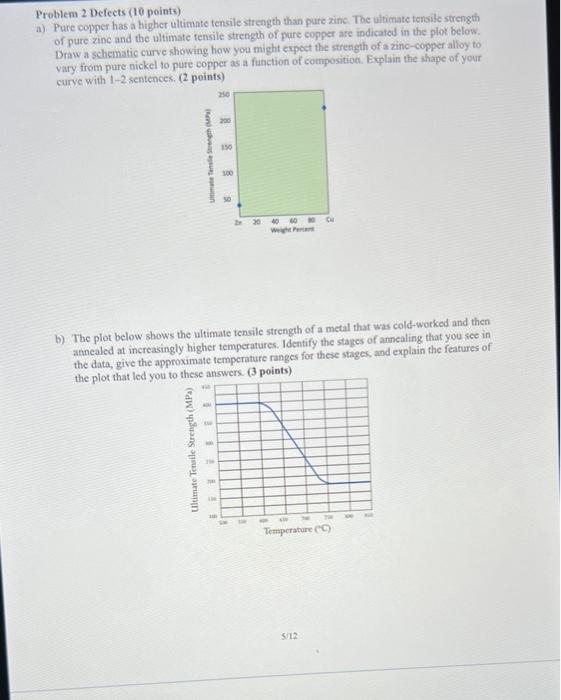
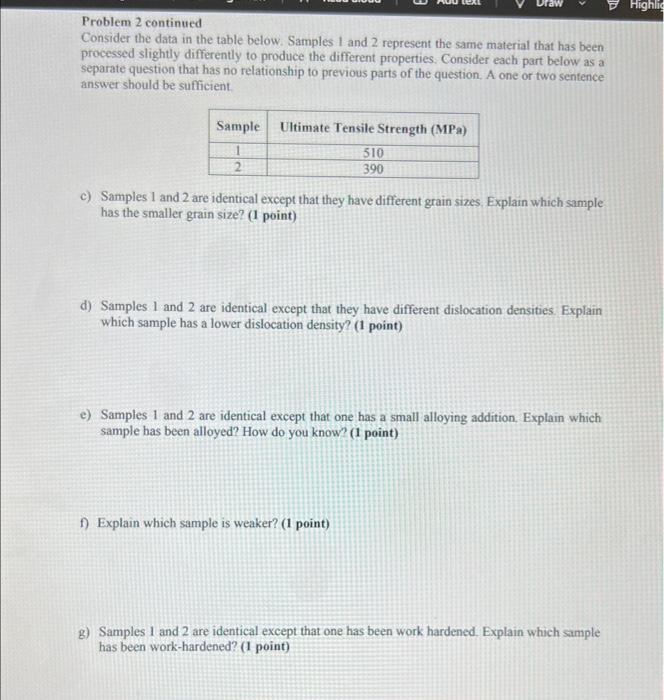
Problem 2 Defects (10 points) a) Pure copper has a higher ultimate tensile strength than pure zinc. The ultimate tensile strength of pure zine and the ultimate tensile strength of pure copper are indicated in the plot below. Draw a schematic curve showing how you might expect the strength of a zinc-copper alloy to vary from pure nickel to pure copper as a function of composition. Explain the shape of your curve with 1-2 sentences (2 points) 250 150 100 S > 40 b) The plot below shows the ultimate tensile strength of a metal that was cold-worked and then annealed at increasingly higher temperatures. Identify the stages of annealing that you see in the data, give the approximate temperature ranges for these stages, and explain the features of the plot that led you to these answers (3 points) Ultimate Tensile Strength (MP) Temperature CC) 5112 Highlig Problem 2 continued Consider the data in the table below. Samples 1 and 2 represent the same material that has been processed slightly differently to produce the different properties. Consider each part below as a separate question that has no relationship to previous parts of the question. A one or two sentence answer should be sufficient Sample 1 2 Ultimate Tensile Strength (MPa) 510 390 c) Samples 1 and 2 are identical except that they have different grain sizes Explain which sample has the smaller grain size? (1 point) d) Samples 1 and 2 are identical except that they have different dislocation densities. Explain which sample has a lower dislocation density? (1 point) e) Samples 1 and 2 are identical except that one has a small alloying addition. Explain which sample has been alloyed? How do you know? (1 point) 1) Explain which sample is weaker? (1 point) g) Samples 1 and 2 are identical except that one has been work hardened. Explain which sample has been work-hardened? (1 point)
Step by Step Solution
There are 3 Steps involved in it

Get step-by-step solutions from verified subject matter experts
 Study Help