Question: Please answer the question according to the case study of Kingston Family Vineyard no generalization: Which of the investment alternatives would you recommend for Kingston
Please answer the question according to the case study of Kingston Family Vineyard no generalization:
Which of the investment alternatives would you recommend for Kingston Family Vineyard and why
How do non-market considerations impact the investment that you would make?
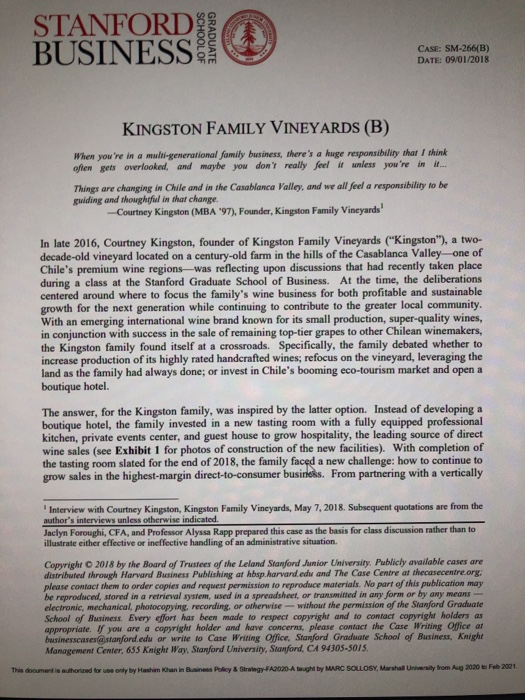
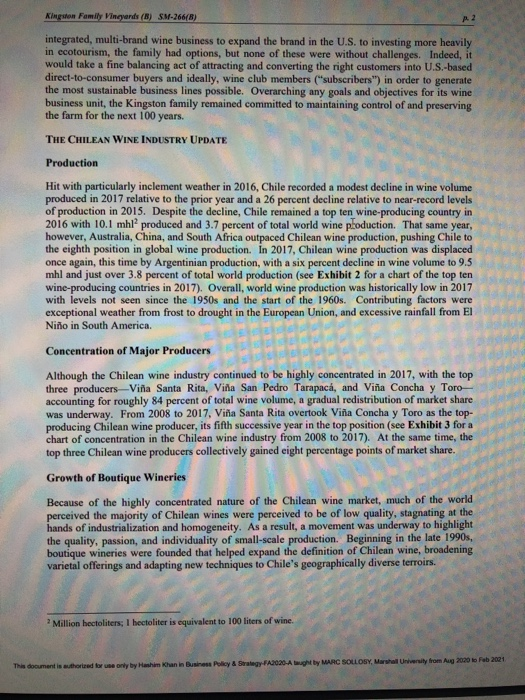
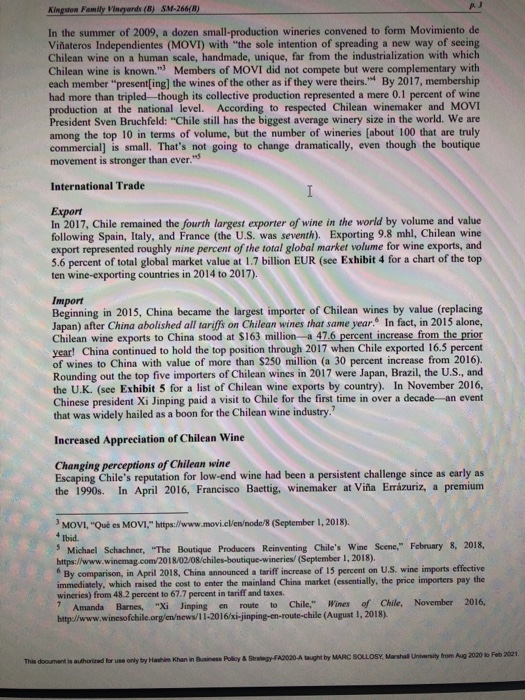
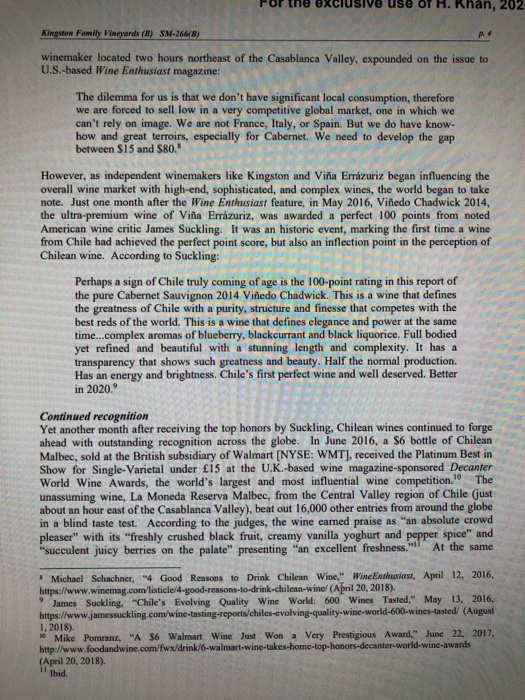
STANFORDI BUSINESS CASE: SM-266(B) DATE: 09/01/2018 KINGSTON FAMILY VINEYARDS (B) When you're in a multi-generational family business, there's a huge responsibility that I think often gets overlooked, and maybe you don't really feel it unless you're in ... Things are changing in Chile and in the Casablanca Valley, and we all feel a responsibility to be guiding and thoughtful in that change. -Courtney Kingston (MBA '97), Founder, Kingston Family Vineyards! In late 2016, Courtney Kingston, founder of Kingston Family Vineyards ("Kingston"), a two- decade-old vineyard located on a century-old farm in the hills of the Casablanca Valley-one of Chile's premium wine regions was reflecting upon discussions that had recently taken place during a class at the Stanford Graduate School of Business. At the time, the deliberations centered around where to focus the family's wine business for both profitable and sustainable growth for the next generation while continuing to contribute to the greater local community. With an emerging international wine brand known for its small production, super-quality wines, in conjunction with success in the sale of remaining top-tier grapes to other Chilean winemakers, the Kingston family found itself at a crossroads. Specifically, the family debated whether to increase production of its highly rated handcrafted wines, refocus on the vineyard, leveraging the land as the family had always done; or invest in Chile's booming eco-tourism market and open a boutique hotel. The answer, for the Kingston family, was inspired by the latter option. Instead of developing a boutique hotel, the family invested in a new tasting room with a fully equipped professional kitchen, private events center, and guest house to grow hospitality, the leading source of direct wine sales (see Exhibit 1 for photos of construction of the new facilities). With completion of the tasting room slated for the end of 2018, the family faced a new challenge: how to continue to grow sales in the highest-margin direct-to-consumer business. From partnering with a vertically Interview with Courtney Kingston, Kingston Family Vineyards, May 7, 2018. Subsequent quotations are from the author's interviews unless otherwise indicated. Jaclyn Foroughi, CFA, and Professor Alyssa Rapp prepared this case as the basis for class discussion rather than to illustrate either effective or ineffective handling of an administrative situation. Copyright 2018 by the Board of Trustees of the Leland Stanford Junior University. Publicly available cases are distributed through Harvard Business Publishing at hbsp.harvard.edu and The Case Centre at thecasecentre.org, please contact them to order copies and request permission to reproduce materials. No part of this publication may be reproduced, stored in a retrieval system, used in a spreadsheet, or transmitted in any form or by any means - electronic, mechanical, photocopying, recording, or otherwise --without the permission of the Stanford Graduate School of Business. Every effort has been made to respect copyright and to contact copyright holders as appropriate you are a copyright holder and have concerns, please contact the Case Writing Office at businesscases@stanford.edu or write to Case Writing Office, Stanford Graduate School of Business, Knight Management Center, 655 Knight Way, Stanford University, Stanford, CA 94305-5015. This document is authored for use only by Hashim Canine Policy & Strategy-FA2020- Aug by MARC SOLLOSY, Marshall University from Aug 2020 Feb 2021 Kingston Family Vineyards (B) SM-266(8) A2 integrated, multi-brand wine business to expand the brand in the U.S. to investing more heavily in ecotourism, the family had options, but none of these were without challenges. Indeed, it would take a fine balancing act of attracting and converting the right customers into U.S.-based direct-to-consumer buyers and ideally, wine club members ("subscribers") in order to generate the most sustainable business lines possible. Overarching any goals and objectives for its wine business unit, the Kingston family remained committed to maintaining control of and preserving the farm for the next 100 years. THE CHILEAN WINE INDUSTRY UPDATE Production Hit with particularly inclement weather in 2016, Chile recorded a modest decline in wine volume produced in 2017 relative to the prior year and a 26 percent decline relative to near-record levels of production in 2015. Despite the decline, Chile remained a top ten wine-producing country in 2016 with 10.1 mhl produced and 3.7 percent of total world wine production. That same year, however, Australia, China, and South Africa outpaced Chilean wine production, pushing Chile to the eighth position in global wine production. In 2017, Chilean wine production was displaced once again, this time by Argentinian production, with a six percent decline in wine volume to 9.5 mhl and just over 3.8 percent of total world production (see Exhibit 2 for a chart of the top ten wine-producing countries in 2017). Overall, world wine production was historically low in 2017 with levels not seen since the 1950s and the start of the 1960s. Contributing factors were exceptional weather from frost to drought in the European Union, and excessive rainfall from El Nio in South America Concentration of Major Producers Although the Chilean wine industry continued to be highly concentrated in 2017, with the top three producers-Via Santa Rita, Via San Pedro Tarapac, and Via Concha y Toro- accounting for roughly 84 percent of total wine volume, a gradual redistribution of market share was underway. From 2008 to 2017, Via Santa Rita overtook Via Concha y Toro as the top- producing Chilean wine producer, its fifth successive year in the top position (see Exhibit 3 for a chart of concentration in the Chilean wine industry from 2008 to 2017). At the same time, the top three Chilean wine producers collectively gained eight percentage points of market share. Growth of Boutique Wineries Because of the highly concentrated nature of the Chilean wine market, much of the world perceived the majority of Chilean wines were perceived to be of low quality, stagnating at the hands of industrialization and homogeneity. As a result, a movement was underway to highlight the quality, passion, and individuality of small-scale production. Beginning in the late 1990s, boutique wineries were founded that helped expand the definition of Chilean wine, broadening varietal offerings and adapting new techniques to Chile's geographically diverse terroirs. Million hectoliters; 1 hectoliter is equivalent to 100 liters of wine. This document is authorized for use only by Hashim Khan in Business Policy & Strategy-FA2020-A laught by MARC SOLLOSY, Marshall University from Aug 2020 Feb 2021 Kingston Family Vineyards (B) SM-266(H) In the summer of 2009, a dozen small production wineries convened to form Movimiento de Viateros Independientes (MOVI) with the sole intention of spreading a new way of seeing Chilean wine on a human scale, handmade, unique, far from the industrialization with which Chilean wine is known." Members of MOVI did not compete but were complementary with each member "present[ing] the wines of the other as if they were theirs. By 2017, membership had more than tripled though its collective production represented a mere 0.1 percent of wine production at the national level. According to respected Chilean winemaker and MOVI President Sven Bruchfeld: "Chile still has the biggest average winery size in the world. We are among the top 10 in terms of volume, but the number of wineries (about 100 that are truly commercial) is small. That's not going to change dramatically, even though the boutique movement is stronger than ever." International Trade I Export In 2017, Chile remained the fourth largest exporter of wine in the world by volume and value following Spain, Italy, and France (the U.S. was seventh). Exporting 9.8 mhl, Chilean wine export represented roughly nine percent of the total global market volume for wine exports, and 5.6 percent of total global market value at 1.7 billion EUR (see Exhibit 4 for a chart of the top ten wine-exporting countries in 2014 to 2017). Import Beginning in 2015, China became the largest importer of Chilean wines by value (replacing Japan) after China abolished all tariffs on Chilean wines that same year. In fact, in 2015 alone, Chilean wine exports to China stood at $163 million a 47.6 percent increase from the prior year! China continued to hold the top position through 2017 when Chile exported 16.5 percent of wines to China with value of more than $250 million (a 30 percent increase from 2016). Rounding out the top five importers of Chilean wines in 2017 were Japan, Brazil, the U.S., and the U.K. (see Exhibit 5 for a list of Chilean wine exports by country). In November 2016, Chinese president Xi Jinping paid a visit to Chile for the first time in over a decade an event that was widely hailed as a boon for the Chilean wine industry.? Increased Appreciation of Chilean Wine Changing perceptions of Chilean wine Escaping Chile's reputation for low-end wine had been a persistent challenge since as early as the 1990s. In April 2016, Francisco Baettig, winemaker at Via Errzuriz, a premium 5 MOVI, "Qu es MOVI," https://www.movi.cl/enode/8 (September 1, 2018). Ibid Michael Schachner, "The Boutique Producers Reinventing Chile's Wine Scene," February 8, 2018, https://www.winemag.com/2018/02/08/chiles-boutique-wineries/ (September 1, 2018). 6 By comparison, in April 2018, China announced a tariff increase of 15 percent on U.S. wine imports effective immediately, which raised the cost to enter the mainland China market (essentially, the price importers pay the wineries) from 48.2 percent to 67.7 percent in tariff and taxes. 7 Amanda Barnes, "Xi Jinping en route to Chile," Wines of Chile. November 2016, http://www.winesofchile.org/enews/11-2016/xi-jinping-cn-route-chile (August 1, 2018). This document is authorized for use only by Hashim Khan in Business Policy & Serlegy-FA2020-A taught by MARC SOLLOSY, Marshall University from Aug 2020 to Feb 2001 use H. Khan, 202 Kingston Family Vineyards (B) SM-266(B) winemaker located two hours northeast of the Casablanca Valley, expounded on the issue to U.S.-based Wine Enthusiast magazine: The dilemma for us is that we don't have significant local consumption, therefore we are forced to sell low in a very competitive global market, one in which we can't rely on image. We are not France, Italy, or Spain. But we do have know- how and great terroirs, especially for Cabernet. We need to develop the gap between $15 and $80. However, as independent winemakers like Kingston and Via Errzuriz began influencing the overall wine market with high-end, sophisticated, and complex wines, the world began to take note. Just one month after the Wine Enthusiast feature, in May 2016, Viedo Chadwick 2014, the ultra-premium wine of Via Errzuriz, was awarded a perfect 100 points from noted American wine critic James Suckling. It was an historic event, marking the first time a wine from Chile had achieved the perfect point score, but also an inflection point in the perception of Chilean wine. According to Suckling: Perhaps a sign of Chile truly coming of age is the 100-point rating in this report of the pure Cabernet Sauvignon 2014 Viedo Chadwick. This is a wine that defines the greatness of Chile with a purity, structure and finesse that competes with the best reds of the world. This is a wine that defines elegance and power at the same time...complex aromas of blueberry, blackcurrant and black liquorice. Full bodied yet refined and beautiful with a stunning length and complexity. It has a transparency that shows such greatness and beauty. Half the normal production. Has an energy and brightness. Chile's first perfect wine and well deserved. Better in 2020. Continued recognition Yet another month after receiving the top honors by Suckling, Chilean wines continued to forge ahead with outstanding recognition across the globe. In June 2016, a $6 bottle of Chilean Malbec, sold at the British subsidiary of Walmart (NYSE: WMT), received the Platinum Best in Show for Single-Varietal under 15 at the U.K.-based wine magazine-sponsored Decanter World Wine Awards, the world's largest and most influential wine competition. The unassuming wine, La Moneda Reserva Malbec, from the Central Valley region of Chile just about an hour east of the Casablanca Valley), beat out 16,000 other entries from around the globe in a blind taste test. According to the judges, the wine eamed praise as an absolute crowd pleaser" with its "freshly crushed black fruit, creamy vanilla yoghurt and pepper spice and "succulent juicy berries on the palate" presenting an excellent freshness."!! At the same Michael Schachner, *4 Good Reasons to Drink Chilean Wine," Wine Enthusiast, April 12, 2016, https://www.winemag.com/listicle/4-good-reasons-to-drink-chilean-wine/(April 20, 2018). 9 James Suckling. "Chile's Evolving Quality Wine World: 600 Wines Tasted," May 13, 2016, https://www.jamessuckling.com/wine-tasting-reports/chiles-evolving-quality-wine-world-600-wines-tasted (August 1, 2018) 10 Mike Pomranz, "A S6 Walmart Wine Just Won a Very Prestigious Award," June 22, 2017, http://www.foodandwine.com/fwx/drink/6-walmart-wine-takes-home-top-honors-decanter-world-wine-awards April 20, 2018) Ibid. Kingston Family Vineyards (B) SM-2668) competition that same year, five other Chilean wines from various regions also received Platinum Best in Show awards. Meanwhile, at the end of 2016, Decanter's Top 50 of 2016 featured two Chilean wines: De Martino's Viejas Tinajas Muscat 2015 of the Itata Valley, located in southern Chile; and Casa Marin's Cipreses Vineyard Sauvignon Blanc 2015 of the San Antonio Valley, located just 30 minutes southwest of the Casablanca Valley.2 Looking ahead Suckling traveled to Chile in April 2017 to sample wines ahead of compiling his much- anticipated "100 Best Wines of 2017" list, which hand-picked the top 100 wines from close to 17,000 wines across the world. Speaking to Wines of Chile, Suckling foreshadowed the exceptional quality of wine observed: There's never been a better time to buy Chilean wine (emphasis added). I recently took my fifth trip to Chile in three years to score nearly 800 wines and found that a large majority of wines (601 out of 715) were worthy of 90 points or more! An additional 41 wines were 95 points or more. Most were tasted blind at the W Hotel in Santiago with my team, though I did make a few day trips, including ones to Valle de Colchagua and Puente Alto. Indeed, hundreds of outstanding quality wines are entering the market. It doesn't hurt that the current vintages available, especially for reds, are fantastic - mostly 2013, 2014, and 2015. In fact, there has not been a bad vintage in years, although 2017 is questionable due to an exceptionally small crop and large scale forest fires in the country that may have tainted some wines. The quality-price ratio is also hard to ignore: highly rated Chilean bottles that cost $15 to $30 a bottle in the United States can easily compete with European or Californian counterparts that would cost three to four times as much."13 Just seven months later, in November 2017, Suckling released his much-anticipated "100 Best Wines of 2017." Once again, Almaviva Puente Alto 2015, a Chilean Bordeaux blend produced by Via Almaviva, located roughly two hours southwest of the Casablanca Valley in the Central Valley region, took top honors with 2017 Wine of the Year." This is a wine that epitomizes greatness with its intensity, structure and balance. It underlines the movement away from overdone, jammy wines to a neoclassicism with energy and finesse. It also highlights how South America, specifically Chile, has come into its own as a wine area, producing superb wines that can compete with the best in the world. 12 13 "Two Chilean wines in Decanter's Top 50 of 2016," Wines of Chile, April 20, 2018, http://www.winesofchile.org/enews/12-2016/two-chilean-wines-decanters-top-50-2016 (August 1, 2018). "James Suckling: "The time for Chilean wine is now, Wines of Chile, April 20, 2018, http://www.winesofchile.org/enews/05-2017/james-suckling-time-chilean-wine-now (August 1, 2018). James Suckling. "Top 100 Wines of 2017." November 2, 2017, https://www.jamessuckling.com/wine-tasting- reports/top-100-wines-2017/ (August 1, 2018) I This document is authorized for use only by Hashim Khan in Business Policy & Strategy-FA2020 A tag by MARC SOLLOSY, Marshall University from Aug 2020 to Feb 2001 A6 Kingstow Family Wingards (8) SM-266/B) Two additional Chilean wines were included in the top ten of Suckling's infamous list, Sea Valle de Aconcagua 2015 and Clos Apalta 2014, with Suckling noting that they are both perfect wines, is KINGSTON FAMILY VINEYARDS Going Organic In addition to making an investment in hospitality, the Kingston family also took steps to increase the quality and price of the grapes grown at the vineyard. Beginning in July 2016, the family initiated the transition of a little more than a third of its vineyards to organic farming (with full certification anticipated around 2020). (See Exhibit 6 for a map of the transition to organic.) According to Ben Culver, a fellow at Kingston, the decision resulted from two major motivations: first, to responsibly manage the farm in a way that would minimize its negative impacts on the environment and ensure its longevity for future generations, and second, to create a healthier, stronger vineyard that produced even higher-quality grapes for Kingston Family wine. Using compost produced by the cows at the Kingston farm, vineyard soil would regenerate after years of depletion by herbicides. As a result, vines would grow healthier, more resilient to variability in climate, and for a longer period of time. Due to the long-term nature of the transition to organic, however, the effects of the investment would take many years, if not decades to influence the premium pricing that grapes from Kingston already commanded, and thus the winery's financials. Relative to select high- and low- end California regions and varietals in 2017, Kingston grape prices were generally mid-range (see Exhibit 7 for select California region and varietal pricing relative to Kingston in 2017). Among its Casablanca Valley regional peers, however, Kingston continued to obtain premium pricing for its grapes (see Exhibit 8 for a table of Kingston grape prices relative to Casablanca regional averages in 2017). Financial Update Kingston Family Vineyards was comprised of three highly intertwined segments: the vineyard in Chile, the winery and tasting room in Chile, and the import business in the U.S. The vineyard consisted of the grape-growing engine, one of the main drivers of the overall business, while the winery was responsible for winemaking and marketing the grapes of the vineyard) and entertaining of tourists. Tourism revenue was mostly recognized in Kingston's import business as inventory was shipped from California to consumers throughout the U.S. These consumers primarily resulted directly from wine tastings and tours at the winery in Casablanca Valley, Chile. By mid-2018, Kingston's grape-growing business was on track for its sixth year of profitability despite the increased cost of going organic. Meanwhile, the winery business including tourism was expected to turn a profit following the 2018 high season (see Exhibit 9 for Kingston Family 15 Ibid. 16 Ben Culver, "Charla Con Benja: Our Transition to Organic," Kingston Family Vineyards blog, May 23, 2017 https://www.kingstonvineyards.com/blog/why-we-are-transitioning-to-organic-vineyards (August 1, 2018). This document is authored for use only by Hashim Khan in Business Policy & Strategy-FA2020 A taught by MARC SOLLOSY, Marshall University from Aug 2020 to Feb 20 P Kingston Family Vincards (B) SM-266/B) Vineyard Winery and Import financials from 2012 to mid-2018). During 2017 and 2018, the tourism business was largely impacted by increased outlays related to growth in the family's hospitality team as a result of its investment in the new facilities. Specifically, the family invested in training for its growing sales team, which consisted of entrepreneurially minded Chilean employees complemented by recent college graduates as part of the Kingston Family Fellowship Program. Additional costs in the tourism business were related to generous samplings for guests offered in the winery's wine tastings and tours. Although the winery was Kingston's main source of lead generation, high local tax laws (value-added tax and sin taxes) of nearly 40 percent had a significant negative impact on margins from "cellar door" or winery sales. Growing Conversions With the completion of the tasting room and guest house imminent, the Kingston family was focused on how best to sustainably grow sales in the highest margin, U.S.-based direct-to- consumer business. For them, this meant figuring out how to get the right visitors through the door and making sure that their experiences were so unique that they converted in one of two ways: by filling out an order form onsite during a tasting or tour at the winery and having a retail purchase shipped back to the U.S. or by joining the Old Corral Club ("the Club") Kingston's wine club offering exclusive access to premier wines, library wines, and club-only bottlings. While conversion to the Club offered the greatest lifetime value (averaging $2,070 per transaction), conversion through a retail purchase shipped back to the U.S. was also highly valuable. Since the winery initiated wine tastings and tours in 2012, visitors to Kingston had grown at an annualized rate of 74 percent with nearly 4,900 visitors by mid-2018 (see Exhibit 10 for a chart of Kingston Direct Sales and Winery Visits). In addition, a visit to Kingston continued to be ranked as a top-rated "Thing to Do in Casablanca on the world's largest travel forum, TripAdvisor (see Exhibit 11). In fact, TripAdvisor continued to be a vital source of direct referrals since Kingston was able to acquire the customer directly upon registration for a "by appointment only tour or tasting. Establishing more direct connections with original buyers in the U.S. in addition to having to go through Chilean tour operators offered greater supplier power. In addition, ensuring the referral of the right customers was paramount. The family was wary of potential low or negative margin flow such as visitors shipping low-volume retail purchases to "three-tier" [system] states in the U.S. Another concern for the family was the introduction of more international clientele, which limited direct-to-consumer shipments due to regulations and costs around shipping to non-U.S. countries. In fact, while U.S. guests initially were nearly 90 percent of visitors to Kingston, that number had decreased dramatically to around 50 percent by mid-2018. Meanwhile, in 2017, nearly 212,000 U.S. tourists arrived in Chile." "Brainstorming on how to get more tourists visiting Patagonia, the Lake District, and Atacama to know about and come to Kingston is my number one challenge," said Courtney. Still, winery visits remained the primary driver of U.S. 17 TurismoChile,"Tourist Arrivals to Chile Will Rise 8.5% in 2018," January 30, 2018, http://turismochile travel 2018/01/30/tourist-arrivals-to-chile-rise-8-5-in-2018 (August 1, 2018). This document is authorized for use only by Hashim Khan in Business Policy & Strategy FA2020-A laught by MARC SOLLOSY, Marshall University from Aug 2020 Feb 2011 Kingston Family Vineyards (B) SM-266(R) Ad direct sales, reaching nearly 88 percent of total U.S. sales by mid-2018 (Exhibit 12 for a chart of the transition from direct-to-consumer/retail sales from the traditional wholesale/export model). Finally, while the average purchase value at Kingston had increased from the 2017 to 2018 high season, basket sizes continued to lag those of U.S. tasting rooms. And while the 2018 Kingston conversion rate to wine club members was above its peer group, churn (club member drops) continued to be an issue. As a result, improving member retention presented another significant opportunity for club expansion. NEXT STEPS FOR KINGSTON FAMILY VINEYARDS For the Kingston family, building a sustainable and profitable business for the next century meant optimizing the direct-to-consumer model by attracting and developing lasting relationships with customers who were connected with the Kingston storyan effort only partly satisfied by its investment in hospitality. Indeed, the real challenge was figuring out how to accelerate growth in customer acquisition and retention while staying consistent with the family's long-term goals. Partner with a Multi-Brand Wine Business One option that the Kingston family could pursue would be to expand the Kingston brand in the U.S. by partnering with a vertically integrated, multi-brand wine business. In this instance, a similarly minded (values-based and mission-focused) wine company would acquire the Kingston brand, talent, and/or grapes. This would allow for Kingston to gain access to the acquiring company's extensive in-house distribution channel in exchange for Kingston's unique brand and winemaking style. In addition, Kingston would retain ownership of the land, allowing the family to keep its promise of developing the land and its integration within the local community for generations to come. Invest Heavily in Eco-tourism Another option for the Kingston family to consider was investing more heavily in eco-tourism. While the family had already invested in a private events center and guest house, they observed that the longer guests stayed with them, the higher the conversion rate. As a result, the family wondered if there was a better way to host guests on site, and what the right investment would be, based on potential future growth. According to Courtney, "Capacity doesn't seem to be a problem. Accelerating growth in a manageable way is the real challenge." Work with Cruise Lines A third option was for the family to partner with a local ground operator for cruise lines coming into Valparaiso or San Antonio. By offering visiting cruise ship guests excursion programs in Chile, ground operators such as DMC Norway would open up an invaluable sales channel for Kingston. This was particularly relevant now that Kingston had the facilities to accommodate a larger number of guests. And while channel sales were a more complicated source of lead generation, the Kingston family recognized that the volume inherent in cruise lines was an important complement to direct leads. Once again, however, it would be imperative to ensure This document is thered for use only by Hashim Khan in Business Policy & Strategy FA2020 AM by MARC SOLLOSY, Marshall University from Aug 2020 Feb 2001 Kingston Family Vingurds (B) SM-266(B) the right flow of guests those who understood the Kingston story and generated high margin sales (ideally, either through joining the Club or shipping wine purchases back to the U.S.). Leverage a Current Digital Marketplace for Wine Finally, the family could explore the use of a current digital marketplace for wine to increase brand awareness in the U.S. Examples included eBay Wine, Vivino, or Amazon through its Amazon Fresh or Prime Now offerings. The main issue with this option, however, was that Kingston would lose control over the digital customer experience and would have limited influence over the customers choosing to order through these platforms. Specifically, due to regulatory constraints and prohibitive shipping costs, Kingston would not be able to ship direct to all states or all countries an inherent limit on growth in direct sales. This was particularly difficult given the increased growth in wine consumption in China and other non-U.S. countries. CONCLUSION With their sights set on the century ahead, the Kingston family was ready to make some critical decisions. Having leveraged the land across multiple incarnations from mining to cattle, and vineyards to hospitality, it was clear that the family was committed to fulfilling its purpose of developing successful and entrepreneurial businesses while embracing a binational and collaborative team spirit. At the same time, the family remained laser-focused on making exceptional wine, all while having an impact on the land and the community within Chile's Casablanca Valley DISCUSSION QUESTIONS 1. Analyze the importance of the direct-to-consumer sales channel to Kingston. 2. Where should Kingston Family Vineyards concentrate their efforts to grow direct-to- consumer sales? Why? 3. What additional avenues for growth might Kingston consider? 4. What challenges are specific to Kingston as a family business trying to grow direct-to- consumer sales? Amazon Wine, launched in late 2012, was Amazon's third attempt at entering the online wine sales marketplace. However, six months after Amazon's purchase of the Whole Foods grocery chain, Amazon Wine, the third-party marketing website, shut down at the end of 2017 STANFORDI BUSINESS CASE: SM-266(B) DATE: 09/01/2018 KINGSTON FAMILY VINEYARDS (B) When you're in a multi-generational family business, there's a huge responsibility that I think often gets overlooked, and maybe you don't really feel it unless you're in ... Things are changing in Chile and in the Casablanca Valley, and we all feel a responsibility to be guiding and thoughtful in that change. -Courtney Kingston (MBA '97), Founder, Kingston Family Vineyards! In late 2016, Courtney Kingston, founder of Kingston Family Vineyards ("Kingston"), a two- decade-old vineyard located on a century-old farm in the hills of the Casablanca Valley-one of Chile's premium wine regions was reflecting upon discussions that had recently taken place during a class at the Stanford Graduate School of Business. At the time, the deliberations centered around where to focus the family's wine business for both profitable and sustainable growth for the next generation while continuing to contribute to the greater local community. With an emerging international wine brand known for its small production, super-quality wines, in conjunction with success in the sale of remaining top-tier grapes to other Chilean winemakers, the Kingston family found itself at a crossroads. Specifically, the family debated whether to increase production of its highly rated handcrafted wines, refocus on the vineyard, leveraging the land as the family had always done; or invest in Chile's booming eco-tourism market and open a boutique hotel. The answer, for the Kingston family, was inspired by the latter option. Instead of developing a boutique hotel, the family invested in a new tasting room with a fully equipped professional kitchen, private events center, and guest house to grow hospitality, the leading source of direct wine sales (see Exhibit 1 for photos of construction of the new facilities). With completion of the tasting room slated for the end of 2018, the family faced a new challenge: how to continue to grow sales in the highest-margin direct-to-consumer business. From partnering with a vertically Interview with Courtney Kingston, Kingston Family Vineyards, May 7, 2018. Subsequent quotations are from the author's interviews unless otherwise indicated. Jaclyn Foroughi, CFA, and Professor Alyssa Rapp prepared this case as the basis for class discussion rather than to illustrate either effective or ineffective handling of an administrative situation. Copyright 2018 by the Board of Trustees of the Leland Stanford Junior University. Publicly available cases are distributed through Harvard Business Publishing at hbsp.harvard.edu and The Case Centre at thecasecentre.org, please contact them to order copies and request permission to reproduce materials. No part of this publication may be reproduced, stored in a retrieval system, used in a spreadsheet, or transmitted in any form or by any means - electronic, mechanical, photocopying, recording, or otherwise --without the permission of the Stanford Graduate School of Business. Every effort has been made to respect copyright and to contact copyright holders as appropriate you are a copyright holder and have concerns, please contact the Case Writing Office at businesscases@stanford.edu or write to Case Writing Office, Stanford Graduate School of Business, Knight Management Center, 655 Knight Way, Stanford University, Stanford, CA 94305-5015. This document is authored for use only by Hashim Canine Policy & Strategy-FA2020- Aug by MARC SOLLOSY, Marshall University from Aug 2020 Feb 2021 Kingston Family Vineyards (B) SM-266(8) A2 integrated, multi-brand wine business to expand the brand in the U.S. to investing more heavily in ecotourism, the family had options, but none of these were without challenges. Indeed, it would take a fine balancing act of attracting and converting the right customers into U.S.-based direct-to-consumer buyers and ideally, wine club members ("subscribers") in order to generate the most sustainable business lines possible. Overarching any goals and objectives for its wine business unit, the Kingston family remained committed to maintaining control of and preserving the farm for the next 100 years. THE CHILEAN WINE INDUSTRY UPDATE Production Hit with particularly inclement weather in 2016, Chile recorded a modest decline in wine volume produced in 2017 relative to the prior year and a 26 percent decline relative to near-record levels of production in 2015. Despite the decline, Chile remained a top ten wine-producing country in 2016 with 10.1 mhl produced and 3.7 percent of total world wine production. That same year, however, Australia, China, and South Africa outpaced Chilean wine production, pushing Chile to the eighth position in global wine production. In 2017, Chilean wine production was displaced once again, this time by Argentinian production, with a six percent decline in wine volume to 9.5 mhl and just over 3.8 percent of total world production (see Exhibit 2 for a chart of the top ten wine-producing countries in 2017). Overall, world wine production was historically low in 2017 with levels not seen since the 1950s and the start of the 1960s. Contributing factors were exceptional weather from frost to drought in the European Union, and excessive rainfall from El Nio in South America Concentration of Major Producers Although the Chilean wine industry continued to be highly concentrated in 2017, with the top three producers-Via Santa Rita, Via San Pedro Tarapac, and Via Concha y Toro- accounting for roughly 84 percent of total wine volume, a gradual redistribution of market share was underway. From 2008 to 2017, Via Santa Rita overtook Via Concha y Toro as the top- producing Chilean wine producer, its fifth successive year in the top position (see Exhibit 3 for a chart of concentration in the Chilean wine industry from 2008 to 2017). At the same time, the top three Chilean wine producers collectively gained eight percentage points of market share. Growth of Boutique Wineries Because of the highly concentrated nature of the Chilean wine market, much of the world perceived the majority of Chilean wines were perceived to be of low quality, stagnating at the hands of industrialization and homogeneity. As a result, a movement was underway to highlight the quality, passion, and individuality of small-scale production. Beginning in the late 1990s, boutique wineries were founded that helped expand the definition of Chilean wine, broadening varietal offerings and adapting new techniques to Chile's geographically diverse terroirs. Million hectoliters; 1 hectoliter is equivalent to 100 liters of wine. This document is authorized for use only by Hashim Khan in Business Policy & Strategy-FA2020-A laught by MARC SOLLOSY, Marshall University from Aug 2020 Feb 2021 Kingston Family Vineyards (B) SM-266(H) In the summer of 2009, a dozen small production wineries convened to form Movimiento de Viateros Independientes (MOVI) with the sole intention of spreading a new way of seeing Chilean wine on a human scale, handmade, unique, far from the industrialization with which Chilean wine is known." Members of MOVI did not compete but were complementary with each member "present[ing] the wines of the other as if they were theirs. By 2017, membership had more than tripled though its collective production represented a mere 0.1 percent of wine production at the national level. According to respected Chilean winemaker and MOVI President Sven Bruchfeld: "Chile still has the biggest average winery size in the world. We are among the top 10 in terms of volume, but the number of wineries (about 100 that are truly commercial) is small. That's not going to change dramatically, even though the boutique movement is stronger than ever." International Trade I Export In 2017, Chile remained the fourth largest exporter of wine in the world by volume and value following Spain, Italy, and France (the U.S. was seventh). Exporting 9.8 mhl, Chilean wine export represented roughly nine percent of the total global market volume for wine exports, and 5.6 percent of total global market value at 1.7 billion EUR (see Exhibit 4 for a chart of the top ten wine-exporting countries in 2014 to 2017). Import Beginning in 2015, China became the largest importer of Chilean wines by value (replacing Japan) after China abolished all tariffs on Chilean wines that same year. In fact, in 2015 alone, Chilean wine exports to China stood at $163 million a 47.6 percent increase from the prior year! China continued to hold the top position through 2017 when Chile exported 16.5 percent of wines to China with value of more than $250 million (a 30 percent increase from 2016). Rounding out the top five importers of Chilean wines in 2017 were Japan, Brazil, the U.S., and the U.K. (see Exhibit 5 for a list of Chilean wine exports by country). In November 2016, Chinese president Xi Jinping paid a visit to Chile for the first time in over a decade an event that was widely hailed as a boon for the Chilean wine industry.? Increased Appreciation of Chilean Wine Changing perceptions of Chilean wine Escaping Chile's reputation for low-end wine had been a persistent challenge since as early as the 1990s. In April 2016, Francisco Baettig, winemaker at Via Errzuriz, a premium 5 MOVI, "Qu es MOVI," https://www.movi.cl/enode/8 (September 1, 2018). Ibid Michael Schachner, "The Boutique Producers Reinventing Chile's Wine Scene," February 8, 2018, https://www.winemag.com/2018/02/08/chiles-boutique-wineries/ (September 1, 2018). 6 By comparison, in April 2018, China announced a tariff increase of 15 percent on U.S. wine imports effective immediately, which raised the cost to enter the mainland China market (essentially, the price importers pay the wineries) from 48.2 percent to 67.7 percent in tariff and taxes. 7 Amanda Barnes, "Xi Jinping en route to Chile," Wines of Chile. November 2016, http://www.winesofchile.org/enews/11-2016/xi-jinping-cn-route-chile (August 1, 2018). This document is authorized for use only by Hashim Khan in Business Policy & Serlegy-FA2020-A taught by MARC SOLLOSY, Marshall University from Aug 2020 to Feb 2001 use H. Khan, 202 Kingston Family Vineyards (B) SM-266(B) winemaker located two hours northeast of the Casablanca Valley, expounded on the issue to U.S.-based Wine Enthusiast magazine: The dilemma for us is that we don't have significant local consumption, therefore we are forced to sell low in a very competitive global market, one in which we can't rely on image. We are not France, Italy, or Spain. But we do have know- how and great terroirs, especially for Cabernet. We need to develop the gap between $15 and $80. However, as independent winemakers like Kingston and Via Errzuriz began influencing the overall wine market with high-end, sophisticated, and complex wines, the world began to take note. Just one month after the Wine Enthusiast feature, in May 2016, Viedo Chadwick 2014, the ultra-premium wine of Via Errzuriz, was awarded a perfect 100 points from noted American wine critic James Suckling. It was an historic event, marking the first time a wine from Chile had achieved the perfect point score, but also an inflection point in the perception of Chilean wine. According to Suckling: Perhaps a sign of Chile truly coming of age is the 100-point rating in this report of the pure Cabernet Sauvignon 2014 Viedo Chadwick. This is a wine that defines the greatness of Chile with a purity, structure and finesse that competes with the best reds of the world. This is a wine that defines elegance and power at the same time...complex aromas of blueberry, blackcurrant and black liquorice. Full bodied yet refined and beautiful with a stunning length and complexity. It has a transparency that shows such greatness and beauty. Half the normal production. Has an energy and brightness. Chile's first perfect wine and well deserved. Better in 2020. Continued recognition Yet another month after receiving the top honors by Suckling, Chilean wines continued to forge ahead with outstanding recognition across the globe. In June 2016, a $6 bottle of Chilean Malbec, sold at the British subsidiary of Walmart (NYSE: WMT), received the Platinum Best in Show for Single-Varietal under 15 at the U.K.-based wine magazine-sponsored Decanter World Wine Awards, the world's largest and most influential wine competition. The unassuming wine, La Moneda Reserva Malbec, from the Central Valley region of Chile just about an hour east of the Casablanca Valley), beat out 16,000 other entries from around the globe in a blind taste test. According to the judges, the wine eamed praise as an absolute crowd pleaser" with its "freshly crushed black fruit, creamy vanilla yoghurt and pepper spice and "succulent juicy berries on the palate" presenting an excellent freshness."!! At the same Michael Schachner, *4 Good Reasons to Drink Chilean Wine," Wine Enthusiast, April 12, 2016, https://www.winemag.com/listicle/4-good-reasons-to-drink-chilean-wine/(April 20, 2018). 9 James Suckling. "Chile's Evolving Quality Wine World: 600 Wines Tasted," May 13, 2016, https://www.jamessuckling.com/wine-tasting-reports/chiles-evolving-quality-wine-world-600-wines-tasted (August 1, 2018) 10 Mike Pomranz, "A S6 Walmart Wine Just Won a Very Prestigious Award," June 22, 2017, http://www.foodandwine.com/fwx/drink/6-walmart-wine-takes-home-top-honors-decanter-world-wine-awards April 20, 2018) Ibid. Kingston Family Vineyards (B) SM-2668) competition that same year, five other Chilean wines from various regions also received Platinum Best in Show awards. Meanwhile, at the end of 2016, Decanter's Top 50 of 2016 featured two Chilean wines: De Martino's Viejas Tinajas Muscat 2015 of the Itata Valley, located in southern Chile; and Casa Marin's Cipreses Vineyard Sauvignon Blanc 2015 of the San Antonio Valley, located just 30 minutes southwest of the Casablanca Valley.2 Looking ahead Suckling traveled to Chile in April 2017 to sample wines ahead of compiling his much- anticipated "100 Best Wines of 2017" list, which hand-picked the top 100 wines from close to 17,000 wines across the world. Speaking to Wines of Chile, Suckling foreshadowed the exceptional quality of wine observed: There's never been a better time to buy Chilean wine (emphasis added). I recently took my fifth trip to Chile in three years to score nearly 800 wines and found that a large majority of wines (601 out of 715) were worthy of 90 points or more! An additional 41 wines were 95 points or more. Most were tasted blind at the W Hotel in Santiago with my team, though I did make a few day trips, including ones to Valle de Colchagua and Puente Alto. Indeed, hundreds of outstanding quality wines are entering the market. It doesn't hurt that the current vintages available, especially for reds, are fantastic - mostly 2013, 2014, and 2015. In fact, there has not been a bad vintage in years, although 2017 is questionable due to an exceptionally small crop and large scale forest fires in the country that may have tainted some wines. The quality-price ratio is also hard to ignore: highly rated Chilean bottles that cost $15 to $30 a bottle in the United States can easily compete with European or Californian counterparts that would cost three to four times as much."13 Just seven months later, in November 2017, Suckling released his much-anticipated "100 Best Wines of 2017." Once again, Almaviva Puente Alto 2015, a Chilean Bordeaux blend produced by Via Almaviva, located roughly two hours southwest of the Casablanca Valley in the Central Valley region, took top honors with 2017 Wine of the Year." This is a wine that epitomizes greatness with its intensity, structure and balance. It underlines the movement away from overdone, jammy wines to a neoclassicism with energy and finesse. It also highlights how South America, specifically Chile, has come into its own as a wine area, producing superb wines that can compete with the best in the world. 12 13 "Two Chilean wines in Decanter's Top 50 of 2016," Wines of Chile, April 20, 2018, http://www.winesofchile.org/enews/12-2016/two-chilean-wines-decanters-top-50-2016 (August 1, 2018). "James Suckling: "The time for Chilean wine is now, Wines of Chile, April 20, 2018, http://www.winesofchile.org/enews/05-2017/james-suckling-time-chilean-wine-now (August 1, 2018). James Suckling. "Top 100 Wines of 2017." November 2, 2017, https://www.jamessuckling.com/wine-tasting- reports/top-100-wines-2017/ (August 1, 2018) I This document is authorized for use only by Hashim Khan in Business Policy & Strategy-FA2020 A tag by MARC SOLLOSY, Marshall University from Aug 2020 to Feb 2001 A6 Kingstow Family Wingards (8) SM-266/B) Two additional Chilean wines were included in the top ten of Suckling's infamous list, Sea Valle de Aconcagua 2015 and Clos Apalta 2014, with Suckling noting that they are both perfect wines, is KINGSTON FAMILY VINEYARDS Going Organic In addition to making an investment in hospitality, the Kingston family also took steps to increase the quality and price of the grapes grown at the vineyard. Beginning in July 2016, the family initiated the transition of a little more than a third of its vineyards to organic farming (with full certification anticipated around 2020). (See Exhibit 6 for a map of the transition to organic.) According to Ben Culver, a fellow at Kingston, the decision resulted from two major motivations: first, to responsibly manage the farm in a way that would minimize its negative impacts on the environment and ensure its longevity for future generations, and second, to create a healthier, stronger vineyard that produced even higher-quality grapes for Kingston Family wine. Using compost produced by the cows at the Kingston farm, vineyard soil would regenerate after years of depletion by herbicides. As a result, vines would grow healthier, more resilient to variability in climate, and for a longer period of time. Due to the long-term nature of the transition to organic, however, the effects of the investment would take many years, if not decades to influence the premium pricing that grapes from Kingston already commanded, and thus the winery's financials. Relative to select high- and low- end California regions and varietals in 2017, Kingston grape prices were generally mid-range (see Exhibit 7 for select California region and varietal pricing relative to Kingston in 2017). Among its Casablanca Valley regional peers, however, Kingston continued to obtain premium pricing for its grapes (see Exhibit 8 for a table of Kingston grape prices relative to Casablanca regional averages in 2017). Financial Update Kingston Family Vineyards was comprised of three highly intertwined segments: the vineyard in Chile, the winery and tasting room in Chile, and the import business in the U.S. The vineyard consisted of the grape-growing engine, one of the main drivers of the overall business, while the winery was responsible for winemaking and marketing the grapes of the vineyard) and entertaining of tourists. Tourism revenue was mostly recognized in Kingston's import business as inventory was shipped from California to consumers throughout the U.S. These consumers primarily resulted directly from wine tastings and tours at the winery in Casablanca Valley, Chile. By mid-2018, Kingston's grape-growing business was on track for its sixth year of profitability despite the increased cost of going organic. Meanwhile, the winery business including tourism was expected to turn a profit following the 2018 high season (see Exhibit 9 for Kingston Family 15 Ibid. 16 Ben Culver, "Charla Con Benja: Our Transition to Organic," Kingston Family Vineyards blog, May 23, 2017 https://www.kingstonvineyards.com/blog/why-we-are-transitioning-to-organic-vineyards (August 1, 2018). This document is authored for use only by Hashim Khan in Business Policy & Strategy-FA2020 A taught by MARC SOLLOSY, Marshall University from Aug 2020 to Feb 20 P Kingston Family Vincards (B) SM-266/B) Vineyard Winery and Import financials from 2012 to mid-2018). During 2017 and 2018, the tourism business was largely impacted by increased outlays related to growth in the family's hospitality team as a result of its investment in the new facilities. Specifically, the family invested in training for its growing sales team, which consisted of entrepreneurially minded Chilean employees complemented by recent college graduates as part of the Kingston Family Fellowship Program. Additional costs in the tourism business were related to generous samplings for guests offered in the winery's wine tastings and tours. Although the winery was Kingston's main source of lead generation, high local tax laws (value-added tax and sin taxes) of nearly 40 percent had a significant negative impact on margins from "cellar door" or winery sales. Growing Conversions With the completion of the tasting room and guest house imminent, the Kingston family was focused on how best to sustainably grow sales in the highest margin, U.S.-based direct-to- consumer business. For them, this meant figuring out how to get the right visitors through the door and making sure that their experiences were so unique that they converted in one of two ways: by filling out an order form onsite during a tasting or tour at the winery and having a retail purchase shipped back to the U.S. or by joining the Old Corral Club ("the Club") Kingston's wine club offering exclusive access to premier wines, library wines, and club-only bottlings. While conversion to the Club offered the greatest lifetime value (averaging $2,070 per transaction), conversion through a retail purchase shipped back to the U.S. was also highly valuable. Since the winery initiated wine tastings and tours in 2012, visitors to Kingston had grown at an annualized rate of 74 percent with nearly 4,900 visitors by mid-2018 (see Exhibit 10 for a chart of Kingston Direct Sales and Winery Visits). In addition, a visit to Kingston continued to be ranked as a top-rated "Thing to Do in Casablanca on the world's largest travel forum, TripAdvisor (see Exhibit 11). In fact, TripAdvisor continued to be a vital source of direct referrals since Kingston was able to acquire the customer directly upon registration for a "by appointment only tour or tasting. Establishing more direct connections with original buyers in the U.S. in addition to having to go through Chilean tour operators offered greater supplier power. In addition, ensuring the referral of the right customers was paramount. The family was wary of potential low or negative margin flow such as visitors shipping low-volume retail purchases to "three-tier" [system] states in the U.S. Another concern for the family was the introduction of more international clientele, which limited direct-to-consumer shipments due to regulations and costs around shipping to non-U.S. countries. In fact, while U.S. guests initially were nearly 90 percent of visitors to Kingston, that number had decreased dramatically to around 50 percent by mid-2018. Meanwhile, in 2017, nearly 212,000 U.S. tourists arrived in Chile." "Brainstorming on how to get more tourists visiting Patagonia, the Lake District, and Atacama to know about and come to Kingston is my number one challenge," said Courtney. Still, winery visits remained the primary driver of U.S. 17 TurismoChile,"Tourist Arrivals to Chile Will Rise 8.5% in 2018," January 30, 2018, http://turismochile travel 2018/01/30/tourist-arrivals-to-chile-rise-8-5-in-2018 (August 1, 2018). This document is authorized for use only by Hashim Khan in Business Policy & Strategy FA2020-A laught by MARC SOLLOSY, Marshall University from Aug 2020 Feb 2011 Kingston Family Vineyards (B) SM-266(R) Ad direct sales, reaching nearly 88 percent of total U.S. sales by mid-2018 (Exhibit 12 for a chart of the transition from direct-to-consumer/retail sales from the traditional wholesale/export model). Finally, while the average purchase value at Kingston had increased from the 2017 to 2018 high season, basket sizes continued to lag those of U.S. tasting rooms. And while the 2018 Kingston conversion rate to wine club members was above its peer group, churn (club member drops) continued to be an issue. As a result, improving member retention presented another significant opportunity for club expansion. NEXT STEPS FOR KINGSTON FAMILY VINEYARDS For the Kingston family, building a sustainable and profitable business for the next century meant optimizing the direct-to-consumer model by attracting and developing lasting relationships with customers who were connected with the Kingston storyan effort only partly satisfied by its investment in hospitality. Indeed, the real challenge was figuring out how to accelerate growth in customer acquisition and retention while staying consistent with the family's long-term goals. Partner with a Multi-Brand Wine Business One option that the Kingston family could pursue would be to expand the Kingston brand in the U.S. by partnering with a vertically integrated, multi-brand wine business. In this instance, a similarly minded (values-based and mission-focused) wine company would acquire the Kingston brand, talent, and/or grapes. This would allow for Kingston to gain access to the acquiring company's extensive in-house distribution channel in exchange for Kingston's unique brand and winemaking style. In addition, Kingston would retain ownership of the land, allowing the family to keep its promise of developing the land and its integration within the local community for generations to come. Invest Heavily in Eco-tourism Another option for the Kingston family to consider was investing more heavily in eco-tourism. While the family had already invested in a private events center and guest house, they observed that the longer guests stayed with them, the higher the conversion rate. As a result, the family wondered if there was a better way to host guests on site, and what the right investment would be, based on potential future growth. According to Courtney, "Capacity doesn't seem to be a problem. Accelerating growth in a manageable way is the real challenge." Work with Cruise Lines A third option was for the family to partner with a local ground operator for cruise lines coming into Valparaiso or San Antonio. By offering visiting cruise ship guests excursion programs in Chile, ground operators such as DMC Norway would open up an invaluable sales channel for Kingston. This was particularly relevant now that Kingston had the facilities to accommodate a larger number of guests. And while channel sales were a more complicated source of lead generation, the Kingston family recognized that the volume inherent in cruise lines was an important complement to direct leads. Once again, however, it would be imperative to ensure This document is thered for use only by Hashim Khan in Business Policy & Strategy FA2020 AM by MARC SOLLOSY, Marshall University from Aug 2020 Feb 2001 Kingston Family Vingurds (B) SM-266(B) the right flow of guests those who understood the Kingston story and generated high margin sales (ideally, either through joining the Club or shipping wine purchases back to the U.S.). Leverage a Current Digital Marketplace for Wine Finally, the family could explore the use of a current digital marketplace for wine to increase brand awareness in the U.S. Examples included eBay Wine, Vivino, or Amazon through its Amazon Fresh or Prime Now offerings. The main issue with this option, however, was that Kingston would lose control over the digital customer experience and would have limited influence over the customers choosing to order through these platforms. Specifically, due to regulatory constraints and prohibitive shipping costs, Kingston would not be able to ship direct to all states or all countries an inherent limit on growth in direct sales. This was particularly difficult given the increased growth in wine consumption in China and other non-U.S. countries. CONCLUSION With their sights set on the century ahead, the Kingston family was ready to make some critical decisions. Having leveraged the land across multiple incarnations from mining to cattle, and vineyards to hospitality, it was clear that the family was committed to fulfilling its purpose of developing successful and entrepreneurial businesses while embracing a binational and collaborative team spirit. At the same time, the family remained laser-focused on making exceptional wine, all while having an impact on the land and the community within Chile's Casablanca Valley DISCUSSION QUESTIONS 1. Analyze the importance of the direct-to-consumer sales channel to Kingston. 2. Where should Kingston Family Vineyards concentrate their efforts to grow direct-to- consumer sales? Why? 3. What additional avenues for growth might Kingston consider? 4. What challenges are specific to Kingston as a family business trying to grow direct-to- consumer sales? Amazon Wine, launched in late 2012, was Amazon's third attempt at entering the online wine sales marketplace. However, six months after Amazon's purchase of the Whole Foods grocery chain, Amazon Wine, the third-party marketing website, shut down at the end of 2017









 Study Help