Question: Please evaluate the quality of the design (answer questions within 1-4 on the gas turbine recuperator rating problem). Please answer all questions asked. Show all
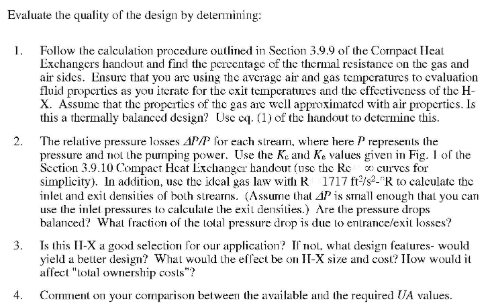
Please evaluate the quality of the design (answer questions within 1-4 on the gas turbine recuperator rating problem). Please answer all questions asked. Show all calculations. I have provided additional resource documents when needed (which most will be needed). Please take your time, there are a lot of details. The main questions to be answered are:
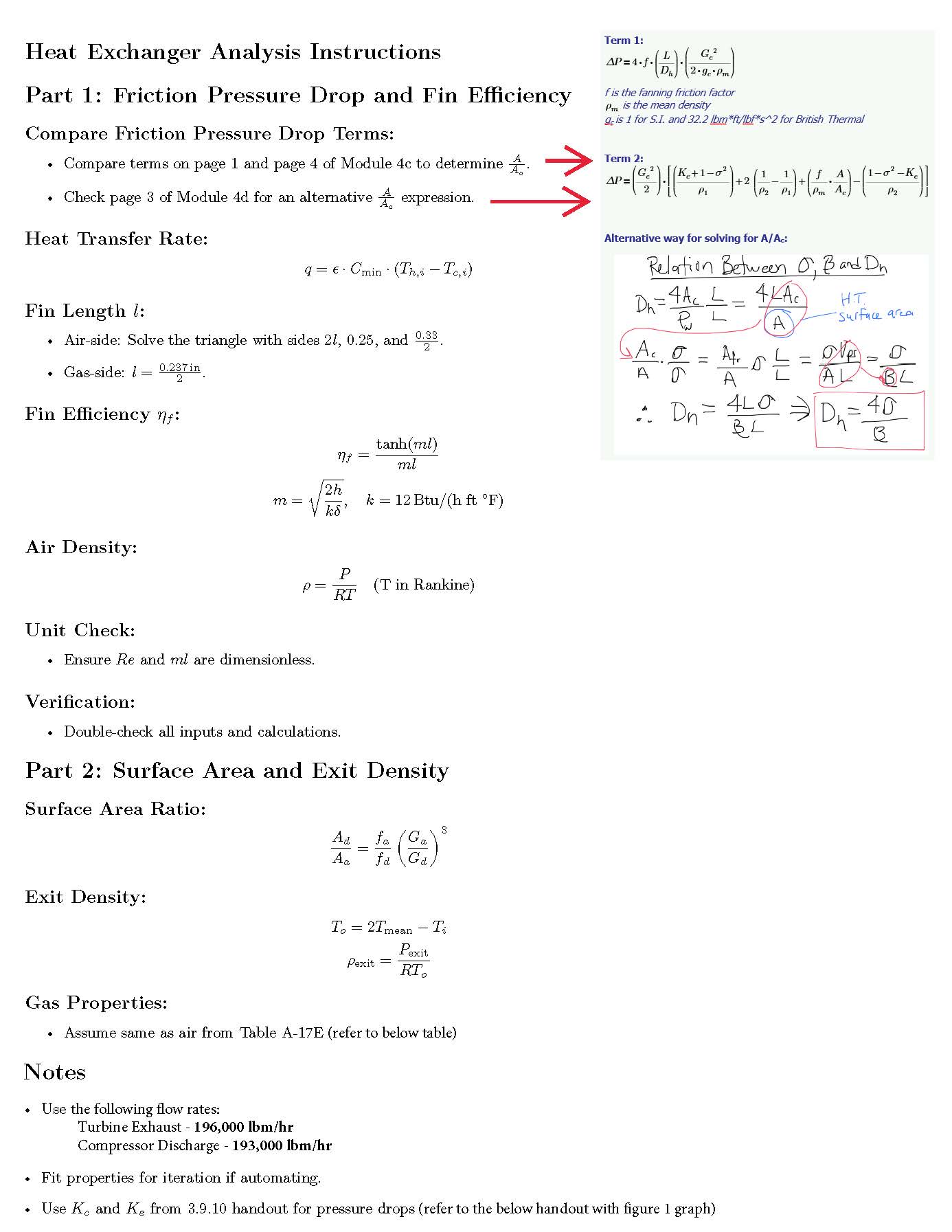
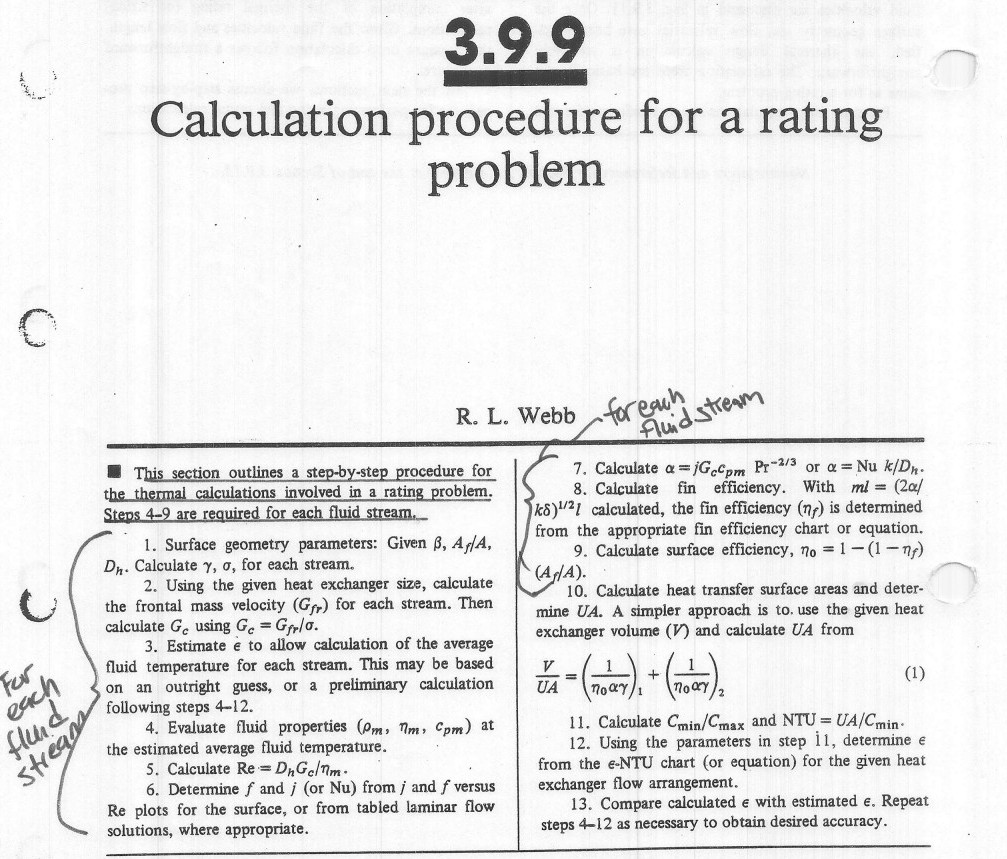
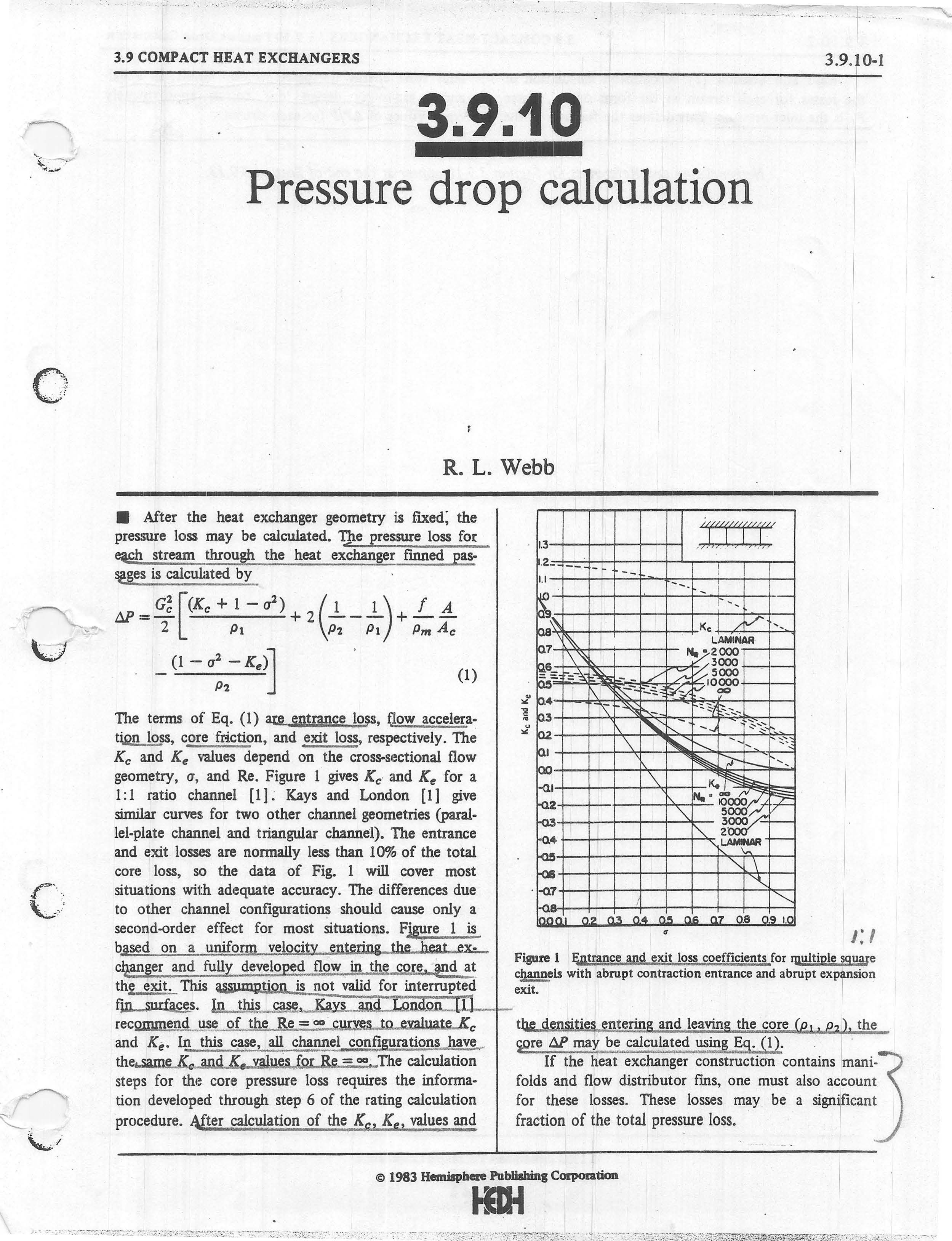
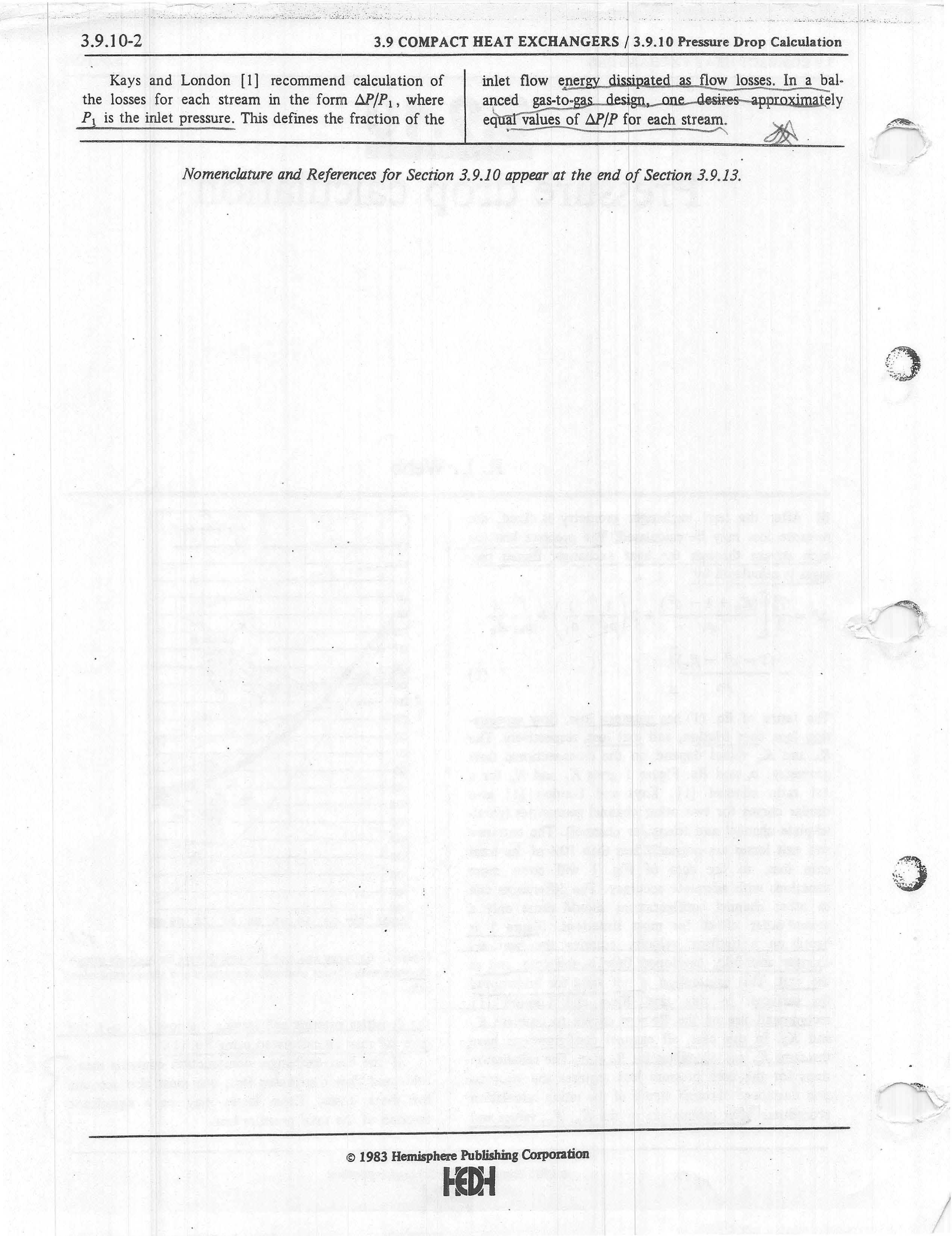
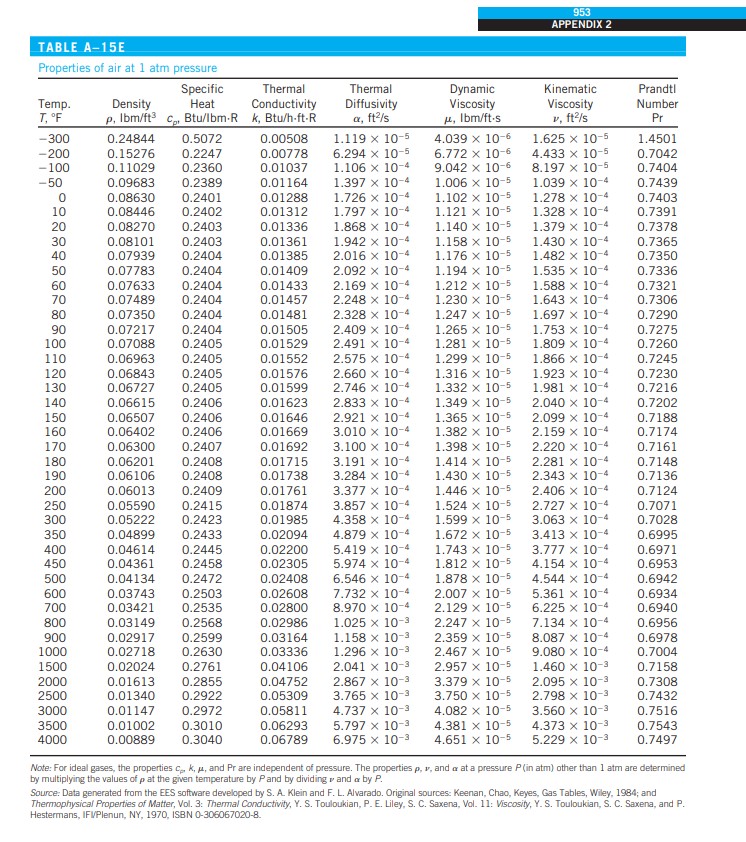
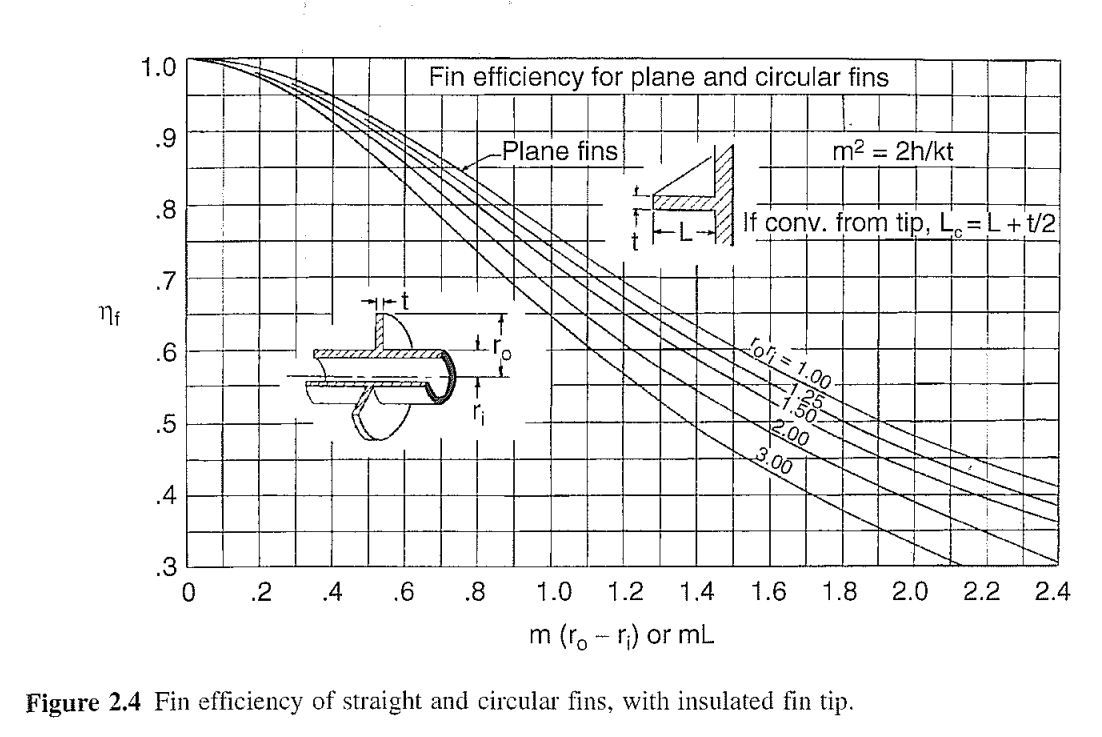
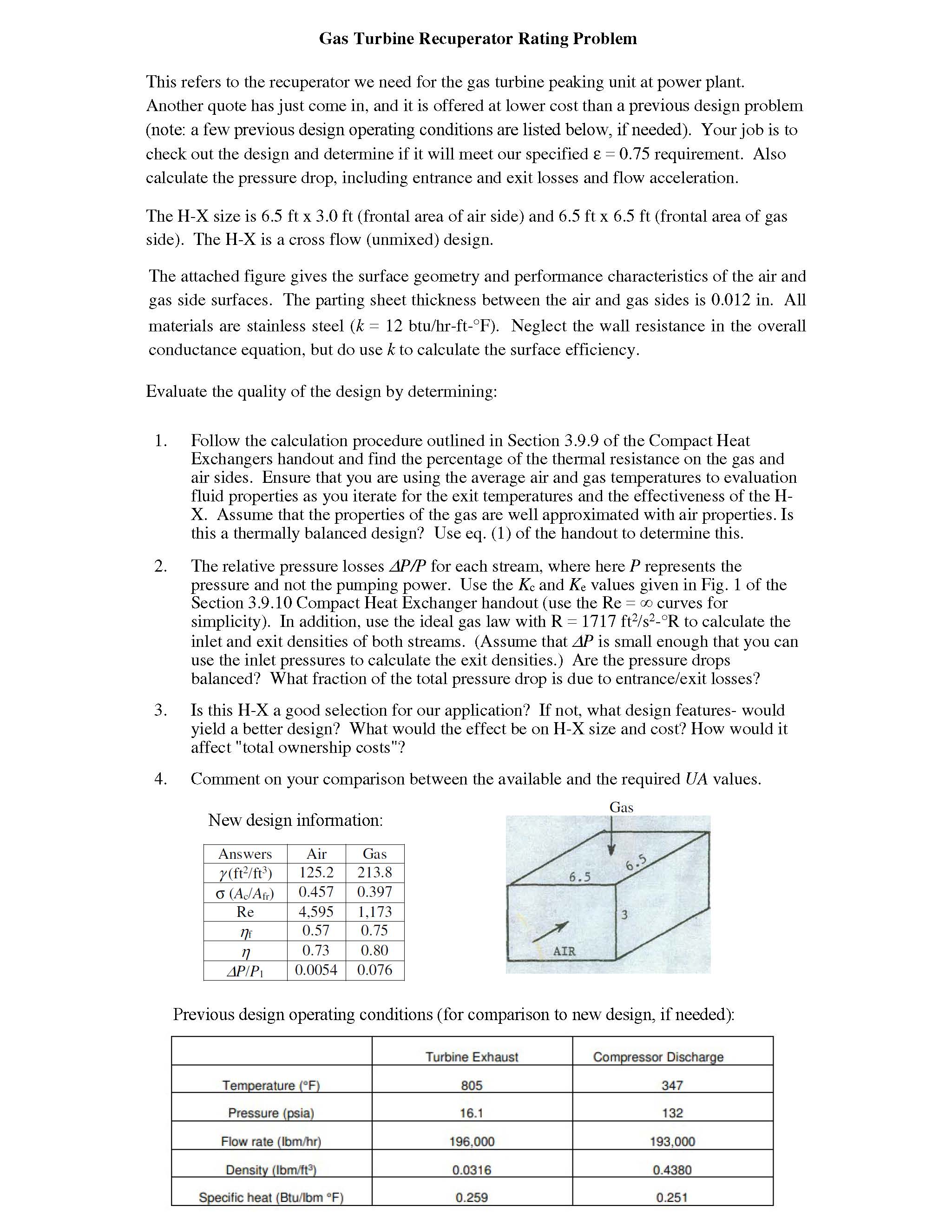
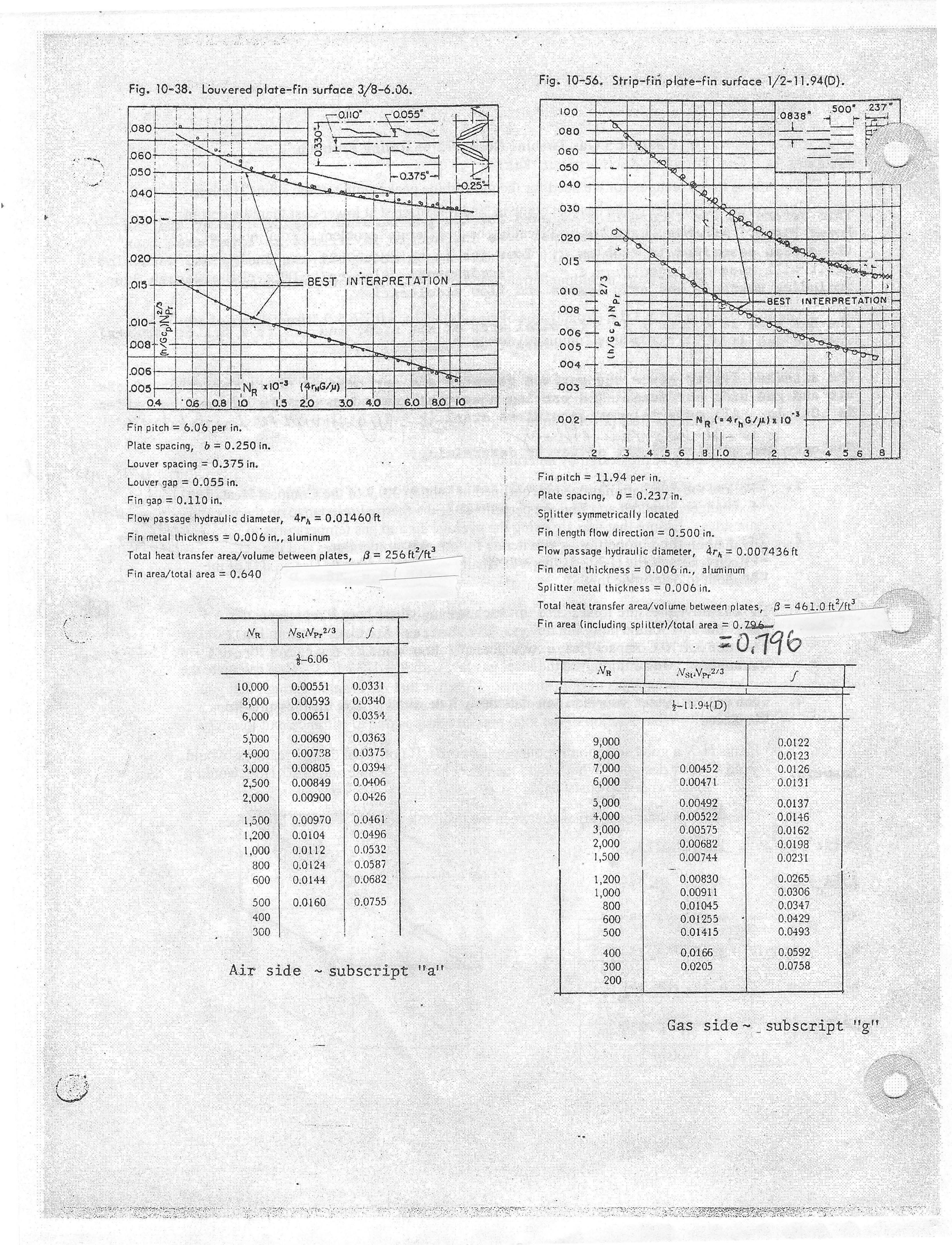
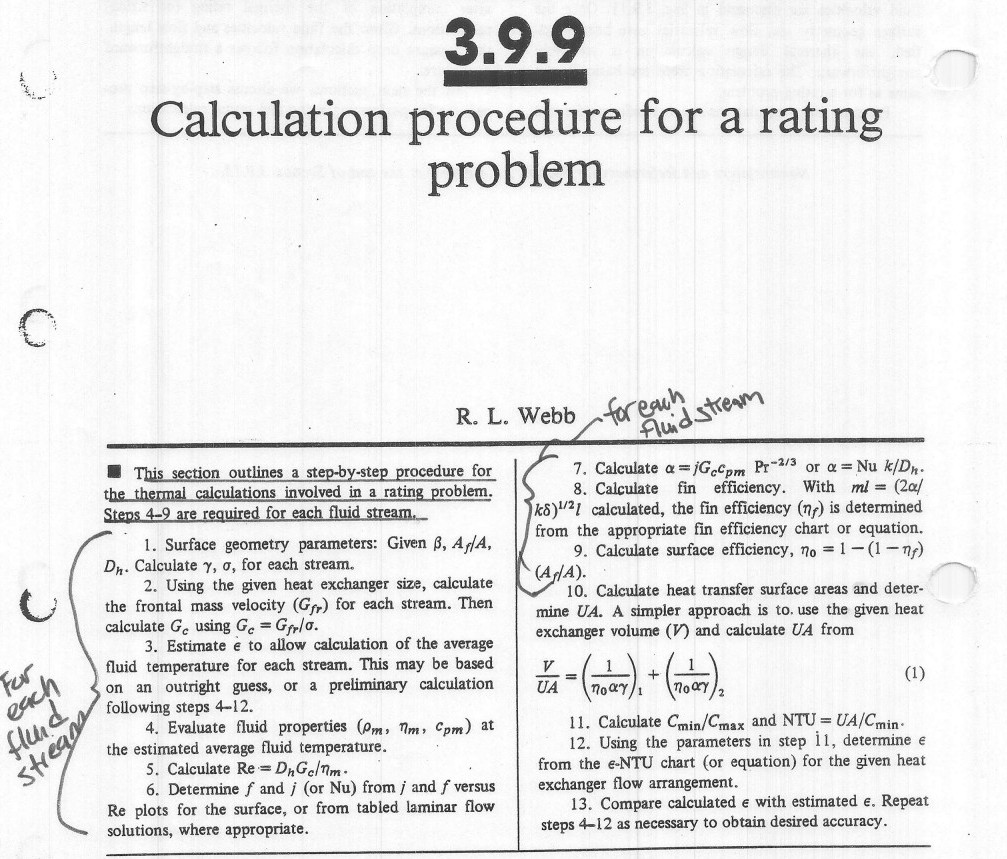
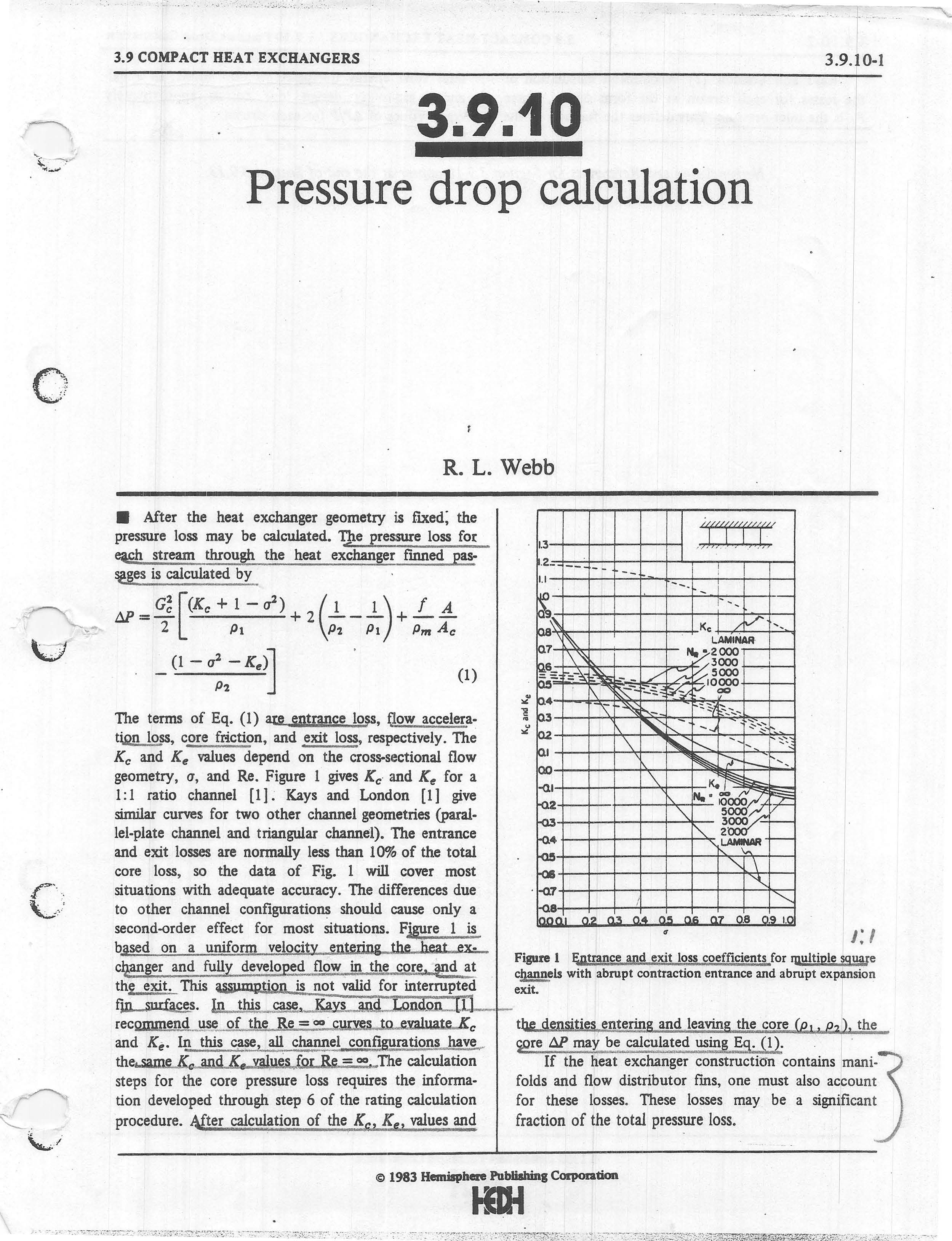
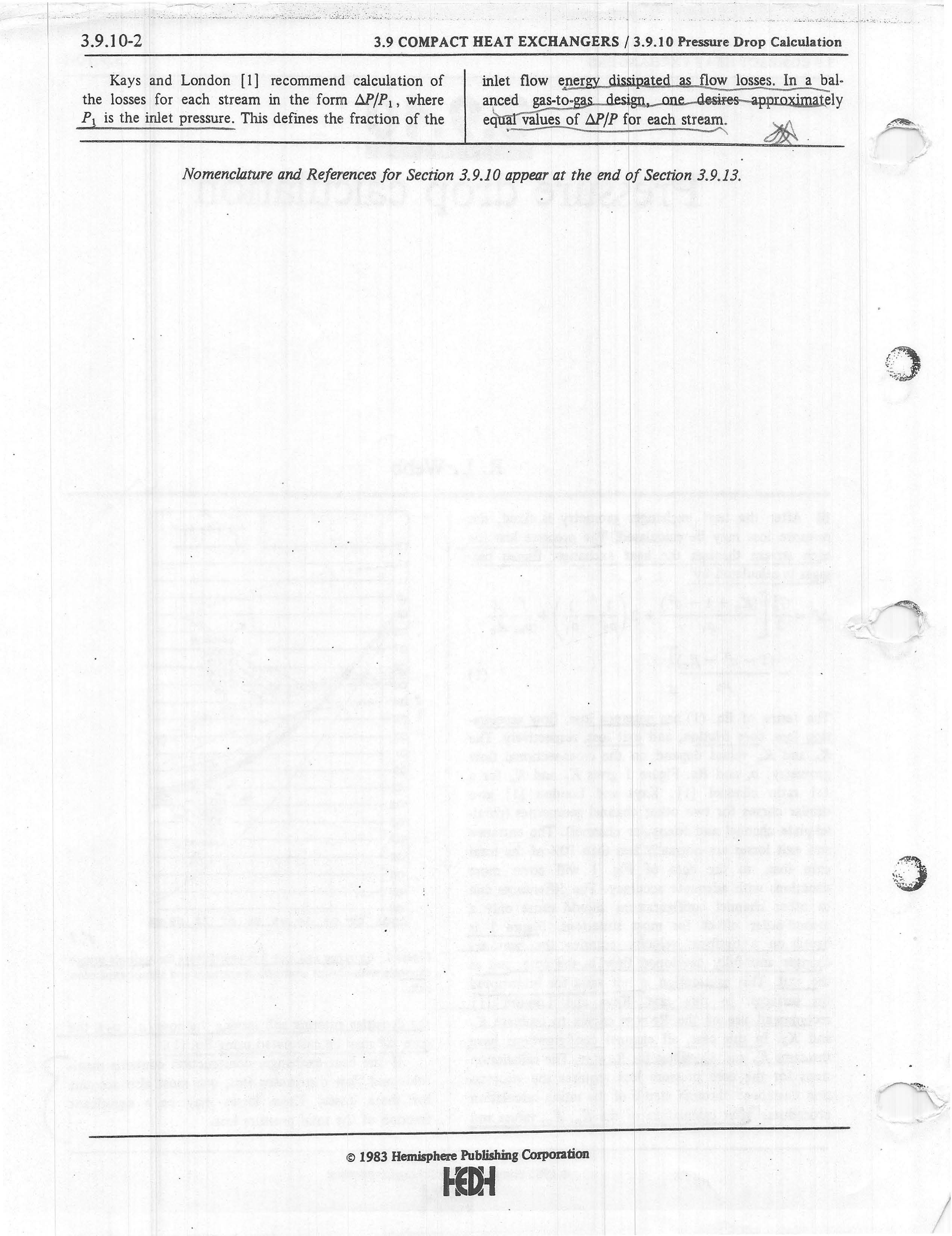
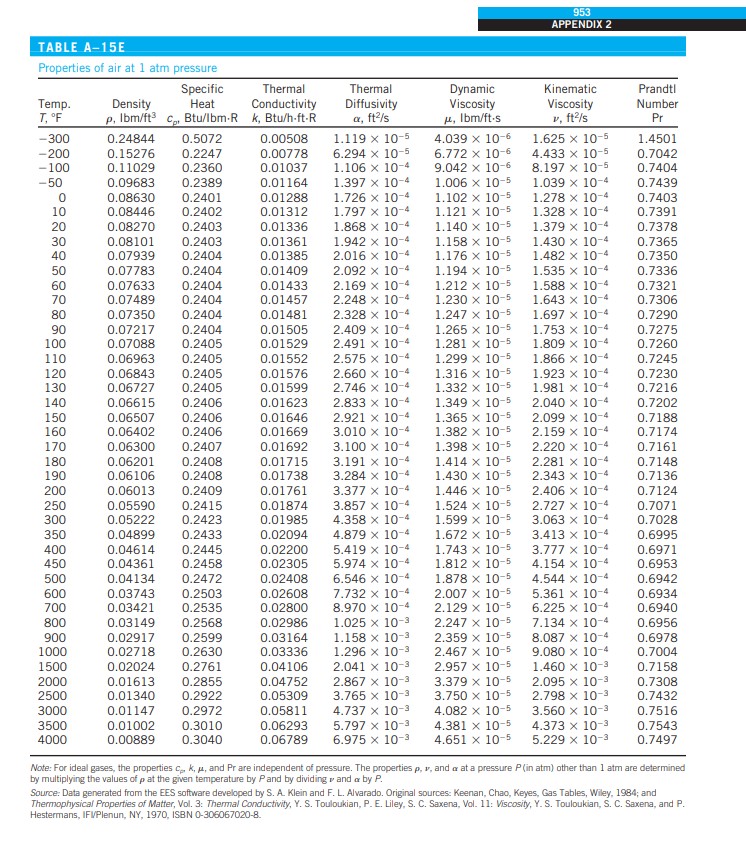
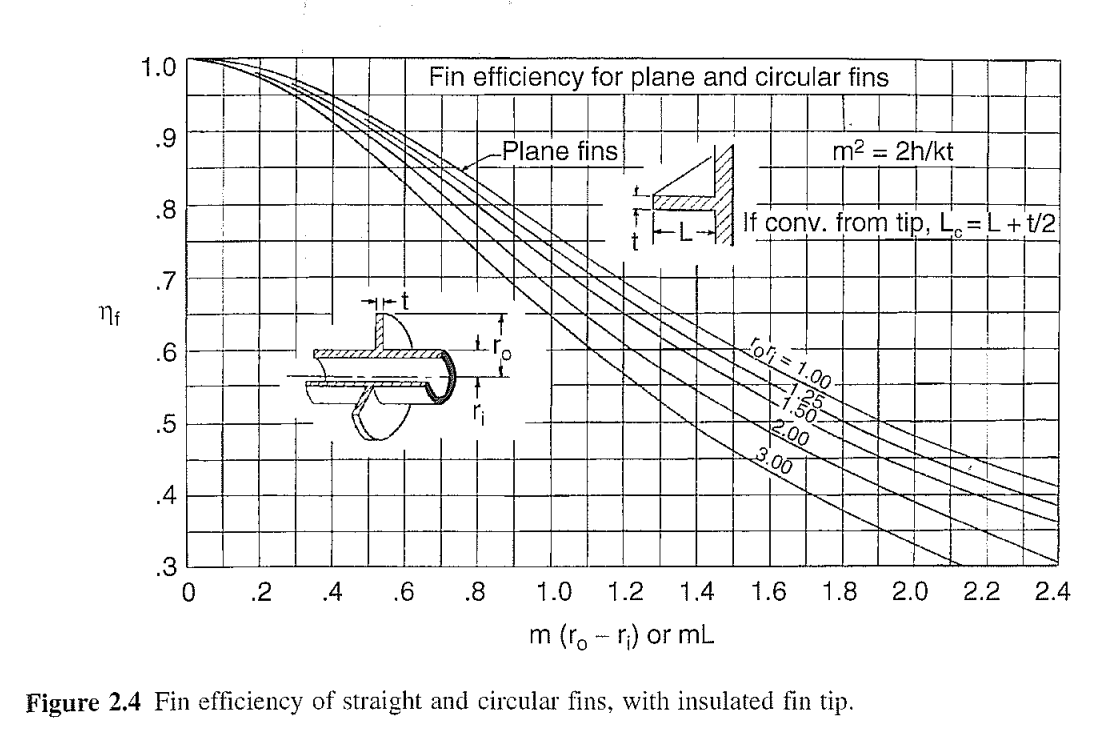
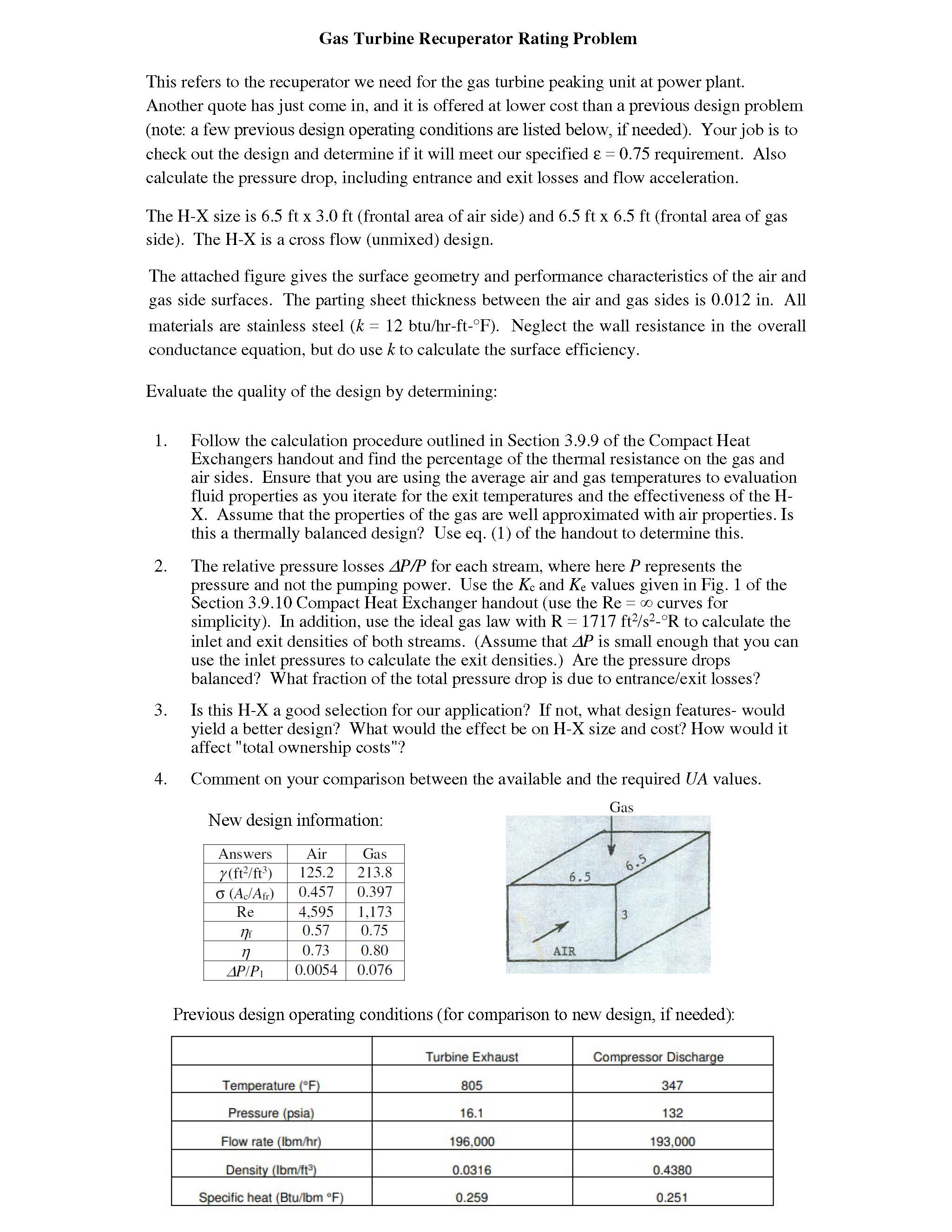
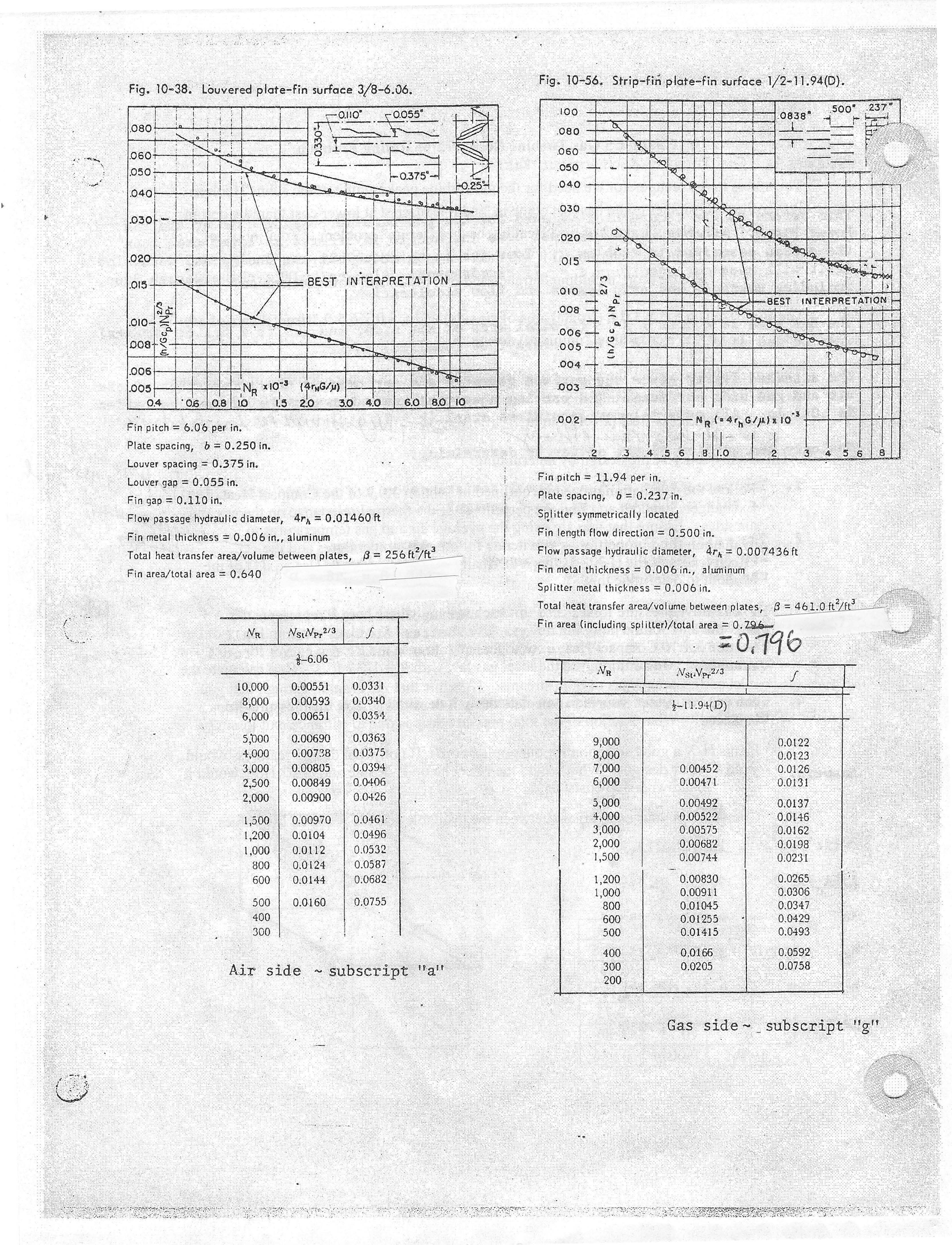
Evaluate the quality of the design by determining: 1. Follow the calculation procedure outlined in Section 3.9.9 of the Compact Heat Exchangers handout and find the percentage of the thermal resistance on the gas and air sides. Ensure that you are using the average air and gas temperatures to evaluation fluid properties as you itcrate for the exit temperatures and the effectiveness of the H- X. Assume that the properties of the gas are well approximated with air properties. Is this a thermally balanced design? Use eq. (1) of the handout to determine this. 2. The relative pressure losses AM/ for each stream, where here / represents the pressure and not the pumping power. Use the Re and Ke values given in Fig. I of the Section 3.9.10 Compact Heat Exchanger handout (use the Re o curves for simplicity). In addition, use the ideal gas law with R 1717 fry's -"R to calculate the inlet and exit densities of both streams. (Assume that iP is small enough that you can use the inlet pressures to calculate the exil densities.) Are the pressure drops balanced? What fraction of the total pressure drop is due to entrance/exit losses? 3. Is this II-X a good selection for our application? IInot. what design features- would yield a better design? What would the effect be on II-X size and cost? How would it affect "tolal ownership costs"? 4. Comment on your comparison between the available and the required A values.Term 1: Heat Exchanger Analysis Instructions AP = 4.f. L). G2 DR) 2 . 9 6' Pm ) Part 1: Friction Pressure Drop and Fin Efficiency f is the fanning friction factor m is the mean density de is 1 for S.I. and 32.2 Ibm*ft/lbf*s^2 for British Thermal Compare Friction Pressure Drop Terms: . Compare terms on page 1 and page 4 of Module 4c to determine . Term 2: ( G2 ) . [(K . + 1 -0 ) + 2 ( 12 p.) + (Pm . Check page 3 of Module 4d for an alternative 4- expression. Heat Transfer Rate: Alternative way for solving for A/Ac: q =E . Cmin .(Thi - Tc,i) Relation Between O B and Dn Dy = 4ALL- 4KAc H. T. Fin Length 4: Pu L A surface area Air-side: Solve the triangle with sides 21, 0.25, and 9.38. Ac. D = Ats- ONes = D . Gas-side: 1 = 0.287in A D A AL BL Fin Efficiency nf: BL .". Dn = 4LO = D = 40 B tanh(ml) 2h m = V iS' k = 12 Btu/(h ft 'F) Air Density: P P = RT (T in Rankine) Unit Check: . Ensure Re and mi are dimensionless. Verification: Double check all inputs and calculations. Part 2: Surface Area and Exit Density Surface Area Ratio: Ad - Ja Aa fa Ga) Exit Density: To = 2Tmean - Ti Pexit Pexit =- RT. Gas Properties: Assume same as air from Table A-17E (refer to below table) Notes . Use the following flow rates: Turbine Exhaust - 196,000 1bm/hr Compressor Discharge - 193,000 1bm/hr . Fit properties for iteration if automating. Use K. and Ke from 3.9.10 handout for pressure drops (refer to the below handout with figure 1 graph)3.9.9 Calculation procedure for a rating problem R. L. Webb for each Fluid stream This section outlines a step-by-step procedure for 7. Calculate a = jG.Com Pr-2/3 or a = Nu k/Dn. the thermal calculations involved in a rating problem. 8. Calculate fin efficiency. With mi = (2a/ Steps 4-9 are required for each fluid stream,_ ko)1/2/ calculated, the fin efficiency (n) is determined 1. Surface geometry parameters: Given B, A,/A, from the appropriate fin efficiency chart or equation. Dn. Calculate y, o, for each stream. 9. Calculate surface efficiency, no = 1 - (1 - 7/) 2. Using the given heat exchanger size, calculate (AffA). C 10. Calculate heat transfer surface areas and deter- the frontal mass velocity (G,) for each stream. Then mine UA. A simpler approach is to. use the given heat calculate Ge using Ge = GAY/o. 3. Estimate e to allow calculation of the average exchanger volume () and calculate UA from For fluid temperature for each stream. This may be based V + on an outright guess, or a preliminary calculation UA no ay/ 2 (1) each following steps 4-12. fled 4. Evaluate fluid properties (Pm, nm, Cpm) at 11. Calculate Cmin/Cmax and NTU = UA/Cmin. stread the estimated average fluid temperature. 12. Using the parameters in step 1 1, determine e 5. Calculate Re = Dn Gem - from the e-NTU chart (or equation) for the given heat 6. Determine f and / (or Nu) from / and f versus exchanger flow arrangement. Re plots for the surface, or from tabled laminar flow 3. Compare calculated e with estimated e. Repeat solutions, where appropriate. steps 4-12 as necessary to obtain desired accuracy.3.9 COMPACT HEAT EXCHANGERS 3.9.10-1 3.9.10 Pressure drop calculation O R. L. Webb After the heat exchanger geometry is fixed, the pressure loss may be calculated. The pressure loss for each stream through the heat exchanger finned pas- ages is calculated by AP = Ge (Ke + 1 - 02) 2 2 +JA P1 -PI Pm Ac Ket LAMINAR Na 2 000 - 02 - Ke) 3000 (1) 5000 P 2 10 000 0.4- The terms of Eq. (1) are entrance loss, flow accelera- Kc and a3- tion loss, core friction, and exit loss, respectively. The 02- Ke and Ke values depend on the cross-sectional flow geometry, o, and Re. Figure 1 gives Ke and Ke for a 1:1 ratio channel [1]. Kays and London [1] give - al - 16 : 10000 similar curves for two other channel geometries (paral- 5000~ Q3 - 3000 lel-plate channel and triangular channel). The entrance - Q4 2000 LAMINAR and exit losses are normally less than 10% of the total as - core loss, so the data of Fig. I will cover most -OB - C situations with adequate accuracy. The differences due to other channel configurations should cause only a -as - second-order effect for most situations. Figure 1 is (9001 02 03 04 05 06 07 08 09 10 based on a uniform velocity entering the heat ex- changer and fully developed flow in the core, and at Figure 1 Entrance and exit loss coefficients for multiple square channels with abrupt contraction entrance and abrupt expansion the exit. This assumption is not valid for interrupted exit. fin surfaces. In this case, Kays and London [1] recommend use of the Re =0. curves to evaluate Kc the densities entering and leaving the core (P1, p2), the and Ke. In this case, all channel configurations have core AP may be calculated using Eq. (1). the same Ko and K. values for Reco. The calculation If the heat exchanger construction contains mani- steps for the core pressure loss requires the informa- folds and flow distributor fins, one must also account tion developed through step 6 of the rating calculation for these losses. These losses may be a significant procedure. After calculation of the Ke, Ke, values and fraction of the total pressure loss. @ 1983 Hemisphere Publishing Corporation HEDH3.9.10-2 3.9 COMPACT HEAT EXCHANGERS / 3.9.10 Pressure Drop Calculation Kays and London [1] recommend calculation of inlet flow energy dissipated as flow losses. In a bal- the losses for each stream in the form AP/P1, where anced gas-to-gas design, one desires approximately P1 is the inlet pressure. This defines the fraction of the equal values of AP/P for each stream. Nomenclature and References for Section 3.9.10 appear at the end of Section 3.9.13. O 1983 Hemisphere Publishing Corporation HEDH953 APPENDIX 2 TABLE A-15E Properties of air at 1 atm pressure Specific Thermal Thermal Dynamic Kinematic Prandtl Temp. Density Heat Conductivity Diffusivity Viscosity Viscosity Number T, OF p, Ibm/fts c., Btu/Ibm.R k, Btu/h-ft-R c, ft2 /s M, Ibm/ft.s v, ft /s Pr -300 0.24844 0.5072 0.00508 1.119 x 10⁻⁵ 4.039 x 10⁻⁶ 1.625 x 10⁻⁵ 1.4501 -200 0.15276 0.2247 0.00778 6.294 x 10⁻⁵ 6.772 x 10⁻⁶ 4.433 x 10⁻⁵ 0.7042 -100 0.11029 0.2360 0.01037 1.106 x 10⁻⁴ 9.042 x 10⁻⁶ 8.197 x 10⁻⁵ 0.7404 -50 0.09683 0.2389 0.01164 1.397 x 10⁻⁴ 1.006 x 10⁻⁵ 1.039 x 10⁻⁴ 0.7439 0 0.08630 0.2401 0.01288 1.726 x 10⁻⁴ 1.102 x 10⁻⁵ 1.278 x 10⁻⁴ 0.7403 10 0.08446 0.2402 0.01312 1.797 x 10⁻⁴ 1.121 x 10⁻⁵ 1.328 x 10⁻⁴ 0.7391 20 0.08270 0.2403 0.01336 1.868 x 10⁻⁴ 1.140 x 10⁻⁵ 1.379 x 10⁻⁴ 0.7378 30 0.08101 0.2403 0.01361 1.942 x 10⁻⁴ 1.158 x 10⁻⁵ 1.430 x 10⁻⁴ 0.7365 40 0.07939 0.2404 0.01385 2.016 x 10⁻⁴ 1.176 x 10⁻⁵ 1.482 x 10⁻⁴ 0.7350 50 0.07783 0.2404 0.01409 2.092 x 10⁻⁴ 1.194 x 10⁻⁵ 1.535 x 10⁻⁴ 0.7336 60 0.07633 0.2404 0.01433 2.169 x 10⁻⁴ 1.212 x 10⁻⁵ 1.588 x 10⁻⁴ 0.7321 70 0.07489 0.2404 0.01457 2.248 x 10⁻⁴ 1.230 x 10⁻⁵ 1.643 x 10⁻⁴ 0.7306 80 0.07350 0.2404 0.01481 2.328 x 10⁻⁴ 1.247 x 10⁻⁵ 1.697 x 10⁻⁴ 0.7290 90 0.07217 0.2404 0.01505 2.409 x 10⁻⁴ 1.265 x 10⁻⁵ 1.753 x 10⁻⁴ 0.7275 100 0.07088 0.2405 0.01529 2.491 x 10⁻⁴ 1.281 x 10⁻⁵ 1.809 x 10⁻⁴ 0.7260 110 0.06963 0.2405 0.01552 2.575 x 10⁻⁴ 1.299 x 10⁻⁵ 1.866 x 10⁻⁴ 0.7245 120 0.06843 0.2405 0.01576 2.660 x 10⁻⁴ 1.316 x 10⁻⁵ 1.923 x 10⁻⁴ 0.7230 130 0.06727 0.2405 0.01599 2.746 x 10⁻⁴ 1.332 x 10⁻⁵ 1.981 x 10⁻⁴ 0.7216 140 0.06615 0.2406 0.01623 2.833 x 10⁻⁴ 1.349 x 10⁻⁵ 2.040 x 10⁻⁴ 0.7202 150 0.06507 0.2406 0.01646 2.921 x 10⁻⁴ 1.365 x 10⁻⁵ 2.099 x 10⁻⁴ 0.7188 160 0.06402 0.2406 0.01669 3.010 x 10⁻⁴ 1.382 x 10⁻⁵ 2.159 x 10⁻⁴ 0.7174 170 0.06300 0.2407 0.01692 3.100 x 10⁻⁴ 1.398 x 10⁻⁵ 2.220 x 10⁻⁴ 0.7161 180 0.06201 0.2408 0.01715 3.191 x 10⁻⁴ 1.414 x 10⁻⁵ 2.281 x 10⁻⁴ 0.7148 190 0.06106 0.2408 0.01738 3.284 x 10⁻⁴ 1.430 x 10⁻⁵ 2.343 x 10⁻⁴ 0.7136 200 0.06013 0.2409 0.01761 3.377 x 10⁻⁴ 1.446 x 10⁻⁵ 2.406 x 10⁻⁴ 0.7124 250 0.05590 0.2415 0.01874 3.857 x 10⁻⁴ 1.524 x 10⁻⁵ 2.727 x 10⁻⁴ 0.7071 300 0.05222 0.2423 0.01985 4.358 x 10⁻⁴ 1.599 x 10⁻⁵ 3.063 x 10⁻⁴ 0.7028 350 0.04899 0.2433 0.02094 4.879 x 10⁻⁴ 1.672 x 10⁻⁵ 3.413 x 10⁻⁴ 0.6995 400 0.04614 0.2445 0.02200 5.419 x 10⁻⁴ 1.743 x 10⁻⁵ 3.777 x 10⁻⁴ 0.6971 450 0.04361 0.2458 0.02305 5.974 x 10⁻⁴ 1.812 x 10⁻⁵ 4.154 x 10⁻⁴ 0.6953 500 0.04134 0.2472 0.02408 6.546 x 10⁻⁴ 1.878 x 10⁻⁵ 4.544 x 10⁻⁴ 0.6942 600 0.03743 0.2503 0.02608 7.732 x 10⁻⁴ 2.007 x 10⁻⁵ 5.361 x 10⁻⁴ 0.6934 700 0.03421 0.2535 0.02800 8.970 x 10⁻⁴ 2.129 x 10⁻⁵ 6.225 x 10⁻⁴ 0.6940 800 0.03149 0.2568 0.02986 1.025 x 10⁻³ 2.247 x 10⁻⁵ 7.134 x 10⁻⁴ 0.6956 900 0.02917 0.2599 0.03164 1.158 x 10⁻³ 2.359 x 10⁻⁵ 8.087 x 10⁻⁴ 0.6978 1000 0.02718 0.2630 0.03336 1.296 x 10⁻³ 2.467 x 10⁻⁵ 9.080 x 10⁻⁴ 0.7004 1500 0.02024 0.2761 0.04106 2.041 x 10⁻³ 2.957 x 10⁻⁵ 1.460 x 10⁻³ 0.7158 2000 0.01613 0.2855 0.04752 2.867 x 10⁻³ 3.379 x 10⁻⁵ 2.095 x 10⁻³ 0.7308 2500 0.01340 0.2922 0.05309 3.765 x 10⁻³ 3.750 x 10⁻⁵ 2.798 x 10⁻³ 0.7432 3000 0.01147 0.2972 0.05811 4.737 x 10⁻³ 4.082 x 10⁻⁵ 3.560 x 10⁻³ 0.7516 3500 0.01002 0.3010 0.06293 5.797 x 10⁻³ 4.381 x 10⁻⁵ 4.373 x 10⁻³ 0.7543 4000 0.00889 0.3040 0.06789 6.975 x 10⁻³ 4.651 x 10⁻⁵ 5.229 x 10⁻³ 0.7497 Note: For ideal gases, the properties co, k, A, and Pr are independent of pressure. The properties p, i, and a at a pressure (in atm) other than 1 atm are determined by multiplying the values of p at the given temperature by Pand by dividing r and a by P. Source: Data generated from the EES software developed by S. A. Klein and F. L. Alvarado. Original sources: Keenan, Chao, Keyes, Gas Tables, Wiley, 1984; and Thermophysical Properties of Matter, Vol. 3: Thermal Conductivity, Y. S. Touloukian, P. E. Liley, S. C. Saxena, Vol. 11: Viscosity, Y. S. Touloukian, S. C. Saxena, and P. Hestermans, IFV/Plenun, NY, 1970, ISBN 0-306067020-8.1.0 Fin efficiency for plane and circular fins .9 Plane fins m2 = 2h/kt 8 If conv. from tip, L. = L + 1/2 .7 ni 6 .5 .4 .3 0 .2 4 .6 .8 1.0 1.2 1.4 1.6 1.8 2.0 2.2 2.4 m (r - r;) or mL Figure 2.4 Fin efficiency of straight and circular fins, with insulated fin tip.Gas Turbine Recuperator Rating Problem This refers to the recuperator we need for the gas turbine peaking unit at power plant. Another quote has just come in, and it is offered at lower cost than a previous design problem (note: a few previous design operating conditions are listed below, if needed). Your job is to check out the design and determine if it will meet our specified = 0.75 requirement. Also calculate the pressure drop, including entrance and exit losses and flow acceleration. The H-X size is 6.5 ft x 3.0 ft (frontal area of air side) and 6.5 ft x 6.5 ft (frontal area of gas side). The H-X is a cross flow (unmixed) design. The attached figure gives the surface geometry and performance characteristics of the air and gas side surfaces. The parting sheet thickness between the air and gas sides is 0.012 in. All materials are stainless steel (k = 12 btu/hr-ft-F). Neglect the wall resistance in the overall conductance equation, but do use & to calculate the surface efficiency. Evaluate the quality of the design by determining: 1. Follow the calculation procedure outlined in Section 3.9.9 of the Compact Heat Exchangers handout and find the percentage of the thermal resistance on the gas and air sides. Ensure that you are using the average air and gas temperatures to evaluation fluid properties as you iterate for the exit temperatures and the effectiveness of the H- X. Assume that the properties of the gas are well approximated with air properties. Is this a thermally balanced design? Use eq. (1) of the handout to determine this. 2. Therelative pressure losses AP/P for each stream, where here P represents the pressure and not the pumping power. Use the Ke and Ke values given in Fig. | of the Section 3.9.10 Compact Heat Exchanger handout (use the Re = curves for simplicity). In addition, use the ideal gas law with R = 1717 ft?/s?-R to calculate the inlet and exit densities of both streams. (Assume that AP is small enough that you can use the inlet pressures to calculate the exit densities.) Are the pressure drops balanced? What fraction of the total pressure drop is due to entrance/exit losses? 3. Is this H-X a good selection for our application? If not, what design features- would yield a better design? What would the effect be on H-X size and cost? How would it affect "total ownership costs"? 4. Comment on your comparison between the available and the required UA values. New design information: Answers Air Gas y(ft?7/tt) 125.2 | 213.8 0 (A/Ar:) | 0.457 | 0.397 Re 4,595 | 1,173 7 0.57 0.75 1 0.73 0.80 APIP 0.0054 | 0.076 Previous design operating conditions (for comparison to new design, if needed): Turbine Exhaust Compressor Discharge Temperature (F) 805 Pressure (psia) 16.1 Flow rate (lbm/hr) 196,000 193,000 Specific heat (Btu/lbm F) 0.259 0.251 Fig. 10-38. Louvered plate-fin surface 3/8-6.06. Fig. 10-56. Strip-fin plate-fin surface 1/2-11.94(D). _0.055' 100 0838" 500 237 .080 080 060 .060 .050 050 - 0.375- .040 .040 .030 .030 .020 1.020 .015 .015 - BEST INTERPRETATION 010 .008 - BEST INTERPRE .010-at 006 - ( h / Gc p ) N pr LET 005 .006 004 - 1005 No x10-3 (arNG/4) 0.4 :06 0.8 10 5 2.0 3.0 40 6.0 8.0 10 Fin pitch = 6.06 per in. .002 - NR ( +41 , G/#18 10 3 Plate spacing, b = 0.250 in. Louver spacing = 0.375 in. Louver gap = 0.055 in. Fin pitch = 11.94 per in. Fin gap = 0.110 in. Plate spacing, b = 0.237 in. Flow passage hydraulic diameter, 4rx = 0.01460 ft Splitter symmetrically located Fin metal thickness = 0.006 in., aluminum Fin length flow direction = 0.500 in. Total heat transfer area/volume between plates, B = 256 ft2/ft? Flow passage hydraulic diameter, 4rx = 0.007436 ft Fin area/total area = 0.640 Fin metal thickness = 0.006 in., aluminum Splitter metal thickness = 0.006 in. Total heat transfer area/volume between plates, B = 461.0 ft?/ft3 NR NSINp, 213 Fin area (including splitter)/total area = 0. 796- = 0.796 -6.06 NR VSuVp,2/3 10,000 0.00551 0.0331 8,000 0.00593 0.0340 1-11.94(D) 6,000 0.00651 0.0354 5,000 0.00690 0.0363 9,000 0.0122 4,000 0.00738 0.0375 3,000 0.0123 3,000 0.00805 0.0394 7,000 0.00452 0.0126 2,500 0.00849 0.0406 5,000 0.00471 0.0131 ,000 0.00900 0.0426 5,000 0.00492 0.0137 1,500 0.00970 0.0461 4,000 0.00522 0.0146 3.000 1,200 0.0104 0.0496 0.00575 0.0162 2,00 1,000 0.0112 0.0532 0.00682 0.0198 1.500 0.0074+ 0.0231 800 0.0124 0.058 600 0.0144 0.0682 1,200 0.00830 0.0265 1,000 0.0091 1 0.0306 500 0.0160 0.0755 800 0.01045 0.0347 400 500 0.01255 0.0429 300 500 0.01415 0.0493 400 0.0166 0.0592 Air side ~ subscript "a" 300 0.0205 0.0758 200 Gas side ~ _subscript "g'3.9.9 Calculation procedure for a rating problem R. L. Webb for each Fluid stream This section outlines a step-by-step procedure for 7. Calculate a = jG.Com Pr-2/3 or a = Nu k/Dn. the thermal calculations involved in a rating problem. 8. Calculate fin efficiency. With mi = (2a/ Steps 4-9 are required for each fluid stream,_ ko)1/2/ calculated, the fin efficiency (n) is determined 1. Surface geometry parameters: Given B, A,/A, from the appropriate fin efficiency chart or equation. Dn. Calculate y, o, for each stream. 9. Calculate surface efficiency, no = 1 - (1 - 7/) 2. Using the given heat exchanger size, calculate (AffA). C 10. Calculate heat transfer surface areas and deter- the frontal mass velocity (G,) for each stream. Then mine UA. A simpler approach is to. use the given heat calculate Ge using Ge = GAY/o. 3. Estimate e to allow calculation of the average exchanger volume () and calculate UA from For fluid temperature for each stream. This may be based V + on an outright guess, or a preliminary calculation UA no ay/ 2 (1) each following steps 4-12. fled 4. Evaluate fluid properties (Pm, nm, Cpm) at 11. Calculate Cmin/Cmax and NTU = UA/Cmin. stread the estimated average fluid temperature. 12. Using the parameters in step 1 1, determine e 5. Calculate Re = Dn Gem - from the e-NTU chart (or equation) for the given heat 6. Determine f and / (or Nu) from / and f versus exchanger flow arrangement. Re plots for the surface, or from tabled laminar flow 3. Compare calculated e with estimated e. Repeat solutions, where appropriate. steps 4-12 as necessary to obtain desired accuracy.3.9 COMPACT HEAT EXCHANGERS 3.9.10-1 3.9.10 Pressure drop calculation O R. L. Webb After the heat exchanger geometry is fixed, the pressure loss may be calculated. The pressure loss for each stream through the heat exchanger finned pas- ages is calculated by AP = Ge (Ke + 1 - 02) 2 2 +JA P1 -PI Pm Ac Ket LAMINAR Na 2 000 - 02 - Ke) 3000 (1) 5000 P 2 10 000 0.4- The terms of Eq. (1) are entrance loss, flow accelera- Kc and a3- tion loss, core friction, and exit loss, respectively. The 02- Ke and Ke values depend on the cross-sectional flow geometry, o, and Re. Figure 1 gives Ke and Ke for a 1:1 ratio channel [1]. Kays and London [1] give - al - 16 : 10000 similar curves for two other channel geometries (paral- 5000~ Q3 - 3000 lel-plate channel and triangular channel). The entrance - Q4 2000 LAMINAR and exit losses are normally less than 10% of the total as - core loss, so the data of Fig. I will cover most -OB - C situations with adequate accuracy. The differences due to other channel configurations should cause only a -as - second-order effect for most situations. Figure 1 is (9001 02 03 04 05 06 07 08 09 10 based on a uniform velocity entering the heat ex- changer and fully developed flow in the core, and at Figure 1 Entrance and exit loss coefficients for multiple square channels with abrupt contraction entrance and abrupt expansion the exit. This assumption is not valid for interrupted exit. fin surfaces. In this case, Kays and London [1] recommend use of the Re =0. curves to evaluate Kc the densities entering and leaving the core (P1, p2), the and Ke. In this case, all channel configurations have core AP may be calculated using Eq. (1). the same Ko and K. values for Reco. The calculation If the heat exchanger construction contains mani- steps for the core pressure loss requires the informa- folds and flow distributor fins, one must also account tion developed through step 6 of the rating calculation for these losses. These losses may be a significant procedure. After calculation of the Ke, Ke, values and fraction of the total pressure loss. @ 1983 Hemisphere Publishing Corporation HEDH3.9.10-2 3.9 COMPACT HEAT EXCHANGERS / 3.9.10 Pressure Drop Calculation Kays and London [1] recommend calculation of inlet flow energy dissipated as flow losses. In a bal- the losses for each stream in the form AP/P1, where anced gas-to-gas design, one desires approximately P1 is the inlet pressure. This defines the fraction of the equal values of AP/P for each stream. Nomenclature and References for Section 3.9.10 appear at the end of Section 3.9.13. O 1983 Hemisphere Publishing Corporation HEDH953 APPENDIX 2 TABLE A-15E Properties of air at 1 atm pressure Specific Thermal Thermal Dynamic Kinematic Prandtl Temp. Density Heat Conductivity Diffusivity Viscosity Viscosity Number T, OF p, Ibm/fts c., Btu/Ibm.R k, Btu/h-ft-R c, ft2 /s M, Ibm/ft.s v, ft /s Pr -300 0.24844 0.5072 0.00508 1.119 x 10⁻⁵ 4.039 x 10⁻⁶ 1.625 x 10⁻⁵ 1.4501 -200 0.15276 0.2247 0.00778 6.294 x 10⁻⁵ 6.772 x 10⁻⁶ 4.433 x 10⁻⁵ 0.7042 -100 0.11029 0.2360 0.01037 1.106 x 10⁻⁴ 9.042 x 10⁻⁶ 8.197 x 10⁻⁵ 0.7404 -50 0.09683 0.2389 0.01164 1.397 x 10⁻⁴ 1.006 x 10⁻⁵ 1.039 x 10⁻⁴ 0.7439 0 0.08630 0.2401 0.01288 1.726 x 10⁻⁴ 1.102 x 10⁻⁵ 1.278 x 10⁻⁴ 0.7403 10 0.08446 0.2402 0.01312 1.797 x 10⁻⁴ 1.121 x 10⁻⁵ 1.328 x 10⁻⁴ 0.7391 20 0.08270 0.2403 0.01336 1.868 x 10⁻⁴ 1.140 x 10⁻⁵ 1.379 x 10⁻⁴ 0.7378 30 0.08101 0.2403 0.01361 1.942 x 10⁻⁴ 1.158 x 10⁻⁵ 1.430 x 10⁻⁴ 0.7365 40 0.07939 0.2404 0.01385 2.016 x 10⁻⁴ 1.176 x 10⁻⁵ 1.482 x 10⁻⁴ 0.7350 50 0.07783 0.2404 0.01409 2.092 x 10⁻⁴ 1.194 x 10⁻⁵ 1.535 x 10⁻⁴ 0.7336 60 0.07633 0.2404 0.01433 2.169 x 10⁻⁴ 1.212 x 10⁻⁵ 1.588 x 10⁻⁴ 0.7321 70 0.07489 0.2404 0.01457 2.248 x 10⁻⁴ 1.230 x 10⁻⁵ 1.643 x 10⁻⁴ 0.7306 80 0.07350 0.2404 0.01481 2.328 x 10⁻⁴ 1.247 x 10⁻⁵ 1.697 x 10⁻⁴ 0.7290 90 0.07217 0.2404 0.01505 2.409 x 10⁻⁴ 1.265 x 10⁻⁵ 1.753 x 10⁻⁴ 0.7275 100 0.07088 0.2405 0.01529 2.491 x 10⁻⁴ 1.281 x 10⁻⁵ 1.809 x 10⁻⁴ 0.7260 110 0.06963 0.2405 0.01552 2.575 x 10⁻⁴ 1.299 x 10⁻⁵ 1.866 x 10⁻⁴ 0.7245 120 0.06843 0.2405 0.01576 2.660 x 10⁻⁴ 1.316 x 10⁻⁵ 1.923 x 10⁻⁴ 0.7230 130 0.06727 0.2405 0.01599 2.746 x 10⁻⁴ 1.332 x 10⁻⁵ 1.981 x 10⁻⁴ 0.7216 140 0.06615 0.2406 0.01623 2.833 x 10⁻⁴ 1.349 x 10⁻⁵ 2.040 x 10⁻⁴ 0.7202 150 0.06507 0.2406 0.01646 2.921 x 10⁻⁴ 1.365 x 10⁻⁵ 2.099 x 10⁻⁴ 0.7188 160 0.06402 0.2406 0.01669 3.010 x 10⁻⁴ 1.382 x 10⁻⁵ 2.159 x 10⁻⁴ 0.7174 170 0.06300 0.2407 0.01692 3.100 x 10⁻⁴ 1.398 x 10⁻⁵ 2.220 x 10⁻⁴ 0.7161 180 0.06201 0.2408 0.01715 3.191 x 10⁻⁴ 1.414 x 10⁻⁵ 2.281 x 10⁻⁴ 0.7148 190 0.06106 0.2408 0.01738 3.284 x 10⁻⁴ 1.430 x 10⁻⁵ 2.343 x 10⁻⁴ 0.7136 200 0.06013 0.2409 0.01761 3.377 x 10⁻⁴ 1.446 x 10⁻⁵ 2.406 x 10⁻⁴ 0.7124 250 0.05590 0.2415 0.01874 3.857 x 10⁻⁴ 1.524 x 10⁻⁵ 2.727 x 10⁻⁴ 0.7071 300 0.05222 0.2423 0.01985 4.358 x 10⁻⁴ 1.599 x 10⁻⁵ 3.063 x 10⁻⁴ 0.7028 350 0.04899 0.2433 0.02094 4.879 x 10⁻⁴ 1.672 x 10⁻⁵ 3.413 x 10⁻⁴ 0.6995 400 0.04614 0.2445 0.02200 5.419 x 10⁻⁴ 1.743 x 10⁻⁵ 3.777 x 10⁻⁴ 0.6971 450 0.04361 0.2458 0.02305 5.974 x 10⁻⁴ 1.812 x 10⁻⁵ 4.154 x 10⁻⁴ 0.6953 500 0.04134 0.2472 0.02408 6.546 x 10⁻⁴ 1.878 x 10⁻⁵ 4.544 x 10⁻⁴ 0.6942 600 0.03743 0.2503 0.02608 7.732 x 10⁻⁴ 2.007 x 10⁻⁵ 5.361 x 10⁻⁴ 0.6934 700 0.03421 0.2535 0.02800 8.970 x 10⁻⁴ 2.129 x 10⁻⁵ 6.225 x 10⁻⁴ 0.6940 800 0.03149 0.2568 0.02986 1.025 x 10⁻³ 2.247 x 10⁻⁵ 7.134 x 10⁻⁴ 0.6956 900 0.02917 0.2599 0.03164 1.158 x 10⁻³ 2.359 x 10⁻⁵ 8.087 x 10⁻⁴ 0.6978 1000 0.02718 0.2630 0.03336 1.296 x 10⁻³ 2.467 x 10⁻⁵ 9.080 x 10⁻⁴ 0.7004 1500 0.02024 0.2761 0.04106 2.041 x 10⁻³ 2.957 x 10⁻⁵ 1.460 x 10⁻³ 0.7158 2000 0.01613 0.2855 0.04752 2.867 x 10⁻³ 3.379 x 10⁻⁵ 2.095 x 10⁻³ 0.7308 2500 0.01340 0.2922 0.05309 3.765 x 10⁻³ 3.750 x 10⁻⁵ 2.798 x 10⁻³ 0.7432 3000 0.01147 0.2972 0.05811 4.737 x 10⁻³ 4.082 x 10⁻⁵ 3.560 x 10⁻³ 0.7516 3500 0.01002 0.3010 0.06293 5.797 x 10⁻³ 4.381 x 10⁻⁵ 4.373 x 10⁻³ 0.7543 4000 0.00889 0.3040 0.06789 6.975 x 10⁻³ 4.651 x 10⁻⁵ 5.229 x 10⁻³ 0.7497 Note: For ideal gases, the properties co, k, A, and Pr are independent of pressure. The properties p, i, and a at a pressure (in atm) other than 1 atm are determined by multiplying the values of p at the given temperature by Pand by dividing r and a by P. Source: Data generated from the EES software developed by S. A. Klein and F. L. Alvarado. Original sources: Keenan, Chao, Keyes, Gas Tables, Wiley, 1984; and Thermophysical Properties of Matter, Vol. 3: Thermal Conductivity, Y. S. Touloukian, P. E. Liley, S. C. Saxena, Vol. 11: Viscosity, Y. S. Touloukian, S. C. Saxena, and P. Hestermans, IFV/Plenun, NY, 1970, ISBN 0-306067020-8.1.0 Fin efficiency for plane and circular fins .9 Plane fins m2 = 2h/kt 8 If conv. from tip, L. = L + 1/2 .7 ni 6 .5 .4 .3 0 .2 4 .6 .8 1.0 1.2 1.4 1.6 1.8 2.0 2.2 2.4 m (r - r;) or mL Figure 2.4 Fin efficiency of straight and circular fins, with insulated fin tip.Gas Turbine Recuperator Rating Problem This refers to the recuperator we need for the gas turbine peaking unit at power plant. Another quote has just come in, and it is offered at lower cost than a previous design problem (note: a few previous design operating conditions are listed below, if needed). Your job is to check out the design and determine if it will meet our specified = 0.75 requirement. Also calculate the pressure drop, including entrance and exit losses and flow acceleration. The H-X size is 6.5 ft x 3.0 ft (frontal area of air side) and 6.5 ft x 6.5 ft (frontal area of gas side). The H-X is a cross flow (unmixed) design. The attached figure gives the surface geometry and performance characteristics of the air and gas side surfaces. The parting sheet thickness between the air and gas sides is 0.012 in. All materials are stainless steel (k = 12 btu/hr-ft-F). Neglect the wall resistance in the overall conductance equation, but do use & to calculate the surface efficiency. Evaluate the quality of the design by determining: 1. Follow the calculation procedure outlined in Section 3.9.9 of the Compact Heat Exchangers handout and find the percentage of the thermal resistance on the gas and air sides. Ensure that you are using the average air and gas temperatures to evaluation fluid properties as you iterate for the exit temperatures and the effectiveness of the H- X. Assume that the properties of the gas are well approximated with air properties. Is this a thermally balanced design? Use eq. (1) of the handout to determine this. 2. Therelative pressure losses AP/P for each stream, where here P represents the pressure and not the pumping power. Use the Ke and Ke values given in Fig. | of the Section 3.9.10 Compact Heat Exchanger handout (use the Re = curves for simplicity). In addition, use the ideal gas law with R = 1717 ft?/s?-R to calculate the inlet and exit densities of both streams. (Assume that AP is small enough that you can use the inlet pressures to calculate the exit densities.) Are the pressure drops balanced? What fraction of the total pressure drop is due to entrance/exit losses? 3. Is this H-X a good selection for our application? If not, what design features- would yield a better design? What would the effect be on H-X size and cost? How would it affect "total ownership costs"? 4. Comment on your comparison between the available and the required UA values. New design information: Answers Air Gas y(ft?7/tt) 125.2 | 213.8 0 (A/Ar:) | 0.457 | 0.397 Re 4,595 | 1,173 7 0.57 0.75 1 0.73 0.80 APIP 0.0054 | 0.076 Previous design operating conditions (for comparison to new design, if needed): Turbine Exhaust Compressor Discharge Temperature (F) 805 Pressure (psia) 16.1 Flow rate (lbm/hr) 196,000 193,000 Specific heat (Btu/lbm F) 0.259 0.251 Fig. 10-38. Louvered plate-fin surface 3/8-6.06. Fig. 10-56. Strip-fin plate-fin surface 1/2-11.94(D). _0.055' 100 0838" 500 237 .080 080 060 .060 .050 050 - 0.375- .040 .040 .030 .030 .020 1.020 .015 .015 - BEST INTERPRETATION 010 .008 - BEST INTERPRE .010-at 006 - ( h / Gc p ) N pr LET 005 .006 004 - 1005 No x10-3 (arNG/4) 0.4 :06 0.8 10 5 2.0 3.0 40 6.0 8.0 10 Fin pitch = 6.06 per in. .002 - NR ( +41 , G/#18 10 3 Plate spacing, b = 0.250 in. Louver spacing = 0.375 in. Louver gap = 0.055 in. Fin pitch = 11.94 per in. Fin gap = 0.110 in. Plate spacing, b = 0.237 in. Flow passage hydraulic diameter, 4rx = 0.01460 ft Splitter symmetrically located Fin metal thickness = 0.006 in., aluminum Fin length flow direction = 0.500 in. Total heat transfer area/volume between plates, B = 256 ft2/ft? Flow passage hydraulic diameter, 4rx = 0.007436 ft Fin area/total area = 0.640 Fin metal thickness = 0.006 in., aluminum Splitter metal thickness = 0.006 in. Total heat transfer area/volume between plates, B = 461.0 ft?/ft3 NR NSINp, 213 Fin area (including splitter)/total area = 0. 796- = 0.796 -6.06 NR VSuVp,2/3 10,000 0.00551 0.0331 8,000 0.00593 0.0340 1-11.94(D) 6,000 0.00651 0.0354 5,000 0.00690 0.0363 9,000 0.0122 4,000 0.00738 0.0375 3,000 0.0123 3,000 0.00805 0.0394 7,000 0.00452 0.0126 2,500 0.00849 0.0406 5,000 0.00471 0.0131 ,000 0.00900 0.0426 5,000 0.00492 0.0137 1,500 0.00970 0.0461 4,000 0.00522 0.0146 3.000 1,200 0.0104 0.0496 0.00575 0.0162 2,00 1,000 0.0112 0.0532 0.00682 0.0198 1.500 0.0074+ 0.0231 800 0.0124 0.058 600 0.0144 0.0682 1,200 0.00830 0.0265 1,000 0.0091 1 0.0306 500 0.0160 0.0755 800 0.01045 0.0347 400 500 0.01255 0.0429 300 500 0.01415 0.0493 400 0.0166 0.0592 Air side ~ subscript "a" 300 0.0205 0.0758 200 Gas side ~ _subscript "g'Here's an analysis of each question. 1. Thermal Resistance and Thermally Balanced Design. This question requires following the calculation procedure in Section 3.99 of the Compact Heat Exchangers handout to determine the percentage of thermal resistance on the gas and air sides and to check if the design is "thermally . Purpose of Calculation: Determining the percentage of hermal resistance on each side helps identify which fluid path (air or gas) limits the heat transfer. A higher resistance on one side means that side is a greater barrier the actual heat transfer achieved compared to the maximum possible Thermally Balanced Design: A design is considered thermally balanced when the effectiveness on the air side (epsilon al is ap the gas side (\\epsilon-g). This typically indicates efficient use of the heat transfer surface area for both streams. The problem statement explicitly defines this as \\epsilon a approx \\epsilon-g. . Information Provided in the Image: The "New design nformation' table provides "\\eta" (overall surface efficiency) values for air (0.73) and gas (o.so) and "\\eta_f (fin efficiency) for air (o.73) and gas (o.72). These efficiencies are components used in calculating overall neat transfer coefficient () and thermal resistances. Without the full calculation procedure from the handout. the explici can bepsion a and \\epsilon-g be directly derived from the given information. 2. Relative Pressure Losses and Entrance/Exit Losses this question asks to calculate the relative pressure losses (\\Delta P/P) for each stream using K_c and K_e values from Fig. 1 of Section 3.910. and to determine if the pressure crops are balanced and what fraction is due to entrance/exit losses. Purpose of Calculation: Pressure drop is a critical design consideration as it directly relates to pumping power equirements and thus operating costs. Information Provided in the Image: The "New design information' table directly provides the relative pressure losses: . \\Delta P/P_i for Air: 0.0054 . \\Delta PAP_i for Gas: 0.076 Pressure Drops Balanced? Comparing the given s significantly higher than on the air side (o.oost) Therefore, based on these values. the pressure drops are not balanced. A bala values for both streams. which is not the case here. This mbalance could lead to higher parasitic power consumption. for the gas flow. Fraction due to Entrance/Exit Losses: To determine the fraction of the losses. one would need to perform the detailed calculation using the K_c and K_e values (contraction and expansion loss coefficients) from Fig. 1 and compare these specific loss components to the total calculated pressure drop. This calculation cannot erformed with the information available solely in the image. 3. Suitability of the H-X and Design Improvements This question asks whether the H-X is a good selection what design features would yield a better design and how t would affect H-X ze. cost. and "total ownership costs." . Suitability. Without knowing the specific target performance and cost constraints. a definitive "good selection" is difficult. However. based on the provided information . The problem states a "specified \\epsilon - 0.75 equirement". The current effectivenesses (epsilon a epsilon g) are not provided. but the given beta values (0.73 for air. 0.80 for gas) suggest potential for Inc significant imbalance al pressure craps (suelta r P_i for gas is much higher than air) indicates a potential area for improvement. High pressure drops contribute to operational costs. The H-X is a cross-flow (unmixed) design Design Features for a Better Design. . Reduce Gas Side Pressure Drop Since the gas side has a much higher relative pressure drop. design modifications to reduce this would be beneficial. This could civolve. " Increasing the flow area on the gas side to reduce velocity. . Optimizing the aas side care geometry fea. fin . Modifying entrance/exit geometries to minimize contraction/expansion losses. . Balance Pressure Drops. Aiming for more balanced pressure drops between the air and gas sides would reduce overall pumping power requirements and potentially improve overall system efficiency. . Increase Effectiveness (if needed). If the current design does not meet the 0.75 effectiveness requirement. increasing the heat transfer area leg. longer flow paths. more fins, different fin geometry) or improving overall heat transfer coefficients would be necessary . Effect on H-X Size. Cost, and Total Ownership Costs: Increasing effectiveness by adding more surface area would so generally increase size. . Cost . Increasing size and complexity (more surface area. specialized fins) would generally increase the initial capital cost of the H-X. . Modifying material or manufacturing processes for mproved flow characteristics could also impact cost. . Total Ownership Costs: . Initial Cost (Capital Expenditure). Increases with araer size or more complex design. pressure drop (especially on the gas side) would lead to lower pumping power equirements, thus significantly reducing operating costs over the life of the recuperator. higher effectiveness would also lead to better fuel efficiency for the gas turbine. further reducing operating costs. * Maintenance Cos designs. but a well-designed unit should have a long operational life. . Overall: A design that balances initial cost with lowe operating costs (due to reduced pressure drop and higher Hectivere costs over the long term. T. Comparison between Available and Required UA Values This question asks to comment on the comparison between available and required UA values. UA Value. UA represents the overall heat transfer coefficient (U) multiplied by the total heat transfer area AL It is a measure of the overall heat transfer capability of the heat exchanger. " Required UA: The 'required UA" is determined by the heat canster duty an problem states a "specified \\epsilon - 0.75 requirement. sing this required effectiveness and the known operating conditions (inlet temperatures, flow rates. specific heats rom the "Previous design operating conditions" table). one achieve this performance. . Available UA. The "available UA" is calculated from the actual physical design of the heat exchanger. considering its geometry. material properties. fluid properties, and the derived heat transfer coefficients and efficiencies (like Seta_f and \\eta provided in the New design information table). . Comparison . If the "Available UA is greater than or equal to the "Required UA" the heat exchanger design is theoretically capable of meeting or exceeding the required heat transfer performance (ie. the specified effectiveness of 0.75). . If the "Available UP" is less than the Required UA. th cat exchanger design is undersized and will not meet the pecified effectiveness. . The New design information" provides some parameters like \\eta_ and \\etal that would be used in calculating th Available UA. However. without the full heat transfer correlations and explicit both required and available UA values. a direct parison cannot be made from the provided image. Conceptually, a good design would aim for the available UA to be slightly greater than or equal to the required UA ensuring performance without cessive oversizing and cost.I need more information to answer your question . The image you provided contains two figures ( Fig. 10-38 and Fig. 10-54) related to heat transfer surfaces, along with tables of data and descriptions . However, you haven't asked a specific question about the content of the image . Please tell me what you would like to know or what question you want me to answer based on the provided image. For example, you could ask: . "What is the heat transfer area/volume for the Fig. 10-38 surface ?" . "What is the fin pitch for the Fig. 10-54 surface?" . "Explain the Best Interpretation' line in Fig. 10-38." . " Compare the fin metal thickness for the two surfaces ." Once you provide a specific question , I will do my best to answer it using the information from the image
Step by Step Solution
There are 3 Steps involved in it
1 Expert Approved Answer
Step: 1 Unlock
Question Has Been Solved by an Expert!
Get step-by-step solutions from verified subject matter experts
Step: 2 Unlock
Step: 3 Unlock
Students Have Also Explored These Related Accounting Questions!










 Study Help