







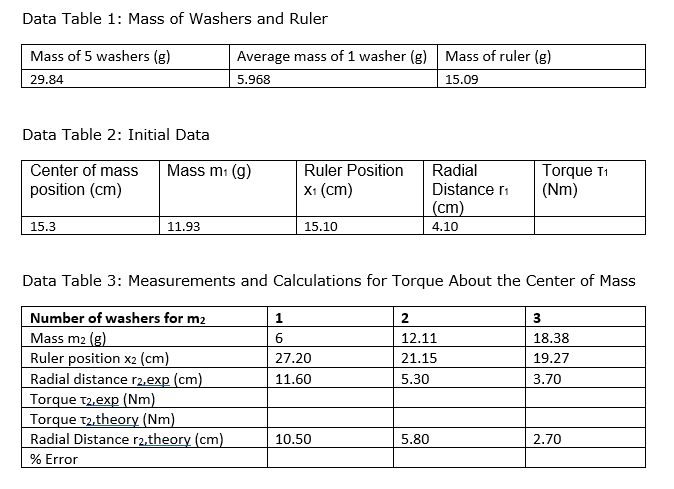
Question: Please help me complete the tables! Thank you for your time! Data Table 1: Mass of Washers and Ruler Mass of 5 washers {g} Average
Please help me complete the tables! Thank you for your time!
![Average mass of 1 washer [g] Mass of ruler {g} Data Table](https://dsd5zvtm8ll6.cloudfront.net/si.experts.images/questions/2024/09/66f6a53abc4a5_18666f6a53a7ab40.jpg)

![position (cm) 3o {cm} Distance n [Nm] Data Table 3: Measurements and](https://dsd5zvtm8ll6.cloudfront.net/si.experts.images/questions/2024/09/66f6a53b65228_18766f6a53b54f5c.jpg)
![12.11 a as Ruler position K2 [cm] 2?. 2D 21.15 19122]Ir Radial](https://dsd5zvtm8ll6.cloudfront.net/si.experts.images/questions/2024/09/66f6a53c2d213_18866f6a53c0b5bb.jpg)
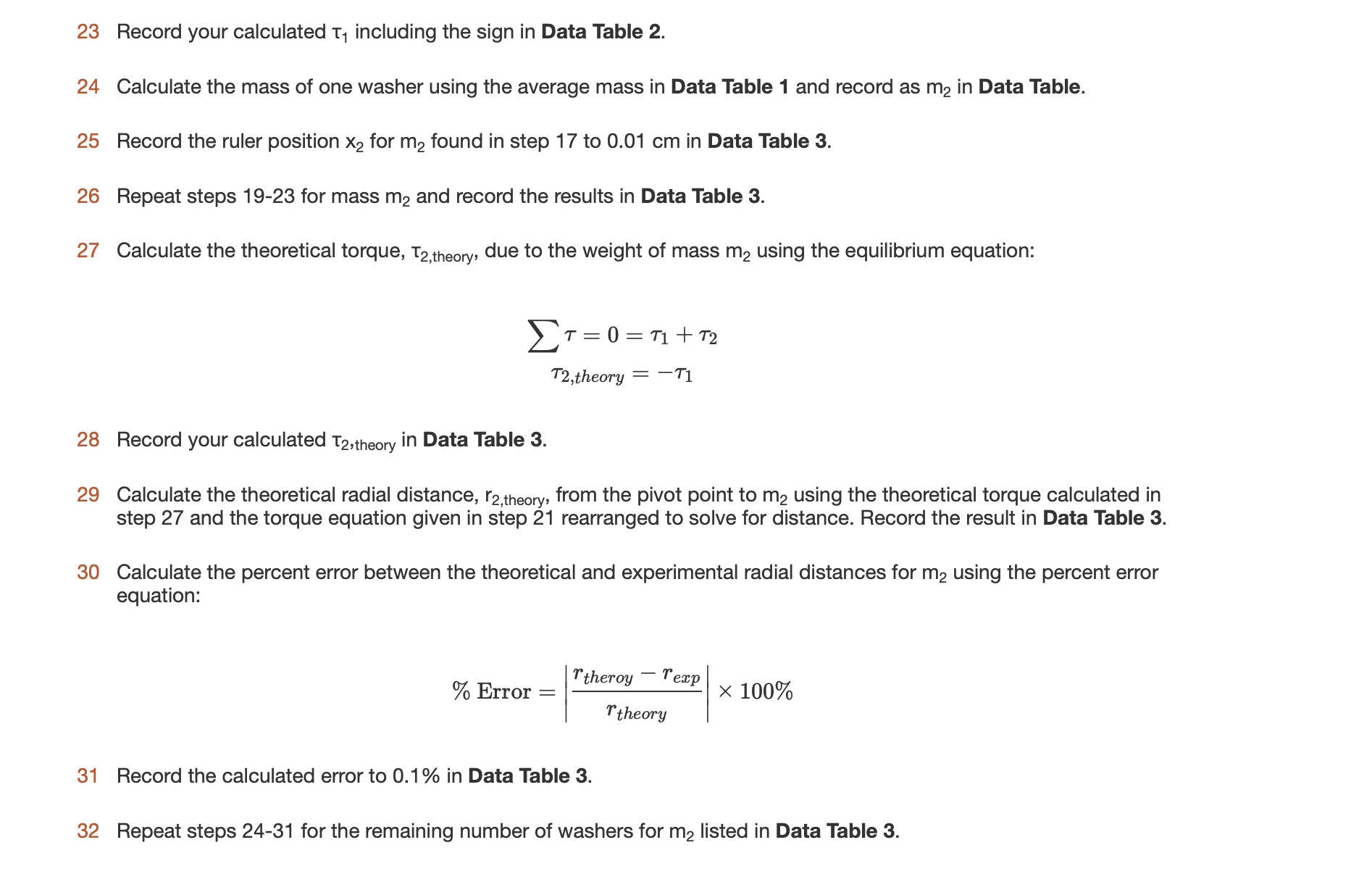
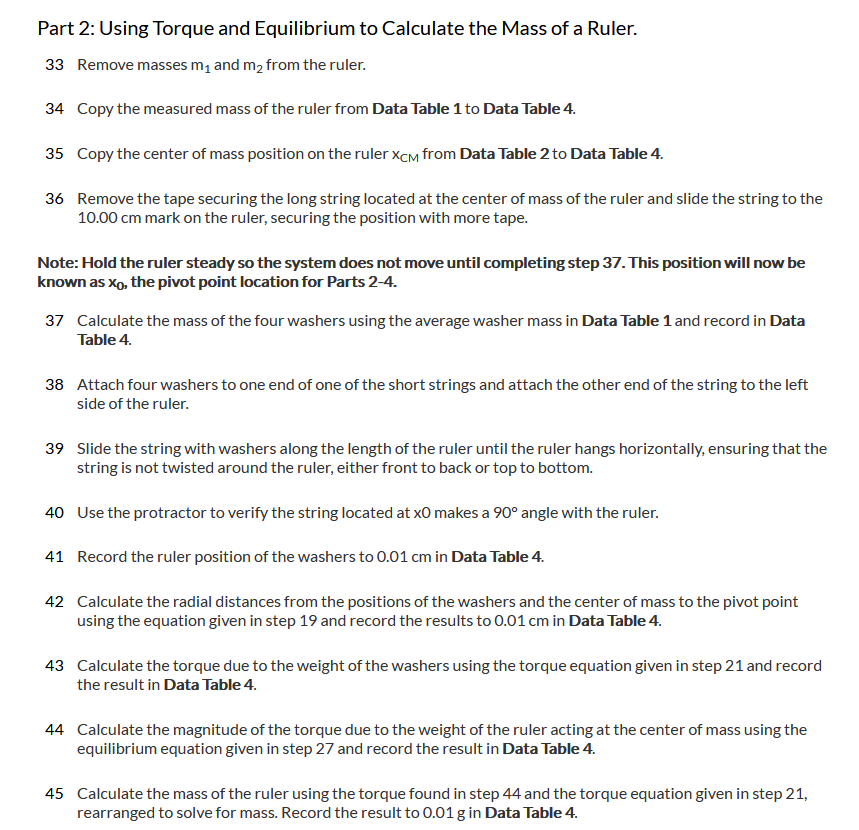
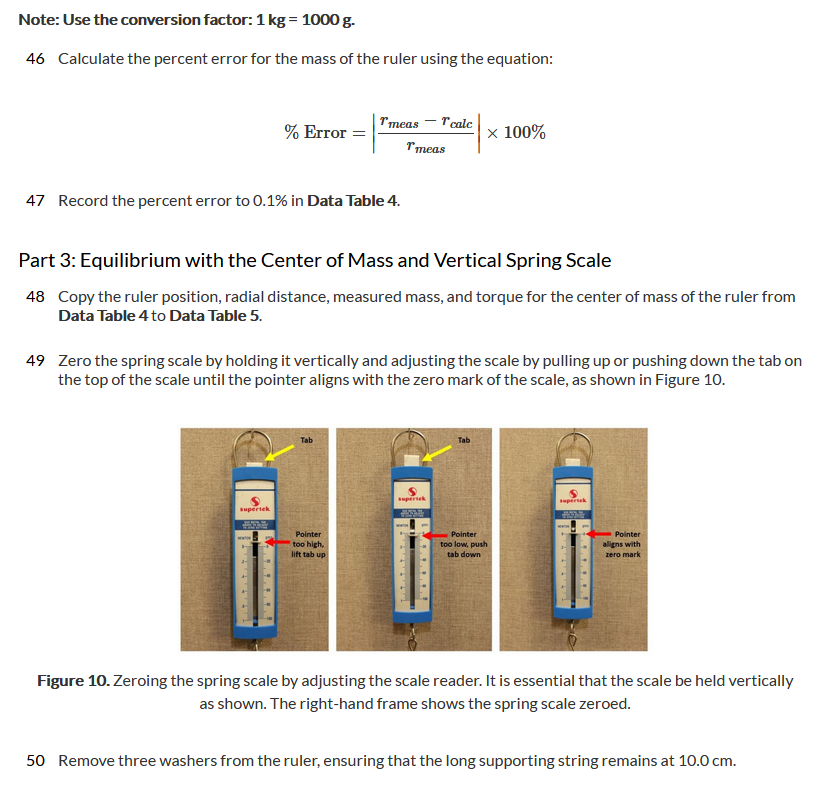
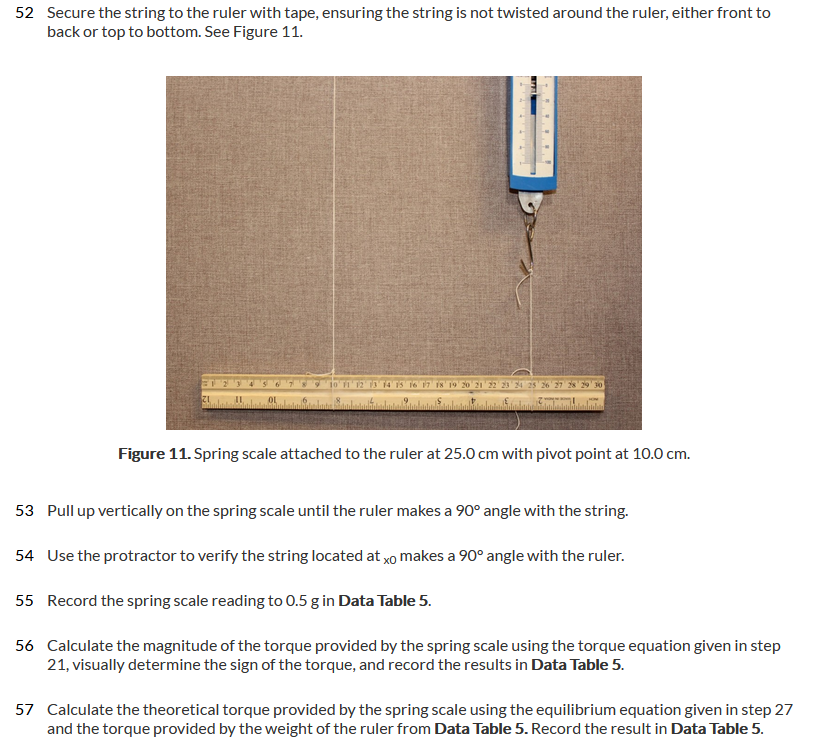
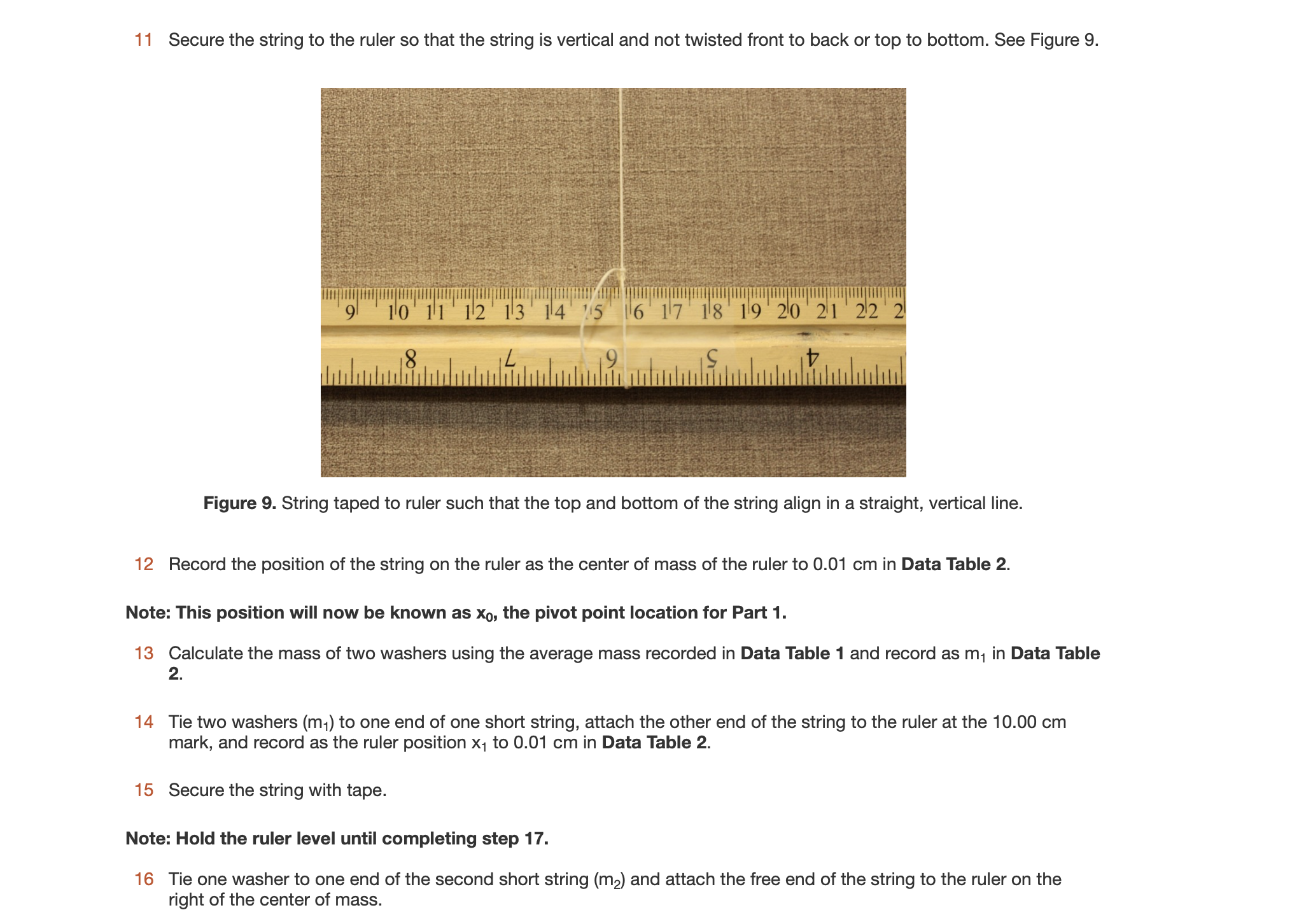
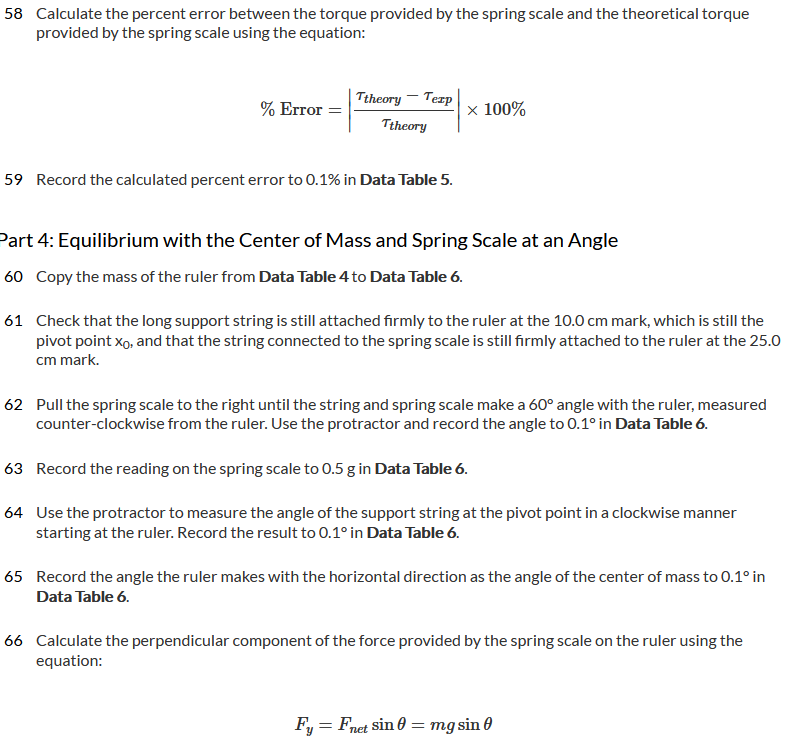
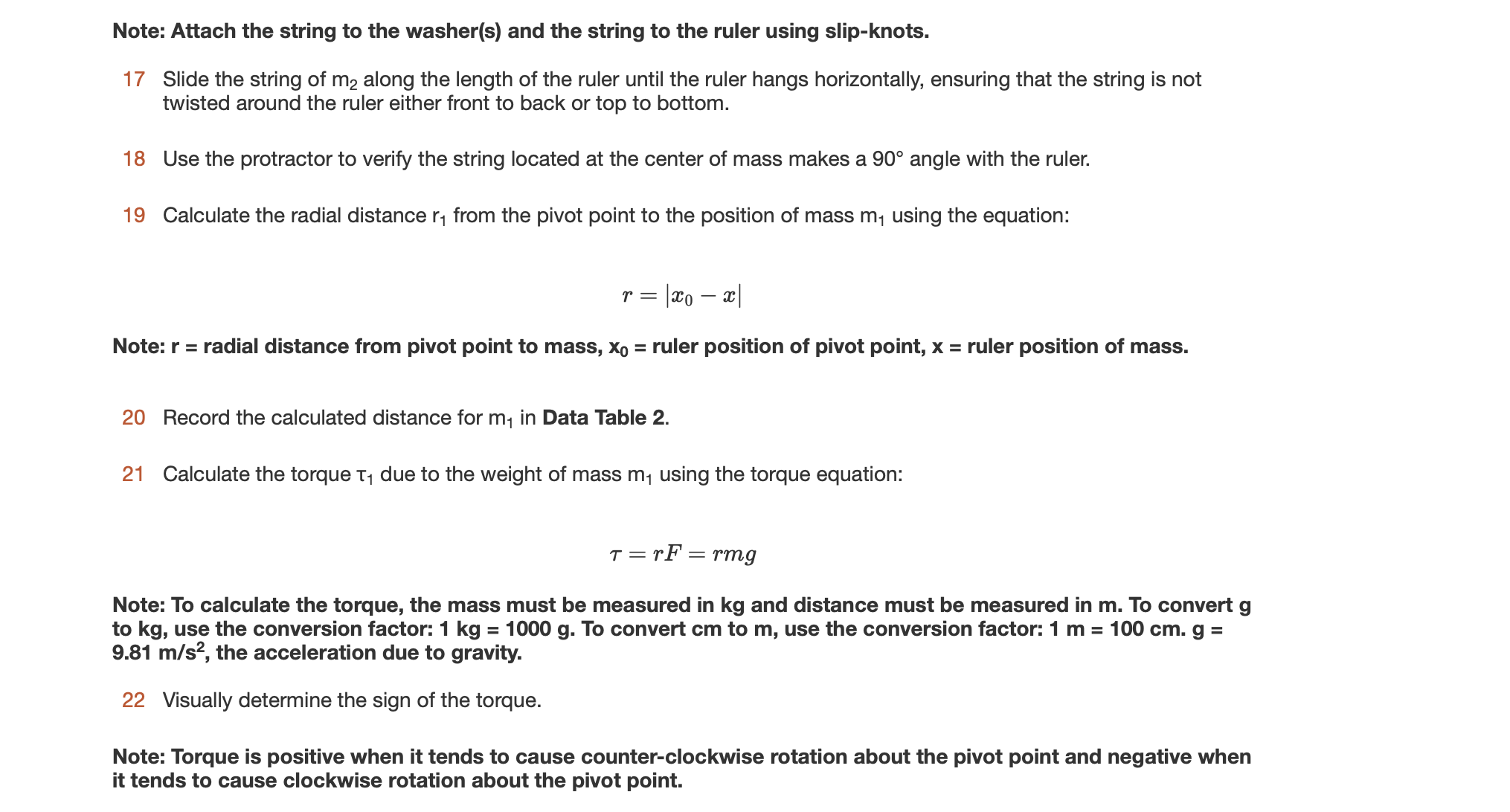
Data Table 1: Mass of Washers and Ruler Mass of 5 washers {g} Average mass of 1 washer [g] Mass of ruler {g} Data Table 2: Initial Data |Center of mass Ruler Position Radial Toro ue T1 position (cm) 3o {cm} Distance n [Nm] Data Table 3: Measurements and Calculations for Torque About the Center of Mass \"momma-1min. m ___ M_ 12.11 a as Ruler position K2 [cm] 2?. 2D 21.15 19122]Ir Radial distance r ax am 11.60 m w 58 Calculate the percent error between the torque provided by the spring scale and the theoretical torque provided bv the spring scale using the equation: 59 Record the calculated percent error to 0.1% in Data Table 5. \"art 4: Equilibrium with the Center of Mass and Spring Scale at an Angle 60 Copy:r the mass of the ruler from Data Table 4 to Data Table 6. 61 Check that the long support string is still attached rmlvto the ruler at the 10.0 cm mark. which is still the pivot point :10, and that the string connected to the spring scale is still rmly:r attached to the ruler at the 25.0 cm marl-1. 62 Pull the spring scale to the right until the string and spring scale make a 60 angle with the ru ler. measured counter-clockwise from the ruler. Use the protractor and record the angle to 0.1\" in Data Table 6. 63 Record the reading on the spring scale to 0.5 g in DataTable 6. 64 Use the protractor to measure the angle ofthe support string at the pivot point in a clockwise manner starting at the ruler. Record the result to 0.1\" in Data Table 6. 65 Record the angle the ruler makes with the horizontal direction as the angle of the center of mass to 0.1\" in Data Table 6. 66 Calculate the perpendicular component of the force provided bv the spring scale on the ruler usingthe equation: FyszainzmgainH Note: m = mass reading from spring scale (kg), g = 9.81 m/s , the acceleration due to gravity, and 0 = angle measured from the ruler to the spring scale ("). 67 Record the calculated force, including the sign, to three significant figures in Data Table 6. 68 Repeat steps 66-67 for the mass of the ruler located at the center of mass of the ruler. 69 Calculate the perpendicular component of the force of the support string at the pivot point, Fpivoty, using the equilibrium equation: Fnet,y = 0 = Fpivot,y + FCMy + Fscale,y 70 Record the calculated force including the sign to three significant figures in Data Table 6. 71 Calculate the horizontal component of the spring scale force and the weight of the ruler at the center of mass, Fscale, x and FCM, x, using the equation: Fr = F cos 0 72 Record the calculated forces, including the signs, in Data Table 6. 73 Calculate the horizontal component of the force of the support string at the pivot point, Fpivot,x, using the equilibrium equation given in step 69 modified for the horizontal direction. Record the result in Data Table 6. 74 Calculate the magnitude of the total force of the weight of the ruler at the center of mass using the Pythagorean Theorem: net =F2+F275 Record the calculated force to three significant figures in Data Table 6. 76 Calculate the torque on the ruler at the pivot point due to the weight of the ruler using the torque equation given in step 21, the perpendicular component of the force, and the radial distance recorded in Data Table 5. Record the result in Data Table 6.Data Table 4: Center of Mass Equilibrium with Hanging Mass Xo = 10.00 Measured Ruler Radial Torque Calculated Percent cm mass Position Distance I (Nm) mass (g) error m (g) x (cm) r (cm) (9%) Ruler 14.39 15.30 5.5 center of mass 4 washers 25.11 5.70 4.2 Data Table 5: Center of Mass Equilibrium with Vertical Spring Scale Xo = 10.00 Ruler Radial Spring Torque Torque Percent cm position distance r scale Texe (Nm) Tatheory (Nm) error x (cm) (cm) reading (%) or mass (g) Spring 25 15 12.60 Scale Ruler 14.68 4.54 16 center mass Data Table 6: Center of Mass Equilibrium with Spring Scale at an Angle Location Center of mass Spring scale Pivot point Spring scale reading 15.5 12.90 or mass (g) Angle 0 (") 75 62 105 Perpendicular Force 0.147 0.0940 -0.229 FI (N) Parallel Force FI (N) 0.0461 0.0545 0.0536 Net Force Fnat (N) 0.155 0.113 0.237 Torque t (Nm) 0Note: Attach the string to the washer(s) and the string to the ruler using slip-knots. 17 Slide the string of mg along the length of the ruler until the ruler hangs horizontally, ensuring that the string is not twisted around the ruler either front to back or top to bottom. 18 Use the protractor to verify the string located at the center of mass makes a 90 angle with the ruler. 19 Calculate the radial distance r1 from the pivot point to the position of mass m using the equation: r=|w09:| Note: r = radial distance from pivot point to mass, x0 = ruler position of pivot point. x = ruler position of mass. 20 Record the calculated distance for m in Data Table 2. 21 Calculate the torque T1 due to the weight of mass m using the torque equation: 1' = TF 2 rmg Note: To calculate the torque, the mass must be measured in kg and distance must be measured in m. To convert g to kg, use the conversion factor: 1 kg = 1000 9. To convert cm to m, use the conversion factor: 1 m = 100 cm. 9 = 9.81 m/s"', the acceleration due to gravity. 22 Visually determine the sign of the torque. Note: Torque is positive when it tends to cause counter-clockwise rotation about the pivot point and negative when it tends to cause clockwise rotation about the pivot point. Part 1: Torque About the Center of Mass 1 Gather the supplies necessary for the experiment, including five washers, string, wooden ruler, digital scale, protractor, safety goggles, and a wall hook attached to a suitable location to hang a ruler. Note: Instead of a wall hook, an over-the-door coat hook, shower curtain rod, or balcony railing are possible locations that could be used to hang the ruler. The following exercise will work best if a solid surface, such as a wall or door, is directly behind the hook. 2 Put on your safety goggles. Note: \\ew the video, Using the Digital Scale, before continuing the procedures. If needed, a descriptive text transcrip_t is available. Using the Digital Scale I L? This video shows how to use a digital scale 3 Use the digital scale to measure the mass of five washers and record to 0.01 g in Data Table 1. 4 Calculate the average mass of each washer and record to 0.01 g in Data Table 1. 5 Use the digital scale to measure the mass of the ruler and record to 0.01 g in Data Table 1. 6 Cut two lengths of string to 20 cm and one length of 60 cm from the 4 m length of string. 7 Tie one end of the 60 cm length of string to the wall hook or other support. 8 Tie the other end of the 60 cm string around the ruler near its center so that the centimeter scale is on top. 9 Adjust the location of the string along the ruler until the ruler hangs horizontally from the string. 10 Use the protractor to verify that the string makes a 90 angle with the ruler as shown in Figure 8. 23 Record your calculated T1 including the sign in Data Table 2. 24 Calculate the mass of one washer using the average mass in Data Table 1 and record as mg in Data Table. 25 Record the ruler position x2 for m2 found in step 17 to 0.01 cm in Data Table 3. 26 Repeat steps 19-23 for mass m2 and record the results in Data Table 3. 27 Calculate the theoretical torque, Tammy, due to the weight of mass m2 using the equilibrium equation: ZT=0=T1+72 T2,theory = _71 28 Record your calculated 12mm\Part 2: Using Torque and Equilibrium to Calculate the Mass of a Ruler. 33 Remove masses m1 and ma from the ruler. 34 Copy the measured mass of the ruler from Data Table 1 to Data Table 4. 35 Copv the center of mass position on the ruler XCM from Data Table 2 to Data Table 4. 36 Remove the tape secu ring the long string located at the center of mass ofthe ruler and slide the string to the 10.00 cm mark on the ru ler. securing the position with more tape. Note: Hold the ruler steady so the system does not move until completing step 3?. This position will now be known as it\Note: Usethemwersiunfactor: 1kg: 10m; 4s Calculate the percent error for the mass of the ruler using the equation: finals _ Tunic % Error 2 x 100% Tums 4? Record the percent error to 0.1% in DataTiiJle 4. Part 3: Equilibrium with the Center of Mass and Vertical Spring Scale 48 Copy the ruler position, radial distance, measured mass, and torque for the center of mass of the ruler from Data Table 4to DataTable 5. 49 Zero the spring scale by holding it vertically and adjusting the scale by pulling up or pushing down the tab on the top of the scale until the pointer aligns with the zero mark of the scale, as shown in Figure 10. Figure 10. Zeroing the spring scale by adjusting the scale reader. It is essential that the scale be held vertically as shown. The righthand frame shows the spring scale zeroed. 50 Remove three washers from the ruler, ensuring that the long supporting string remains at 10.0 cm. 52 Secure the string to the ruler with tape, ensuring the string is not twisted around the ruler, either front to back or top to bottom. See Figure 11. F'gure 11L Spring scale attached to the ruler at 25.0 cm with pivot point at 10.0 cm. 53 Pull up vertically on the spring scale until the ruler makes a 90 angle with the string. 54 Use the protractor to verifyr the string located at m makes a 90 angle with the ruler. 55 Record the spring scale reading to 0.5 g in Data Table 5. 56 Calculate the magnitude of the torque provided lav the spring scale using the torque equation given in step 21. visually determine the sign of the torque, and record the results in DataTable 5. 5? Calculate the theoretical torque provided by the spring scale using the equilibrium equation given in step 2? and the torque provided by the weight of the ruler from DataTable 5. Record the result in Data Table 5. 11 Secure the string to the ruler so that the string is vertical and not twisted front to back or top to bottom. See Figure 9. Figure 9. String taped to ruler such that the top and bottom of the string align in a straight, vertical line. 12 Record the position of the string on the ruler as the center of mass of the ruler to 0.01 cm in Data Table 2. Note: This position will now be known as x0, the pivot point location for Part 1. 13 Calculate the mass of two washers using the average mass recorded in Data Table 1 and record as m in Data Table 2. 14 Tie two washers (m1) to one end of one short string, attach the other end of the string to the ruler at the 10.00 cm mark, and record as the ruler position x1 to 0.01 cm in Data Table 2. 15 Secure the string with tape. Note: Hold the ruler level until completing step 17. 16 Tie one washer to one end of the second short string (m2) and attach the free end of the string to the ruler on the right of the center of mass
Step by Step Solution
There are 3 Steps involved in it
Lets complete the missing data and calculations Data Table 2 Initial Data Radial Distance r Calculat... View full answer

Get step-by-step solutions from verified subject matter experts
 Study Help