







Question: please help. thank you so much. As we discussed during lecture, according to the Central Limit Theorem, when the success- failure conditions are met, i.e.
please help. thank you so much.
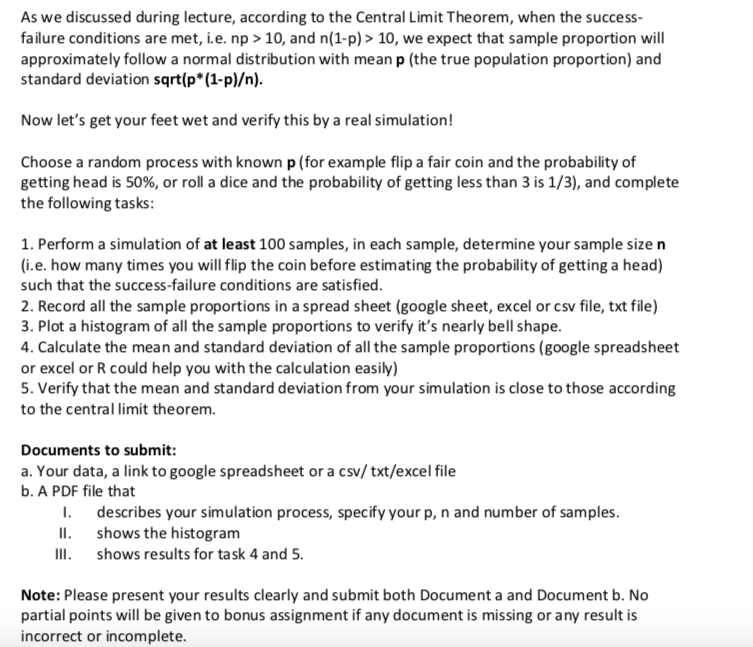
As we discussed during lecture, according to the Central Limit Theorem, when the success- failure conditions are met, i.e. np > 10, and n(1-p) > 10, we expect that sample proportion will approximately follow a normal distribution with mean p (the true population proportion) and standard deviation sqrt(p* (1-p)). Now let's get your feet wet and verify this by a real simulation! Choose a random process with known p (for example flip a fair coin and the probability of getting head is 50%, or roll a dice and the probability of getting less than 3 is 1/3), and complete the following tasks: 1. Perform a simulation of at least 100 samples, in each sample, determine your sample size n (i.e. how many times you will flip the coin before estimating the probability of getting a head) such that the success-failure conditions are satisfied. 2. Record all the sample proportions in a spread sheet (google sheet, excel or cav file, txt file) 3. Plot a histogram of all the sample proportions to verify it's nearly bell shape. 4. Calculate the mean and standard deviation of all the sample proportions (google spreadsheet or excel or R could help you with the calculation easily) 5. Verify that the mean and standard deviation from your simulation is close to those according to the central limit theorem. Documents to submit: a. Your data, a link to google spreadsheet or a csv/ txt/excel file b. A PDF file that 1. describes your simulation process, specify your p, n and number of samples. II. shows the histogram III. shows results for task 4 and 5. Note: Please present your results clearly and submit both Document a and Document b. No partial points will be given to bonus assignment if any document is missing or any result is incorrect or incomplete
Step by Step Solution
There are 3 Steps involved in it

Get step-by-step solutions from verified subject matter experts
 Study Help