







Question: please show all the steps with explanations thank you Prof. James L. Popp, PhD 18.7 | Beats: Interference in Time Problems Chapter 17 of Physics
please show all the steps with explanations thank you
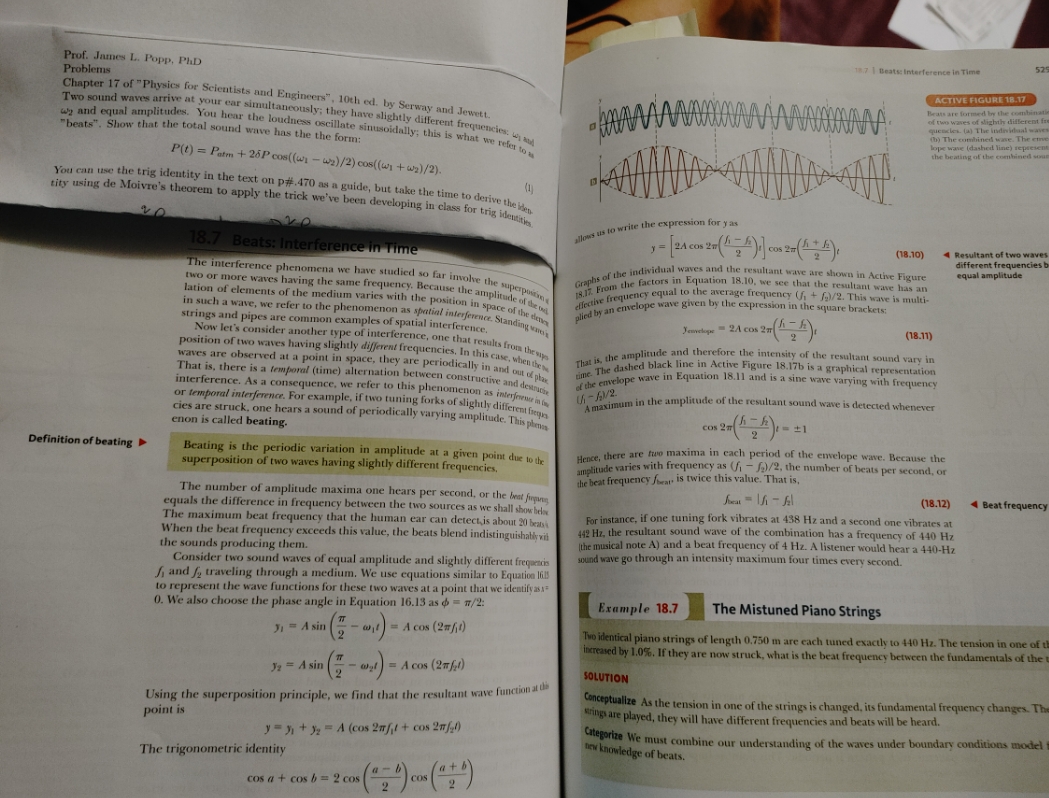
Prof. James L. Popp, PhD 18.7 | Beats: Interference in Time Problems Chapter 17 of "Physics for Scientists and Engineers", 10th ed. by Serway and Jewett. ACTIVE FIGURE 18.17 Brats are formed by the combinat Two sound waves arrive at your ear simultaneously; they have slightly different frequencies. way of two waves of slightly different f wy and equal amplitudes. You hear the loudness oscillate sinusoidally; this is what we refer to quencher. (a] The Individual wave "beats". Show that the total sound wave has the the form: (by The combined wase. The emm lope wave (dashed line) replete the beating of the combined sous P(t) = Pate + 26P cos((wi - we)/2) cos((wi + wa)/2). You can use the trig identity in the text on p#.470 as a guide, but take the time to derive the way tity using de Moivre's theorem to apply the trick we've been developing in class for trig identity allows us to write the expression for y as 18.7 Beats: Interference in Time = 2Acus 2(1 7 4 ]] cos 20 ( f # 1) (18.10) Resultant of two wave different frequencies The interference phenomena we have studied so far involve the superporn Graphs of the individual waves and the resultant wave are shown in Active Figure equal amplitude two or more waves having the same frequency. Because the amplitude of the . 18.17. From the factors in Equation 18.10, we see that the resultant wave has an lation of elements of the medium varies with the position in space of the dens effective frequency equal to the average frequency (f, + [,)/2. This wave is multi- in such a wave, we refer to the phenomenon as spatial interference. Standing une plied by an envelope wave given by the expression in the square brackets: strings and pipes are common examples of spatial interference. (18.11) Now let's consider another type of interference, one that results from the sy position of two waves having slightly different frequencies. In this case, when they waves are observed at a point in space, they are periodically in and out of play That is, the amplitude and therefore the intensity of the resultant sound vary in That is, there is a temporal (time) alternation between constructive and desirgin time. The dashed black line in Active Figure 18.17b is a graphical representation interference. As a consequence, we refer to this phenomenon as interference in for of the envelope wave in Equation 18.11 and is a sine wave varying with frequency Of temporal interference. For example, if two tuning forks of slightly different freqa A maximum in the amplitude of the resultant sound wave is detected whenever cies are struck, one hears a sound of periodically varying amplitude. This phena enon is called beating. cox 27( 1 - h)= =1 Definition of beating Beating is the periodic variation in amplitude at a given point due to the Hence, there are two maxima in cach period of the envelope wave. Because the superposition of two waves having slightly different frequencies. amplitude varies with frequency as (f, - f;)/2, the number of beats per second, or the beat frequency fbeat. is twice this value. That is, The number of amplitude maxima one hears per second, or the best firing Sbeat = Ifi - JEl (18.12) Beat frequency equals the difference in frequency between the two sources as we shall showbela The maximum beat frequency that the human ear can detect is about 20 beast For instance, if one tuning fork vibrates at 438 Hz and a second one vibrates at When the beat frequency exceeds this value, the beats blend indistinguishably wit 142 Ha, the resultant sound wave of the combination has a frequency of 440 Hz the sounds producing them. [the musical note A) and a beat frequency of 4 Hz. A listener would hear a 440-Hz Consider two sound waves of equal amplitude and slightly different frequentis sound wave go through an intensity maximum four times every second. and f traveling through a medium. We use equations similar to Equation lils to represent the wave functions for these two waves at a point that we identify as 0. We also choose the phase angle in Equation 16.13 as $ = #7/2: Example 18.7 The Mistuned Piano Strings 31 = Asin (5 - or,() = A cos (2#fit) Two identical piano strings of length 0.750 m are each tuned exactly to 440 Hz. The tension in one of increased by 1.0%. If they are now struck, what is the beat frequency between the fundamentals of the 12 = Asin (5 - wyf ) = A cos (27 /4) SOLUTION Using the superposition principle, we find that the resultant wave function at the Conceptualize As the tension in one of the strings is changed, its fundamental frequency changes. Th point is wrings are played, they will have different frequencies and beats will be heard. y = 31 + 32 = A (cos 2m/jf + cos 2#/0) Categorize We must combine our understanding of the waves under boundary conditions model The trigonometric identity new knowledge of beats. cos a + cos b = 2 cos () costs)
Step by Step Solution
There are 3 Steps involved in it

Get step-by-step solutions from verified subject matter experts
 Study Help