







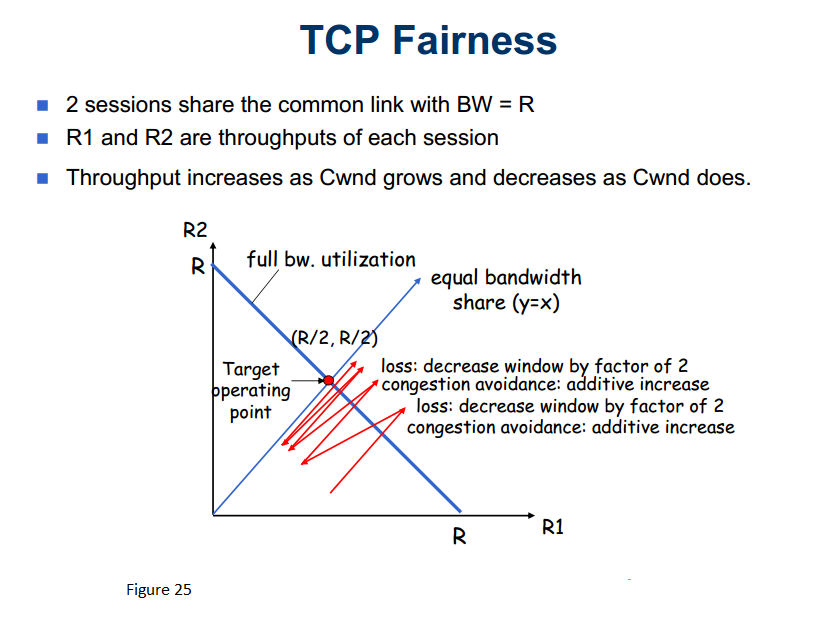
Question: Problem A: Consider TCP fairness scenario as shown in figure 25, which illustrates the convergence of TCPs AIMD algorithm. There are two connections through the
Problem A:
Consider TCP fairness scenario as shown in figure 25, which illustrates the convergence of TCPs AIMD algorithm. There are two connections through the same bottleneck link of capacity R to the same server, as depicted in the figure 24. Suppose that instead of a multiplicative decrease, TCP decreases the window size by a constant amount as follows:
a) Both connections decrease their window size by 1 instead of multiplicative decrease. Would the resulting AIAD algorithm converge to an equal share? Justify your answer using a diagram similar to that in figure 24 with short explanation on the plot you draw.
b) Now, connection 1 decreases its window size by 3 while connection 2 decreases only by 1. All other parts remain the same as above. Would this version of AIAD algorithm (but two connections behave differently) converge to an equal share? Justify your answer using a diagram similar to that in figure 24 with short explanation on the plot you draw.
Problem B:
Consider the same TCP fairness scenario as in the previous problem. There are two connections through the same bottleneck link of capacity R to the same server, as depicted in the figure 24. Connection 1 follows the original AIMD algorithm. Suppose that connection 2 (or user 2) is smart enough to modify his/her own TCP congestion control algorithm and performs the following: upon ACK, the window size increases by one as usual. Upon congestion, i.e., 3 duplicate acknowledgements, it maintains the same window size (instead of halving it).
What are the long-term throughput of these two connections? Justify your answer by showing how the throughput of two connections (users) evolve over time, assuming that they start from the point A in Figure 2.
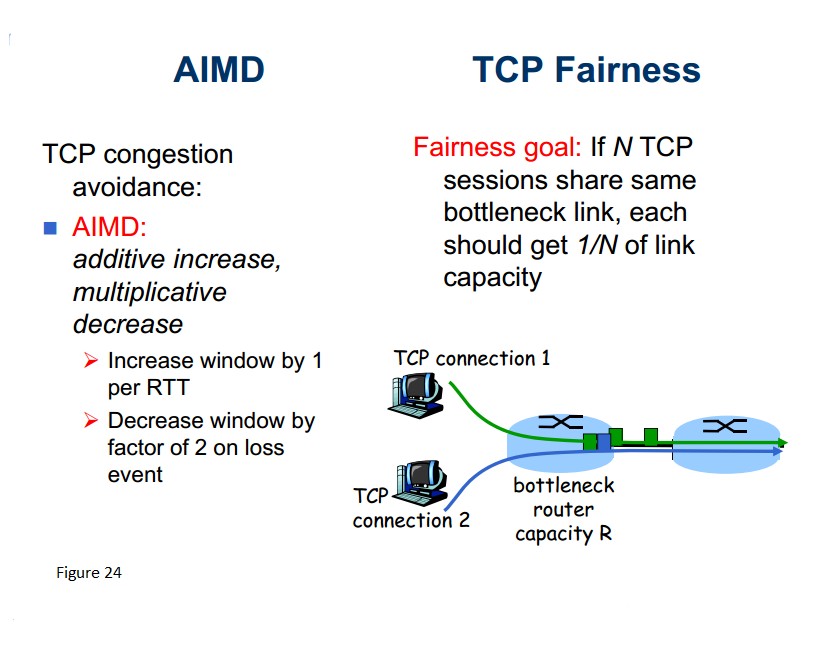
AIMD TCP Fairness Fairness goal: N TCP sessions share same bottleneck link, each should get 1/N of link TCP congestion avoidance: AIMD additive increase, multiplicative decrease capacity Increase window by 1 TCP connection 1 per RTT Decrease window by factor of 2 on loss event TCP connection 2 bottleneck router capacity R Figure 24 AIMD TCP Fairness Fairness goal: N TCP sessions share same bottleneck link, each should get 1/N of link TCP congestion avoidance: AIMD additive increase, multiplicative decrease capacity Increase window by 1 TCP connection 1 per RTT Decrease window by factor of 2 on loss event TCP connection 2 bottleneck router capacity R Figure 24
Step by Step Solution
There are 3 Steps involved in it

Get step-by-step solutions from verified subject matter experts
 Study Help