







Question: Consider TCP fairness scenario as shown in the lecture note, slide #25 in Transport chapter, which illustrates the convergence of TCP's AIMD algorithm. There are
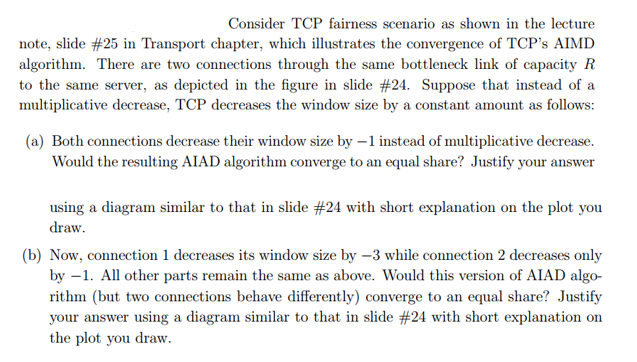
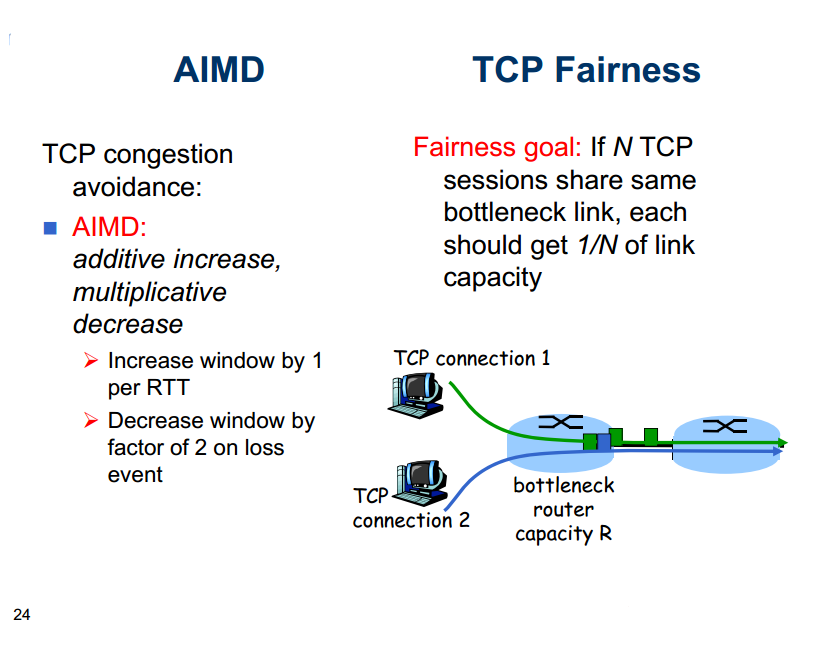
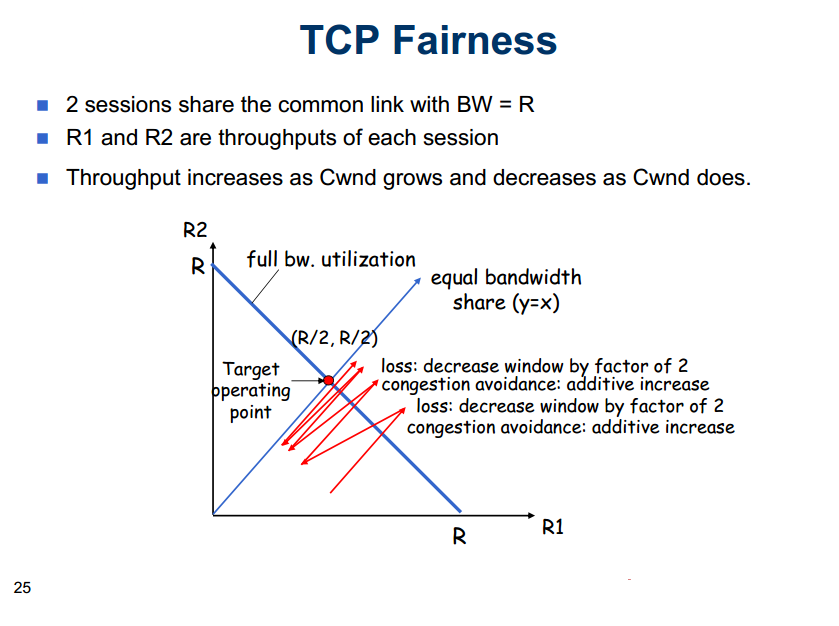
Consider TCP fairness scenario as shown in the lecture note, slide #25 in Transport chapter, which illustrates the convergence of TCP's AIMD algorithm. There are two connections through the same bottleneck link of capacity R to the same server, as depicted in the figure in slide #24. Suppose that instead of a multiplicative decrease, TCP decreases the window size by a constant amount as follows: (a) Both connections decrease their window size by-1 instead of multiplicative decrease. Would the resulting AIAD algorithm converge to an equal share? Justify your answer using a diagram similar to that in slide #24 with short explanation on the plot you draw (b) Now, by -1. All other parts remain the same as above. Would this version of AIAD algo- rithm (but two connections behave differently) converge to an equal share? Justify your answer using a diagram similar to that in slide #24 with short explanation on the plot you draw Consider TCP fairness scenario as shown in the lecture note, slide #25 in Transport chapter, which illustrates the convergence of TCP's AIMD algorithm. There are two connections through the same bottleneck link of capacity R to the same server, as depicted in the figure in slide #24. Suppose that instead of a multiplicative decrease, TCP decreases the window size by a constant amount as follows: (a) Both connections decrease their window size by-1 instead of multiplicative decrease. Would the resulting AIAD algorithm converge to an equal share? Justify your answer using a diagram similar to that in slide #24 with short explanation on the plot you draw (b) Now, by -1. All other parts remain the same as above. Would this version of AIAD algo- rithm (but two connections behave differently) converge to an equal share? Justify your answer using a diagram similar to that in slide #24 with short explanation on the plot you draw
Step by Step Solution
There are 3 Steps involved in it

Get step-by-step solutions from verified subject matter experts
 Study Help