







Question: Problem section A (1, 3,4,7,8,9, 11, 12, 13, 14) Proborn section B ( 3,7, 25,29) also explain how you solved each problem :) 80 1
Problem section A (1, 3,4,7,8,9, 11, 12, 13, 14)
Proborn section B ( 3,7, 25,29)
also explain how you solved each problem :)
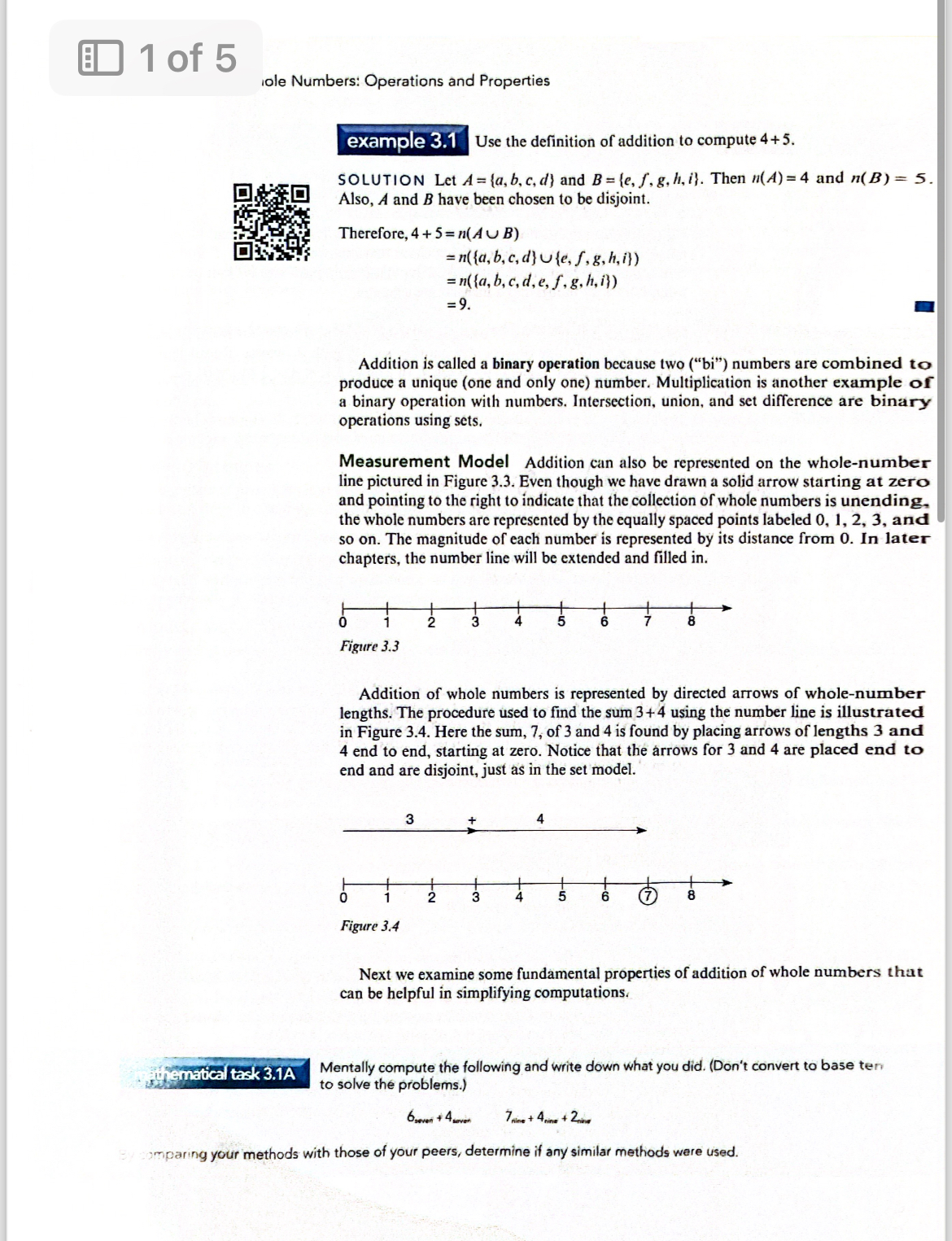
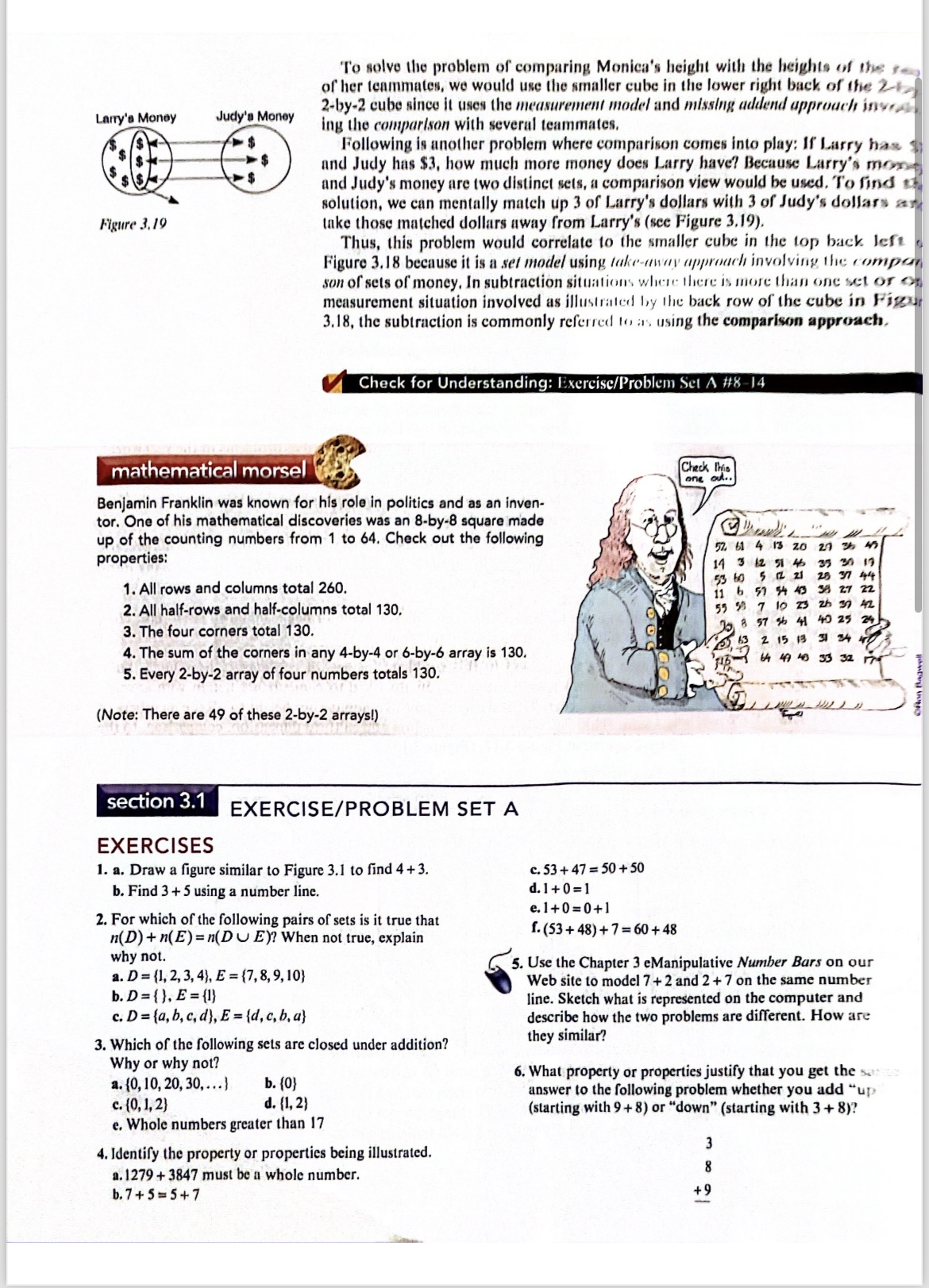
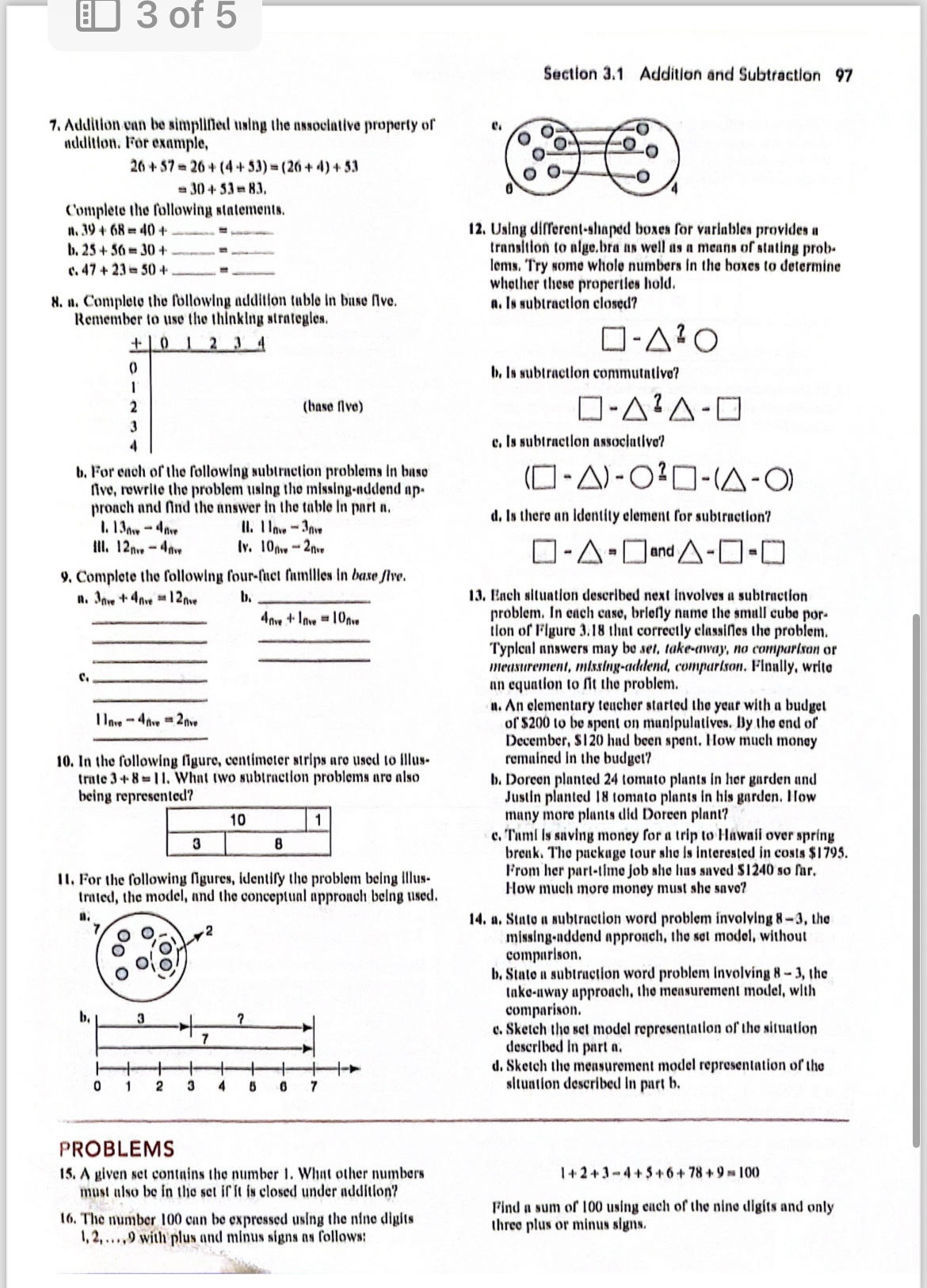
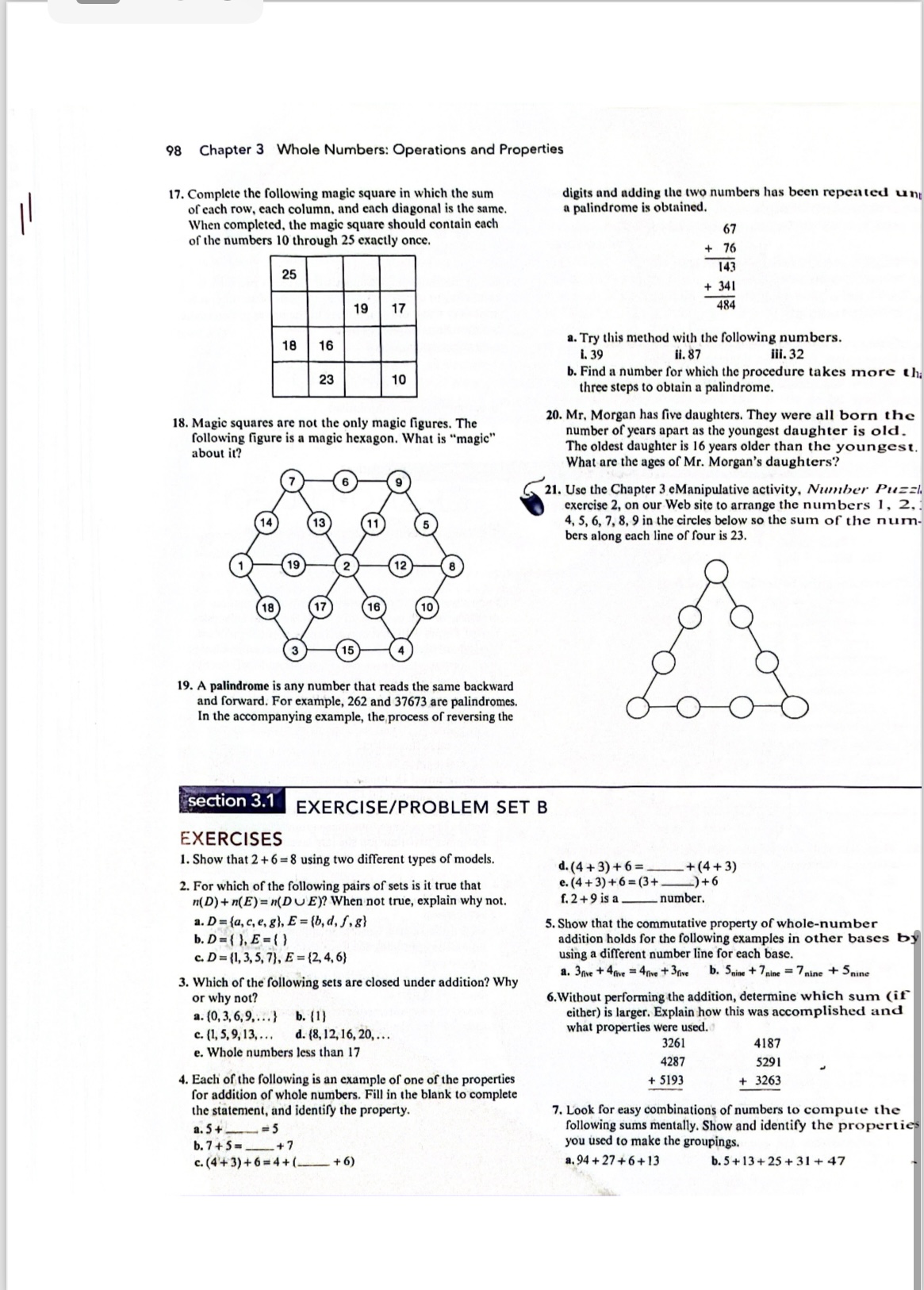
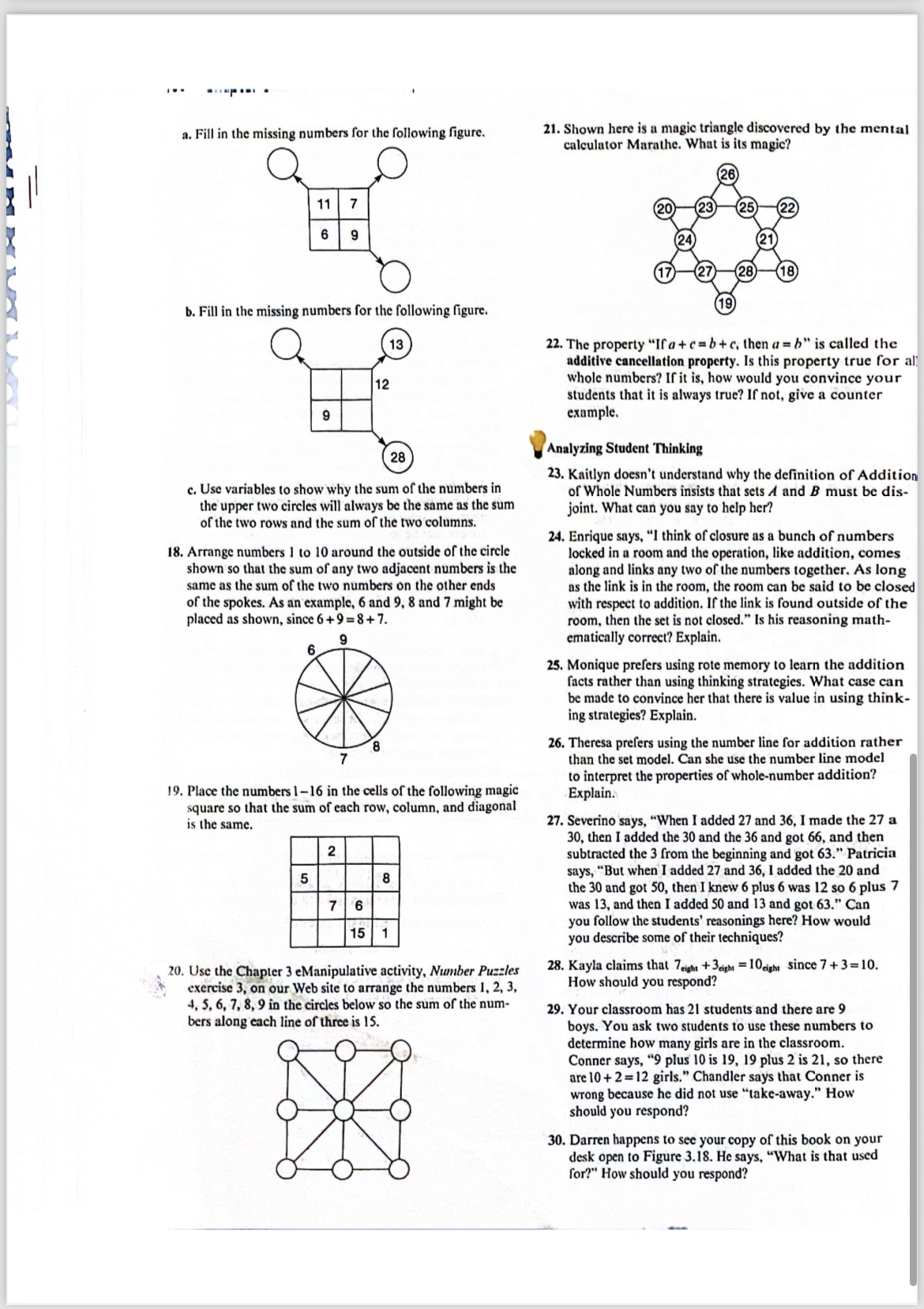
80 1 of 5 ole Numbers: Operations and Properties example 3.1 Use the definition of addition to compute 4+ 5. SOLUTION Let A= (a, b, c, d) and B = (e, f, g, h, i). Then n(A) = 4 and n( B) = 5. Also, A and B have been chosen to be disjoint. Therefore, 4 + 5=n(A U B) = n({a, b, c, d} ute, f, g, h, i)) =n( (a, b, c, d, e, f, g, h, i)) =9. Addition is called a binary operation because two ("bi") numbers are combined to produce a unique (one and only one) number. Multiplication is another example of a binary operation with numbers. Intersection, union, and set difference are binary operations using sets. Measurement Model Addition can also be represented on the whole-number line pictured in Figure 3.3. Even though we have drawn a solid arrow starting at zero and pointing to the right to indicate that the collection of whole numbers is unending. the whole numbers are represented by the equally spaced points labeled 0, 1, 2, 3, and so on. The magnitude of each number is represented by its distance from 0. In later chapters, the number line will be extended and filled in. 2 Figure 3.3 Addition of whole numbers is represented by directed arrows of whole-number lengths. The procedure used to find the sum 3+4 using the number line is illustrated in Figure 3.4. Here the sum, 7, of 3 and 4 is found by placing arrows of lengths 3 and 4 end to end, starting at zero. Notice that the arrows for 3 and 4 are placed end to end and are disjoint, just as in the set model. 3 2 Figure 3.4 Next we examine some fundamental properties of addition of whole numbers that can be helpful in simplifying computations. athematical task 3.1A Mentally compute the following and write down what you did. (Don't convert to base ten to solve the problems.) omparing your methods with those of your peers, determine if any similar methods were used.To solve the problem of comparing Monica's height with the heights of the of her teammates, we would use the smaller cube in the lower right back of the 21 Larry's Money July's Money 2-by-2 cube since it uses the measurement model and missing addend approach inved ing the comparison with several teammates, Following is another problem where comparison comes into play: If Larry has and Judy has $3, how much more money does Larry have? Because Larry's more and Judy's money are two distinct sets, a comparison view would be used. To find th solution, we can mentally match up 3 of Larry's dollars with 3 of Judy's dollars ar Figure 3.19 take those matched dollars away from Larry's (see Figure 3.19). Thus, this problem would correlate to the smaller cube in the top back left Figure 3.18 because it is a set model using take-away approach involving the compar son of sets of money. In subtraction situations where there is more than one set or on measurement situation involved as illustrated by the back row of the cube in Figx 3.18, the subtraction is commonly referred to as using the comparison approach, Check for Understanding: Exercise/Problem Set A #8-14 mathematical morsel Check This one at . . Benjamin Franklin was known for his role in politics and as an inven- tor. One of his mathematical discoveries was an 8-by-8 square made up of the counting numbers from 1 to 64. Check out the following 52 61 4 13 27 36 45 properties: 14 3 45 35 30 19 20 37 1. All rows and columns total 260. 38 27 22 2. All half-rows and half-columns total 130. 3. The four corners total 130 57 5% 4 40 25 15 31 34 4. The sum of the corners in any 4-by-4 or 6-by-6 array is 130. 4 33 32 5. Every 2-by-2 array of four numbers totals 130. (Note: There are 49 of these 2-by-2 arrays!) section 3.1 EXERCISE/PROBLEM SET A EXERCISES 1. a. Draw a figure similar to Figure 3.1 to find 4 + 3. c. 53 + 47 = 50 + 50 b. Find 3 + 5 using a number line. d. 1+0=1 e. 1+0=0+1 2. For which of the following pairs of sets is it true that n(D) + n(E) = n(DU E)? When not true, explain f. (53+ 48) +7=60+48 why not. a. D = (1, 2, 3, 4), E = (7, 8, 9, 10) 5. Use the Chapter 3 eManipulative Number Bars on our Web site to model 7 + 2 and 2 + 7 on the same number b. D = ( ). E = (1) line. Sketch what is represented on the computer and c. D = (a, b, c, d), E = (d, c, b, a} describe how the two problems are different. How are 3. Which of the following sets are closed under addition? they similar? Why or why not' a. (0, 10, 20, 30, ...) b. (0} 6. What property or properties justify that you get the sar answer to the following problem whether you add " up c. {0, 1, 2) d. (1, 2) (starting with 9 + 8) or "down" (starting with 3+ 8)? e. Whole numbers greater than 17 4. Identify the property or properties being illustrated. a. 1279 + 3847 must be a whole number. b. 7+5=5+78 3 of 5 Section 3.1 Addition and Subtraction 97 7. Addition can be simplified using the associative property of addition. For example, 26 + 57 - 26 + (4+ 53) = (26 + 4) +53 = 30 4 53 - 83. Complete the following statements. n. 39 + 68 = 40 + - 12. Using different-shaped boxes for variables provides a b. 25 +56 = 30 + transition to algebra as well as a means of stating prob- c. 47 + 23 - 50 + lems. Try some whole numbers in the boxes to determine whether these properties hold. 8. n. Complete the following addition table In base five. a. Is subtraction closed? Remember to use the thinking strategies. + 0 1 2 3 4 b, Is subtraction commutative? (base five) 0-A'A- 0 c, Is subtraction associative? b. For each of the following subtraction problems In base five, rewrite the problem using the missing-addend ap- (0-A)-O'0-(4-0) proach and find the answer in the table In part a. d. Is there an Identity element for subtraction? Ill. 12pre - 4av lv. 10five - 2nw O-A -and A - 0].0 9. Complete the following four-fact families in base five. 1. Dove + 4Ave = 12 nve 13. Each situation described next involves a subtraction problem. In each case, briefly name the small cube por- tion of Figure 3.18 that correctly classifies the problem. Typical answers may be set, take-away, no comparison or measurement, missing-addend, comparison. Finally, write an equation to fit the problem. a. An elementary teacher started the year with a budget of $200 to be spent on manipulatives. By the end of December, $120 had been spent. How much money 10. In the following figure, centimeter strips are used to illus- remained In the budget? trate 3 +8 =11. What two subtraction problems are also b. Doreen planted 24 tomato plants in her garden and being represented? Justin planted 18 tomato plants in his garden. How 10 many more plants did Doreen plant? 3 c. Tami Is saving money for a trip to Hawaii over spring break. The package tour she Is interested in costs $1795. It. For the following figures, identify the problem being Illus- From her part-time job she has saved $1240 so far. trated, the model, and the conceptual approach being used. How much more money must she save? 14. a. State a subtraction word problem involving 8 -3, the missing-addend approach, the set model, without comparison. b. State a subtraction word problem involving 8 - 3, the take-away approach, the measurement model, with comparison. c. Sketch the set model representation of the situation described in part a. d. Sketch the measurement model representation of the situation described In part b. PROBLEMS 15. A given set contains the number 1. What other numbers 1+2+3-4+5+6+78+9= 100 must also be in the set if it is closed under addition? 16. The number 100 can be expressed using the nine digits Find a sum of 100 using each of the nine digits and only three plus or minus signs. 1, 2, ....9 with plus and minus signs as follows:98 Chapter 3 Whole Numbers: Operations and Properties 17. Complete the following magic square in which the sum digits and adding the two numbers has been repeated um of each row, each column, and each diagonal is the same. a palindrome is obtained. When completed, the magic square should contain each 67 of the numbers 10 through 25 exactly once. + 76 25 143 + 341 19 17 484 a. Try this method with the following numbers. 16 i. 39 ii. 87 iii. 32 23 10 b. Find a number for which the procedure takes more th three steps to obtain a palindrome. 18. Magic squares are not the only magic figures. The 20. Mr. Morgan has five daughters. They were all born the following figure is a magic hexagon. What is "magic" number of years apart as the youngest daughter is old. about it? The oldest daughter is 16 years older than the youngest. What are the ages of Mr. Morgan's daughters? 21. Use the Chapter 3 eManipulative activity, Number Puzz, exercise 2, on our Web site to arrange the numbers 1, 2. 4, 5, 6, 7, 8, 9 in the circles below so the sum of the num- bers along each line of four is 23. 19. A palindrome is any number that reads the same backward and forward. For example, 262 and 37673 are palindromes. In the accompanying example, the process of reversing the section 3.1 EXERCISE/PROBLEM SET B EXERCISES 1. Show that 2 + 6 =8 using two different types of models. d. (4+3) +6 = _ + (4+3) 2. For which of the following pairs of sets is it true that e. (4+3) +6= (3+ -)+6 "(D) + n(E) = n(DUE)? When not true, explain why not. f. 2 +9 is a . - number. a. D= (a, c, e, g), E = (b, d, f, 8) 5. Show that the commutative property of whole-number b. D= ( ), E=( ) addition holds for the following examples in other bases by C. D = (1, 3, 5, 7), E = (2, 4, 6) using a different number line for each base. 3. Which of the following sets are closed under addition? Why a. 3five + 4five = 4five + 3five b. Swine + 7 nine = 7nine + 5nine or why not? 6. Without performing the addition, determine which sum (if a. (0, 3, 6,9,...} b. (1) either) is larger. Explain how this was accomplished and c. (1, 5,9, 13, ... d. (8, 12, 16, 20, ... what properties were used. 3261 4187 e. Whole numbers less than 17 4287 5291 4. Each of the following is an example of one of the properties + 5193 + 3263 for addition of whole numbers. Fill in the blank to complete the statement, and identify the property. 7. Look for easy combinations of numbers to compute the a. 5 += 5 following sums mentally. Show and identify the properties b. 7+5 = +7 you used to make the groupings. c. (4 + 3) +6=4+1- _+6) a. 94 + 27+6+13 b.5+13+25+31+47L -l A e . i>dy = 20. \"mpas a ' a. Fill in the missing numbers for the following figure. c. Use variables to show why the sum of the numbers in the upper two circles will always be the same as the sum of the two rows and the sum of the two columns. Arrange numbers | to 10 around the outside of the circle shown so that the sum of any two adjacent numbers is the same as the sum of the two numbers on the other ends of the spokes. As an example, 6 and 9, 8 and 7 might be placed as shown, since 6+9=8+17. 9 6 8 7 . Place the numbers 1 - 16 in the cells of the following magic square 5o that the sum of cach row, column, and diagonal is the same. Use the Chapter 3 eManipulative activity, Number Puzzles exercise 3, on our Web site to arrange the numbers 1, 2, 3, 4,5,6,7,8,9 in the circles below so the sum of the num- bers along each line of three is 15. 21. Shown here is o magic triangle discovered by the mental calculator Marathe. What is its magic? 22. The property \"Ifa+c=b+c, thenu= 5" is called the additive cancellation property. Is this property true for al' whole numbers? If it is, how would you convince your students that it is always true? If not, give a counter exomple, ?An-]yzlng Student Thinking 23. Kaitlyn doesn't understand why the definition of Addition of Whole Numbers insists that sets 4 and 8 must be dis- joint. What can you say to help her? 24. Enrique says, \"I think of closure as a bunch of numbers locked in a room and the operation, like addition, comes along and links any two of the numbers together. As long as the link is in the room, the room can be said to be closed with respect to addition. If the link is found outside of the room, then the set is not closed.\" Is his reasoning math- ematically correct? Explain. 25, Monique prefers using rote memory to learn the addition facts rather than using thinking strategies. What case can be made to convince her that there is value in using think- ing strategies? Explain. 26. Theresa prefers using the number line for addition rather than the set model. Can she use the number line model to interpret the properties of whole-number addition? Explain. 27. Severino says, \"When I added 27 and 36, I made the 27 a 30, then I added the 30 and the 36 and got 66, and then subtracted the 3 from the beginning and got 63.\" Patricia says, \"But when I added 27 and 36, | added the 20 and the 30 and got 50, then I knew 6 plus 6 was 12 so 6 plus 7 was 13, and then I added 50 and 13 and got 63." Can you follow the students' reasonings here? How would you describe some of their techniques? 28. Kayla claims that Teg +3apm =10ap since 7+ 3=10. How should you respond? 29. Your classroom has 21 students and there are 9 boys. You ask two students to use these numbers (0 determine how many girls are in the classroom. Conner says, \"9 plus 10is 19, 19 plus 2 is 21, so there are 10 + 2 =12 girls.\" Chandler says that Conner is wrong because he did not use \"take-away.\" How should you respond? 30. Darren happens to see your copy of this book on your desk open to Figure 3.18. He says, \"What is that used for?" How should you respond
Step by Step Solution
There are 3 Steps involved in it

Get step-by-step solutions from verified subject matter experts
 Study Help