







Question: pter 21 567 are information (such as bed days, number of visits, payment amounts. that contains a list of no less than twelve numerical amounts.
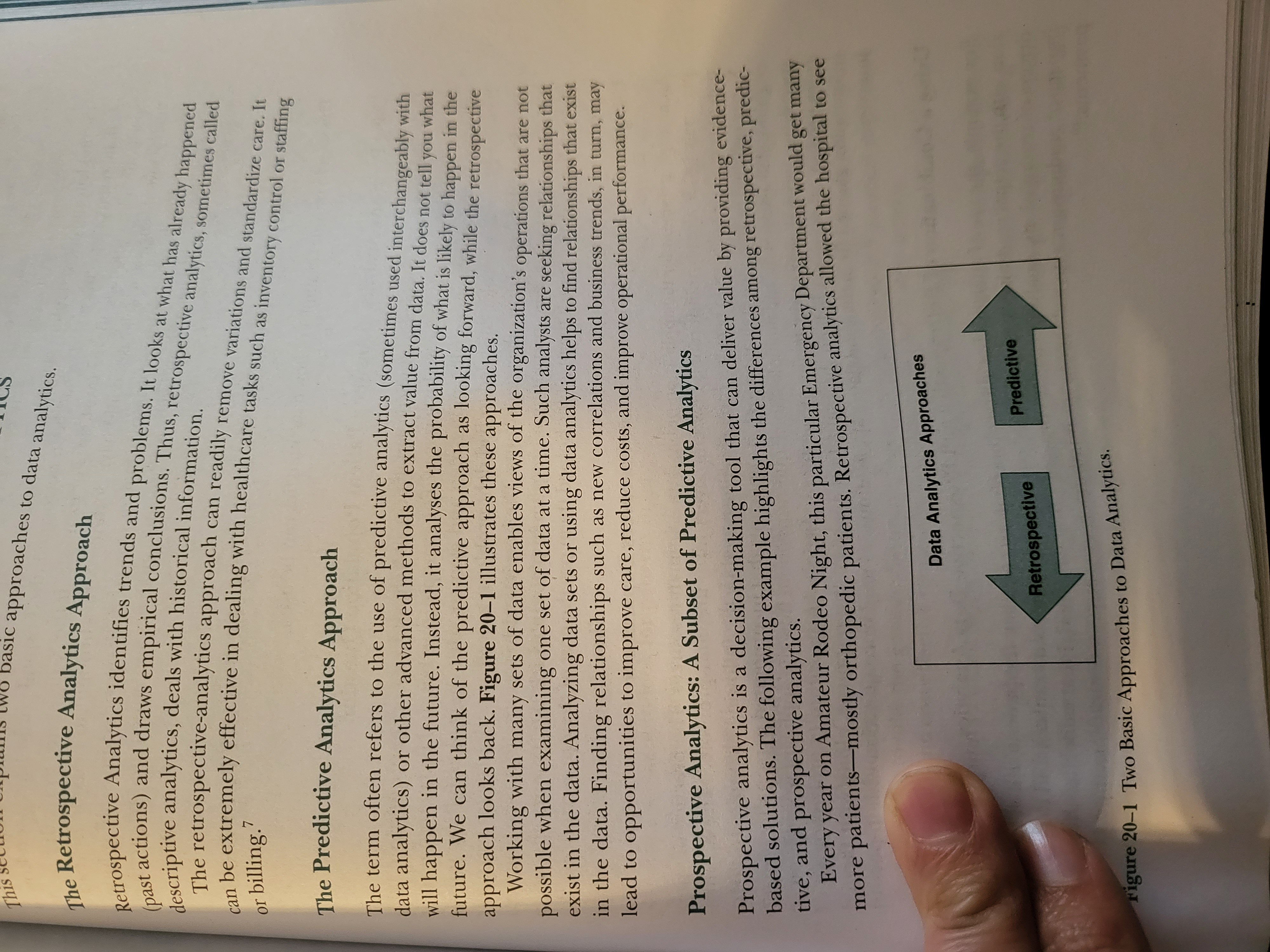
pter 21 567 are information (such as bed days, number of visits, payment amounts. that contains a list of no less than twelve numerical amounts. 9. Divide the list you have found into quartiles. things, 2. Enter your results on a worksheet with the highest quartile first and the lowest quartile last. Include an explanation of your computations. orrow ance CHAPTER 20 pare ment Assignment 20-1 ike? Study the chapter text that discusses retrospective versus predictive data analytics. Required 1. Locate an article that presents a healthcare study of some sort that has used data analytics. 2. Write a review of the article. Your review should identify whether retrospective or predic tive analytics have been used to obtain the study results. 3. If you had designed this study, would you have used the same type of analysis. If so, explain why. If not, explain why not. Assignment 20-2 text about big data, especially the section about big data in the healthcare Review the ~This s basic approaches to data analytics. The Retrospective Analytics Approach Retrospective Analytics identifies trends and problems. It looks at what has already happened (past actions) and draws empirical conclusions. Thus, retrospective analytics, sometimes called descriptive analytics, deals with historical information. The retrospective-analytics approach can readily remove variations and standardize care. It or billing. can be extremely effective in dealing with healthcare tasks such as inventory control or staffing The Predictive Analytics Approach The term often refers to the use of predictive analytics (sometimes used interchangeably with data analytics) or other advanced methods to extract value from data. It does not tell you what will happen in the future. Instead, it analyses the probability of what is likely to happen in the future. We can think of the predictive approach as looking forward, while the retrospective approach looks back. Figure 20-1 illustrates these approaches. Working with many sets of data enables views of the organization's operations that are not possible when examining one set of data at a time. Such analysts are seeking relationships that exist in the data. Analyzing data sets or using data analytics helps to find relationships that exist in the data. Finding relationships such as new correlations and business trends, in turn, may lead to opportunities to improve care, reduce costs, and improve operational performance. Prospective Analytics: A Subset of Predictive Analytics Prospective analytics is a decision-making tool that can deliver value by providing evidence- based solutions. The following example highlights the differences among retrospective, predict tive, and prospective analytics. Every year on Amateur Rodeo Night, this particular Emergency Department would get many more patients-mostly orthopedic patients. Retrospective analytics allowed the hospital to see Data Analytics Approaches Predictive Retrospective Figure 20-1 Two Basic Approaches to Data Analytics.236 CHAPTER 20 Understanding the Impact of Data Analytics and Big Data Using a how many patients were treated on Rodeo Saturday night compared to the previous 20 or 30 Saturday nights. In other words, retrospective analytics identified the ED's problem. Express Predictive analytics told the hospital what the likelihood was that it would need an increase in Express certain services that would be relevant to these emergency room injuries. (Needing, for exam ple, more X-rays, operating rooms, staff, etc.). In other words, predictive analytics anticipated data an flags to the problem and allowed future planning. It, however, prospective analytics had been performed, the hospital could have seen how to are con specifically adjust resources for the overload. For example, if the X-ray suites were all full, the clinical analytics would suggest which cases could have portable X-rays brought to bedside instead of fraud. 12 using the suites. In other words, prospective analytics would have provided possible solutions One to the problem that had been identified by retrospective analytics and anticipated by predictive the wif analytics. obtain codon DATA ANALYTICS AND HEALTHCARE ANALYTICS SERVE MANY PURPOSES several This section provides examples of how data analytics can be used. that p aware Using Predictive Analytics to Answer a Patient Population Question DAT From a demographic perspective, predictive analytics can help answer a primary question: Who are the most likely candidates for health services? For example, one hospital learned that their This self-pay population was split equally among men and women, with their ages falling mostly between 18 and 26 years old, which led to bad debt problems as well as patients who were less Wha compliant with their care than other age groups. The hospital addressed the issue starting with incentives to reduce bad debt and putting a program in place in which the patients agreed to The be compliant with their care if the provider helped them pay the cost of their prescriptions. 78 proc Using Predictive Analytics in the Human Resources Department How An emerging domain for the application of big data is human resources. The practice of "peo- ple analytics" is already transforming how employers hire, fire, and promote. The applica- By U tion of predictive analytics to people's careers is illustrated by the following example. In 2010, lear Xerox switched to an online evaluation for job applicants that incorporated personality testing, and cognitive-skill assessment, and multiple-choice questions about how the applicant would handle sets specific scenarios that he or she might encounter on the job. An algorithm (a process or set of interviews. rules used in calculations) behind the evaluation analyzed the responses, along with factual information gleaned from the candidate's application-as used in conjunction with in-person A Ke of Using a Combination of Retrospective and Prospective Data Analytics tha mc For example, the use of analytics has allowed hospitals to correlate the patient risk of readmis sion with the actual readmission rate, the total cost of readmission encounters, and the clinical An payments. 10 drivers of readmissions. Analytics can also provide a financial model that calculates the overall In impact of readmission rate reductions on reimbursement, cost, and value-based purchasing fu Work, connect battery zen' HP Fast Charge sor and driveor 30 ease in Using a Sophisticated Analytics Approach to Combat Prescription Drug Fraud Data Mining 237 exam- ipated Express Scripts, a national pharmacy benefit management organization, has created the Express Scripts Fraud, Waste, & Abuse Team. The team uses ".industry-leading, proprietary now to data analytics to uncover patterns of potential fraud or abuse, and scans for behavioral red all, the flags to identify when someone is involved in wrongdoing." The proprietary data analytics ead of are combined with Express Script's Health Decision Science platform (behavioral sciences, fraud . 12 utions clinical specialization, and actionable data) to identify 290 potential indicators of pharmacy dictive One case uncovered by the team involved a husband and wife. Over just eight months, the wife obtained over 2,800 tablets from 8 physicians and 5 pharmacies, while the husband obtained almost 4,000 tablets from 9 physicians and 12 pharmacies. The tablets included oxy- ES codone, Endocet, and hydrocodone. The team member goes on to say "..upon contacting several of the physicians we found that in several instances, the couple had signed agreements that prohibited obtaining narcotics from other doctors. However, none of the physicians was aware of the couple's visits to the others."14 DATA MINING n: Who This section defines data mining and provides examples of its use. at their mostly What Is Data Mining? ere less ng with The big data "revolution" encompasses yet another semantic variant: Data Mining. This is a reed to process used by organizations to turn raw data into useful information. Ons. 7-8 How Is Data Mining Used? By using software to look for patterns in large batches of data, healthcare organizations can learn more about their customers, develop effective marketing strategies, increase utilization, f "peo- and decrease costs. Data mining depends on effective data collection and working with many applica- sets of data in what is often called a data warehouse. n 2010, testing, A Hospital's Clinical Research Example of Data Mining handle A noteworthy application of data mining to clinical medicine is occurring at Memorial-Sloan r set of Kettering (MSK) Cancer Center in New York City. MSK scientists leverage the massive amount of data produced by tumor sequencing to learn more about the biology of cancer. 15 They use factual that leverage to take the genetic discoveries made through analysis and use them to produce -person more-precise and cost-effective treatments for people with cancer more quickly. Another Hospital's Patient Safety Research Example of Data Mining yet another example, Boston Children's Hospital has teamed with the nonprofit, federally guided MITRE Corporation research center to tackle patent surely issues. " In harnessing big readmis- boost patient safety, they are pulling data together from multiple sources-electronic clinical pull records, safety event reports, physiologic monitors, " togain insights into what may e overall have caused patient harm. chasing
Step by Step Solution
There are 3 Steps involved in it

Get step-by-step solutions from verified subject matter experts
 Study Help