







Question: Q. 2. A machine supports 16 bit instructions and has 32 general purpose registers. The machine supports the following types of instructions: (3+8+5 +4 20
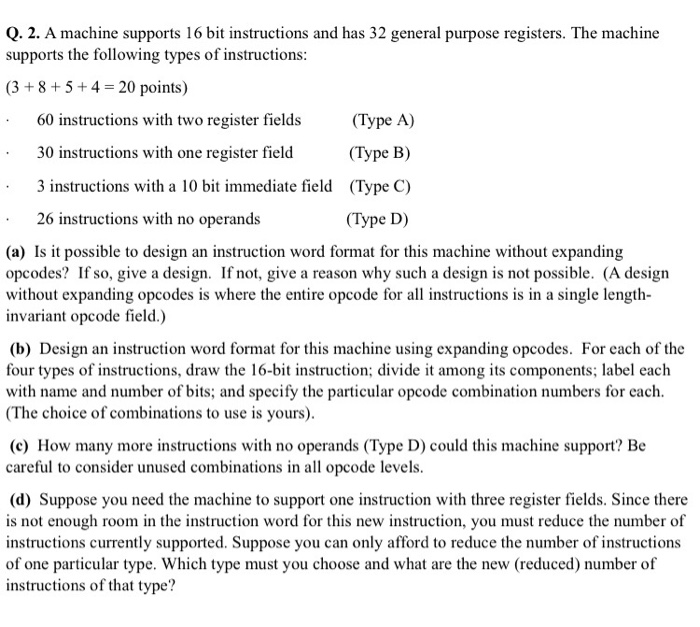
Q. 2. A machine supports 16 bit instructions and has 32 general purpose registers. The machine supports the following types of instructions: (3+8+5 +4 20 points) 0 instructions with two register fields(Type A) 0 instructions with one register field (Type B .3 instructions with a 10 bit immediate field (Type C) (Type D) 26 instructions with no operands (a) Is it possible to design an instruction word format for this machine without expanding opcodes? If so, give a design. Ifnot, give a reason why such a design is not possible. (A design without expanding opcodes is where the entire opcode for all instructions is in a single length- invariant opcode field.) (b) Design an instruction word format for this machine using expanding opcodes. For each of the four types of instructions, draw the 16-bit instruction divide it among its components; label each with name and number of bits; and specify the particular opcode combination numbers for cach. (The choice of combinations to use is yours). (c) How many more instructions with no operands (Type D) could this machine support? Be careful to consider unused combinations in all opcode levels. (d) Suppose you need the machine to support one instruction with three register fields. Since there is not enough room in the instruction word for this new instruction, you must reduce the number o instructions currently supported. Suppose you can only afford to reduce the number of instructions of one particular type. Which type must you choose and what are the new (reduced) number of instructions of that type
Step by Step Solution
There are 3 Steps involved in it

Get step-by-step solutions from verified subject matter experts
 Study Help