







Question: QUESTION 1 a ) Give an example of a distributed system. Explain why it is distributed and what advantage it has over a non -
QUESTION
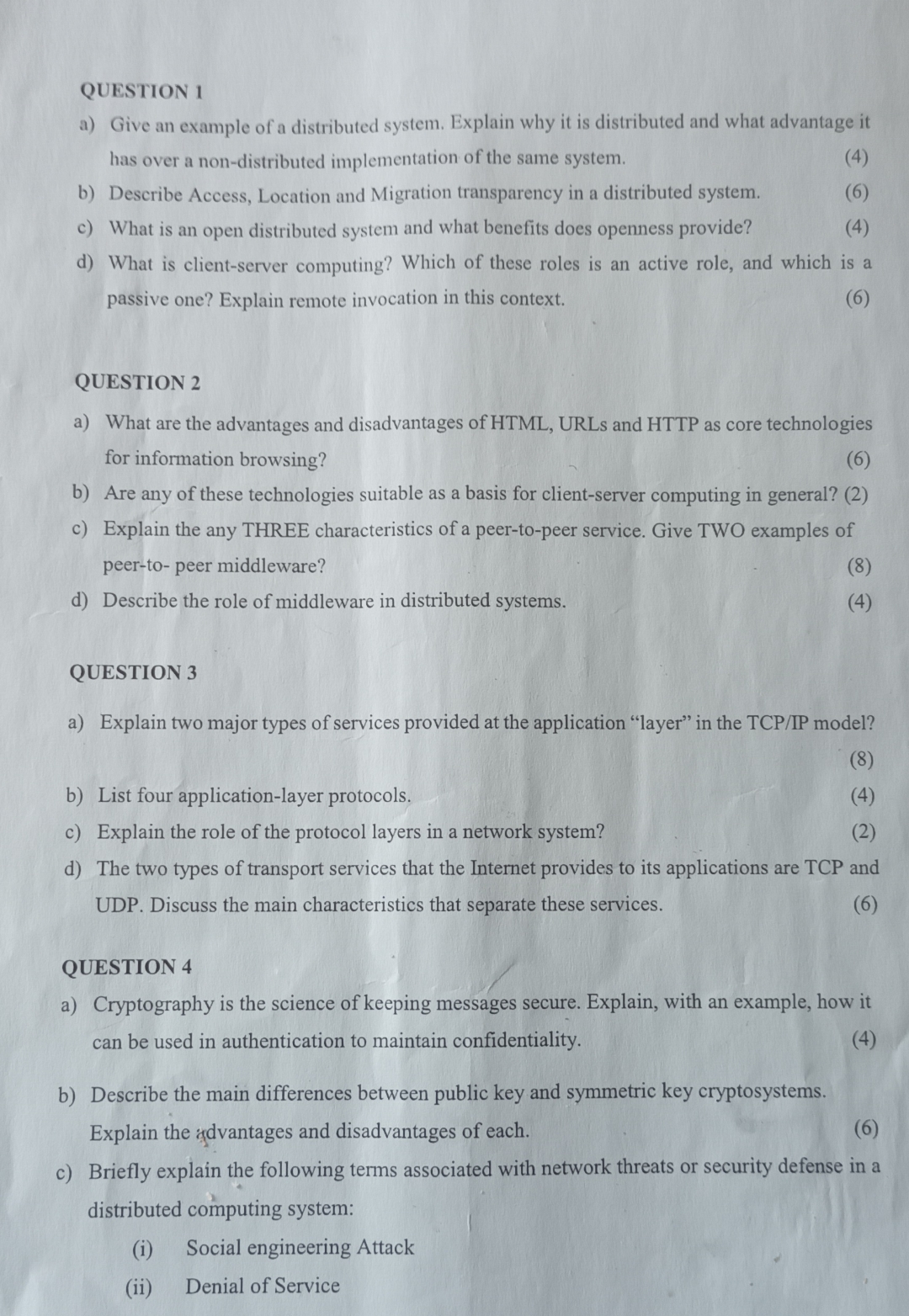
a Give an example of a distributed system. Explain why it is distributed and what advantage it has over a nondistributed implementation of the same system.
b Describe Access, Location and Migration transparency in a distributed system.
c What is an open distributed system and what benefits does openness provide?
d What is clientserver computing? Which of these roles is an active role, and which is a passive one? Explain remote invocation in this context.
QUESTION
a What are the advantages and disadvantages of HTML URLs and HTTP as core technologies for information browsing?
b Are any of these technologies suitable as a basis for clientserver computing in general?
c Explain the any THREE characteristics of a peertopeer service. Give TWO examples of peerto peer middleware?
d Describe the role of middleware in distributed systems.
QUESTION
a Explain two major types of services provided at the application "layer" in the TCPIP model?
b List four applicationlayer protocols.
c Explain the role of the protocol layers in a network system?
d The two types of transport services that the Internet provides to its applications are TCP and UDP. Discuss the main characteristics that separate these services.
QUESTION
a Cryptography is the science of keeping messages secure Explain, with an example, how it can be used in authentication to maintain confidentiality.
b Describe the main differences between public key and symmetric key cryptosystems. Explain the gdvantages and disadvantages of each.
c Briefly explain the following terms associated with network threats or security defense in a distributed computing system:
i Social engineering Attack
ii Denial of Service
Step by Step Solution
There are 3 Steps involved in it
1 Expert Approved Answer
Step: 1 Unlock

Question Has Been Solved by an Expert!
Get step-by-step solutions from verified subject matter experts
Step: 2 Unlock
Step: 3 Unlock
 Study Help