







Question: Question: (1) Write an example of Independently Testable Functions (ITF) in this specification (2) Identify the parameters and environment elements that are relevant to the
 Question: (1) Write an example of Independently Testable Functions (ITF) in this specification (2) Identify the parameters and environment elements that are relevant to the ITF. (3) work out characteristics of your parameters and environment elements. (4) Indentify value classes for each of your characteristics
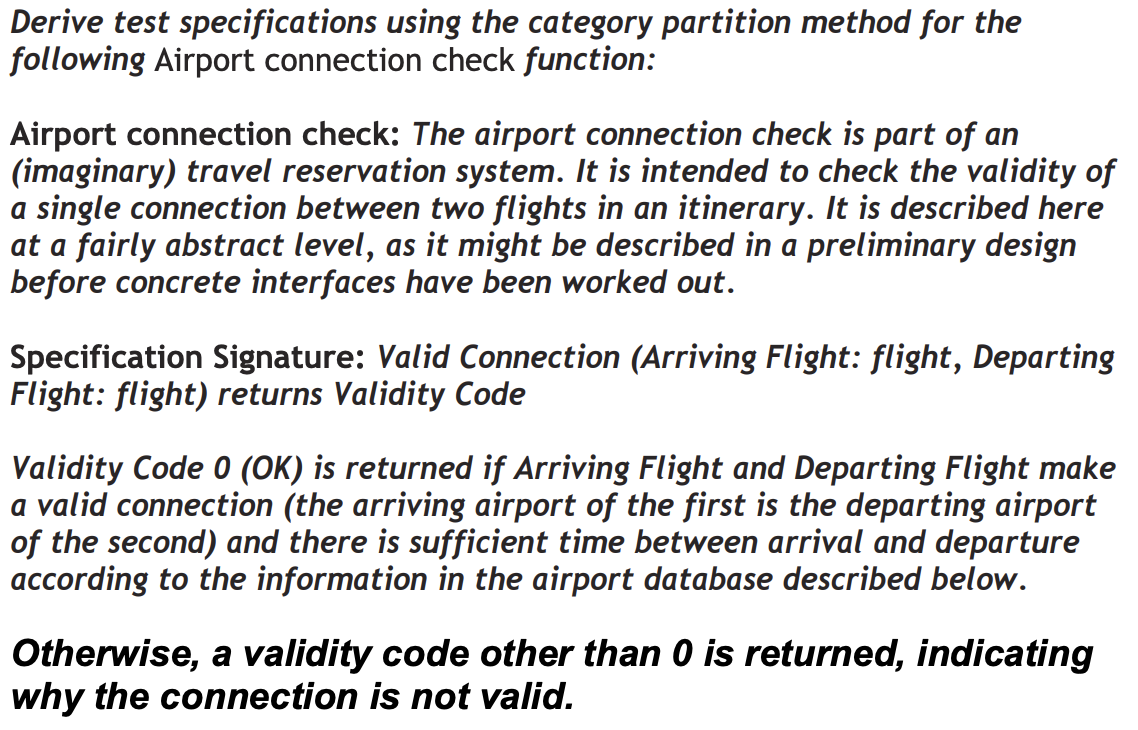
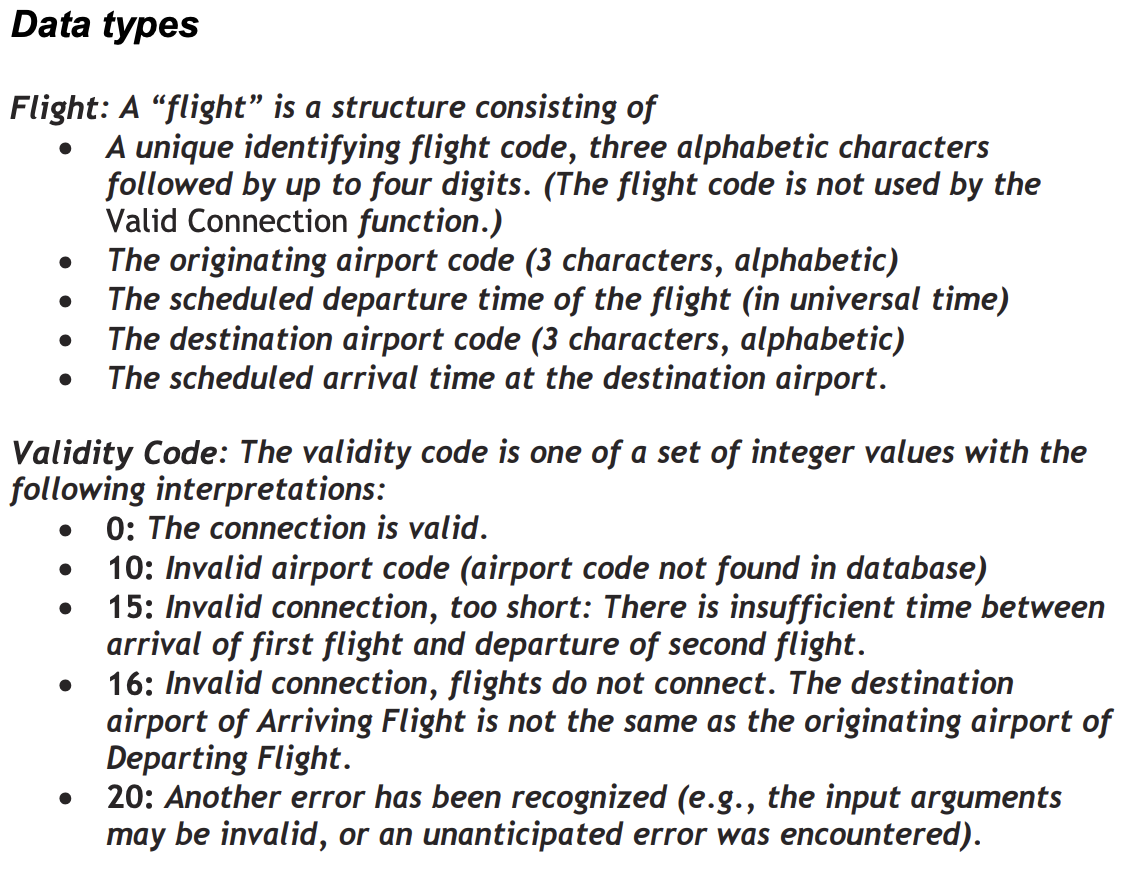
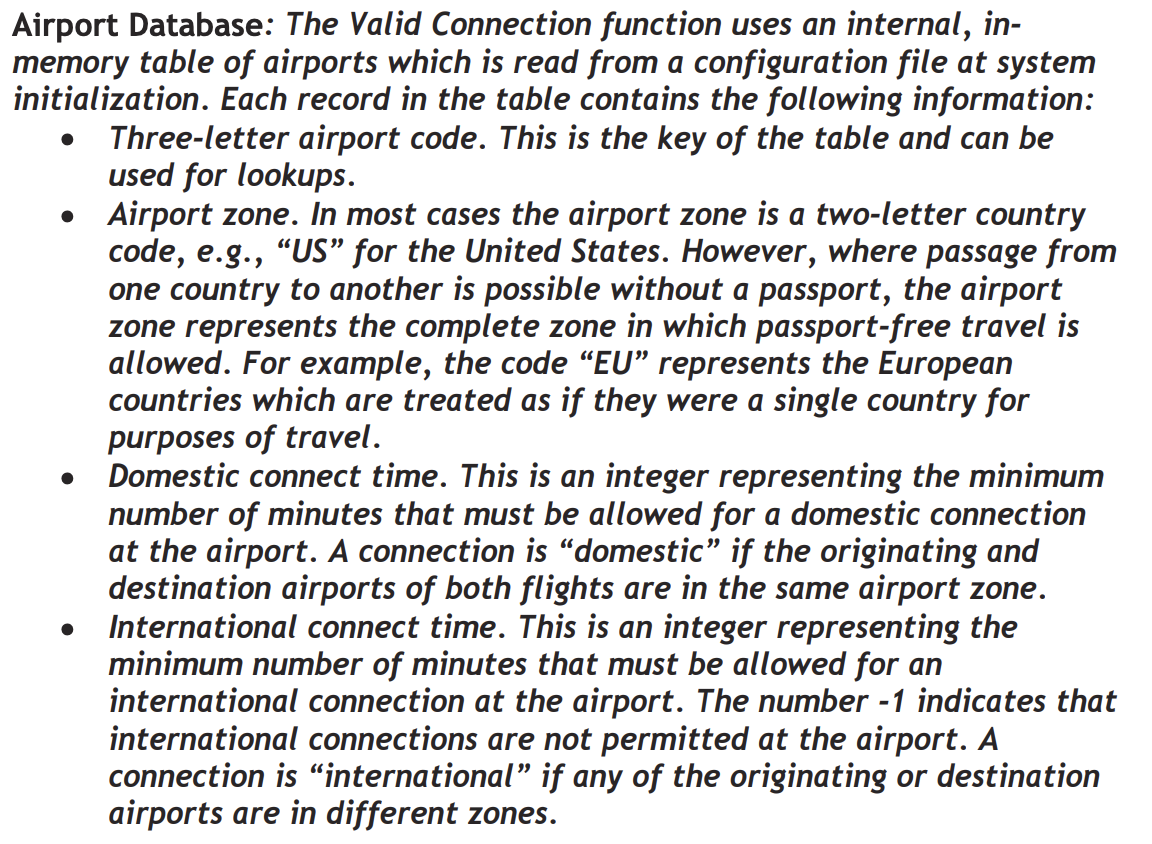
Derive test specifications using the category partition method for the following Airport connection check function: Airport connection check: The airport connection check is part of an (imaginary) travel reservation system. It is intended to check the validity of a single connection between two flights in an itinerary. It is described here at a fairly abstract level, as it might be described in a preliminary design before concrete interfaces have been worked out. Specification Signature: Valid Connection (Arriving Flight: flight, Departing Flight: flight) returns Validity Code Validity Code O (OK) is returned if Arriving Flight and Departing Flight make a valid connection (the arriving airport of the first is the departing airport of the second) and there is sufficient time between arrival and departure according to the information in the airport database described below. Otherwise, a validity code other than 0 is returned, indicating why the connection is not valid. Data types . Flight: A flight is a structure consisting of A unique identifying flight code, three alphabetic characters followed by up to four digits. (The flight code is not used by the Valid Connection function.) The originating airport code (3 characters, alphabetic) The scheduled departure time of the flight (in universal time) The destination airport code (3 characters, alphabetic) The scheduled arrival time at the destination airport. . . . . . Validity Code: The validity code is one of a set of integer values with the following interpretations: 0: The connection is valid. 10: Invalid airport code (airport code not found in database) 15: Invalid connection, too short: There is insufficient time between arrival of first flight and departure of second flight. 16: Invalid connection, flights do not connect. The destination airport of Arriving Flight is not the same as the originating airport of Departing Flight. 20: Another error has been recognized (e.g., the input arguments may be invalid, or an unanticipated error was encountered). . . . . Airport Database: The Valid Connection function uses an internal, in- memory table of airports which is read from a configuration file at system initialization. Each record in the table contains the following information: Three-letter airport code. This is the key of the table and can be used for lookups. Airport zone. In most cases the airport zone is a two-letter country code, e.g., US for the United States. However, where passage from one country to another is possible without a passport, the airport zone represents the complete zone in which passport-free travel is allowed. For example, the code EU represents the European countries which are treated as if they were a single country for purposes of travel. Domestic connect time. This is an integer representing the minimum number of minutes that must be allowed for a domestic connection at the airport. A connection is domestic if the originating and destination airports of both flights are in the same airport zone. International connect time. This is an integer representing the minimum number of minutes that must be allowed for an international connection at the airport. The number - 1 indicates that international connections are not permitted at the airport. A connection is international if any of the originating or destination airports are in different zones. . Derive test specifications using the category partition method for the following Airport connection check function: Airport connection check: The airport connection check is part of an (imaginary) travel reservation system. It is intended to check the validity of a single connection between two flights in an itinerary. It is described here at a fairly abstract level, as it might be described in a preliminary design before concrete interfaces have been worked out. Specification Signature: Valid Connection (Arriving Flight: flight, Departing Flight: flight) returns Validity Code Validity Code O (OK) is returned if Arriving Flight and Departing Flight make a valid connection (the arriving airport of the first is the departing airport of the second) and there is sufficient time between arrival and departure according to the information in the airport database described below. Otherwise, a validity code other than 0 is returned, indicating why the connection is not valid. Data types . Flight: A flight is a structure consisting of A unique identifying flight code, three alphabetic characters followed by up to four digits. (The flight code is not used by the Valid Connection function.) The originating airport code (3 characters, alphabetic) The scheduled departure time of the flight (in universal time) The destination airport code (3 characters, alphabetic) The scheduled arrival time at the destination airport. . . . . . Validity Code: The validity code is one of a set of integer values with the following interpretations: 0: The connection is valid. 10: Invalid airport code (airport code not found in database) 15: Invalid connection, too short: There is insufficient time between arrival of first flight and departure of second flight. 16: Invalid connection, flights do not connect. The destination airport of Arriving Flight is not the same as the originating airport of Departing Flight. 20: Another error has been recognized (e.g., the input arguments may be invalid, or an unanticipated error was encountered). . . . . Airport Database: The Valid Connection function uses an internal, in- memory table of airports which is read from a configuration file at system initialization. Each record in the table contains the following information: Three-letter airport code. This is the key of the table and can be used for lookups. Airport zone. In most cases the airport zone is a two-letter country code, e.g., US for the United States. However, where passage from one country to another is possible without a passport, the airport zone represents the complete zone in which passport-free travel is allowed. For example, the code EU represents the European countries which are treated as if they were a single country for purposes of travel. Domestic connect time. This is an integer representing the minimum number of minutes that must be allowed for a domestic connection at the airport. A connection is domestic if the originating and destination airports of both flights are in the same airport zone. International connect time. This is an integer representing the minimum number of minutes that must be allowed for an international connection at the airport. The number - 1 indicates that international connections are not permitted at the airport. A connection is international if any of the originating or destination airports are in different zones
Step by Step Solution
There are 3 Steps involved in it

Get step-by-step solutions from verified subject matter experts
 Study Help