



Question: Question 3) a) Explain the Bragg's law and necessary conditions for constructive interference (5 pts); b) Determine the expected diffraction angle (' ) for the
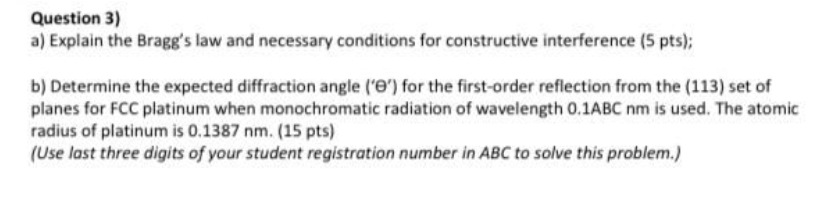
Question 3) a) Explain the Bragg's law and necessary conditions for constructive interference (5 pts); b) Determine the expected diffraction angle (' ) for the first-order reflection from the (113) set of planes for FCC platinum when monochromatic radiation of wavelength 0.1ABCnm is used. The atomic radius of platinum is 0.1387nm. (15 pts) (Use last three digits of your student registration number in ABC to solve this problem.) Question 3) a) Explain the Bragg's law and necessary conditions for constructive interference (5 pts); b) Determine the expected diffraction angle (' ) for the first-order reflection from the (113) set of planes for FCC platinum when monochromatic radiation of wavelength 0.1ABCnm is used. The atomic radius of platinum is 0.1387nm. (15 pts) (Use last three digits of your student registration number in ABC to solve this problem.)
Step by Step Solution
There are 3 Steps involved in it

Get step-by-step solutions from verified subject matter experts