







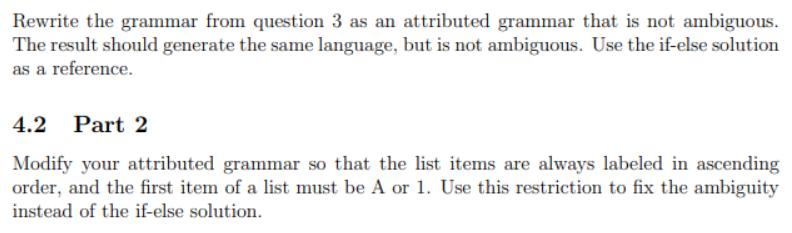
Question: ? ?? Rewrite the grammar from question 3 as an attributed grammar that is not ambiguous. The result should generate the same language, but is
? ??
??
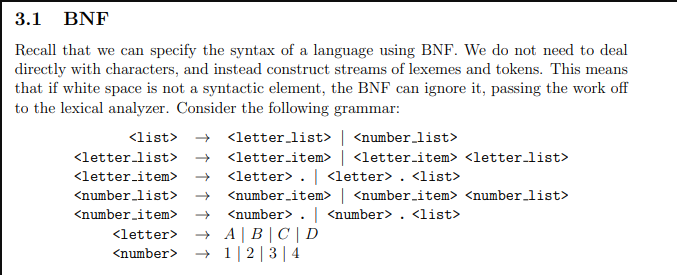
Rewrite the grammar from question 3 as an attributed grammar that is not ambiguous. The result should generate the same language, but is not ambiguous. Use the if-else solution as a reference. 4.2 Part 2 Modify your attributed grammar so that the list items are always labeled in ascending order, and the first item of a list must be A or 1. Use this restriction to fix the ambiguity instead of the if-else solution. 3.1 BNF Recall that we can specify the syntax of a language using BNF. We do not need to deal directly with characters, and instead construct streams of lexemes and tokens. This means that if white space is not a syntactic element, the BNF can ignore it, passing the work off to the lexical analyzer. Consider the following grammar: | . . | . . A|B|C| D 1 | 2 | 3 | 4
Step by Step Solution
3.42 Rating (155 Votes )
There are 3 Steps involved in it
To address the problem we need to rewrite the given BNF grammar as an unambiguous attributed grammar ... View full answer

Get step-by-step solutions from verified subject matter experts
 Study Help