







Question: Question 4 (20 points) Consider two transactions T and U on simple integer objects i and j: T:r = read(); write(), 33); U : write(3,
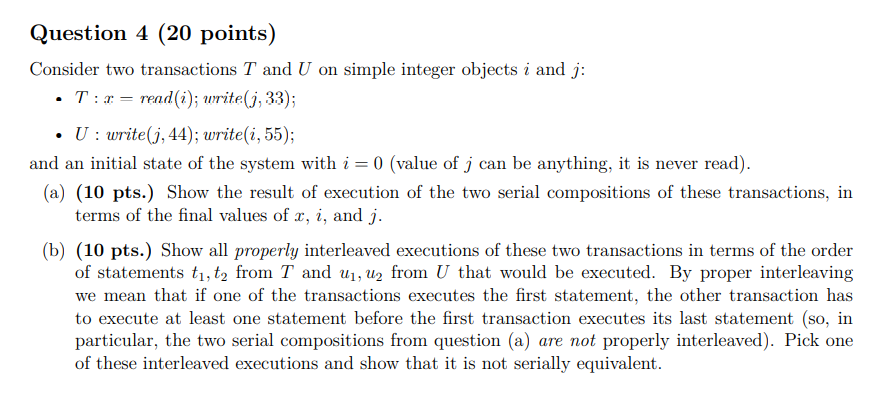
Question 4 (20 points) Consider two transactions T and U on simple integer objects i and j: T:r = read(); write(), 33); U : write(3, 44); writei, 55); and an initial state of the system with i = 0 (value of j can be anything, it is never read). (a) (10 pts.) Show the result of execution of the two serial compositions of these transactions, in terms of the final values of x, i, and j. (b) (10 pts.) Show all properly interleaved executions of these two transactions in terms of the order of statements t, tfrom T and u1, U2 from U that would be executed. By proper interleaving we mean that if one of the transactions executes the first statement, the other transaction has to execute at least one statement before the first transaction executes its last statement (so, in particular, the two serial compositions from question (a) are not properly interleaved). Pick one of these interleaved executions and show that it is not serially equivalent
Step by Step Solution
There are 3 Steps involved in it
To solve this we need to evaluate the serial and interleaved execution of transactions T and U Here ... View full answer

Get step-by-step solutions from verified subject matter experts
 Study Help