







Question: Question As you read in the Article 4 CRM done right, EXPLAIN (in your own words) how the appropriate CRM system/technology-modules & CRM initiatives were
Question
As you read in the Article 4 CRM done right, EXPLAIN (in your own words) how the appropriate CRM system/technology-modules & CRM initiatives were implemented by the following firms (given in the article) for their respective business progression:
* Aviall
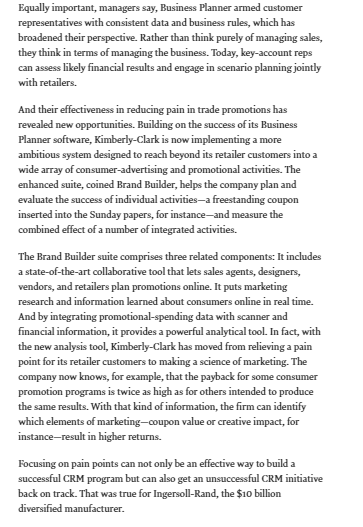
* Kimberly-Clark
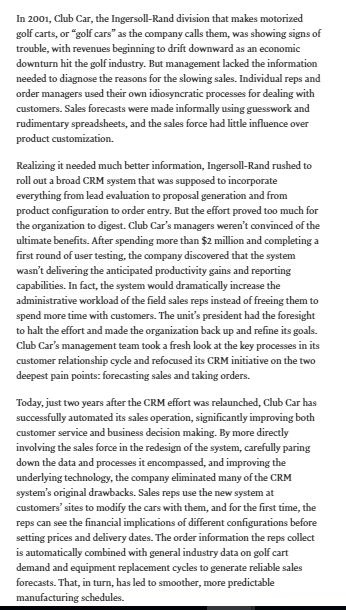
* Ingersoll-Rand
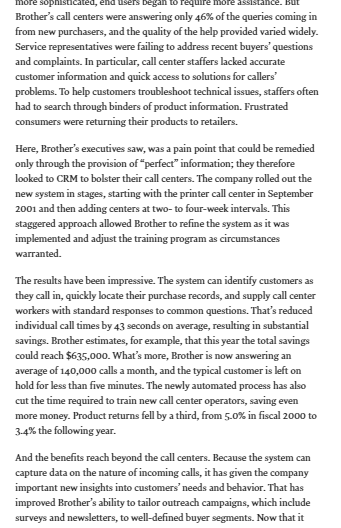
* Brother-International
* Molex
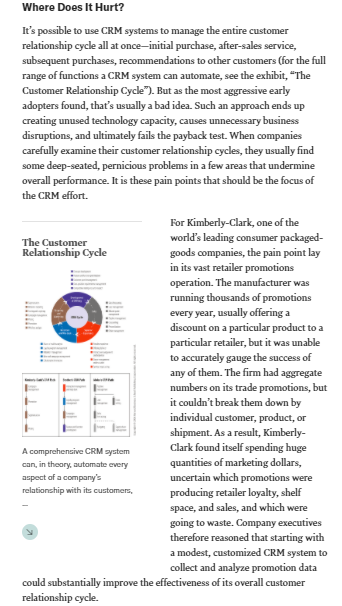
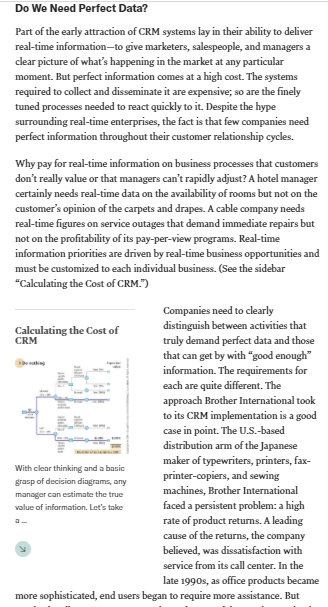
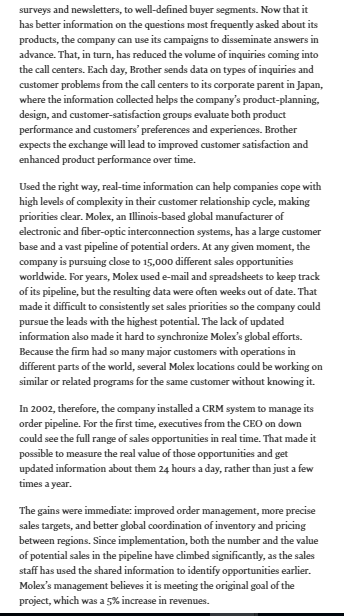
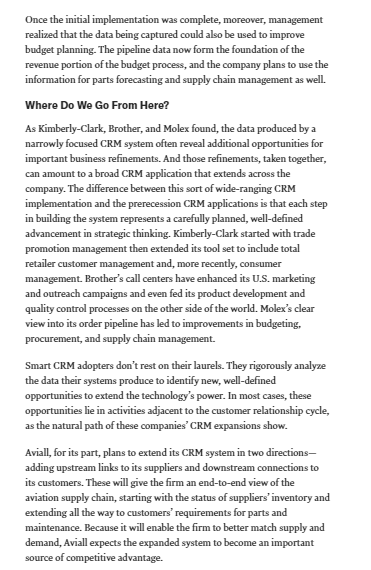
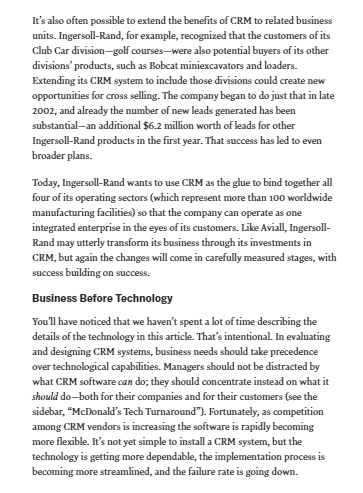
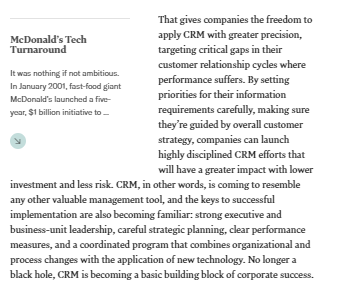
Marketing CRM Done Right by Dianne Ledingham and Darrell K. Rigby From the Magazine (November 2004) Ssas W PRESCRIBE BETTER.DATA Summary. Disappointed by the high costs and elusive benefits, early adopters of customer relationship management systems came, in the post dot-com era, to view the technology as just another overhyped IT investment whose initial promise would never be fulfilled. But this year, something unexpected is happening. System sales are rising, and executives are reporting satisfaction with their CRM investments. What's changed? A wide range of companies are successfully taking a pragmatic, disciplined approach to CRM. Rather than use it to transform entire businesses, they've directed their investments toward solving clearly defined problems within their customer relationship cycle. The authors have distilled the experiences of these CRM leaders into four questions that all companies should ask themselves as they launch their own CRM initiatives: Is the problem strategic? Is the system focused on the pain point? Do we need perfect data? What's the right way to expand an initial implementation? The questions reflect a new realism about when and how to deploy CRM to best advantage. Understanding that highly accurate and timely data are not required everywhere in their businesses, CRM leaders have tailored their real-time initiatives to those customer relationships that can be significantly enhanced by "perfect information. Once they've succeeded with their first targeted CRM project, they can use it as a springboard for solving additional problems. CRM, in other words, is coming to resemble any other valuable management tool, and the keys to successful implementation are also becoming familiar: strong executive and business-unit leadership, careful strategic planning, clear performance measures, and a coordinated program that combines organizational and process changes with the application of new technology The successful users have also exhibited a healthy skepticism, discounting overblown claims that the ultimate payback from a CRM system is the creation of a "real-time enterprise." Understanding that highly accurate and timely data are not required everywhere in their businesses, they've tailored their real-time CRM initiatives to those parts of their customer relationships that truly do depend on perfect" information. Once they've succeeded with the smaller, more-targeted CRM project, they've used their initial investments as springboards for solving additional problems. We've distilled the experiences of the CRM leaders into four questions that all companies should ask themselves as they launch their CRM initiatives: Is it strategic? Where does it hurt? Do we need perfect data? Where do we go from here? The questions reflect a new realism about when and how to deploy CRM to its best advantage. When Darrell Rigby, Fred Reichheld, and Phil Schefter took stock of CRM's effectiveness in these pages nearly three years ago Gin "Avoid the Four Perils of CRM," February 2002), lots of companies were still placing big bets that the technology would pay off- somehow. Lacking clear customer strategies and the organizational structures to support them, many firms got burned and grew distrustful of CRM. The difficult lessons such organizations learned have led them to sharpen their customer strategies, setting the stage for real gains from more-focused CRM applications. In this article, we'll show how several companies have implemented successful CRM efforts-aircraft parts distributor Aviall, consumer product giant Kimberly-Clark, diversified equipment maker Ingersoll- Rand, home and office-machine company Brother International, and electronic connector manufacturer Molex. We'll also lay out some basic considerations that can help firms determine which CRM projects are likely to yield the most value. Is It Strategic? There's no getting around it: A CRM program involves complicated business and technology issues and requires significant investments of time and money.CRM is not a tool for buffing a company's performance at the edges, it should be applied only to processes vital to a company's competitivenessthose that can distance a firm from its competitors or keep a function (such as call center response time) on par with the rest of the industry when parity counts. If the target is not truly strategic, the organization will be hard-pressed to summon the vigor necessary to tackle entrenched business processes or retool its organizational structure and garner expected returns. Before spending a dime on CRM, therefore, executives need to make sure they have the right targets in their sights. Paul Fulchino knew the stakes involved when he brought CRM into Aviall after being appointed CEO in 2000. Fulchino had ambitious plans to transform the Dallas-based distributor of aircraft parts into the premier vendor of supply chain management services to the aviation industry. By becoming the preferred partner of both the big original equipment manufacturers (OEMs) and the commercial and military fleet owners, Aviall could consolidate customer demand and extend its reach worldwide, which would reinvigorate its sales and strengthen its margins. But Fulchino faced a daunting obstacle to realizing his vision: Poor information and cumbersome processes hampered the company's sales and service operation. Difficulties with an existing IT system had increased sales reps' workloads, sometimes keeping salespeople trapped in local branches, helping managers input order information instead of making sales calls. What's more, the company hadn't trained the sales reps in proper time and territory management, which led to inefficient phone call routing and haphazard calling schedules. Customer inquiries were often routed to distant call centers that lacked up-to-date data on orders, products, and prices. The weak customer service left key accounts vulnerable to competitors' attacks and undermined the company's ability to charge the premium prices typically associated with flawless product delivery. A better- trained and more proactive sales force was a strategic necessity. Without one, Fulchino's aggressive plans for the company would go unfulfilled. So the new CEO, working closely with his sales and marketing head, Jim Quinn, and his technology chief, Joe Lacik, dedicated Aviall's initial CRM outlays to this critical challenge. Rather than attempt a full-scale implementation of a broad CRM program, the executives took a more focused approach, installing only the sales force, order entry, and call center applications to begin with. Their goal was to coordinate customer information seamlessly from the outside sales agents, first to the inside sales support staff, then to the customer service representatives who were manning the company's 36 regional call centers. The relatively narrow focus allowed the sales force to become familiar with the system without being overwhelmed and delivered quick victories that helped win broader management and line support and gather momentum behind the project. The gains were striking. Before having the CRM system, the sales force relied on an outmoded database for managing client information. The system's inflexibility made it difficult for sales and service staffers to get even basic information on a customer's order history and credit status. "There's nothing more frustrating than having a customer spend 15 minutes on an order and then realizing at the very end that there's a credit issue," says Lacik. "In the old system, credit problems didn't get flagged until you tried to place the order. Then the credit group would be called in, and you either had to have the customer on hold for a long time or call them back. In our business, there's a moment of truth: You have to have the right product, the right information, and the right price. If you don't have those three things put together, you lose the call-and if you lose the call, 90% of the time you lose the sale. With the new system, a customer's credit history instantly popped up on the order screen. The rich information the new system provided allowed Jim Quinn to flip a switch in the sales force. It helped the agents get organized and spurred them to make more customer calls, knowing they could immediately deliver firm quotes on tailored sets of products or services. Placing an order had once required them to go through 11 screens and nearly 50 steps, now they could do it with one screen and ten steps. Just four months into rolling out the CRM system, the number of daily sales calls tripled, and the customer base grew by 33%. In fact, the productivity of the entire sales and service operation skyrocketed, helping Aviall recapture market share and win large orders for new product lines. The number of orders handled per day jumped from 1,000 to 2,500, even as error rates declined, with no increase in staff. It's possible to use CRM systems to manage the entire customer relationship cycle, but that's usually a bad idea. The expanded capacity, together with the improvements in service, have built the platform the company needed to reshape itself as a full-service provider of aviation logistics support. Aviall's sales and profits have grown rapidly, and it has steadily stolen market share from competitors. In a testament to Aviall's success, engine maker Rolls-Royce recently awarded the firm a ten-year supply contract worth $3 billionthe largest deal ever struck by any company in the industry. Says CIO Lacik "We showed Rolls-Royce the level of visibility we had into our customer base -visibility that we could share with them to give them a deeper understanding of customer buying trends and behavior...A simple analysis showed Rolls-Royce that it had several years' worth of supply in some products while being understocked in others because it was not matching manufacturing adequately with customer demand. That was a pivotal moment in winning the contract." Tightly focused on a single area of critical strategic importance, CRM has become a linchpin of Aviall's reinvention Where Does It Hurt? It's possible to use CRM systems to manage the entire customer relationship cycle all at once-initial purchase, after-sales service, subsequent purchases, recommendations to other customers (for the full range of functions a CRM system can automate, see the exhibit, "The Customer Relationship Cycle"). But as the most aggressive early adopters found that's usually a bad idea. Such an approach ends up creating unused technology capacity, causes unnecessary business disruptions, and ultimately fails the payback test. When companies carefully examine their customer relationship cycles, they usually find some deep-seated, pernicious problems in a few areas that undermine overall performance. It is these pain points that should be the focus of the CRM effort. For Kimberly-Clark, one of the The Customer world's leading consumer packaged- Relationship Cycle goods companies, the pain point lay in its vast retailer promotions operation. The manufacturer was running thousands of promotions every year, usually offering a discount on a particular product to a particular retailer, but it was unable to accurately gauge the success of any of them. The firm had aggregate numbers on its trade promotions, but it couldn't break them down by individual customer, product, or shipment. As a result, Kimberly- A comprehensive CRM system Clark found itself spending huge can, in theory, automate every quantities of marketing dollars, aspect of a company's uncertain which promotions were relationship with its customers, producing retailer loyalty, shelf space, and sales, and which were going to waste. Company executives therefore reasoned that starting with a modest, customized CRM system to collect and analyze promotion data could substantially improve the effectiveness of its overall customer relationship cycle. Kimberly-Clark started by building Routine Aches Versus onto an existing software program Strategic Pain Points for account management, called Profit Calculator, which its sales department had developed to track investments in individual promotion efforts. By integrating that with shipment data, the enhanced system could go beyond just providing general information about whether ROI was positive or negative. It could more precisely measure the impact of Doctors commonly distinguish a particular promotion on sales and profits for both Kimberly-Clark and between routine aches ("Take two aspirin and call me in the its retailer customers. Says Bruce morning and perilous pains - Paynter, Kimberly-Clark's vice president for customer development: "Now we can see what the real-time impact on our sales and profit is when running promotions Moreover, we can integrate this information into our sales and planning process with our customer. Renamed Business Planner, the software became the heart of the company's sales and marketing efforts: salespeople used the tool in the field to design promotional packages for specific retailers, while the company's marketing staff used it to plot broader promotion plans. Rolled out to all of Kimberly-Clark's businesses in 2000, and supported by intensive training programs led by the organization's top executives, Business Planner rapidly proved a success. In its first year, the system was used to manage more than 2,300 promotional events involving all of the company's U.S.consumer product lines. "We applied real-time promotional-lift models (models of just how much a given promotion can lift sales) at the market, customer, and category level to aid our planning efforts with customers," Paynter says. "Using the knowledge gained through the Business Planner, we have been able to redirect $30 million in marketing spending across all our U.S.consumer businesses to drive incremental sales and profit and further build brand for our customers and Kimberly-Clark." Equally important, managers say, Business Planner armed customer representatives with consistent data and business rules, which has broadened their perspective. Rather than think purely of managing sales, they think in terms of managing the business. Today, key-account reps can assess likely financial results and engage in scenario planning jointly with retailers. And their effectiveness in reducing pain in trade promotions has revealed new opportunities. Building on the success of its Business Planner software, Kimberly-Clark is now implementing a more ambitious system designed to reach beyond its retailer customers into a wide array of consumer-advertising and promotional activities. The enhanced suite, coined Brand Builder, helps the company plan and evaluate the success of individual activitiesa freestanding coupon inserted into the Sunday papers, for instanceand measure the combined effect of a number of integrated activities. The Brand Builder suite comprises three related components: It includes a state-of-the-art collaborative tool that lets sales agents, designers, vendors, and retailers plan promotions online. It puts marketing research and information learned about consumers online in real time. And by integrating promotional-spending data with scanner and financial information, it provides a powerful analytical tool. In fact, with the new analysis tool, Kimberly-Clark has moved from relieving a pain point for its retailer customers to making a science of marketing. The company now knows, for example, that the payback for some consumer promotion programs is twice as high as for others intended to produce the same results. With that kind of information, the firm can identify which elements of marketing-coupon value or creative impact, for instance-result in higher returns. Focusing on pain points can not only be an effective way to build a successful CRM program but can also get an unsuccessful CRM initiative back on track. That was true for Ingersoll-Rand, the $10 billion diversified manufacturer. Do We Need Perfect Data? Part of the early attraction of CRM systems lay in their ability to deliver real-time information-to give marketers, salespeople, and managers a clear picture of what's happening in the market at any particular moment. But perfect information comes at a high cost. The systems required to collect and disseminate it are expensive, so are the finely tuned processes needed to react quickly to it. Despite the hype surrounding real-time enterprises, the fact is that few companies need perfect information throughout their customer relationship cycles. Why pay for real-time information on business processes that customers don't really value or that managers can't rapidly adjust? A hotel manager certainly needs real-time data on the availability of rooms but not on the customer's opinion of the carpets and drapes. A cable company needs real-time figures on service outages that demand immediate repairs but not on the profitability of its pay-per-view programs. Real-time information priorities are driven by real-time business opportunities and must be customized to each individual business. (See the sidebar "Calculating the Cost of CRM.") Companies need to clearly Calculating the Cost of distinguish between activities that truly demand perfect data and those that can get by with "good enough" information. The requirements for each are quite different. The approach Brother International took to its CRM implementation is a good case in point. The U.S.-based distribution arm of the Japanese maker of typewriters, printers, fax- With clear thinking and a basic grasp of decision diagrams, any printer-copiers, and sewing machines, Brother International value of information. Let's take faced a persistent problem: a high rate of product returns. A leading cause of the returns, the company believed, was dissatisfaction with service from its call center. In the late 1990s, as office products became more sophisticated, end users began to require more assistance. But CRM manager can estimate the true Buu more sophisticated, end users began Brother's call centers were answering only 46% of the queries coming in from new purchasers, and the quality of the help provided varied widely. Service representatives were failing to address recent buyers' questions and complaints. In particular, call center staffers lacked accurate customer information and quick access to solutions for callers problems. To help customers troubleshoot technical issues, staffers often had to search through binders of product information. Frustrated consumers were returning their products to retailers. Here, Brother's executives saw, was a pain point that could be remedied only through the provision of perfect information; they therefore looked to CRM to bolster their call centers. The company rolled out the new system in stages, starting with the printer call center in September 2001 and then adding centers at two-to four-week intervals. This staggered approach allowed Brother to refine the system as it was implemented and adjust the training program as circumstances warranted. The results have been impressive. The system can identify customers as they call in, quickly locate their purchase records, and supply call center workers with standard responses to common questions. That's reduced individual call times by 43 seconds on average, resulting in substantial savings. Brother estimates, for example, that this year the total savings could reach $635,000. What's more, Brother is now answering an average of 140,000 calls a month, and the typical customer is left on hold for less than five minutes. The newly automated process has also cut the time required to train new call center operators, saving even more money. Product returns fell by a third, from 5.0% in fiscal 2000 to 3.4% the following year. And the benefits reach beyond the call centers. Because the system can capture data on the nature of incoming calls, it has given the company important new insights into customers' needs and behavior. That has improved Brother's ability to tailor outreach campaigns, which include surveys and newsletters, to well-defined buyer segments. Now that it surveys and newsletters, to well-defined buyer segments. Now that it has better information on the questions most frequently asked about its products, the company can use its campaigns to disseminate answers in advance. That, in turn, has reduced the volume of inquiries coming into the call centers. Each day, Brother sends data on types of inquiries and customer problems from the call centers to its corporate parent in Japan, where the information collected helps the company's product-planning, design, and customer-satisfaction groups evaluate both product performance and customers' preferences and experiences. Brother expects the exchange will lead to improved customer satisfaction and enhanced product performance over time. Used the right way, real-time information can help companies cope with high levels of complexity in their customer relationship cycle, making priorities clear. Molex, an Illinois-based global manufacturer of electronic and fiber-optic interconnection systems, has a large customer base and a vast pipeline of potential orders. At any given moment, the company is pursuing close to 15,000 different sales opportunities worldwide. For years, Molex used e-mail and spreadsheets to keep track of its pipeline, but the resulting data were often weeks out of date. That made it difficult to consistently set sales priorities so the company could pursue the leads with the highest potential. The lack of updated information also made it hard to synchronize Molex's global efforts. Because the firm had so many major customers with operations in different parts of the world, several Molex locations could be working on similar or related programs for the same customer without knowing it. In 2002, therefore, the company installed a CRM system to manage its order pipeline. For the first time, executives from the CEO on down could see the full range of sales opportunities in real time. That made it possible to measure the real value of those opportunities and get updated information about them 24 hours a day, rather than just a few times a year. The gains were immediate improved order management, more precise sales targets, and better global coordination of inventory and pricing between regions. Since implementation, both the number and the value of potential sales in the pipeline have climbed significantly, as the sales staff has used the shared information to identify opportunities earlier. Molex's management believes it is meeting the original goal of the project, which was a 5% increase in revenues. It's also often possible to extend the benefits of CRM to related business units. Ingersoll-Rand, for example, recognized that the customers of its Club Car division-golf courses-were also potential buyers of its other divisions' products, such as Bobcat miniexcavators and loaders. Extending its CRM system to include those divisions could create new opportunities for cross selling. The company began to do just that in late 2002, and already the number of new leads generated has been substantialan additional $6.2 million worth of leads for other Ingersoll-Rand products in the first year. That success has led to even broader plans. Today, Ingersoll-Rand wants to use CRM as the glue to bind together all four of its operating sectors (which represent more than 100 worldwide manufacturing facilities) so that the company can operate as one integrated enterprise in the eyes of its customers. Like Aviall, Ingersoll- Rand may utterly transform its business through its investments in CRM, but again the changes will come in carefully measured stages, with success building on success. Business Before Technology You'll have noticed that we haven't spent a lot of time describing the details of the technology in this article. That's intentional. In evaluating and designing CRM systems, business needs should take precedence over technological capabilities. Managers should not be distracted by what CRM software can do, they should concentrate instead on what it should do-both for their companies and for their customers (see the sidebar, McDonald's Tech Turnaround). Fortunately, as competition among CRM vendors is increasing the software is rapidly becoming more flexible. It's not yet simple to install a CRM system, but the technology is getting more dependable, the implementation process is becoming more streamlined, and the failure rate is going down. That gives companies the freedom to McDonald's Tech apply CRM with greater precision, Turnaround targeting critical gaps in their customer relationship cycles where It was nothing if not ambitious. In January 2001, fast-food giant performance suffers. By setting McDonald's launched a five- priorities for their information year, $1 billion initiative to requirements carefully, making sure they're guided by overall customer strategy, companies can launch highly disciplined CRM efforts that will have a greater impact with lower investment and less risk CRM, in other words, is coming to resemble any other valuable management tool, and the keys to successful implementation are also becoming familiar: strong executive and business-unit leadership, careful strategic planning, clear performance measures, and a coordinated program that combines organizational and process changes with the application of new technology. No longer a black hole, CRM is becoming a basic building block of corporate successStep by Step Solution
There are 3 Steps involved in it
1 Expert Approved Answer
Step: 1 Unlock

Question Has Been Solved by an Expert!
Get step-by-step solutions from verified subject matter experts
Step: 2 Unlock
Step: 3 Unlock
 Study Help