







Question: Question B Many materials have to operate at elevated temperatures - e.g. in turbines, pipes for steam, reactors etc. In practice, materials that are stable
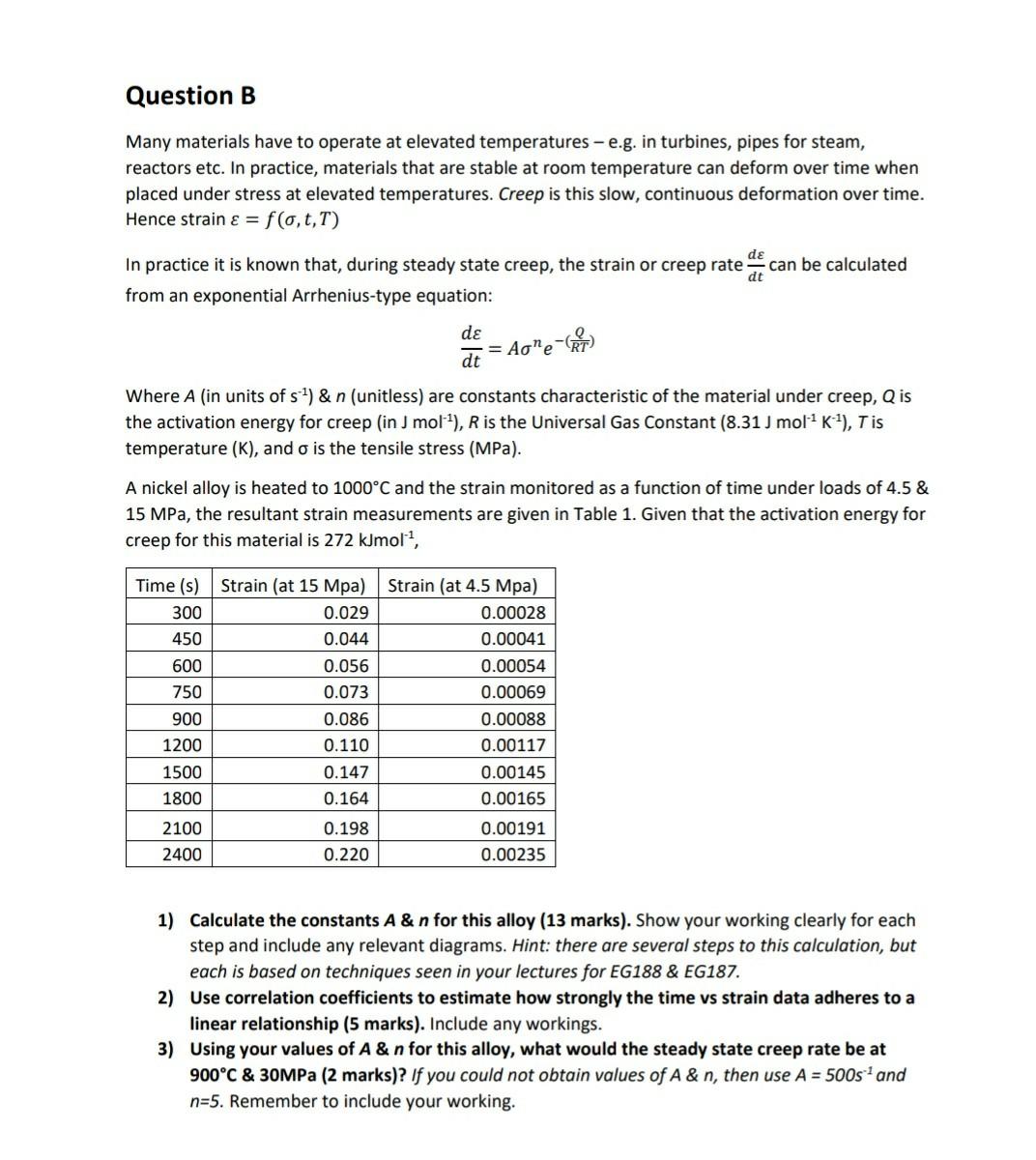
Question B Many materials have to operate at elevated temperatures - e.g. in turbines, pipes for steam, reactors etc. In practice, materials that are stable at room temperature can deform over time when placed under stress at elevated temperatures. Creep is this slow, continuous deformation over time. Hence strain = f(0, t,T) In practice it is known that, during steady state creep, the strain or creep rate e can be calculated dt from an exponential Arrhenius-type equation: de dt = Aone- Where A (in units of s') & n (unitless) are constants characteristic of the material under creep, Q is the activation energy for creep in J mol), R is the Universal Gas Constant (8.31 ) mol- K), T is temperature (K), and o is the tensile stress (MPa). A nickel alloy is heated to 1000C and the strain monitored as a function of time under loads of 4.5 & 15 MPa, the resultant strain measurements are given in Table 1. Given that the activation energy for creep for this material is 272 kJmoll, Time (s) 300 450 600 750 900 1200 Strain (at 15 Mpa) Strain (at 4.5 Mpa) 0.029 0.00028 0.044 0.00041 0.056 0.00054 0.073 0.00069 0.086 0.00088 0.110 0.00117 0.147 0.00145 0.164 0.00165 1500 1800 2100 2400 0.198 0.220 0.00191 0.00235 1) Calculate the constants A & n for this alloy (13 marks). Show your working clearly for each step and include any relevant diagrams. Hint: there are several steps to this calculation, but each is based on techniques seen in your lectures for EG188 & EG187. 2) Use correlation coefficients to estimate how strongly the time vs strain data adheres to a linear relationship (5 marks). Include any workings. 3) Using your values of A & n for this alloy, what would the steady state creep rate be at 900C & 30MPa (2 marks)? If you could not obtain values of A& n, then use A = 500s - and n=5. Remember to include your working
Step by Step Solution
There are 3 Steps involved in it

Get step-by-step solutions from verified subject matter experts
 Study Help