







Question: Recall that for the Shortest Remaining Time First (SRT) scheduling discipline, the priority function P -(t-a), where (t-a) is the remaining time and a lower
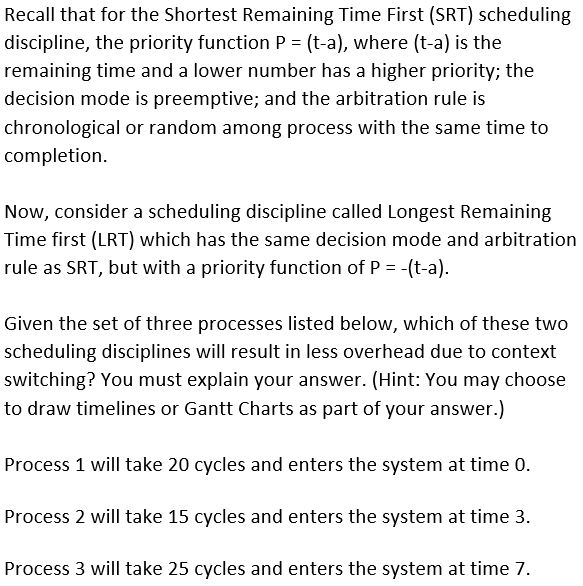
Recall that for the Shortest Remaining Time First (SRT) scheduling discipline, the priority function P -(t-a), where (t-a) is the remaining time and a lower number has a higher priority; the decision mode is preemptive; and the arbitration rule is chronological or random among process with the same time to completion. Now, consider a scheduling discipline called Longest Remaining Time first (LRT) which has the same decision mode and arbitration rule as SRT, but with a priority function of P -(t-a) Given the set of three processes listed below, which of these two scheduling disciplines will result in less overhead due to context switching? You must explain your answer. (Hint: You may choose to draw timelines or Gantt Charts as part of your answer.) Process 1 will take 20 cycles and enters the system at time 0 Process 2 will take 15 cycles and enters the system at time 3 Process 3 will take 25 cycles and enters the system at time 7
Step by Step Solution
There are 3 Steps involved in it

Get step-by-step solutions from verified subject matter experts
 Study Help