







Question: Record your results in the Lab Report section Lab Report - Activity P14: Simple Harmonic Motion - Mass on a Spring Data Table-1 Item Value
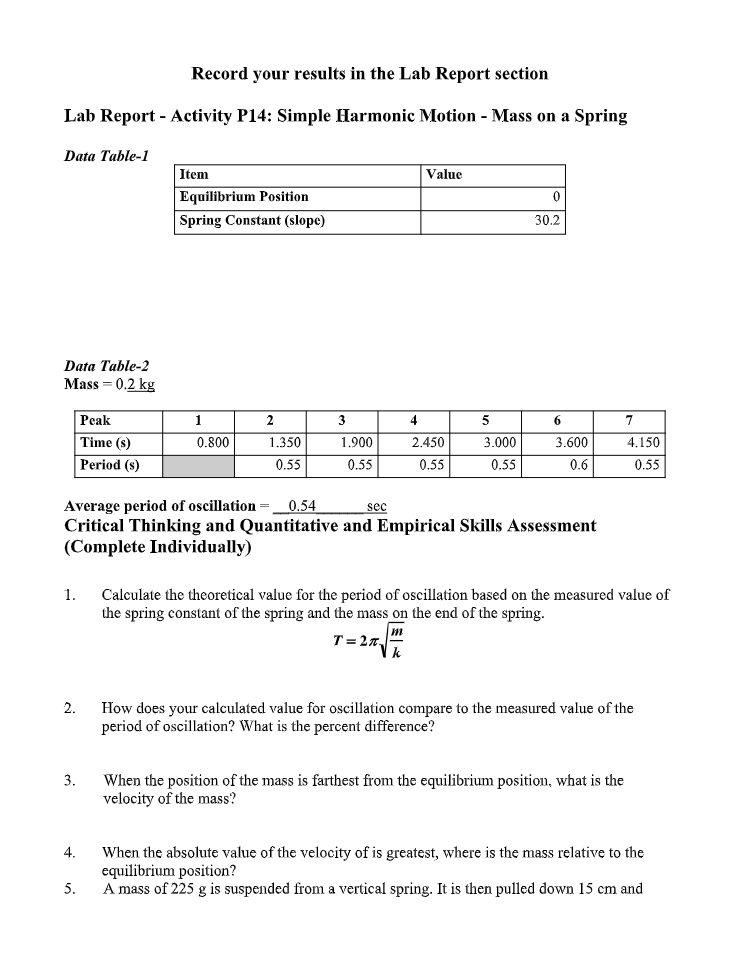
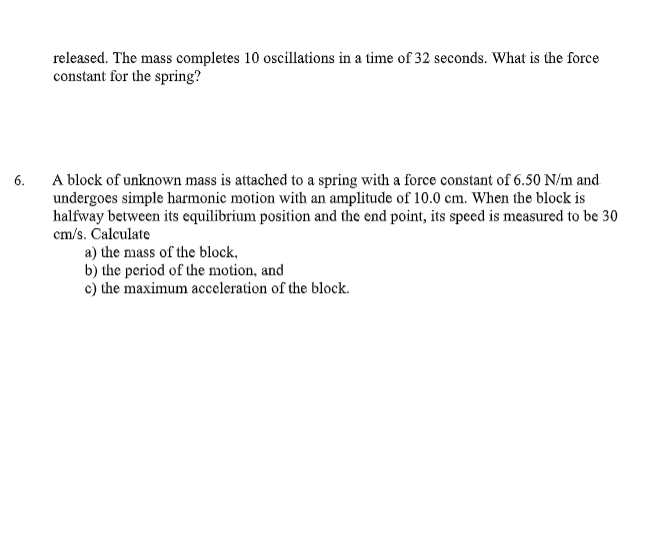
Record your results in the Lab Report section Lab Report - Activity P14: Simple Harmonic Motion - Mass on a Spring Data Table-1 Item Value Equilibrium Position 0 Spring Constant (slope) 30.2 Data Table-2 Mass = 0.2 kg Peak 1 2 3 5 6 7 Time ($) 0.800 1.350 1.900 2.450 3.000 3.600 4.150 Period (s) 0.55 0.55 0.55 0.55 0.6 0.55 Average period of oscillation = _0.54 sec Critical Thinking and Quantitative and Empirical Skills Assessment (Complete Individually) 1. Calculate the theoretical value for the period of oscillation based on the measured value of the spring constant of the spring and the mass on the end of the spring. T =2AT 2. How does your calculated value for oscillation compare to the measured value of the period of oscillation? What is the percent difference? 3. When the position of the mass is farthest from the equilibrium position, what is the velocity of the mass? 4. When the absolute value of the velocity of is greatest, where is the mass relative to the equilibrium position? 5. A mass of 225 g is suspended from a vertical spring. It is then pulled down 15 cm andreleased. The mass completes 10 oscillations in a time of 32 seconds. What is the force constant for the spring? 6. A block of unknown mass is attached to a spring with a force constant of 6.50 N/m and undergoes simple harmonic motion with an amplitude of 10.0 cm. When the block is halfway between its equilibrium position and the end point, its speed is measured to be 30 cm/s. Calculate a) the mass of the block. b) the period of the motion, and c) the maximum acceleration of the block
Step by Step Solution
There are 3 Steps involved in it

Get step-by-step solutions from verified subject matter experts
 Study Help