







Question: Risk free rate is not provided in the problem. I believe the risk (variance of returns) is used in place. Stock Selection Case Study Markowitz
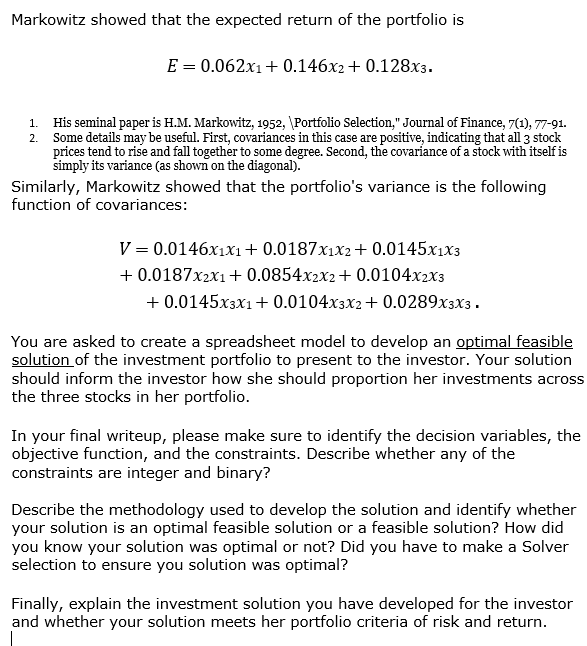
Risk free rate is not provided in the problem. I believe the risk (variance of returns) is used in place.
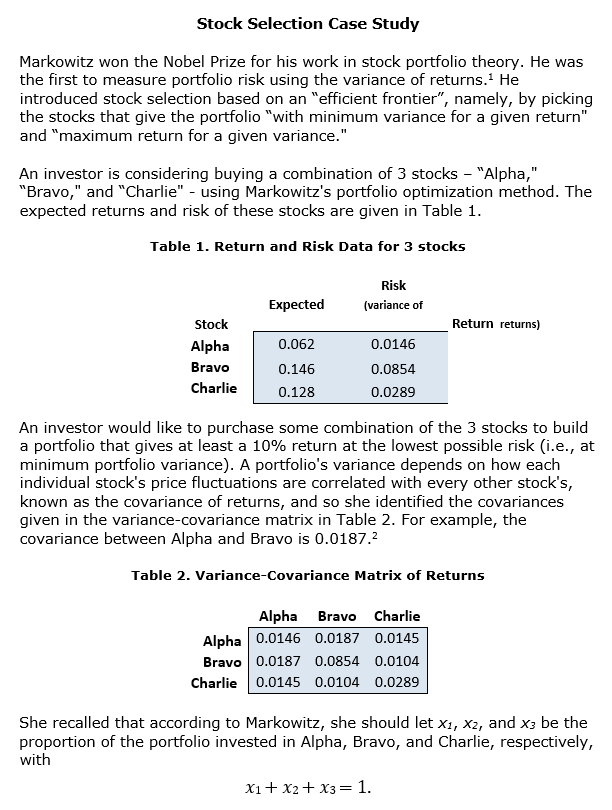
Stock Selection Case Study Markowitz won the Nobel Prize for his work in stock portfolio theory. He was the first to measure portfolio risk using the variance of returns.1 He introduced stock selection based on an "efficient frontier", namely, by picking the stocks that give the portfolio "with minimum variance for a given return" and "maximum return for a given variance." An investor is considering buying a combination of 3 stocks - "Alpha," "Bravo," and "Charlie" - using Markowitz's portfolio optimization method. The expected returns and risk of these stocks are given in Table 1 Table 1. Return and Risk Data for 3 stocks Risk (variance of Expected Stock Alpha Bravo Charlie Return returns) 0.062 0.146 0.128 0.0146 0.0854 0.0289 An investor would like to purchase some combination of the 3 stocks to build a portfolio that gives at least a 10% return at the lowest possible risk (i.e., at minimum portfolio variance). A portfolio's variance depends on how each individual stock's price fluctuations are correlated with every other stock's, known as the covariance of returns, and so she identified the covariances given in the variance-covariance matrix in Table 2. For example, the covariance between Alpha and Bravo is 0.0187.2 Table 2. Variance-Covariance Matrix of Returns Alpha Bravo Charlie Alpha 0.0146 0.0187 0.0145 Bravo 0.0187 0.0854 0.0104 Charlie 0.0145 0.0104 0.0289 She recalled that according to Markowitz, she should let xi, X2, and x3 be the proportion of the portfolio invested in Alpha, Bravo, and Charlie, respectively, with x1 x2 x3 1 Stock Selection Case Study Markowitz won the Nobel Prize for his work in stock portfolio theory. He was the first to measure portfolio risk using the variance of returns.1 He introduced stock selection based on an "efficient frontier", namely, by picking the stocks that give the portfolio "with minimum variance for a given return" and "maximum return for a given variance." An investor is considering buying a combination of 3 stocks - "Alpha," "Bravo," and "Charlie" - using Markowitz's portfolio optimization method. The expected returns and risk of these stocks are given in Table 1 Table 1. Return and Risk Data for 3 stocks Risk (variance of Expected Stock Alpha Bravo Charlie Return returns) 0.062 0.146 0.128 0.0146 0.0854 0.0289 An investor would like to purchase some combination of the 3 stocks to build a portfolio that gives at least a 10% return at the lowest possible risk (i.e., at minimum portfolio variance). A portfolio's variance depends on how each individual stock's price fluctuations are correlated with every other stock's, known as the covariance of returns, and so she identified the covariances given in the variance-covariance matrix in Table 2. For example, the covariance between Alpha and Bravo is 0.0187.2 Table 2. Variance-Covariance Matrix of Returns Alpha Bravo Charlie Alpha 0.0146 0.0187 0.0145 Bravo 0.0187 0.0854 0.0104 Charlie 0.0145 0.0104 0.0289 She recalled that according to Markowitz, she should let xi, X2, and x3 be the proportion of the portfolio invested in Alpha, Bravo, and Charlie, respectively, with x1 x2 x3 1
Step by Step Solution
There are 3 Steps involved in it

Get step-by-step solutions from verified subject matter experts
 Study Help