Question: rumal of Information Technology Teaching Cases 2011 CNC Mac 2016/1 Teaching case From theme park to resort: customer information management at Port Aventura Mariano A
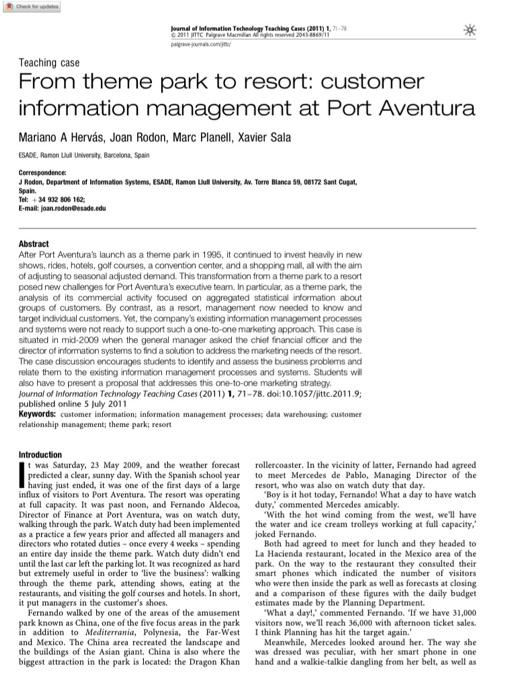
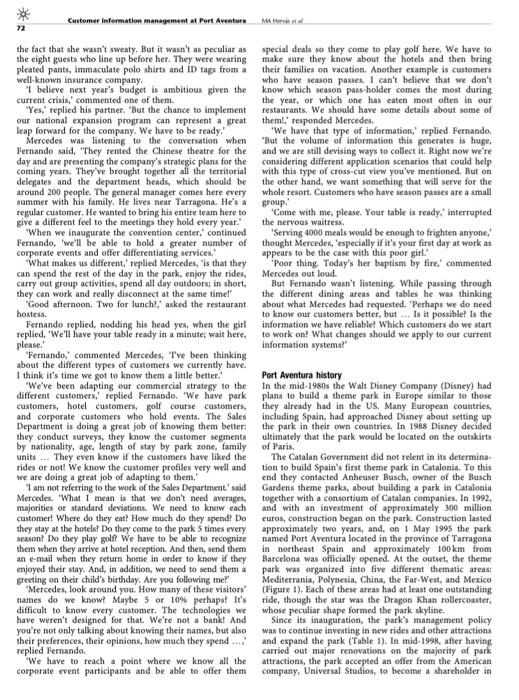
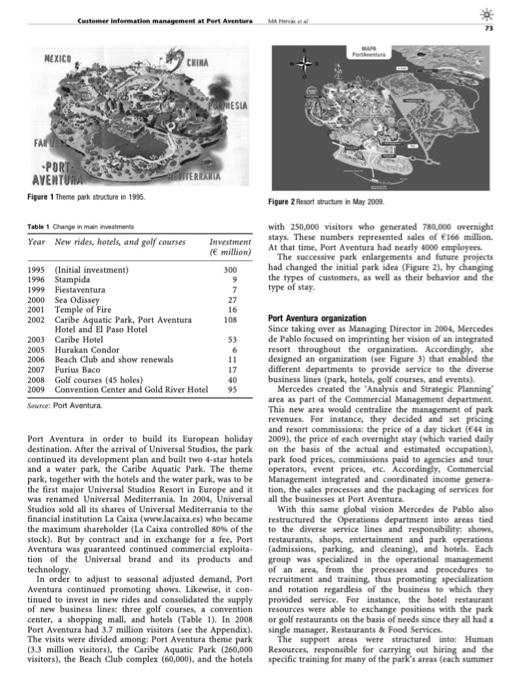
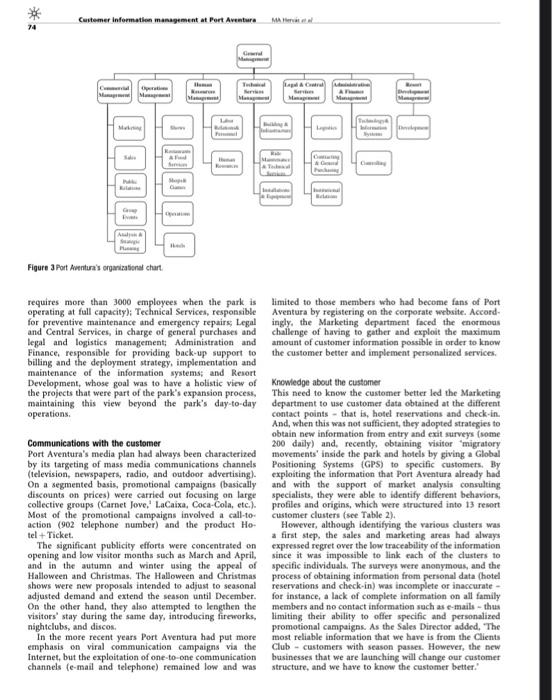
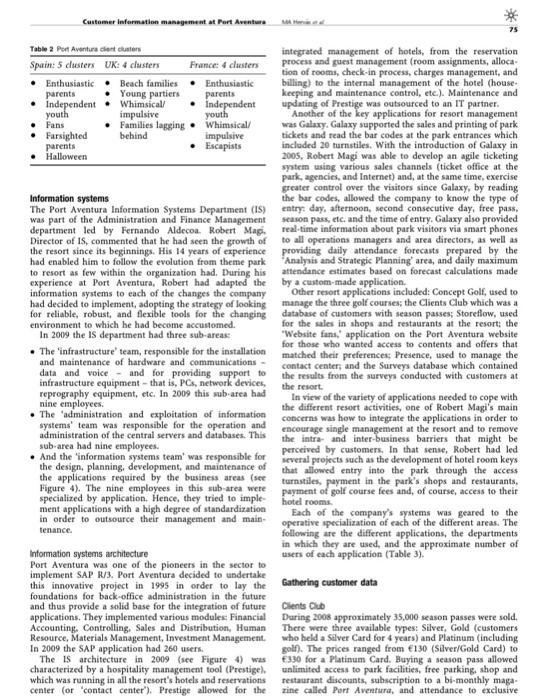
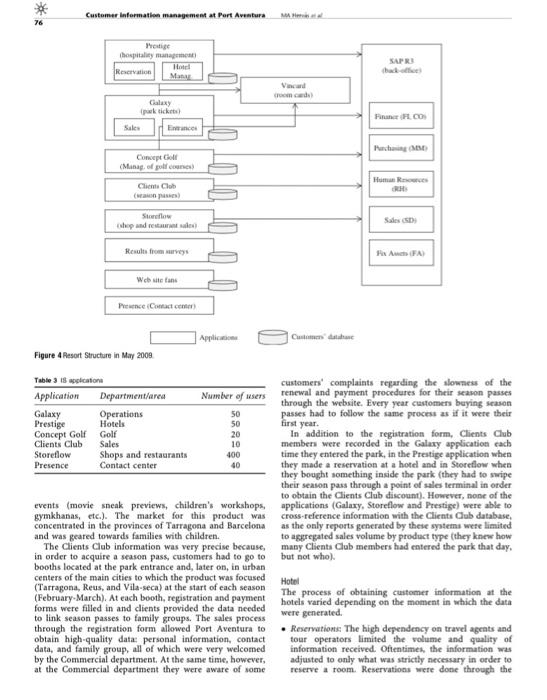
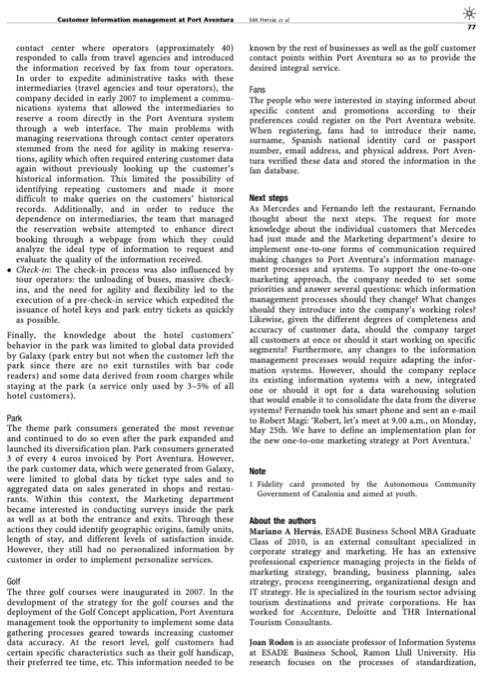
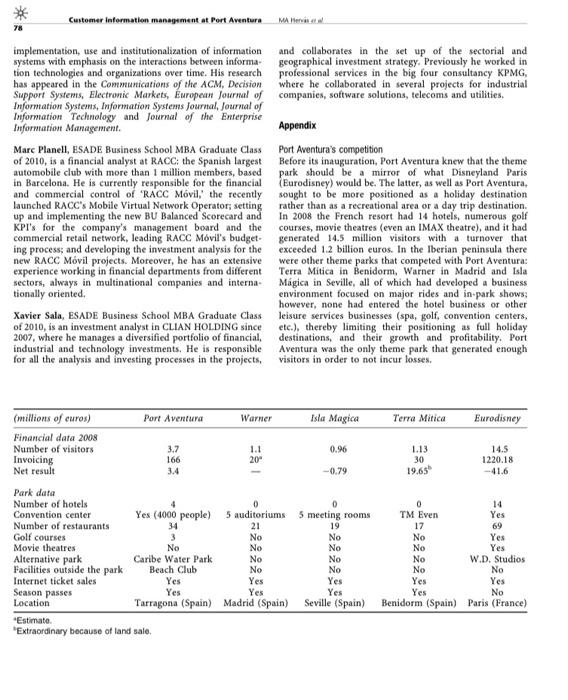
rumal of Information Technology Teaching Cases 2011 CNC Mac 2016/1 Teaching case From theme park to resort: customer information management at Port Aventura Mariano A Hervs, Joan Rodon, Marc Planell, Xavier Sala ESADE, Ramon Llull University, Baroniona, Spain Correspondence Rodon, Department of Information Systems, ESADE, Ramon Llull University. Aw. Torre Blanca 54, 00172 Sant Cupat, Spain. Tel: +32 806 180 E-mailnedosade.edu Abstract After Port Aventura's launch as a theme park in 1996, it continued to invest heavily in new shows.rides, hotels, golf courses, a convention center and a shopping mall, al with the aim of adjusting to seasonal adjusted demand This transformation from a theme park to a resort posed new challenges for Port Aventura's executive team. In particular, as a theme park, the analysis of its commercial activity focused on aggregated statistical information about groups of customers. By contrast, as a resort, management now needed to know and target individual customers. Yet, the company's existing information management processes and systems were not ready to support such a one-to-one marketing approach. This case is situated in mid-2009 when the general manager asked the chief fnancial officer and the director of information systems to find a solution to address the marketing needs of the resort The case discussion encourages students to identity and assess the business problems and relate them to the existing information management processes and systems. Students will also have to present a proposal that addresses this one-to-one marketing strategy Journal of Information Technology Teaching Cases (2011) 1, 71-78. doi:10.1057/jittc.2011.9; published online 5 July 2011 Keywords: customer information information management processes, data warehousing customer relationship management, theme parki resort Introduction t was Saturday, 23 May 2009, and the weather forecast predicted a clear, sunny day. With the Spanish school year having just ended, it was one of the first days of a large influx of visitors to Port Aventura. The resort was operating at full capacity. It was past noon, and Fernando Aldecoa, Director of Finance at Port Aventura, was on watch duty, walking through the park. Watch duty had been implemented as a practice a few years prior and affected all managers and directors who rotated duties-once every 4 weeks - spending an entire day inside the theme park. Watch duty didn't end until the last car left the parking lot. It was recognized as hard but extremely useful in order to "live the business's Walking through the theme park, attending shows, eating at the restaurants, and visiting the golf courses and hotels. In short, it put managers in the customer's shoes Fernando walked by one of the areas of the amusement park known as China, one of the five focus areas in the park in addition to Mediterrania, Polynesia, the Far West and Mexico. The China area recreated the landscape and the buildings of the Asian giant. China is also where the biggest attraction in the park is located: the Dragon Khan rollercoaster. In the vicinity of latter, Fernando had agreed to meet Mercedes de Pablo, Managing Director of the resort, who was also on watch duty that day. "Boy is it hot today, Fernando! What a day to have watch duty' commented Mercedes amicably. "With the hot wind coming from the west, we'll have the water and ice cream trolleys working at full capacity. joked Fernando Both had agreed to meet for lunch and they headed to La Hacienda restaurant, located in the Mexico area of the park. On the way to the restaurant they consulted their smart phones which indicated the number of visitors who were then inside the park as well as forecasts at closing and a comparison of these figures with the daily budget estimates made by the Planning Department. "What a day!.. commented Fernando. "If we have 31,000 visitors now, we'll reach 36,000 with afternoon ticket sales. I think Planning has hit the target again. Meanwhile, Mercedes looked around her. The way she was dressed was peculiar, with her smart phone in one hand and a walkie-talkie dangling from her belt, as well as Customer information management at Port Aventura MAH 72 special deals so they come to play golf here. We have to make sure they know about the hotels and then bring their families on vacation. Another example is customers who have season passes. I can't believe that we don't know which season pass-holder comes the most during the year, or which one has eaten most often in our restaurants. We should have some details about some of them,' responded Mercedes. 'We have that type of information,' replied Fernando But the volume of information this generates is huge. and we are still devising ways to collect it. Right now we're considering different application scenarios that could help with this type of cross-cut view you've mentioned. But on the other hand, we want something that will serve for the whole resort, Customers who have season passes are a small group. "Come with me, please. Your table is ready, interrupted the nervous waitress. Serving 4000 meals would be enough to frighten anyone, thought Mercedes, especially if it's your first day at work as appears to be the case with this poor girl. "Poor thing. Today's her baptism by fire, commented Mercedes out loud. But Fernando wasn't listening While passing through the different dining areas and tables he was thinking about what Mercedes had requested. Perhaps we do need to know our customers better, but Is it possible? Is the information we have reliable! Which customers do we start to work on! What changes should we apply to our current information systems! the fact that she wasn't sweaty. But it wasn't as peculiar as the eight guests who line up before her. They were wearing pleated pants, immaculate polo shirts and ID tags from a well-known insurance company. "I believe next year's budget is ambitious given the current crisis,' commented one of them. "Yes,' replied his partner. But the chance to implement our national expansion program can represent a great leap forward for the company. We have to be ready." Mercedes was listening to the conversation when Fernando said, 'They rented the Chinese theatre for the day and are presenting the company's strategic plans for the coming years. They've brought together all the territorial delegates and the department heads, which should be around 200 people. The general manager comes here every summer with his family. He lives near Tarragona. He's a regular customer. He wanted to bring his entire team here to give a different feel to the meetings they hold every year. "When we inaugurate the convention center, continued Fernando, 'we'll be able to hold a greater number of corporate events and offer differentiating services. "What makes us different,' replied Mercedes, 'is that they can spend the rest of the day in the park, enjoy the rides, carry out group activities, spend all day outdoors; in short they can work and really disconnect at the same time! "Good afternoon. Two for lunch!,' asked the restaurant hostess. Fernando replied, nodding his head yes, when the girl Teplied, 'We'll have your table ready in a minute, wait here, please "Fernando,' commented Mercedes, I've been thinking about the different types of customers we currently have. I think it's time we got to know them a little better. "We've been adapting our commercial strategy to the different customers,' replied Fernando. 'We have park customers, hotel customers, golf course customers, and corporate customers who hold events, The Sales Department is doing a great job of knowing them better they conduct surveys, they know the customer segments by nationality, age, length of stay by park zone, family units ... They even know if the customers have liked the rides or not! We know the customer profiles very well and we are doing a great job of adapting to them." I am not referring to the work of the Sales Department,' said Mercedes, 'What I mean is that we don't need averages, majorities or standard deviations. We need to know each customer! Where do they eat? How much do they spend? Do they stay at the hotels! Do they come to the park 5 times every season! Do they play golf We have to be able to recognize them when they arrive at hotel reception. And then, send them an e-mail when they return home in order to know if they enjoyed their stay. And, in addition, we need to send them a greeting on their child's birthday. Are you following me! "Mercedes, look around you. How many of these visitors names do we know? Maybe 5 or 10% perhaps! It's difficult to know every customer. The technologies we have weren't designed for that. We're not a bankl And you're not only talking about knowing their names, but also their preferences, their opinions, how much they spend ..., replied Fernando 'We have to reach a point where we know all the corporate event participants and be able to offer them Port Aventura history In the mid-1980s the Walt Disney Company (Disney) had plans to build a theme park in Europe similar to those they already had in the US. Many European countries, including Spain, had approached Disney about setting up the park in their own countries. In 1988 Disney decided ultimately that the park would be located on the outskirts of Paris, The Catalan Government did not relent in its determina- tion to build Spain's first theme park in Catalonia. To this end they contacted Anheuser Busch, owner of the Busch Gardens theme parks, about building a park in Catalonia together with a consortium of Catalan companies. In 1992, and with an investment of approximately 300 million curos, construction began on the park. Construction lasted approximately two years, and, on 1 May 1995 the park named Port Aventura located in the province of Tarragona in northeast Spain and approximately 100 km from Barcelona was officially opened. At the outset, the theme park was organized into five different thematic areas Mediterrania, Polynesia, China, the Far West, and Mexico (Figure 1). Each of these areas had at least one outstanding ride, though the star was the Dragon Khan rollercoaster, whose peculiar shape formed the park skyline. Since its inauguration, the park's management policy was to continue investing in new rides and other attractions and expand the park (Table 1). In mid-1998, after having carried out major renovations on the majority of park attractions, the park accepted an offer from the American company. Universal Studios, to become a shareholder in Customer information management at Port Aventura MA NEXICO CHIM FESIA FARIN -PORT AVENTURA Figure 1 Theme park structure in 1996 TERLARA Figure 2 Resort structure in May 2009 with 250,000 visitors who generated 780,000 overnight stays. These numbers represented sales of 166 million At that time, Port Aventura had nearly 4000 employees The successive park enlargements and future projects had changed the initial park idea (Figure 2). by changing the types of customers, as well as their behavior and the type of stay, 300 Table 1 Change in maniement Year New rides, hotels, and golf courses Investment (E million) 1995 (Initial investment) 1996 Stampida 9 1999 Fiestaventura 7 2000 Sea Odissey 27 2001 Temple of Fire 16 2002 Caribe Aquatic Park, Port Aventura 108 Hotel and El Paso Hotel 2003 Caribe Hotel 53 2005 Hurakan Condor 2006 Beach Club and show renewals 11 2007 Furius Baco 17 2008 Golf courses (45 holes) 40 2009 Convention Center and Gold River Hotel 95 Source: Port Aventura Port Aventura in order to build its European holiday destination. After the arrival of Universal Studios, the park continued its development plan and built two 4-star hotels and a water park, the Caribe Aquatic Park. The theme park, together with the hotels and the water park, was to be the first major Universal Studios Resort in Europe and it was renamed Universal Mediterrania. In 2004, Universal Studios sold all its shares of Universal Mediterrania to the financial institution La Caixa (www.lacaixa.es) who became the maximum shareholder (La Caixa controlled 80% of the stock). But by contract and in exchange for a fec. Port Aventura was guaranteed continued commercial exploita tion of the Universal brand and its products and technology In order to adjust to seasonal adjusted demand, Port Aventura continued promoting shows. Likewise, it con- tinued to invest in new rides and consolidated the supply of new business lines three golf courses a convention center, a shopping mall, and hotels (Table 1). In 2008 Port Aventura had 3.7 million visitors (see the Appendix). The visits were divided among: Port Aventura theme park (3.3 million visitors), the Caribe Aquatic Park (260,000 visitors), the Beach Club complex (60,000), and the hotels Port Aventura organization Since taking over as Managing Director in 2004, Mercedes de Pablo focused on imprinting her vision of an integrated resort throughout the organization. Accordingly, she designed an organization (see Figure 3) that enabled the different departments to provide service to the diverse business lines (park, hotels, golf courses, and events). Mercedes created the Analysis and Strategic Planning area as part of the Commercial Management department This new area would centralize the management of park revenues. For instance, they decided and set pricing and resort commissions the price of a day ticket (E44 in 2009), the price of each overnight stay (which varied daily on the basis of the actual and estimated occupation) park food prices, commissions paid to agencies and tour operators, event prices, etc. Accordingly, Commercial Management integrated and coordinated income genera tion, the sales processes and the packaging of services for all the businesses at Port Aventura With this same global vision Mercedes de Pablo also restructured the Operations department into areas tied to the diverse service lines and responsability shows. restaurants, shops, entertainment and park operations (admissions, parking and cleaning), and hotels. Each group was specialized in the operational management of an area, from the processes and procedures to recruitment and training thus promoting specialization and rotation regardless of the busines to which they provided service. For instance, the hotel restaurant resources were able to exchange positions with the park or golf restaurants on the basis of needs since they all had a single manager, Restaurants & Food Services The support areas were structured into: Human Resources, responsible for carrying out hiring and the specific training for many of the park's areas (each summer * Customer Information management at Port Aventura MAR w Tom M A Manam Mama Man AT Figure 3 Port Aventura's organizational chart requires more than 3000 employees when the park is limited to those members who had become fans of Port operating at full capacity): Technical Services, responsible Aventura by registering on the corporate website. Accord for preventive maintenance and emergency repairs Legal ingly, the Marketing department faced the enormous and Central Services, in charge of general purchases and challenge of having to gather and exploit the maximum legal and logistics management Administration and amount of customer information possible in order to know Finance, responsible for providing back-up support to the customer better and implement personalized services, billing and the deployment strategy, implementation and maintenance of the information systems and Resort Development, whose goal was to have a holistic view of Knowledge about the customer the projects that were part of the park's expansion process. This need to know the customer better led the Marketing maintaining this view beyond the park's day-to-day department to use customer data obtained at the different operations contact points - that is, hotel reservations and check-in. And, when this was not sufficient, they adopted strategies to obtain new information from entry and exit surveys (some Communications with the customer 200 daily) and recently, obtaining visitor 'migratory Port Aventura's media plan had always been characterized movements inside the park and hotels by giving a Global by its targeting of mass media communications channels Positioning Systems (GPS) to specific customers. By (television, newspapers, radio, and outdoor advertising) exploiting the information that Port Aventura already had On a segmented basis, promotional campaigns (basically and with the support of market analysis consulting discounts on prices) were carried out focusing on large specialists, they were able to identify different behaviors, collective groups (Carnet Jove,' LaCaixa, Coca-Cola, etc.). profiles and origins, which were structured into 13 resort Most of the promotional campaigns involved a call-to customer clusters (see Table 2). action (902 telephone number) and the product Ho- However, although identifying the various clusters was tel + Ticket. a first step, the sales and marketing areas had always The significant publicity efforts were concentrated on expressed regret over the low traceability of the information opening and low visitor months such as March and April, since it was impossible to link each of the clusters to and in the autumn and winter using the appeal of specific individuals. The surveys were anonymous, and the Halloween and Christmas, The Halloween and Christmas process of obtaining information from personal data (hotel shows were new proposals intended to adjust to seasonal reservations and check-in) was incomplete or inaccurate - adjusted demand and extend the season until December. for instance, a lack of complete information on all family On the other hand, they also attempted to lengthen the members and no contact information such as e-mails - thus visitors' stay during the same day, introducing fireworks, limiting their ability to offer specific and personalized nightclubs, and discos promotional campaigns. As the Sales Director added. The In the more recent years Port Aventura had put more most reliable information that we have is from the Clients emphasis on viral communication campaigns via the Club - customers with season passes. However, the new Internet, but the exploitation of one-to-one communication businesses that we are launching will change our customer channels (e-mail and telephone) remained low and was structure, and we have to know the customer better Customer information management at Port Aventura Table 2 Port Aventura cient clusters integrated management of hotels, from the reservation Spain: 5 clusters UK: 4 clusters Francesclusters process and guest management (room assignments, alloca tion of rooms, check-in process, charges management, and Enthusiastic Beach families. Enthusiastic billing) to the internal management of the hotel (house parents Young partiers parents keeping and maintenance control, etc.). Maintenance and independent Whimsical/ independent updating of Prestige was outsourced to an IT partner. youth impulsive youth Another of the key applications for resort management Fans Families lagging Whimsical/ was Galaxy Galaxy supported the sales and printing of park Farsighted behind impulsive tickets and read the bar codes at the park entrances which parents Escapists included 20 turnstiles. With the introduction of Galaxy in Halloween 2005, Robert Magi was able to develop an agile ticketing system using various sales channels (ticket office at the park, agencies, and Internet) and, at the same time, exercise greater control over the visitors since Galaxy, by reading Information systems the bar codes, allowed the company to know the type of The Port Aventura Information Systems Department (IS) entry day, afternoon, second consecutive day, free pass, was part of the Administration and Finance Management season pass, etc. and the time of entry, Galaxy also provided depart led by Fernando Aldecoa. Robert Mag. realtime information about park visitors via smart phones Director of IS, commented that he had seen the growth of to all operations managers and area directors, as well as the resort since its beginnings. His 14 years of experience providing daily attendance forecasts prepared by the had enabled him to follow the evolution from theme park *Analysis and Strategic Planning area, and daily maximum to resort as few within the organization had. During his attendance estimates based on forecast calculations made experience at Port Aventura, Robert had adapted the by a custom-made application, information systems to each of the changes the company Other resort applications included: Concept Golf, used to had decided to implement, adopting the strategy of looking manage the three golf courses the Clients Club which was a for reliable, robust, and flexible tools for the changing database of customers with season passes; Storeflow, used environment to which he had become accustomed. for the sales in shops and restaurants at the resort: the In 2009 the IS department had three sub-areas "Website fans,' application on the Port Aventura website for those who wanted access to contents and offers that The 'infrastructure' team, responsible for the installation matched their preferences, Presence, used to manage the and maintenance of hardware and communications - data and voice - and for providing support to contact center, and the Surveys database which contained infrastructure equipment that is, PCs, network devices, the results from the surveys conducted with customers at the resort reprography equipment, etc. In 2009 this sub-area had nine employees. In view of the variety of applications needed to cope with the different resort activities, one of Robert Magi's main The administration and exploitation of information concerns was how to integrate the applications in order to systems' team was responsible for the operation and administration of the central servers and databases. This encourage single management at the resort and to remove the intra- and inter-business barriers that might be sub-area had nine employees. perceived by customers. In that sense, Robert had led . And the information systems team' was responsible for several projects such as the development of hotel room keys the design, planning, development, and maintenance of that allowed entry into the park through the access the applications required by the business areas (see Figure 4). The nine employees in this sub-area were turnstiles, payment in the park's shops and restaurants. specialized by application. Hence, they tried to imple payment of golf course fees and, of course, access to their hotel rooms ment applications with a high degree of standardization Each of the company's systems was geared to the in order to outsource their management and main- operative specialization of each of the different areas. The tenance. following are the different applications, the departments in which they are used, and the approximate number of Information systems architecture users of each application (Table 3). Port Aventura was one of the pioneers in the sector to implement SAP R/3. Port Aventura decided to undertake this innovative project in 1995 in order to lay the Gathering customer data foundations for back-office administration in the future and thus provide a solid base for the integration of future Clients Club applications. They implemented various modules Financial During 2008 approximately 35,000 season passes were sold. Accounting. Controlling, Sales and Distribution, Human There were three available types: Silver, Gold (customers Resource Materials Management, Investment Management who held a Silver Card for 4 years) and Platinum (including In 2009 the SAP application had 260 users golf). The price ranged from 130 (Silver/Gold Card) to The Is architecture in 2009 (see Figure 4) was 330 for a Platinum Card. Buying a season pass allowed characterized by a hospitality management tool (Prestige). unlimited access to park facilities, free parking, shop and which was running in all the resort's hotels and reservations restaurant discounts, subscription to a bi-monthly maga center (or contact center"). Prestige allowed for the zine called Port Aventura, and attendance to exclusive Customer Information management at Port Aventura MA 76 Prestige hospitality manage Ho Reservation M SAPRO Vinca Galaxy k ticket Ence Franco Sales Hub Concept Gold (Ming of Chat Kim Hun Slow chop and run Sales Results from HAFA Wc Prence Contact Center Applica Cum dat Figure 4 Resort Structure in May 2009 Table 3 splication Application Departmentarea Galaxy Operations Prestige Hotels Concept Golf Golf Clients Club Sales Storeflow Shops and restaurants Presence Contact center Number of users 50 50 20 10 400 40 customers' complaints regarding the lowess of the renewal and payment procedures for their season passes through the website. Every year customers buying season passes had to follow the same process as if it were their first year. In addition to the registration form, Clients Club members were recorded in the Galaxy application cach time they entered the park, in the Prestige application when they made a reservation at a hotel and in Storeflow when they bought something inside the park (they had to swipe their season pass through a point of sales terminal in order to obtain the Clients Club discount). However, none of the applications (Galaxy, Storeflow and Prestige) were able to cross-reference information with the clients Club database, as the only reports generated by these systems were limited to aggregated sales volume by product type (they knew how many Clients Club members had entered the park that day, but not who events (movie sneak previews, children's workshops, gymkhanas, etc.). The market for this product was concentrated in the provinces of Tarragona and Barcelona and was geared towards families with children. The Clients Club information was very precise because, in order to acquire a season pass, customers had to go to booths located at the park entrance and, later on, in urban centers of the main cities to which the product was focused (Tarragona, Reus, and Vila-seca) at the start of each season (February March). At each booth, registration and payment forms were filled in and clients provided the data needed to link season passes to family groups. The sales process through the registration form allowed Port Aventura to obtain high-quality data: personal information, contact data, and family group, all of which were very welcomed by the Commercial department. At the same time, however, at the Commercial department they were aware of some Hotel The process of obtaining customer information at the hotels varied depending on the moment in which the data were generated . Reservations: The high dependency on travel agents and tour operators limited the volume and quality of information received. Oftentimes, the information was adjusted to only what was strictly necessary in order to reserve a room. Reservations were done through the Customer information management at Port Aventura 77 known by the rest of businesses as well as the golf customer contact points within Port Aventura so as to provide the desired integral service. Fans The people who were interested in staying informed about specific content and promotions according to their preferences could register on the Port Aventura website. When registering fans had to introduce their name, surname. Spanish national identity card or passport number, email address, and physical address, Port Aven- tura verified these data and stored the information in the fan database contact center where operators (approximately 40) responded to calls from travel agencies and introduced the information received by fax from tour operators In order to expedite administrative tasks with these intermediaries (travel agencies and tour operators), the company decided in early 2007 to implement a commu- nications systems that allowed the intermediaries to reserve a room directly in the Port Aventura system through a web interface. The main problems with managing reservations through contact center operators stemmed from the need for agility in making reserva tions, agility which often required entering customer data again without previously looking up the customer's historical information. This limited the possibility of identifying repeating customers and made it more difficult to make queries on the customers' historical records. Additionally, and in order to reduce the dependence on intermediaries, the team that managed the reservation website attempted to enhance direct booking through a webpage from which they could analyze the ideal type of information to request and evaluate the quality of the information received Check-in: The check-in process was also influenced by tour operators: the unloading of buses, massive check ins, and the need for agility and flexibility led to the execution of a pre-check-in service which expedited the issuance of hotel keys and park entry tickets as quickly as possible. Finally, the knowledge about the hotel customers behavior in the park was limited to global data provided by Galaxy (park entry but not when the customer left the park since there are no exit turnstiles with bar code readers) and some data derived from room charges while staying at the park (a service only used by 3-5% of all hotel customers). Next steps As Mercedes and Fernando left the restaurant, Fernando thought about the next steps. The request for more knowledge about the individual customers that Mercedes had just made and the Marketing department's desire to implement one-to-one forms of communication required making changes to Port Aventura's information manage ment processes and systems. To support the one-to-one marketing approach, the company needed to set some priorities and answer several questions which information management processes should they change? What changes should they introduce into the company's working roles! Likewise, given the different degrees of completeness and accuracy of customer data, should the company target all customers at once or should it start working on specific segments! Furthermore, any changes to the information management processes would require adapting the infor- mation systems. However, should the company replace its existing information systems with a new, integrated one or should it opt for a data warehousing solution that would enable it to consolidate the data from the diverse wystems Fernando took his smart phone and sent an e-mail to Robert Magt: "Robert, let's meet at 9.00 a.m., on Monday, May 25th. We have to define an implementation plan for the new one-to-one marketing strategy at Port Aventura.' Note 1 Fidelity and promoted by the Autonomous Community Government of Catalonia and aimed at youth Park The theme park consumers generated the most revenue and continued to do so even after the park expanded and launched its diversification plan. Park consumers generated 3 of every 4 euros invoiced by Port Aventura. However, the park customer data, which were generated from Galaxy were limited to global data by ticket type sales and to aggregated data on sales generated in shops and restau rants. Within this context, the Marketing department became interested in conducting surveys inside the park as well as at both the entrance and exits. Through these actions they could identify geographic origins, family units, length of stay, and different levels of satisfaction inside However, they still had no personalized information by customer in order to implement personalize services. Golf The three golf courses were inaugurated in 2007. In the development of the strategy for the golf courses and the deployment of the Golf Concept application, Port Aventura management took the opportunity to implement some data gathering processes geared towards increasing customer data accuracy. At the resort level, golf customers had certain specific characteristics such as their golf handicap, their preferred tee time, etc. This information needed to be About the authors Mariano A Hervs, ESADE Business School MBA Graduate Class of 2010, is an external consultant specialized in corporate strategy and marketing. He has an extensive professional experience managing projects in the fields of marketing strategy, branding, business planning, sales strategy, process reengineering, organizational design and IT strategy. He is specialized in the tourism sector advising tourism destinations and private corporations. He has worked for Accenture, Deloitte and THR International Tourism Consultants. Joan Rodon is an associate professor of Information Systems a ESADE Business School, Ramon Llull University. His research focuses on the processes of standardization, Customer information management at Port Aventura MAH 78 implementation, use and institutionalization of information and collaborates in the set up of the sectorial and systems with emphasis on the interactions between informa geographical investment strategy. Previously he worked in tion technologies and organizations over time. His research professional services in the big four consultancy KPMG has appeared in the Communications of the ACM, Decision where he collaborated in several projects for industrial Support Systems, Electronic Markets, European Journal of companies, software solutions, telecoms and utilities, Information Systems, Information Systems Journal, Journal of Information Technology and Journal of the Enterprise Information Management. Appendix Marc Planell, ESADE Business School MBA Graduate Class Port Aventura's competition of 2010, is a financial analyst at RACC: the Spanish largest Before its inauguration, Port Aventura knew that the theme automobile club with more than 1 million members, based park should be a mirror of what Disneyland Paris in Barcelona. He is currently responsible for the financial Eurodisney) would be. The latter, as well as Port Aventura, and commercial control of 'RACC Mvil, the recently sought to be more positioned as a holiday destination launched RACC's Mobile Virtual Network Operator, setting rather than as a recreational area or a day trip destination. up and implementing the new BU Balanced Scorecard and In 2008 the French resort had 14 hotels, numerous golf KPI's for the company's management board and the courses, movie theatres (even an IMAX theatre), and it had commercial retail network, leading RACC Mvil's budget- generated 14.5 million visitors with a turnover that ing process, and developing the investment analysis for the exceeded 1.2 billion euros. In the Iberian peninsula there new RACC Mvil projects. Moreover, he has an extensive were other theme parks that competed with Port Aventura: experience working in financial departments from different Terra Mitica in Benidorm, Warner in Madrid and Isla sectors, always in multinational companies and interna Mgica in Seville, all of which had developed a business tionally oriented environment focused on major rides and in park shows; however, none had entered the hotel business or other Xavier Sala, ESADE Business School MBA Graduate Class leisure services businesses (spa, golf, convention centers, of 2010, is an investment analyst in CLIAN HOLDING since etc.), thereby limiting their positioning as full holiday 2007, where he manages a diversified portfolio of financial, destinations, and their growth and profitability. Port industrial and technology investments. He is responsible Aventura was the only theme park that generated enough for all the analysis and investing processes in the projects, visitors in order to not incur losses. (millions of euros) Port Aventura Warner Isla Magica Terra Mitica Eurodisney Financial data 2008 Number of visitors 3.7 1.1 0.96 1.13 14.5 Invoicing 166 20" 30 1220.18 Net result 3.4 -0.79 19.65 -41.6 Park data Number of hotels 4 0 14 Convention center Yes (4000 people) 5 auditoriums 5 meeting rooms TM Even Yes Number of restaurants 34 21 19 17 69 Golf courses No No No Yes Movie theatres No No No No Yes Alternative park Caribe Water Park No No No W.D. Studios Facilities outside the park Beach Club No No No No Internet ticket sales Yes Yes Yes Yes Season passes Yes Yes Yes Yes No Location Tarragona (Spain) Madrid (Spain) Seville (Spain) Benidorm (Spain) Paris (France) "Estimate "Extraordinary because of land sale, Yes Give brief descriptions about the current stage of Port Aventura described in the case. o Describe Port Aventura's organization structure, business processes, information systems used, and the architecture of its information systems. o Describe Port Aventura's coordination and collaboration among internal business units such as departments and business lines, and communications with external entities such as customers and business partners (i.e., travel agencies). rumal of Information Technology Teaching Cases 2011 CNC Mac 2016/1 Teaching case From theme park to resort: customer information management at Port Aventura Mariano A Hervs, Joan Rodon, Marc Planell, Xavier Sala ESADE, Ramon Llull University, Baroniona, Spain Correspondence Rodon, Department of Information Systems, ESADE, Ramon Llull University. Aw. Torre Blanca 54, 00172 Sant Cupat, Spain. Tel: +32 806 180 E-mailnedosade.edu Abstract After Port Aventura's launch as a theme park in 1996, it continued to invest heavily in new shows.rides, hotels, golf courses, a convention center and a shopping mall, al with the aim of adjusting to seasonal adjusted demand This transformation from a theme park to a resort posed new challenges for Port Aventura's executive team. In particular, as a theme park, the analysis of its commercial activity focused on aggregated statistical information about groups of customers. By contrast, as a resort, management now needed to know and target individual customers. Yet, the company's existing information management processes and systems were not ready to support such a one-to-one marketing approach. This case is situated in mid-2009 when the general manager asked the chief fnancial officer and the director of information systems to find a solution to address the marketing needs of the resort The case discussion encourages students to identity and assess the business problems and relate them to the existing information management processes and systems. Students will also have to present a proposal that addresses this one-to-one marketing strategy Journal of Information Technology Teaching Cases (2011) 1, 71-78. doi:10.1057/jittc.2011.9; published online 5 July 2011 Keywords: customer information information management processes, data warehousing customer relationship management, theme parki resort Introduction t was Saturday, 23 May 2009, and the weather forecast predicted a clear, sunny day. With the Spanish school year having just ended, it was one of the first days of a large influx of visitors to Port Aventura. The resort was operating at full capacity. It was past noon, and Fernando Aldecoa, Director of Finance at Port Aventura, was on watch duty, walking through the park. Watch duty had been implemented as a practice a few years prior and affected all managers and directors who rotated duties-once every 4 weeks - spending an entire day inside the theme park. Watch duty didn't end until the last car left the parking lot. It was recognized as hard but extremely useful in order to "live the business's Walking through the theme park, attending shows, eating at the restaurants, and visiting the golf courses and hotels. In short, it put managers in the customer's shoes Fernando walked by one of the areas of the amusement park known as China, one of the five focus areas in the park in addition to Mediterrania, Polynesia, the Far West and Mexico. The China area recreated the landscape and the buildings of the Asian giant. China is also where the biggest attraction in the park is located: the Dragon Khan rollercoaster. In the vicinity of latter, Fernando had agreed to meet Mercedes de Pablo, Managing Director of the resort, who was also on watch duty that day. "Boy is it hot today, Fernando! What a day to have watch duty' commented Mercedes amicably. "With the hot wind coming from the west, we'll have the water and ice cream trolleys working at full capacity. joked Fernando Both had agreed to meet for lunch and they headed to La Hacienda restaurant, located in the Mexico area of the park. On the way to the restaurant they consulted their smart phones which indicated the number of visitors who were then inside the park as well as forecasts at closing and a comparison of these figures with the daily budget estimates made by the Planning Department. "What a day!.. commented Fernando. "If we have 31,000 visitors now, we'll reach 36,000 with afternoon ticket sales. I think Planning has hit the target again. Meanwhile, Mercedes looked around her. The way she was dressed was peculiar, with her smart phone in one hand and a walkie-talkie dangling from her belt, as well as Customer information management at Port Aventura MAH 72 special deals so they come to play golf here. We have to make sure they know about the hotels and then bring their families on vacation. Another example is customers who have season passes. I can't believe that we don't know which season pass-holder comes the most during the year, or which one has eaten most often in our restaurants. We should have some details about some of them,' responded Mercedes. 'We have that type of information,' replied Fernando But the volume of information this generates is huge. and we are still devising ways to collect it. Right now we're considering different application scenarios that could help with this type of cross-cut view you've mentioned. But on the other hand, we want something that will serve for the whole resort, Customers who have season passes are a small group. "Come with me, please. Your table is ready, interrupted the nervous waitress. Serving 4000 meals would be enough to frighten anyone, thought Mercedes, especially if it's your first day at work as appears to be the case with this poor girl. "Poor thing. Today's her baptism by fire, commented Mercedes out loud. But Fernando wasn't listening While passing through the different dining areas and tables he was thinking about what Mercedes had requested. Perhaps we do need to know our customers better, but Is it possible? Is the information we have reliable! Which customers do we start to work on! What changes should we apply to our current information systems! the fact that she wasn't sweaty. But it wasn't as peculiar as the eight guests who line up before her. They were wearing pleated pants, immaculate polo shirts and ID tags from a well-known insurance company. "I believe next year's budget is ambitious given the current crisis,' commented one of them. "Yes,' replied his partner. But the chance to implement our national expansion program can represent a great leap forward for the company. We have to be ready." Mercedes was listening to the conversation when Fernando said, 'They rented the Chinese theatre for the day and are presenting the company's strategic plans for the coming years. They've brought together all the territorial delegates and the department heads, which should be around 200 people. The general manager comes here every summer with his family. He lives near Tarragona. He's a regular customer. He wanted to bring his entire team here to give a different feel to the meetings they hold every year. "When we inaugurate the convention center, continued Fernando, 'we'll be able to hold a greater number of corporate events and offer differentiating services. "What makes us different,' replied Mercedes, 'is that they can spend the rest of the day in the park, enjoy the rides, carry out group activities, spend all day outdoors; in short they can work and really disconnect at the same time! "Good afternoon. Two for lunch!,' asked the restaurant hostess. Fernando replied, nodding his head yes, when the girl Teplied, 'We'll have your table ready in a minute, wait here, please "Fernando,' commented Mercedes, I've been thinking about the different types of customers we currently have. I think it's time we got to know them a little better. "We've been adapting our commercial strategy to the different customers,' replied Fernando. 'We have park customers, hotel customers, golf course customers, and corporate customers who hold events, The Sales Department is doing a great job of knowing them better they conduct surveys, they know the customer segments by nationality, age, length of stay by park zone, family units ... They even know if the customers have liked the rides or not! We know the customer profiles very well and we are doing a great job of adapting to them." I am not referring to the work of the Sales Department,' said Mercedes, 'What I mean is that we don't need averages, majorities or standard deviations. We need to know each customer! Where do they eat? How much do they spend? Do they stay at the hotels! Do they come to the park 5 times every season! Do they play golf We have to be able to recognize them when they arrive at hotel reception. And then, send them an e-mail when they return home in order to know if they enjoyed their stay. And, in addition, we need to send them a greeting on their child's birthday. Are you following me! "Mercedes, look around you. How many of these visitors names do we know? Maybe 5 or 10% perhaps! It's difficult to know every customer. The technologies we have weren't designed for that. We're not a bankl And you're not only talking about knowing their names, but also their preferences, their opinions, how much they spend ..., replied Fernando 'We have to reach a point where we know all the corporate event participants and be able to offer them Port Aventura history In the mid-1980s the Walt Disney Company (Disney) had plans to build a theme park in Europe similar to those they already had in the US. Many European countries, including Spain, had approached Disney about setting up the park in their own countries. In 1988 Disney decided ultimately that the park would be located on the outskirts of Paris, The Catalan Government did not relent in its determina- tion to build Spain's first theme park in Catalonia. To this end they contacted Anheuser Busch, owner of the Busch Gardens theme parks, about building a park in Catalonia together with a consortium of Catalan companies. In 1992, and with an investment of approximately 300 million curos, construction began on the park. Construction lasted approximately two years, and, on 1 May 1995 the park named Port Aventura located in the province of Tarragona in northeast Spain and approximately 100 km from Barcelona was officially opened. At the outset, the theme park was organized into five different thematic areas Mediterrania, Polynesia, China, the Far West, and Mexico (Figure 1). Each of these areas had at least one outstanding ride, though the star was the Dragon Khan rollercoaster, whose peculiar shape formed the park skyline. Since its inauguration, the park's management policy was to continue investing in new rides and other attractions and expand the park (Table 1). In mid-1998, after having carried out major renovations on the majority of park attractions, the park accepted an offer from the American company. Universal Studios, to become a shareholder in Customer information management at Port Aventura MA NEXICO CHIM FESIA FARIN -PORT AVENTURA Figure 1 Theme park structure in 1996 TERLARA Figure 2 Resort structure in May 2009 with 250,000 visitors who generated 780,000 overnight stays. These numbers represented sales of 166 million At that time, Port Aventura had nearly 4000 employees The successive park enlargements and future projects had changed the initial park idea (Figure 2). by changing the types of customers, as well as their behavior and the type of stay, 300 Table 1 Change in maniement Year New rides, hotels, and golf courses Investment (E million) 1995 (Initial investment) 1996 Stampida 9 1999 Fiestaventura 7 2000 Sea Odissey 27 2001 Temple of Fire 16 2002 Caribe Aquatic Park, Port Aventura 108 Hotel and El Paso Hotel 2003 Caribe Hotel 53 2005 Hurakan Condor 2006 Beach Club and show renewals 11 2007 Furius Baco 17 2008 Golf courses (45 holes) 40 2009 Convention Center and Gold River Hotel 95 Source: Port Aventura Port Aventura in order to build its European holiday destination. After the arrival of Universal Studios, the park continued its development plan and built two 4-star hotels and a water park, the Caribe Aquatic Park. The theme park, together with the hotels and the water park, was to be the first major Universal Studios Resort in Europe and it was renamed Universal Mediterrania. In 2004, Universal Studios sold all its shares of Universal Mediterrania to the financial institution La Caixa (www.lacaixa.es) who became the maximum shareholder (La Caixa controlled 80% of the stock). But by contract and in exchange for a fec. Port Aventura was guaranteed continued commercial exploita tion of the Universal brand and its products and technology In order to adjust to seasonal adjusted demand, Port Aventura continued promoting shows. Likewise, it con- tinued to invest in new rides and consolidated the supply of new business lines three golf courses a convention center, a shopping mall, and hotels (Table 1). In 2008 Port Aventura had 3.7 million visitors (see the Appendix). The visits were divided among: Port Aventura theme park (3.3 million visitors), the Caribe Aquatic Park (260,000 visitors), the Beach Club complex (60,000), and the hotels Port Aventura organization Since taking over as Managing Director in 2004, Mercedes de Pablo focused on imprinting her vision of an integrated resort throughout the organization. Accordingly, she designed an organization (see Figure 3) that enabled the different departments to provide service to the diverse business lines (park, hotels, golf courses, and events). Mercedes created the Analysis and Strategic Planning area as part of the Commercial Management department This new area would centralize the management of park revenues. For instance, they decided and set pricing and resort commissions the price of a day ticket (E44 in 2009), the price of each overnight stay (which varied daily on the basis of the actual and estimated occupation) park food prices, commissions paid to agencies and tour operators, event prices, etc. Accordingly, Commercial Management integrated and coordinated income genera tion, the sales processes and the packaging of services for all the businesses at Port Aventura With this same global vision Mercedes de Pablo also restructured the Operations department into areas tied to the diverse service lines and responsability shows. restaurants, shops, entertainment and park operations (admissions, parking and cleaning), and hotels. Each group was specialized in the operational management of an area, from the processes and procedures to recruitment and training thus promoting specialization and rotation regardless of the busines to which they provided service. For instance, the hotel restaurant resources were able to exchange positions with the park or golf restaurants on the basis of needs since they all had a single manager, Restaurants & Food Services The support areas were structured into: Human Resources, responsible for carrying out hiring and the specific training for many of the park's areas (each summer * Customer Information management at Port Aventura MAR w Tom M A Manam Mama Man AT Figure 3 Port Aventura's organizational chart requires more than 3000 employees when the park is limited to those members who had become fans of Port operating at full capacity): Technical Services, responsible Aventura by registering on the corporate website. Accord for preventive maintenance and emergency repairs Legal ingly, the Marketing department faced the enormous and Central Services, in charge of general purchases and challenge of having to gather and exploit the maximum legal and logistics management Administration and amount of customer information possible in order to know Finance, responsible for providing back-up support to the customer better and implement personalized services, billing and the deployment strategy, implementation and maintenance of the information systems and Resort Development, whose goal was to have a holistic view of Knowledge about the customer the projects that were part of the park's expansion process. This need to know the customer better led the Marketing maintaining this view beyond the park's day-to-day department to use customer data obtained at the different operations contact points - that is, hotel reservations and check-in. And, when this was not sufficient, they adopted strategies to obtain new information from entry and exit surveys (some Communications with the customer 200 daily) and recently, obtaining visitor 'migratory Port Aventura's media plan had always been characterized movements inside the park and hotels by giving a Global by its targeting of mass media communications channels Positioning Systems (GPS) to specific customers. By (television, newspapers, radio, and outdoor advertising) exploiting the information that Port Aventura already had On a segmented basis, promotional campaigns (basically and with the support of market analysis consulting discounts on prices) were carried out focusing on large specialists, they were able to identify different behaviors, collective groups (Carnet Jove,' LaCaixa, Coca-Cola, etc.). profiles and origins, which were structured into 13 resort Most of the promotional campaigns involved a call-to customer clusters (see Table 2). action (902 telephone number) and the product Ho- However, although identifying the various clusters was tel + Ticket. a first step, the sales and marketing areas had always The significant publicity efforts were concentrated on expressed regret over the low traceability of the information opening and low visitor months such as March and April, since it was impossible to link each of the clusters to and in the autumn and winter using the appeal of specific individuals. The surveys were anonymous, and the Halloween and Christmas, The Halloween and Christmas process of obtaining information from personal data (hotel shows were new proposals intended to adjust to seasonal reservations and check-in) was incomplete or inaccurate - adjusted demand and extend the season until December. for instance, a lack of complete information on all family On the other hand, they also attempted to lengthen the members and no contact information such as e-mails - thus visitors' stay during the same day, introducing fireworks, limiting their ability to offer specific and personalized nightclubs, and discos promotional campaigns. As the Sales Director added. The In the more recent years Port Aventura had put more most reliable information that we have is from the Clients emphasis on viral communication campaigns via the Club - customers with season passes. However, the new Internet, but the exploitation of one-to-one communication businesses that we are launching will change our customer channels (e-mail and telephone) remained low and was structure, and we have to know the customer better Customer information management at Port Aventura Table 2 Port Aventura cient clusters integrated management of hotels, from the reservation Spain: 5 clusters UK: 4 clusters Francesclusters process and guest management (room assignments, alloca tion of rooms, check-in process, charges management, and Enthusiastic Beach families. Enthusiastic billing) to the internal management of the hotel (house parents Young partiers parents keeping and maintenance control, etc.). Maintenance and independent Whimsical/ independent updating of Prestige was outsourced to an IT partner. youth impulsive youth Another of the key applications for resort management Fans Families lagging Whimsical/ was Galaxy Galaxy supported the sales and printing of park Farsighted behind impulsive tickets and read the bar codes at the park entrances which parents Escapists included 20 turnstiles. With the introduction of Galaxy in Halloween 2005, Robert Magi was able to develop an agile ticketing system using various sales channels (ticket office at the park, agencies, and Internet) and, at the same time, exercise greater control over the visitors since Galaxy, by reading Information systems the bar codes, allowed the company to know the type of The Port Aventura Information Systems Department (IS) entry day, afternoon, second consecutive day, free pass, was part of the Administration and Finance Management season pass, etc. and the time of entry, Galaxy also provided depart led by Fernando Aldecoa. Robert Mag. realtime information about park visitors via smart phones Director of IS, commented that he had seen the growth of to all operations managers and area directors, as well as the resort since its beginnings. His 14 years of experience providing daily attendance forecasts prepared by the had enabled him to follow the evolution from theme park *Analysis and Strategic Planning area, and daily maximum to resort as few within the organization had. During his attendance estimates based on forecast calculations made experience at Port Aventura, Robert had adapted the by a custom-made application, information systems to each of the changes the company Other resort applications included: Concept Golf, used to had decided to implement, adopting the strategy of looking manage the three golf courses the Clients Club which was a for reliable, robust, and flexible tools for the changing database of customers with season passes; Storeflow, used environment to which he had become accustomed. for the sales in shops and restaurants at the resort: the In 2009 the IS department had three sub-areas "Website fans,' application on the Port Aventura website for those who wanted access to contents and offers that The 'infrastructure' team, responsible for the installation matched their preferences, Presence, used to manage the and maintenance of hardware and communications - data and voice - and for providing support to contact center, and the Surveys database which contained infrastructure equipment that is, PCs, network devices, the results from the surveys conducted with customers at the resort reprography equipment, etc. In 2009 this sub-area had nine employees. In view of the variety of applications needed to cope with the different resort activities, one of Robert Magi's main The administration and exploitation of information concerns was how to integrate the applications in order to systems' team was responsible for the operation and administration of the central servers and databases. This encourage single management at the resort and to remove the intra- and inter-business barriers that might be sub-area had nine employees. perceived by customers. In that sense, Robert had led . And the information systems team' was responsible for several projects such as the development of hotel room keys the design, planning, development, and maintenance of that allowed entry into the park through the access the applications required by the business areas (see Figure 4). The nine employees in this sub-area were turnstiles, payment in the park's shops and restaurants. specialized by application. Hence, they tried to imple payment of golf course fees and, of course, access to their hotel rooms ment applications with a high degree of standardization Each of the company's systems was geared to the in order to outsource their management and main- operative specialization of each of the different areas. The tenance. following are the different applications, the departments in which they are used, and the approximate number of Information systems architecture users of each application (Table 3). Port Aventura was one of the pioneers in the sector to implement SAP R/3. Port Aventura decided to undertake this innovative project in 1995 in order to lay the Gathering customer data foundations for back-office administration in the future and thus provide a solid base for the integration of future Clients Club applications. They implemented various modules Financial During 2008 approximately 35,000 season passes were sold. Accounting. Controlling, Sales and Distribution, Human There were three available types: Silver, Gold (customers Resource Materials Management, Investment Management who held a Silver Card for 4 years) and Platinum (including In 2009 the SAP application had 260 users golf). The price ranged from 130 (Silver/Gold Card) to The Is architecture in 2009 (see Figure 4) was 330 for a Platinum Card. Buying a season pass allowed characterized by a hospitality management tool (Prestige). unlimited access to park facilities, free parking, shop and which was running in all the resort's hotels and reservations restaurant discounts, subscription to a bi-monthly maga center (or contact center"). Prestige allowed for the zine called Port Aventura, and attendance to exclusive Customer Information management at Port Aventura MA 76 Prestige hospitality manage Ho Reservation M SAPRO Vinca Galaxy k ticket Ence Franco Sales Hub Concept Gold (Ming of Chat Kim Hun Slow chop and run Sales Results from HAFA Wc Prence Contact Center Applica Cum dat Figure 4 Resort Structure in May 2009 Table 3 splication Application Departmentarea Galaxy Operations Prestige Hotels Concept Golf Golf Clients Club Sales Storeflow Shops and restaurants Presence Contact center Number of users 50 50 20 10 400 40 customers' complaints regarding the lowess of the renewal and payment procedures for their season passes through the website. Every year customers buying season passes had to follow the same process as if it were their first year. In addition to the registration form, Clients Club members were recorded in the Galaxy application cach time they entered the park, in the Prestige application when they made a reservation at a hotel and in Storeflow when they bought something inside the park (they had to swipe their season pass through a point of sales terminal in order to obtain the Clients Club discount). However, none of the applications (Galaxy, Storeflow and Prestige) were able to cross-reference information with the clients Club database, as the only reports generated by these systems were limited to aggregated sales volume by product type (they knew how many Clients Club members had entered the park that day, but not who events (movie sneak previews, children's workshops, gymkhanas, etc.). The market for this product was concentrated in the provinces of Tarragona and Barcelona and was geared towards families with children. The Clients Club information was very precise because, in order to acquire a season pass, customers had to go to booths located at the park entrance and, later on, in urban centers of the main cities to which the product was focused (Tarragona, Reus, and Vila-seca) at the start of each season (February March). At each booth, registration and payment forms were filled in and clients provided the data needed to link season passes to family groups. The sales process through the registration form allowed Port Aventura to obtain high-quality data: personal information, contact data, and family group, all of which were very welcomed by the Commercial department. At the same time, however, at the Commercial department they were aware of some Hotel The process of obtaining customer information at the hotels varied depending on the moment in which the data were generated . Reservations: T










 Study Help