







Question: Sesame, an e-commerce platform, bridges the gap between consumers and sellers. To manage its daily operations effectively and keep track of pertinent information about
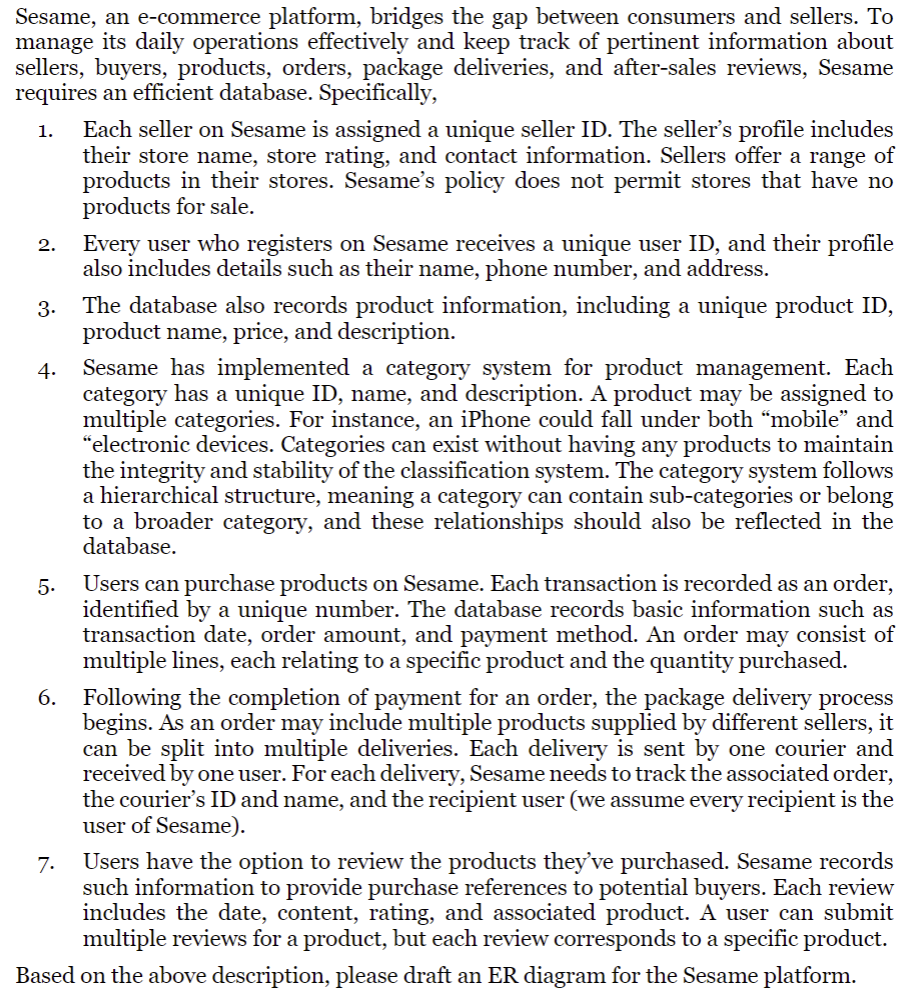
Sesame, an e-commerce platform, bridges the gap between consumers and sellers. To manage its daily operations effectively and keep track of pertinent information about sellers, buyers, products, orders, package deliveries, and after-sales reviews, Sesame requires an efficient database. Specifically, 1. 2. Every user who registers on Sesame receives a unique user ID, and their profile also includes details such as their name, phone number, and address. 3. 4. 5. Each seller on Sesame is assigned a unique seller ID. The seller's profile includes their store name, store rating, and contact information. Sellers offer a range of products in their stores. Sesame's policy does not permit stores that have no products for sale. The database also records product information, including a unique product ID, product name, price, and description. 7. Sesame has implemented a category system for product management. Each category has a unique ID, name, and description. A product may be assigned to multiple categories. For instance, an iPhone could fall under both "mobile" and "electronic devices. Categories can exist without having any products to maintain the integrity and stability of the classification system. The category system follows a hierarchical structure, meaning a category can contain sub-categories or belong to a broader category, and these relationships should also be reflected in the database. Users can purchase products on Sesame. Each transaction is recorded as an order, identified by a unique number. The database records basic information such as transaction date, order amount, and payment method. An order may consist of multiple lines, each relating to a specific product and the quantity purchased. 6. Following the completion of payment for an order, the package delivery process begins. As an order may include multiple products supplied by different sellers, it can be split into multiple deliveries. Each delivery is sent by one courier and received by one user. For each delivery, Sesame needs to track the associated order, the courier's ID and name, and the recipient user (we assume every recipient is the user of Sesame). Users have the option to review the products they've purchased. Sesame records such information to provide purchase references to potential buyers. Each review includes the date, content, rating, and associated product. A user can submit multiple reviews for a product, but each review corresponds to a specific product. Based on the above description, please draft an ER diagram for the Sesame platform.
Step by Step Solution
3.39 Rating (168 Votes )
There are 3 Steps involved in it
Solutions Step 1 Based on your requirement first check the database entities and their relationships The Entities will beSellerUserProductProductOrderOrder Detail and Review Explanation Seller Seller ... View full answer

Get step-by-step solutions from verified subject matter experts
 Study Help